 Purdue University - Extension - Forestry and Natural Resources
Got Nature? Blog
In this edition of ID That Tree, learn how to tell Red Hickory apart from its cousins shellbark, shagbark and pignut hickory. Located typically in upland dry sites, red hickory stands out with compound leaves with seven leaflets, long running interlacing gray bark, buds and twigs free of hairs, and lastly nuts with a husk that separates all the way down the sides of the nut.
If you have any questions regarding wildlife, trees, forest management, wood products, natural resource planning or other natural resource topics, feel free to contact us by using our Ask an Expert web page.
Resources:
ID That Tree, Playlist, Purdue Extension – Forestry and Natural Resources Youtube Channel
A Woodland Management Moment, Playlist, Purdue Extension – FNR Youtube Channel
Shrubs and Woody Vines of Indiana and the Midwest, The Education Store, Purdue Extension Resource Center
Native Trees of the Midwest, The Education Store
Investing in Indiana Woodlands, The Education Store
Forest Improvement Handbook, The Education Store
Lenny Farlee, Sustaining Hardwood Extension Specialist
Purdue University Department of Forestry and Natural Resources
Purdue Landscape Report – Tip Blights of Juniper: Junipers have to be my favorite group of evergreens, behind a select few pine species. They have a fantastic fragrance, are evergreen, many can tolerate drought, are an ingredient in gin (definitely a bonus), and work well in a variety of landscape uses, including as a barrier plant. They look great year round, except when they have tip blight.
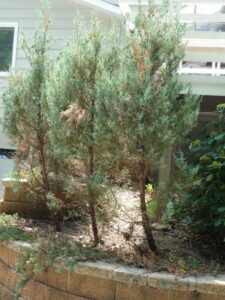
Juniper with tip blight symptoms in the landscape
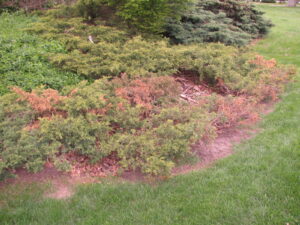
Phomopsis tip blight affecting multiple juniper branches
Tip blight is a common disease in nurseries and landscapes that cause branch tips to die back fairly quickly starting in the spring. Infected branches become chlorotic, progressing from light green to yellow, before turning brown as the season continues. Black fungal structures will develop in the transition zone between affected foliage and green, healthy tissue. Some of the infected scales may turn gray in color, surrounding these structures.
Two fungi cause tip blight, Kabatina and Phomopsis, and knowing which one you have is important to determine your management strategies. Both fungi produce similar symptoms and similar fungal structures,
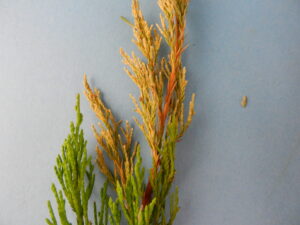
Branch tips turning pale yellow due to infection by Kabatina.
so the presence of tiny black dots cannot help separate these diseases. Both fungi also infect a range of hosts, including arborvitae, cypress, Douglas fir, true firs, yew, Cryptomeria, and Chamaecyparis, but these are not as susceptible as juniper species.
Kabatina infects young, new growth during the growing season, but infected twigs remain green until winter and the following spring . . .
Resources:
Borers of Pines and Other Needle Bearing Evergreens in Landscapes, The Education Store, Purdue Extension resource center
Ask an Expert Question: Blue Spruce dying, what can I do?, Got Nature? Blog, Purdue Extension – Forestry and Natural Resources
Why Spruce Trees Lose Their Needles, Purdue Extension
Diseases Common in Blue Spruce, Purdue Extension
Purdue University Invasive Species
John Bonkowski, Plant Disease Diagnostician
Purdue Botany and Plant Pathology
This native tree comes with its own defense system in very large thorns on the stems and trunk. Meet the honey locust. Purdue Extension forester Lenny Farlee explains that large, long yellow seed pods that resemble bean pods, the option of single or doubly compound leaves on the same tree and smooth gray bark also help identify this species.
If you have any questions regarding wildlife, trees, forest management, wood products, natural resource planning or other natural resource topics, feel free to contact us by using our Ask an Expert web page.
Resources:
ID That Tree, Playlist, Purdue Extension – Forestry and Natural Resources Youtube Channel
A Woodland Management Moment, Playlist, Purdue Extension – FNR Youtube Channel
Shrubs and Woody Vines of Indiana and the Midwest, The Education Store, Purdue Extension Resource Center
Native Trees of the Midwest, The Education Store
Investing in Indiana Woodlands, The Education Store
Forest Improvement Handbook, The Education Store
Lenny Farlee, Sustaining Hardwood Extension Specialist
Purdue University Department of Forestry and Natural Resources
This native Indiana tree species is found in three southwestern counties near the lower Wabash River. It is often found in wet or ponded locations where there is standing water or high water tables. Meet water locust. It has large multi-pronged thorns and compound leaves like its cousin the honey locust, but can be differentiated by its location, its much smaller seed pods and its flattened thorns along the branches.
If you have any questions regarding wildlife, trees, forest management, wood products, natural resource planning or other natural resource topics, feel free to contact us by using our Ask an Expert web page.
Resources:
ID That Tree, Playlist, Purdue Extension – Forestry and Natural Resources Youtube Channel
A Woodland Management Moment, Playlist, Purdue Extension – FNR Youtube Channel
Shrubs and Woody Vines of Indiana and the Midwest, The Education Store, Purdue Extension Resource Center
Native Trees of the Midwest, The Education Store
Investing in Indiana Woodlands, The Education Store
Forest Improvement Handbook, The Education Store
Lenny Farlee, Sustaining Hardwood Extension Specialist
Purdue University Department of Forestry and Natural Resources
If you have ever noticed acorns so numerous that you could not take a step without crushing several, you may be asking the question, “why are there so many acorns?” Some answers to this question can be found in the physiology and ecology of trees and their relationship to wildlife. Oaks and several other tree species occasionally produce enormous crops of seed. This is called “masting” or “mast events”. These events are periodic. In the case of many oak species, a large mast event may happen every two to five years, depending on the species of oak and several other factors. Masting events may be preceded and followed by small or moderate acorn crops, or complete crop failures in some cases. Why does this irregular seed production happen? These events may be tied to several aspects of the life of oaks.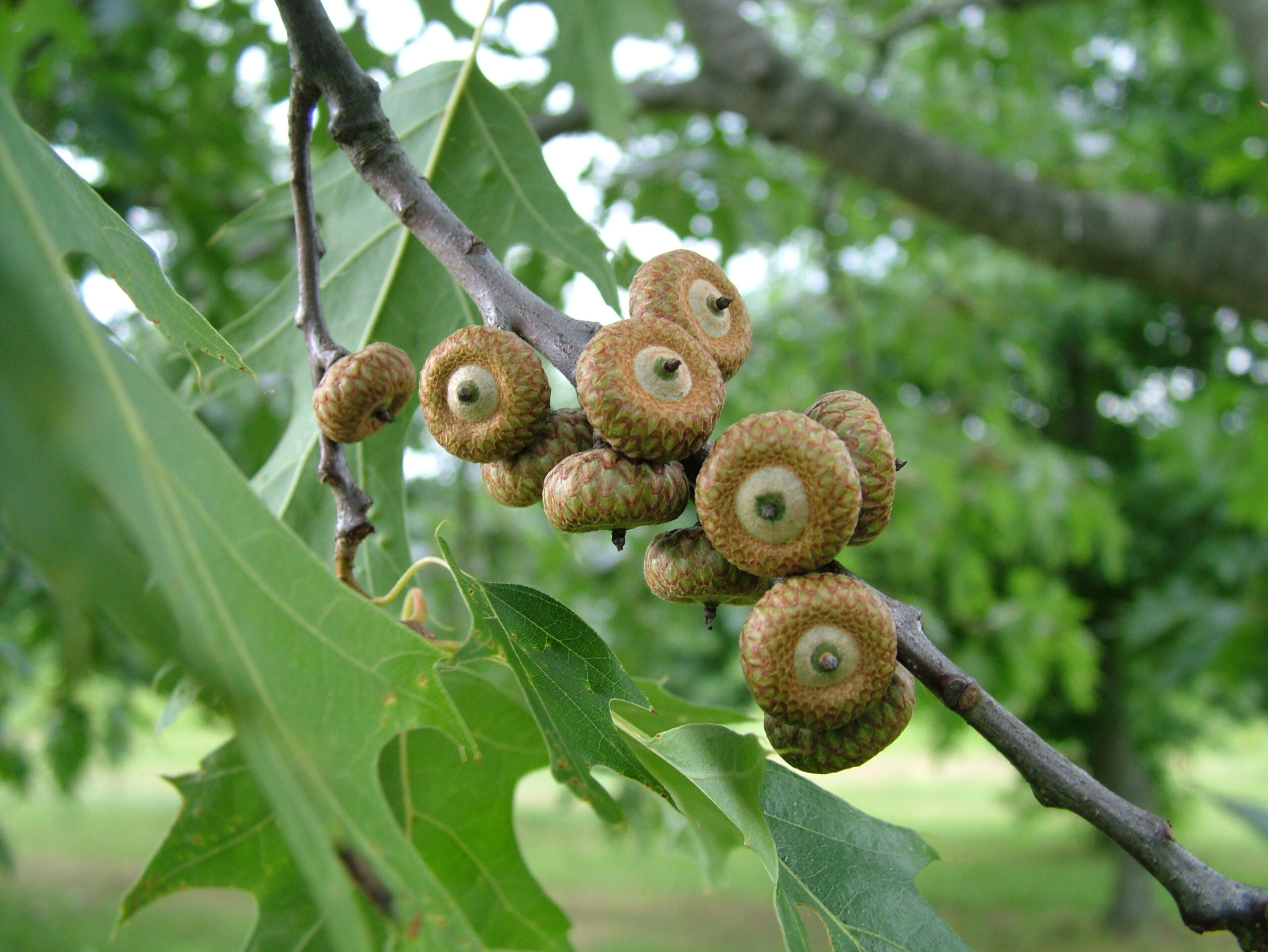
First, the production of a huge volume of a large seed like an acorn requires a lot of resources from the tree. This level of production may not be possible for the tree every year. Trees allocate energy to several different functions, so committing large amounts of energy to one area could mean deficits in others. This may mean there are advantages for the tree to produce occasional, rather than annual, mastings.
Second, weather does not always cooperate to provide the conditions for a bumper acorn crop. Unfavorable weather during pollination and seed development periods can result in reduced production of acorns. Late spring freezes, extremely high temperatures, summer droughts and other weather stresses can reduce acorn pollination and production.
Third, predation by seed-eaters like squirrels, deer, turkey and even weevil larvae can greatly reduce the number of viable acorns. It may take a very large acorn crop to have many acorns escape from the numerous species that depend on acorns for food.
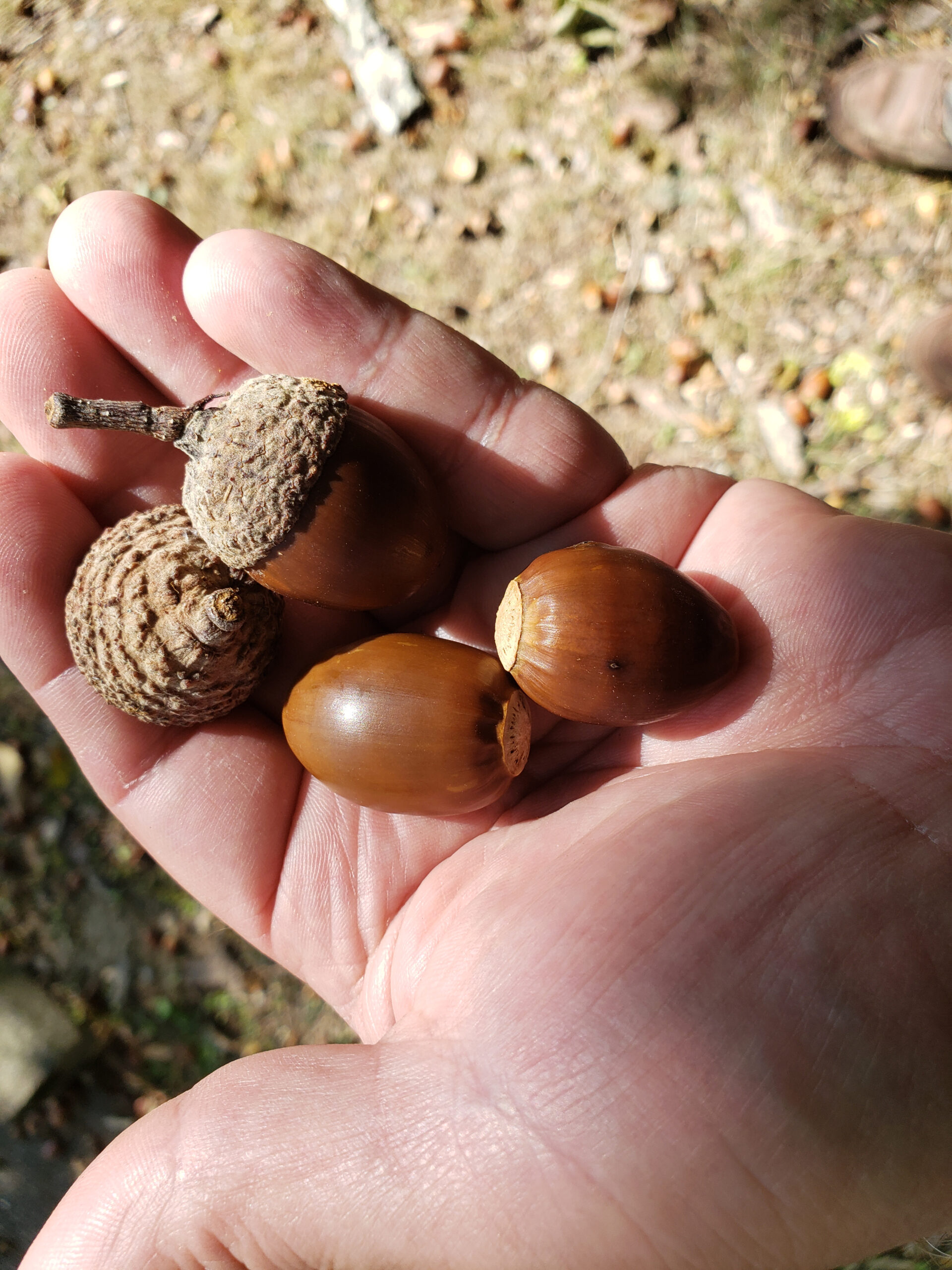
This irregular cycle of large crops can be beneficial for the oaks by overwhelming the seed eaters. Populations of wildlife that depend on acorns may eat most of the seed during normal seed crops, but may not be able to utilize all the seed produced during a masting. This surplus seed is available produce the next generation of oak seedlings.
However, some species will produce copious amounts of the mast if the developmental age of the tree is favorable, regardless of conditions.
Acorn production can vary by species and individual trees across the oak family, but masting is a way this important group of trees can continue to be a part or our Midwestern landscape.
Resources:
Woodland Management Moment: Direct Seeding, Purdue Extension – Forestry and Natural Resources (FNR) YouTube Channel
Ask an Expert: Tree Selection and Planting, Purdue Extension – Forestry and Natural Resources (FNR) YouTube Channel
Forest Improvement Handbook, The Education Store, Purdue Extension resource center
Native Trees of the Midwest, The Education Store
Investing in Indiana Woodlands, The Education Store
Tree Pruning Essentials, The Education Store
Lenny Farlee, Sustaining Hardwood Extension Specialist
Purdue University Department of Forestry and Natural Resources
Lindsey Purcell, Chapter Executive Director and Certificate Liaison
Indiana Arborist Association
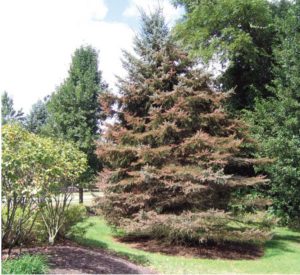
Fig. 1. Severely infected tree showing the ‘purple-brown’ needle symptoms.
Purdue Landscape Report: Colorado blue spruce is not native to Indiana (no spruce is!), and it often suffers from environmental stresses such as drought, excessive heat, humidity, and compacted or heavy clay soils—making it an already poor choice for our landscape. If that weren’t enough, it also suffers from needle cast diseases. Needle cast is a generic term that refers to foliar diseases of coniferous plants that result in the defoliation (“casting off”) of needles. Needle casts vary by host, and severity is dependent upon the age of infected needles. Of all the foliar diseases affecting woody landscape plants and shrubs, needle casts are the most serious for the simple reason that coniferous plants do not have the ability to refoliate, or produce a second flush of needles from defoliated stems. Rhizosphaera needle cast is a fungal disease, caused by Rhizosphaera kalkhoffii that attacks the needles of Colorado blue spruce in the spring, as new needles emerge. However, infected needles often don’t show symptoms right away, and may take one to three years to develop. Infected needles later turn purple to brown and fall from the tree prematurely (Fig. 1), leaving the inner portion of the branch bare.
As the disease progresses, severely infected branches die, leaving the tree with a hollow or thin appearance (Fig. 2). The disease usually starts near the base of the tree where humidity levels are the highest but continues to spread upward. As the disease continues, trees become unsightly and lose their value as a visual screen or privacy fence.
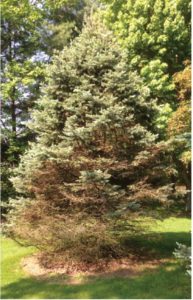
Fig. 2. As the disease spreads up the tree, lower branches begin to die.
The Rhizosphaera pathogen sporulates in the spring (Fig. 3), which is the best time to control this disease. The fungal fruiting structures emerge on these needles and are usually large enough to be visible to the eye, with the fruiting structures appearing as rows of small dots running lengthwise along the white bands of the needles. In severe infections, trees may only have the current year’s needles remaining rather than the 5- to 7-year complement of needles a healthy spruce maintains. Destructive epidemics of needle casts or rusts are not uncommon and develop under periods of extended leaf wetness. The after-affect of these epidemics can persist for several years. In the urban setting, needle casts are more of an endemic, as most conifers are ill-suited to the Midwest urban environment. Most conifers retain their needles for two to seven years. The length of time that a needle is retained depends on the species of coniferous plant and if the plant has been subjected to stress such as drought, flooding, salt damage, disease, or insect pest. Trees that lack the full complement of needles are stressed or undergoing pest attack. When attempting to determine the cause of needle drop, examine the branch carefully to determine if the problem is normal needle drop, the yearly occurrence on normal needle shedding. The newest needles should not be affected and problems should not appear within the last two to three years of growth.
Managing Rhizosphaera: there are conifers that are more resistant to Rhizosphaera, and include white spruce (P. glauca) and its variant Black Hills spruce, both of which are intermediate in resistance. Norway spruce (P. abies) is highly resistant to this disease. Some Colorado blue spruce cultivars, like ‘Hoopsii,’ and ‘Fat Albert’ are reportedly more resistant to the disease.
Spectro-90, or copper-based fungicide, can protect new growth and prevent new infections; Concert II, Heritage, Pageant, and Trinity are labeled for use in commercial and residential landscapes, and nurseries, but data regarding their efficacy is lacking for this disease. Daconil Weatherstik is not labeled for blue spruce in the landscape but is still available for use in the nursery and for other landscape diseases.
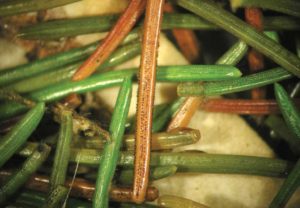
Fig. 3. Closeup of fruiting bodies. Photo by Paul Bachi, UK.
It is important to protect new growth as it emerges no matter which fungicide you apply; fungicides should be applied when the new needles are half elongated (late April or early May) and again three to four weeks later, possibly with a third application if wet weather or growth persists. Rhizosphaera needle cast may be controlled in one year if fungicides are applied correctly. However, severely infected trees usually require two or more years of fungicide applications. Even though fungicide application will effectively control this disease, reinfection may occur in subsequent years. Application to large trees requires special equipment to ensure adequate coverage. Read fungicide labels carefully and apply only as directed.
When planting new trees, consider planting Norway or white spruce, which are more resistant to Rhizosphaera. Other spruce, like Serbian, simply haven’t had widespread evaluation in the Midwest, so buyer beware! Properly spacing spruce trees will help reduce disease incidence. Spruce trees grow best in moderately moist, well-drained soils but can be planted in other soils if adequate moisture is available. Avoid heavy clay, as trees planted on these sites often suffer iron, magnesium, and manganese deficiency. Water newly planted trees, and water during drought periods to help maintain tree vigor and minimize stress. Stressed trees should also be mulched and fertilized as needed. Properly prune dead or severely infected branches during dry weather. If trees are severely infected, the lower whorl of branches may also be removed to help increase air circulation.
Article originally published by the Indian Nursery & Landscape Association Magazine, March/April 2018. www.inla1.org
Resources:
Needlecast in Colorado Blue Spruce, Purdue Landscape Report
Blue Spruce Update, Purdue Landscape Report
Why Spruce Trees Lose Their Needles, Purdue Extension
Blue Spruce Decline, Purdue Extension
Ask an Expert Question: Blue Spruce dying, what can I do?, Purdue Extension – Forestry and Natural Resources (FNR) Got Nature? Blog
Tree Installation: Process and Practices, The Education Store, Purdue Extension resource center
Tree Planting and Urban Forestry Videos, Subscribe to our Purdue Extension-FNR YouTube Channel
Janna Beckerman, professor
Purdue Botany and Plant Pathology
Like the rest of the red/black oak group, the Northern Red Oak has multi-lobed leaves with bristle tips. This native tree, however, has a group of buds at the terminal end of the stem that are smooth, shiny and reddish brown to brown in color. A strong identifier for this species is the bark, which looks like ski tracks or long running ridges that run up and down the sides of the tree. The acorns feature tight shallow caps with tight scales that resemble a beret.
For more on the red oak group, watch this video.
If you have any questions regarding wildlife, trees, forest management, wood products, natural resource planning, or other natural resource topics, feel free to contact us by using our Ask an Expert web page.
Resources:
ID That Tree, Playlist, Purdue Extension – Forestry and Natural Resources Youtube Channel
A Woodland Management Moment, Playlist, Purdue Extension – FNR Youtube Channel
Shrubs and Woody Vines of Indiana and the Midwest, Purdue University Press
Native Trees of the Midwest, Purdue University Press
Investing in Indiana Woodlands, The Education Store
Forest Improvement Handbook, The Education Store
Lenny Farlee, Sustaining Hardwood Extension Specialist
Purdue University Department of Forestry and Natural Resources
On this edition of ID That Tree, meet a range restricted species that is best identified by its bronze to yellowish bark, which often peels off in small flakes. The yellow birch, which is typically found natively in northern Indiana, also has simple finely toothed leaves and twigs that smell like wintergreen when scraped. Learn more from Purdue Extension forester Lenny Farlee inside.
If you have any questions regarding wildlife, trees, forest management, wood products, natural resource planning or other natural resource topics, feel free to contact us by using our Ask an Expert web page.
Resources:
ID That Tree, Playlist, Purdue Extension – Forestry and Natural Resources Youtube Channel
A Woodland Management Moment, Playlist, Purdue Extension – FNR Youtube Channel
Shrubs and Woody Vines of Indiana and the Midwest, Purdue University Press
Native Trees of the Midwest, Purdue University Press
Investing in Indiana Woodlands, The Education Store
Forest Improvement Handbook, The Education Store
Lenny Farlee, Sustaining Hardwood Extension Specialist
Purdue University Department of Forestry and Natural Resources
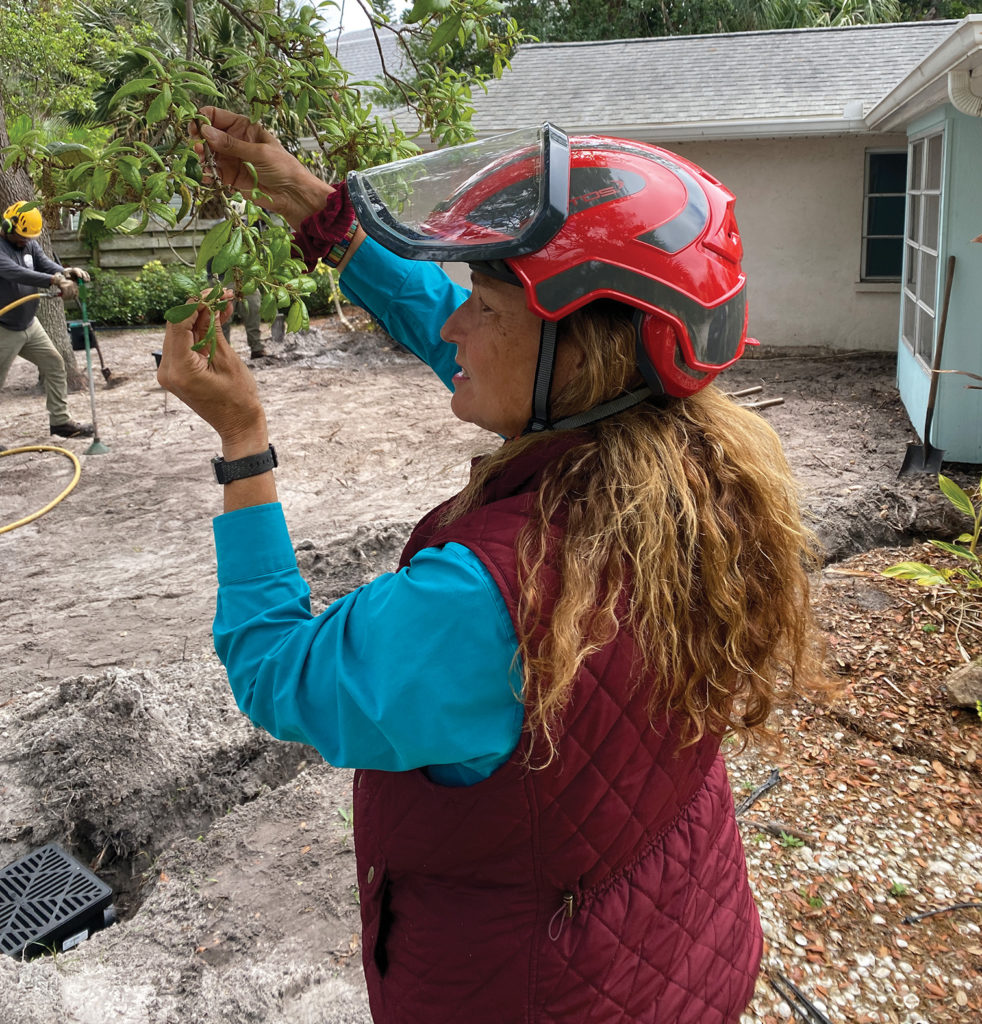
Scouting is the essential first step of an IPM program. Shown here is Tammy Kovar, owner of Biological Tree Services, a nine-year TCIA member company based in Sarasota, Florida. All photos and graphics courtesy of the author.
Tree Care Industry (TCI) Magazine: Plant health care (PHC) is the science and practice of understanding and overcoming the succession of biotic and abiotic factors limiting plants from achieving their full genetic potential in our landscapes and urban forests. Plant health care has been practiced as long as modern arboriculture itself and, as a science-based concept, is an important component in overall integrated pest management (IPM).
Pest management in our urban forests is a moving target and sometimes is overwhelming, especially for those early-career professionals. I remember from my early days in the field the overwhelming thought of needing to know every pest for every tree! I literally had a truckload (back seat of a king cab) of university publications, bulletins and articles ripped out of magazines for reference in the event I couldn’t figure it out quickly and on site. Just that fear of not knowing was often very stressful. Well, that has changed significantly.
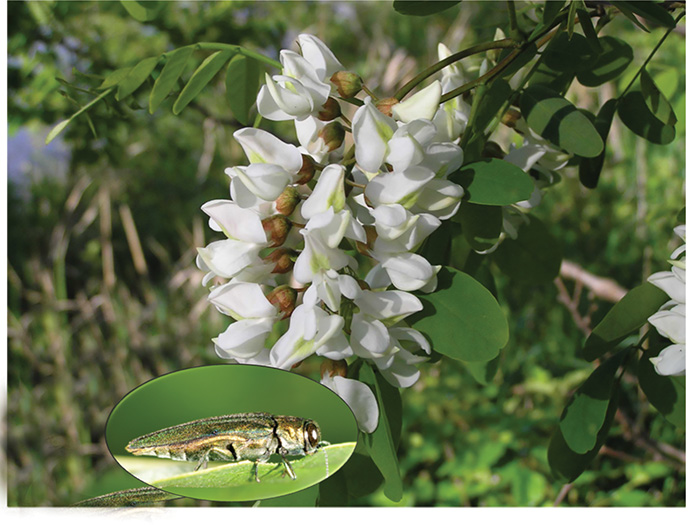
Adult emerald ash borers typically take flight about the same time that black locust trees bloom, indicating a good time for treatment.
The point is that first, you don’t have to know everything, and second, resources now are easily and readily available. Today, the smartphone and computing opportunities available on mobile platforms, apps such as the Purdue Tree Doctor and other web-based apps have improved diagnostics significantly, making it simpler for the technician to get a better idea of their pest issue and easier to find a control strategy.
One of the basic and most important keys when starting a PHC program is just learning to recognize the concerns for common trees already in your care. Tree identification is critically important to determine whether the tree is even a host for any given disease or insect. As a technician, you don’t need to know every tree in North America; just focus on those that are commonly found and that you are called upon to investigate for pest issues with your clients and customers. Few things are as awkward as misidentification of a tree and the corresponding application. Recommendations for treating emerald ash borer on a European mountain ash (Sorbus aucuparia), which is not susceptible to EAB infestation, could be fairly damaging to your credibility and your company!
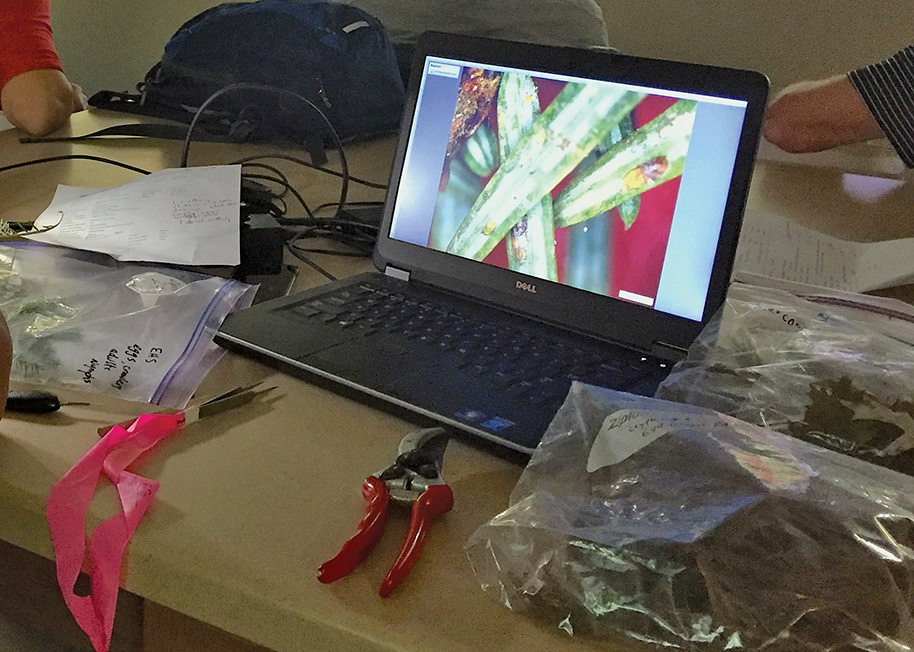
Each state has a land-grant college with resources to assist PHC technicians.
Get some help
All there is to know and what you need to know can be mind-boggling; however, it is more manageable when we are able to discover the resources available. Often overlooked, local extension services from state land-grant colleges provide a tremendous collection of experts trained and educated in pest management. They often have plant and pest diagnostic laboratories assisting with identification of those challenging diseases or insects, usually at a very economical cost, along with the appropriate management strategy to apply for control.
Resources:
Planting Your Tree Part 1: Choosing Your Tree, Purdue Extension YouTube Channel
Tree Installation: Process and Practices, The Extension Store, Purdue Extension resource center
Ask an Expert: Tree Selection and Planting, Purdue FNR Extension YouTube Channel
Webinar: How to Identify Trees in Indiana, Got Nature? Post, Purdue Extension – Forestry and Natural Resources
Shrubs and Woody Vines of Indiana and the Midwest, Purdue University Press
Native Trees of the Midwest, Purdue University Press
ID That Tree, Purdue Extension – Forestry and Natural Resources YouTube Playlist
Purdue Plant and Pest Diagnostic Lab
Emerald Ash Borer Information from Purdue
Lindsey Purcell, Urban Forestry Specialist
Purdue Department of Forestry and Natural Resources
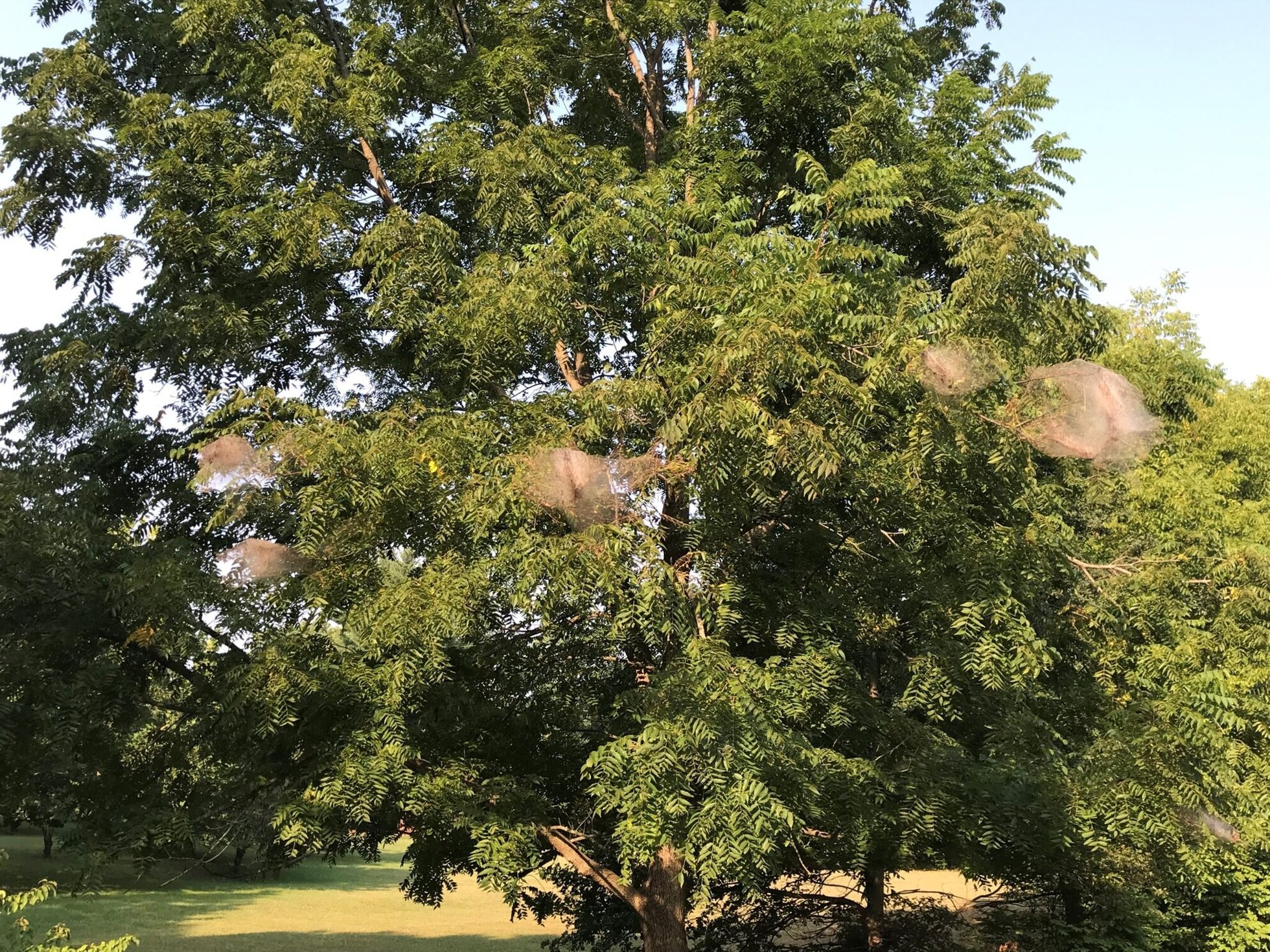
Figure 1. White webs of fall webworm are a common site along roadsides and forest edges.
Purdue Landscape Report: Just after the browned leaves on branches of trees attacked by periodical cicadas began to disappear from view, webworms and their associated browning started to spread through the landscape. Two of the more common webworms I have been seeing are the mimosa and the fall webworm. While neither of them can outright kill trees, they are unsightly, especially at the end of the summer when substantial portions of the tree are disfigured. Treatment late in the summer does little to reduce injury, because it can be difficult to penetrate the webs with insecticides, and because most of the damage has already been done. The best course of action is to plan on managing these insects next year, when they are more easily controlled with insecticides.
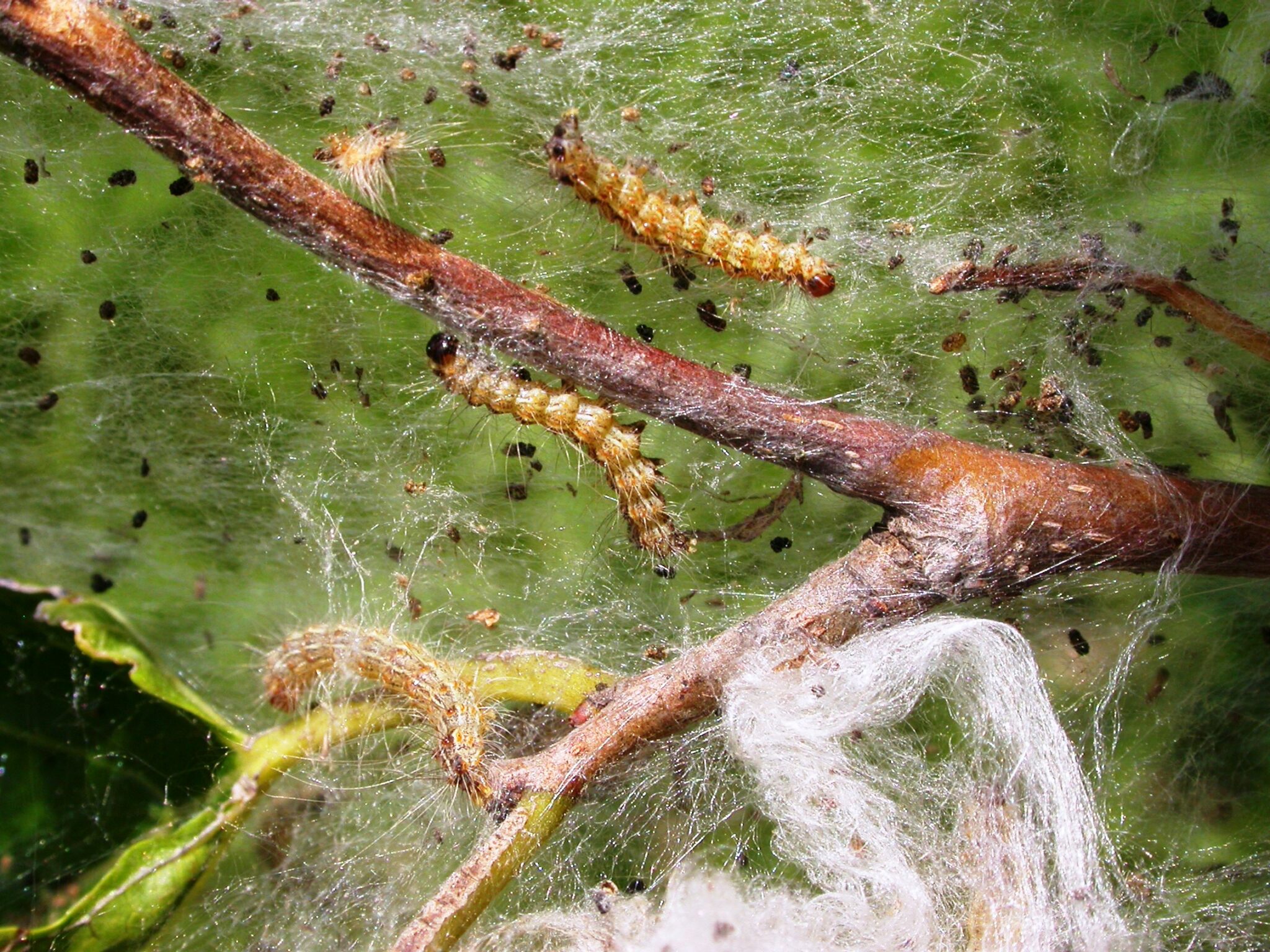
Figure 2. Fall webworms and fecal pellets feeding in web.
Fall webworm attacks a wide range of deciduous trees including flowering fruit trees, black walnuts, elm, hickory and bald cypress. They are most common in suburban areas, roadsides and forest edges that lack the predators and parasites the webworms encounter in the forest. In June adults emerge from wintering sites to lay eggs in the canopy. Eggs hatch into caterpillars that encase branches in webs as they feed. By the end of the second generation in late August webs can cover substantial portions of trees. Caterpillars are yellowish-green with black spots and long white hairs, and grow up to 1.5″. Caterpillar feces falling from trees can be a problem during heavy infestations.
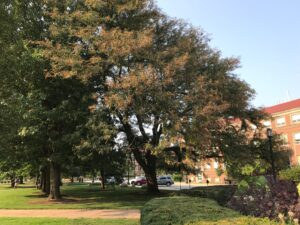
Figure 3. Brown webbing caused by the mimosa webworm is extensive on honeylocust plantings throughout the state.
Unlike fall webworm, the mimosa webworm only attacks honeylocust and mimosa trees. Leaves on ends of branches become webbed together and turn brown as lime-green caterpillars skeletonize leaf tissue. Heavily infested trees appear frosted brown. In early June, adults emerge and lay eggs on trees. First webs can be seen on ends of branches in mid-June when oak leaf hydrangea and tree lilac are in bloom. The second generation of adults fly and lay eggs starting in late July. A third generation occurs in the fall. The dangling caterpillars can be a nuisance under heavily infested trees. We are seeing an uptick in the abundance of this pest because the last two winters have not been cold enough to kill them.
Resources:
Purdue Landscape Report
Ask an Expert, Purdue Extension – Forestry and Natural Resources
Purdue Plant Doctor App Suite, Purdue Extension – Entomology
Landscape & Ornamentals: Bagworms, The Education Store, Purdue Extension
Bagworm caterpillars are out feeding, be ready to spray your trees, Got Nature? Post, Purdue Extension – Forestry and Natural Resources
Fall Webworms: Should You Manage Them, Got Nature? Post, Purdue Extension – Forestry and Natural Resources

Recent Posts
- Urban Tree Spotlight: Planting Deciduous Shade Trees, Purdue Landscape Report
Posted: March 25, 2026 in Forests and Street Trees, Urban Forestry, Woodlands - ID That Tree: Dwarf Chinkapin Oak
Posted: March 20, 2026 in Forestry, Urban Forestry, Wildlife, Woodlands - DNR Hiring for Indiana Conservation Officer Positions, MyDNR
Posted: March 9, 2026 in Urban Forestry, Wildlife, Woodlands - ID That Tree: Shumard Oak
Posted: in Plants, Urban Forestry, Wildlife, Woodlands - A Woodland Management Moment: Windbreak Around Walnut Plantings
Posted: March 3, 2026 in Forestry, Urban Forestry, Woodland Management Moment - Getting Certified as an Indiana Certified Prescribed Burn Manager
Posted: March 2, 2026 in How To, Urban Forestry, Woodlands - Have You Seen a Soaring Eagle Lately? Morning Ag Clips
Posted: February 25, 2026 in Urban Forestry, Wildlife - ID That Tree: Fragrant Sumac
Posted: February 4, 2026 in Plants, Urban Forestry, Wildlife - Tree Silvics and Succession Webinar: A Biological Basis for Management
Posted: January 30, 2026 in Forests and Street Trees, Urban Forestry, Woodlands - Southwest Damage, Scalding or Frost Cracking
Posted: in Forestry, Urban Forestry
Archives
Categories
- Alert
- Aquaculture/Fish
- Aquatic/Aquaculture Resources
- Ask the Expert
- Christmas Trees
- Community Development
- Disease
- Drought
- Forestry
- Forests and Street Trees
- Gardening
- Got Nature for Kids
- Great Lakes
- How To
- Invasive Animal Species
- Invasive Insects
- Invasive Plant Species
- Land Use
- Natural Resource Planning
- Nature of Teaching
- Plants
- Podcasts
- Ponds
- Publication
- Safety
- Spiders
- Timber Marketing
- Uncategorized
- Urban Forestry
- Webinar
- Wildlife
- Wood Products/Manufacturing
- Woodland Management Moment
- Woodlands