 Purdue University - Extension - Forestry and Natural Resources
Got Nature? Blog
Although perhaps a bit late, spring has seemingly sprung upon us. One of the best signals of spring is the symphony of calling frogs and toads in and around wetlands, ponds and lakes throughout Indiana. Amphibians native to Indiana are an important component of healthy ecosystems. They play important roles as both predator and prey in food webs. We can also consider many amphibians as “bio-indicators” of environmental health. Unfortunately, many species of amphibians and reptiles are thought to be in the decline. While the causes for declines are species-specific, the actions that people take can be a contributing factor.
Unlike other vertebrates, most amphibians and reptiles can be observed up close or even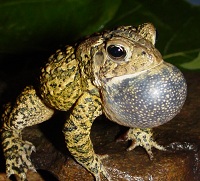 captured by hand – some more easily than others. Exploring natural habitats while searching for, catching and photographing reptiles and amphibians are great ways to gain hands-on experience with nature. However, be mindful that some activities, or the manner in which they are conducted, can harm the very creatures we value. Reptiles and amphibians represent numerous examples where interactions between wildlife and people can have negative consequences despite the best of intentions.
When you go outdoors to enjoy our amphibians and other wildlife, follow some of these simple tips:
Stay on designated roads and trail systems – Human foot traffic can affect plants and animals in some habitats (e.g., you may have noticed the compressed soil and lack of vegetation on even lightly used foot trails). Focusing foot traffic on trails can minimize human impacts on sensitive plants and animals. It is also required on some public properties.
Be a responsible pet owner – Dogs make good companions when hiking outdoors. However, research has demonstrated dogs can disturb, harass or even kill wildlife. While impacts on reptiles and amphibians are unclear, it is good practice to keep your dog leashed while exploring natural areas. Many parks and properties require dogs to be leashed.
Be a good steward of the land – Carelessly turning over logs and coarse woody debris in search of reptiles and amphibians can destroy microhabitat features that took decades to create. It is also prohibited on many public properties. If you do find an animal under a log or rock, return the object to its original location, then place the animal next to it rather than rolling the object directly over the animal.
Minimize or avoid handling animals – If you must handle a wild amphibian or reptile, 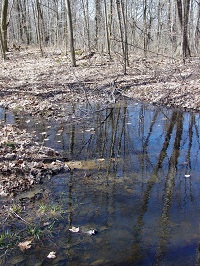 there are safe ways to hold and restrain them. Avoid handling amphibians for long periods of time. Amphibians are prone to desiccation (drying out). There are no formal guidelines on the length of time to handle an amphibian, and it is not clear how handling impacts an animal’s health and wellbeing. Common sense dictates that handling time should be minimized to the greatest extent possible. If a frog or salamander feels “dry,” you have handled it too long, and it should be returned to its location of capture immediately. Keep your hands moist and free of chemicals (e.g., bug spray or sunscreen).
Use good hygiene – The transmission of many diseases among animals can be facilitated by people. There are a number of safeguards that can be implemented to not only protect you, but also the animal populations as well. To prevent spreading diseases and pathogens from one site to another, regularly wash clothing and especially boots that you use in the field. All equipment that contacts an animal or the water the animal was in should be decontaminated using a 1-3 percent bleach solution or air dried for at least three hours before traveling to another water body. You also should use hand sanitizer before and after handling animals in nature. Before eating or handling food, thoroughly wash hands in hot, soapy water if possible; hand sanitizer is an acceptable substitute for remote locations.
For more information about responsibly enjoying wildlife and nature, see Appreciating Reptiles and Amphibians in Nature.
Resources:
Sounds of Frogs & Toads, Purdue Extension – Forestry and Natural Resources (FNR)
Frogs & toads of Indiana, The Education Store, Purdue Extension resource center
Salamanders of Indiana Book, The Education Store
Amphibians: Frogs, Toads, and Salamanders, Purdue Nature of Teaching
The Nature of Teaching: Adaptations for Aquatic Amphibians, The Education Store
Hellbender ID, Playlist, Purdue Extension – FNR YouTube Channel
A Moment in the Wild, Playlist, Purdue Extension – FNR YouTube Channel
Dr. Brian MacGowan, Extension Wildlife Specialist
Department of Forestry & Natural Resources, Purdue University
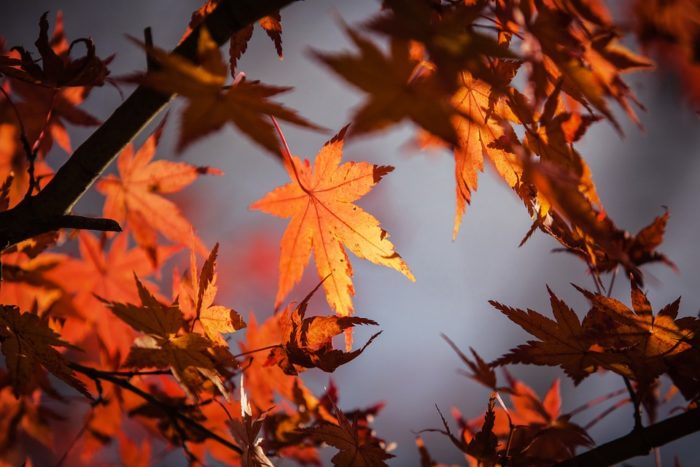 The display of color we enjoy each fall is explained by understanding plant pigments, the physiology and anatomy of leaves, and the influence of climate and seasonal weather conditions. Fall weather conditions favoring formation of bright red autumn color are warm sunny days followed by cool but not freezing nights. As days get shorter and temperatures cooler in the autumn, important physiological processes are triggered that make conditions for chlorophyll production less favorable.
Check out the Why Leaves Change Color publication for more details along with other hardwood tree information.
Resources:
Intro to Trees of Indiana videos, Purdue Extension – Forestry and Natural Resources (FNR)
An Introduction to Trees of Indiana, The Education Store, Purdue Extension’s resource center
Native Trees of the Midwest, Purdue University Press
Shrubs and Woody Vines of Indiana and the Midwest, Purdue University Press
Forest Improvement Handbook, The Education Store
Trees and Storms, The Education Store, Purdue Extension’s resource center
Tree Risk Management, The Education Store
Planting Problems: Trees Planted Too Deep, Video, Purdue Extension – Forestry and Natural Resources YouTube Channel
Lenny Farlee, Extension Forester
Hardwood Improvement Regeneration Center (HTIRC)
Purdue Department of Forestry and Natural Resources
Wildlife identification guides are useful tools that help you figure out what kind of animal you may be looking at. However, they don’t always tell the complete story. Some animals such as garter snakes can have varied appearances which makes identification difficult. Some mammals have varied pelage such as striped skunks with some being almost completely black, white or some combination in between. A very small percentage of animals within a species may look dramatically different due to differences in pigment.
 Albinos lack the ability to produce color pigment in their skin, hair, feathers, scales or eyes. Animals with this condition have a white appearance with red or pink eyes. The latter is the result of tiny blood vessels that are now visible. They are typically hidden by the colored iris which is transparent in albinos.
In wildlife, albinism is a rare occurrence at birth caused by a recessive gene. The rate in wildlife is estimated from 1 in 20,000 to 1 in 1 million. Their solid white coat of fur makes them more susceptible to predation, or conversely, would make it difficult for an albino predator to stalk its prey. Albinos also have poor vision or may even be blind. The combination of these factors results in low survival of albinos, further decreasing their proportion in the population.
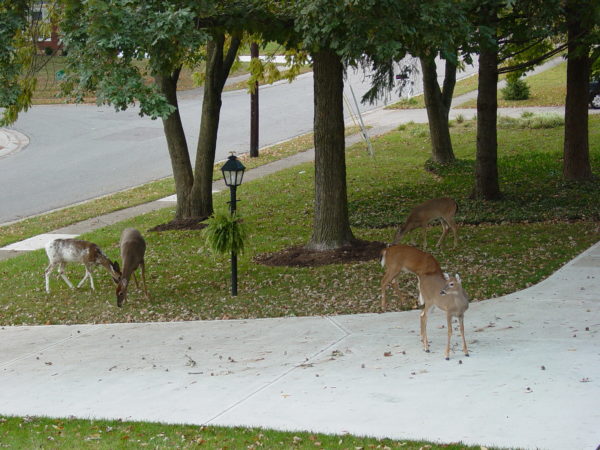
Partial albinism occurs in some animals and is much more common than true albinism. In white-tailed deer, this is sometimes referred to as ‘piebald’ where their fur has a blotchy, white appearance, but they lack the pink eyes found in albinos. Piebald deer occur at a frequency of less than 1 percent in hunted populations. A greater incidence of physical deformities have been reported for piebald deer.
*View in photo the piebald deer on the far left side.
Resources:
Ask an Expert: Wildlife Food Plots, video, Purdue Extension – FNR YouTube Channel
Handling Harvested Game: Episode 1, Field Dressing, video, Purdue Extension – FNR YouTube Channel
Deer Harvest Data Collection, Got Nature? Blog, Purdue Extension – FNR
How to Score Your White-tailed Deer, video, The Education Store, Purdue Extension Resource Center
Age Determination in White-tailed Deer, video, The Education Store
Handling Harvested Deer Ask an Expert? video, Purdue Extension – FNR YouTube Channel
Woodland Stewardship for Landowners: Managing Deer Damage to Young Trees, video, Purdue Extension – FNR YouTube Channel
Managing Your Woods for White-Tailed Deer, The Education Store
Deer Impact Toolbox, Pond and Wildlife Management, Purdue Extension
Snakes and Lizards of Indiana, The Education Store
Subscribe Purdue Extension – Forestry and Natural Resources YouTube Channel, Playlists include wildlife, Nature of Teaching, Moments in the Wild and much more.
Brian MacGowan, Extension Wildlife Specialist
Department of Forestry and Natural Resources, Purdue University
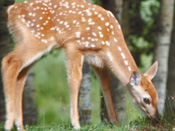 This time of year, sightings of white-tailed deer fawns, fledgling birds and other young critters becomes common. In most cases, the young animal is simply “spreading its wings” and exploring, or mom simply left it to get something to eat. Fawn deer are programmed to hide and remain motionless while mom is away. The fact is wildlife rarely abandons their young. They may leave briefly only to return.
Remember that you should never handle wild animals unless absolutely necessary. Any animal can bite you, and many harbor diseases and pests that can be transmitted to people.
In Indiana, wildlife rehabilitators have necessary state and federal permits to house and care for sick or injured wild animals. If you think you have found a sick or injured animal, you can find a list of licensed Wild Animal Rehabilitators in your area on the DNR Division of Fish and Wildlife’s website.
Resources
Mammals of Indiana, J.O. Whitker and R.E. Mumford
Common Indiana Mammals, R.N. Chapman and R.N. Williams, publication number FNR-413-W
Indiana DNR Orphaned and Injured Animals
Wildlife Habitat Hint: Tips for Evaluating a First Year Native Grass and Forb Plantings, Purdue Extension – FNR YouTube Channel
Drone Seeding Native Grasses and Forbs: Project Overview & Drone Setup, Purdue Extension – FNR YouTube channel
Designing Hardwood Tree Plantings for Wildlife – The Education Store
Forest Management for Reptiles and Amphibians: A Technical Guide for the Midwest, The Education Store
A Template for Your Wildlife Habitat Management Plan, The Education Store
Managing Your Woods for White-Tailed Deer, The Education Store
Woodland Stewardship for Landowners, Playlist, Purdue Extension – FNR YouTube channel
Nature of Teaching Unit 1: Animal Diversity and Tracking, The Education Store
Subscribe Purdue Extension – Forestry and Natural Resources YouTube Channel, Playlists include wildlife, Nature of Teaching, Moments in the Wild and much more.
Brian MacGowan, Extension Wildlife Specialist
Department of Forestry and Natural Resources, Purdue University
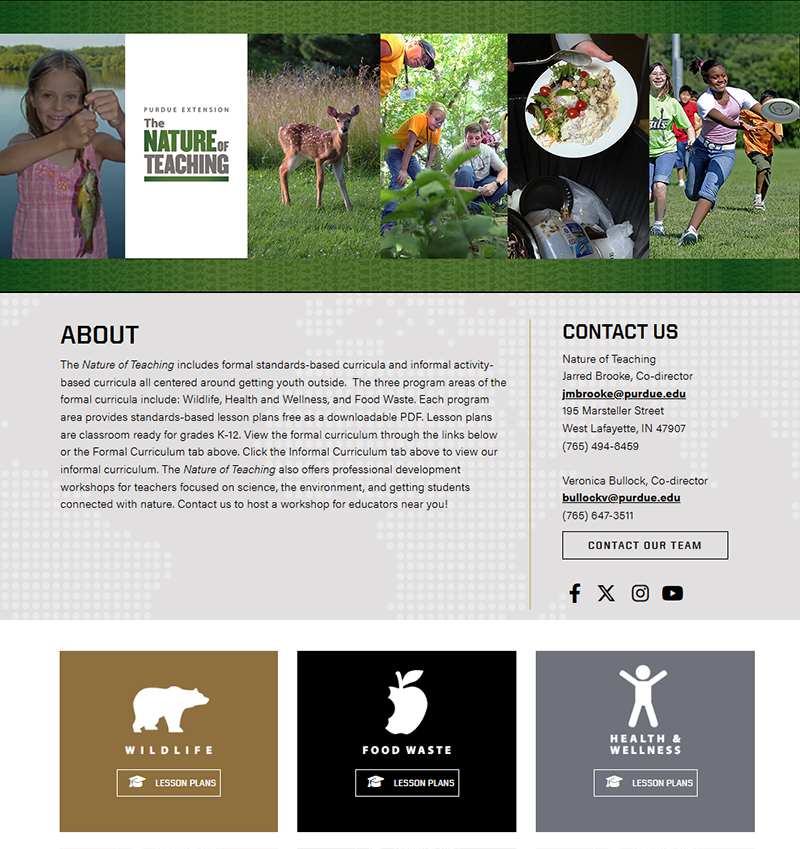 As teachers prepare their lessons for the fall, The Nature of Teaching is a great website to visit for science-based resources. Teachers can find free lesson plans, printable, posters, a photo library, information on upcoming workshops and more. You will find on the website tabs titled “Formal Curriculum” and “Informal Curriculum.” The Nature of Teaching also offers professional development workshops for teachers focused on science, the environment, and getting students connected with nature.
These organized lesson plans meet several K-5 Science and Math Academic Standards along with three 9-12 Natural Resource Management Academic Standards.
Wildlife curriculum include:
- Animal Diversity and Tracking
- Discovering the Watershed: Effects on Water Quality
- Common Indiana Mammals: Natural History and Identification
- Invasive Plants: Impact on Environment and People
- Hellbenders Rock! Natural History and Conservation of the Eastern Hellbender
Food Waste curriculum include:
- Food Waste and Natural Resources
- What a Waste of Food!
- Food Waste and The Environment
- Food Waste Solutions
- Transporting Food Waste
Health & Wellness curriculum include:
- Unit 1 Benefits of Connecting with Nature
- Unit 2 Gardening Station
- Unit 3 Tree Talk Station
Other resources:
- Help the Hellbender, Purdue Extension
- Indiana Department of Natural Resources (INDNR): For Kids
- 4-H, Purdue Extension
- National FFA Organization
- Indiana FFA
- Flying Wild, Association of Fish & Wildlife Agencies
- Project Learning Tree, Indiana Department of Natural Resources
- Project Wet
- Project Wild
- Indiana Wildlife Habitat Evaluation Program (WHEP)
Contact The Nature of Teaching team if you have any questions regarding workshops, certifications and curriculum.
The Nature of Teaching, Purdue Extension
 Several myths have surfaced and resurfaced over many years. Indiana’s state forests have been managed by the Division of Forestry since the first state forest was established in 1903. Questions arise including acreage, management, level of harvest, the forestry profession and a number of other issues. The maintenance of ecosystem processes is inherently more important than a given stage of development that must be preserved.
Check out the Forest Management and Wildlife Habitat Myths and Truths of Indiana State Forests (pdf).
Resources:
Frost Seeding to Establish Wildlife Food Plots and Native Grass and Forb Plantings – Purdue Extension YouTube
Wildlife Habitat Hint: Tips for Evaluating a First Year Native Grass and Forb Plantings, Purdue Extension – FNR YouTube Channel
Drone Seeding Native Grasses and Forbs: Project Overview & Drone Setup, Purdue Extension – FNR YouTube channel
Forest Improvement Handbook, The Education Store
Ordering Seedlings from the State Forest Nursery System, Got Nature? – Purdue Extension-Forestry & Natural Resources (FNR)
Designing Hardwood Tree Plantings for Wildlife – The Education Store
ID That Tree – YouTube Playlist
Forest Management for Reptiles and Amphibians: A Technical Guide for the Midwest, The Education Store
Ask the Expert: Hardwood Ecosystem Experiment – Birds and Salamander Research, Purdue Extension – FNR
A Template for Your Wildlife Habitat Management Plan, The Education Store
Managing Your Woods for White-Tailed Deer, The Education Store
Woodland Stewardship for Landowners, Playlist, Purdue Extension – FNR YouTube channel
Nature of Teaching Unit 1: Animal Diversity and Tracking, The Education Store
Subscribe Purdue Extension – Forestry and Natural Resources YouTube Channel, Playlists include wildlife, Nature of Teaching, Moments in the Wild and much more.
Indiana Department of Natural Resources
Division of Fish and Wildlife
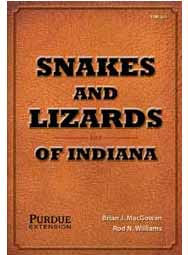 There are 36 species of snakes and lizards in Indiana and about 8,000 species worldwide. Lizards are the most taxonomically diverse and speciose group of reptiles with approximately 5,000 species. Serpentes represents the second most diverse and successful group of reptiles with approximately 3,000 species. Assistant Professor Rod Williams and Extension Wildlife Specialist Brian MacGowan of Purdue Forestry and Natural Resources have authored a book that provides information on the identification, ecology and behavior of snakes and lizards. This colorful resource with maps and photos expands upon their food habits, reproduction and conservation.
For more information about Indiana snakes and lizards, view The Education Store’s Snakes and Lizards of Indiana.
Resources:
Turtles of Indiana, The Education Store
Appreciating Reptiles and Amphibians in Nature, The Education Store
Forestry Management for Reptiles and Amphibians: A Technical Guide for the Midwest, The Education Store
The Nature of Teaching, Unit 3: Reptiles, Amphibians, and the Scientific Method, The Education Store
Snakes of Indiana, The Education Store
IDNR list of Endangered, Threatened & Rare Species
Indiana Herp Atlas
Partners in Amphibian and Reptile Conservation (PARC)
A Moment in the Wild: Black Racer, Video, Purdue Extension – Forestry and Natural Resources YouTube channel
A Moment in the Wild: Eastern Kingsnake, Purdue Extension – FNR Video
A Moment in the Wild: Eastern Hognose, Purdue Extension – FNR Video
Ask An Expert: Turtles and Snakes, Purdue Extension – FNR Video
Ask An Expert, Purdue Extension – FNR Playlist
Brian MacGowan, Wildlife Extension Specialist
Department of Forestry and Natural Resources, Purdue University
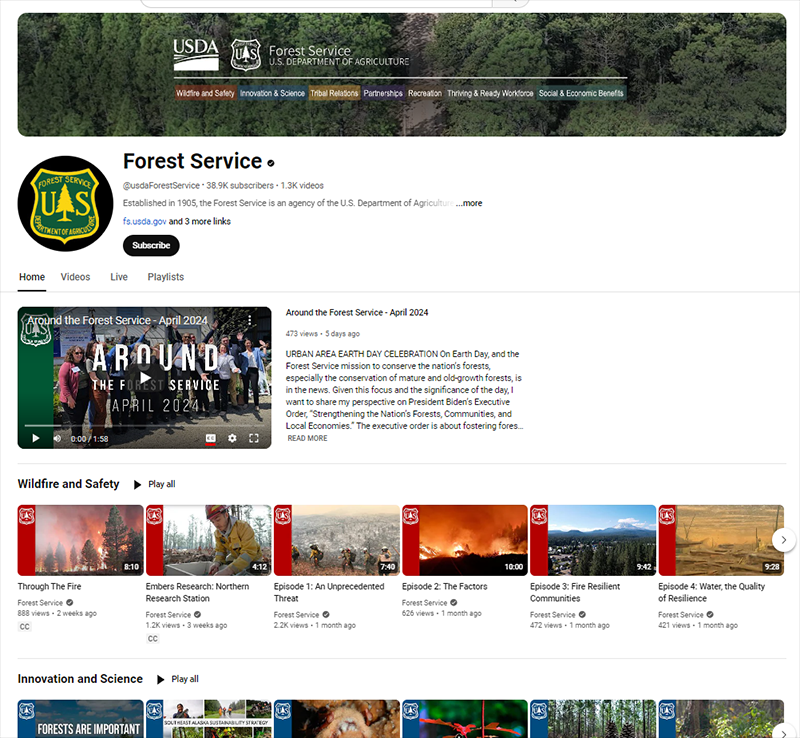 There are 210,076 video clips. Just subscribe to the U.S. Forest Service Channel, and you can search for the video that will share an exclusive insight of forestry that you have not seen before. You will find videos about forest firefighters, wildlife biologists, climate change, national forests, drought conditions, recreation benefits and teaching our youth about watershed.
Established in 1905, the Forest Service is an agency of the U.S. Department of Agriculture. The Forest Service manages public lands in national forests and grasslands. Gifford Pinchot, the first Chief of the Forest Service, summed up the mission of the Forest Service— “to provide the greatest amount of good for the greatest amount of people in the long run.” National forests and grasslands encompass 193 million acres of land, which is an area equivalent to the size of Texas.
USDA is an equal opportunity provider and employer.
Resources:
USDA Forest Service
U.S. Forest Service Facebook
USDA Forest Service X, @forestservice
U.S. Forest Service Instagram, @u.s.forestservice
Forestry Major, Purdue University – Forestry and Natural Resources

Recent Posts
- Woodsy Owl Edition for Educational Learning, USDA – U.S. Forest Service
Posted: January 21, 2026 in Forestry, Forests and Street Trees, Got Nature for Kids, Urban Forestry, Wildlife - Unexpected Plants and Animals of Indiana: Nine-Banded Armadillo
Posted: October 27, 2025 in Got Nature for Kids, Wildlife - Question: Should You Feed Birds in Summer? Understanding the Impact on Migration
Posted: May 13, 2025 in Ask the Expert, Got Nature for Kids, Wildlife - Purdue Alumnus Magazine Highlights FNR Graduate and Nature of Teaching Program
Posted: September 13, 2024 in Got Nature for Kids, Nature of Teaching, Wildlife - Magnificent Trees of Indiana Webinar
Posted: May 12, 2023 in Forestry, Forests and Street Trees, Gardening, Got Nature for Kids, Urban Forestry, Webinar, Woodlands - “Fifty Trees of Indiana” Now Has New Name and New Additional Trees
Posted: January 13, 2022 in Forestry, Forests and Street Trees, Got Nature for Kids, How To, Urban Forestry, Woodlands - Introduction to Nature of Teaching Sneak Peek Videos
Posted: November 2, 2020 in Aquaculture/Fish, Aquatic/Aquaculture Resources, Gardening, Got Nature for Kids, How To, Land Use, Nature of Teaching, Plants, Ponds, Urban Forestry, Wildlife, Woodlands - Nature of Teaching Program Receives Environmental Education Award
Posted: October 30, 2020 in Aquaculture/Fish, Aquatic/Aquaculture Resources, Disease, Drought, Forestry, Forests and Street Trees, Gardening, Got Nature for Kids, How To, Invasive Animal Species, Invasive Insects, Land Use, Natural Resource Planning, Nature of Teaching, Plants, Ponds, Safety, Wildlife - New Publication – The Nature of Teaching: Disease Ecology
Posted: May 20, 2020 in Disease, Forestry, Got Nature for Kids, How To, Nature of Teaching, Plants, Ponds, Publication, Wildlife - Join us on Facebook LIVE – Hellbender Virtual Tour
Posted: April 20, 2020 in Forestry, Got Nature for Kids, Wildlife, Woodlands
Archives
Categories
- Alert
- Aquaculture/Fish
- Aquatic/Aquaculture Resources
- Ask the Expert
- Christmas Trees
- Community Development
- Disease
- Drought
- Forestry
- Forests and Street Trees
- Gardening
- Got Nature for Kids
- Great Lakes
- How To
- Invasive Animal Species
- Invasive Insects
- Invasive Plant Species
- Land Use
- Natural Resource Planning
- Nature of Teaching
- Plants
- Podcasts
- Ponds
- Publication
- Safety
- Spiders
- Timber Marketing
- Uncategorized
- Urban Forestry
- Webinar
- Wildlife
- Wood Products/Manufacturing
- Woodland Management Moment
- Woodlands