 Purdue University - Extension - Forestry and Natural Resources
Got Nature? Blog
Purdue Landscape Report: Earlier this year, Ohio expanded its quarantine for box tree moth (Cydalima perspectalis) to include seven additional counties, bringing the total number of quarantined counties in the state to 14 (ODA, 2026). Michigan currently has 13 counties under quarantine as well. Although this invasive pest has not yet been detected in Indiana, populations close to our borders are continuing to spread. It is important to remain vigilant, particularly in the northeastern and southeastern regions of the state where the risk of introduction is greatest. Landscape professionals, nursery workers, and homeowners can all assist with early detection by monitoring boxwood plantings for signs of infestation.
Signs and Symptoms
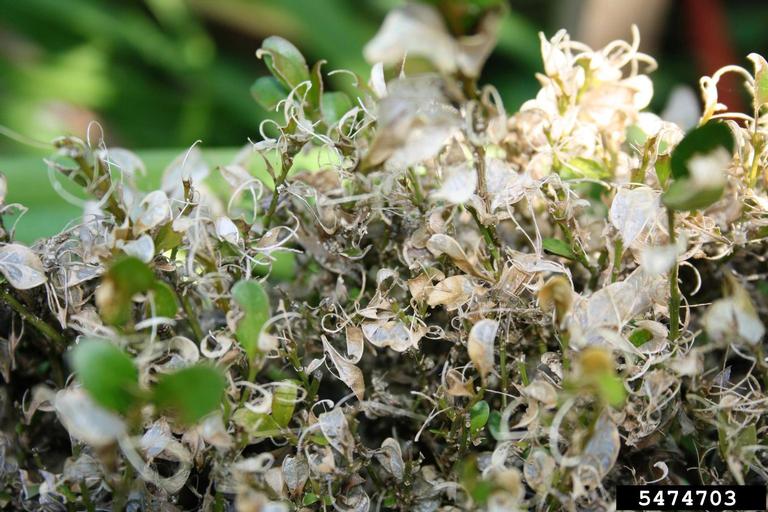
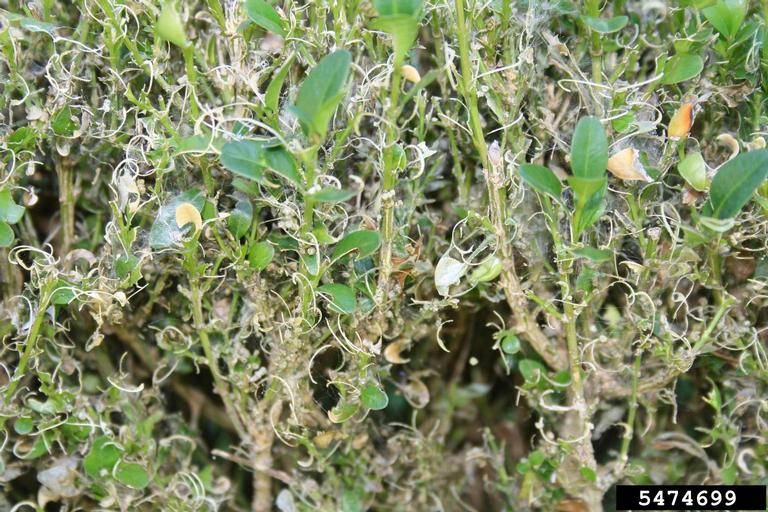
The caterpillar stage of box tree moth is responsible for the damage to boxwoods. Caterpillars are aggressive foliage feeders and often leave behind only the leaf margins or midribs, giving damaged plants a characteristic “stringy” appearance (Figs. 1, 2). As they feed, the larvae also produce large amounts of webbing throughout the shrub canopy.
One of the challenges in detecting infestations is that damage often begins deep within the interior of the shrub. Boxwoods may appear healthy from the outside even while caterpillars are actively feeding inside the canopy. As feeding progresses outward, severe defoliation can develop rapidly. When scouting plants, carefully inspect interior branches for webbing, brown or dried leaves, and feeding injury.
Identification
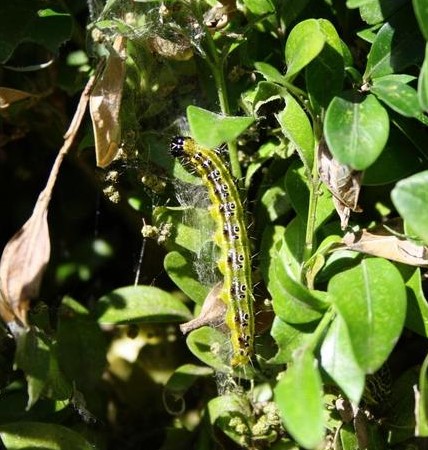
Box tree moth caterpillars are bright yellow-green with black stripes and rows of black spots running the length of the body (Fig. 3). This is the time of year when the caterpillars are active, so take a few minutes to check any boxwoods for them.
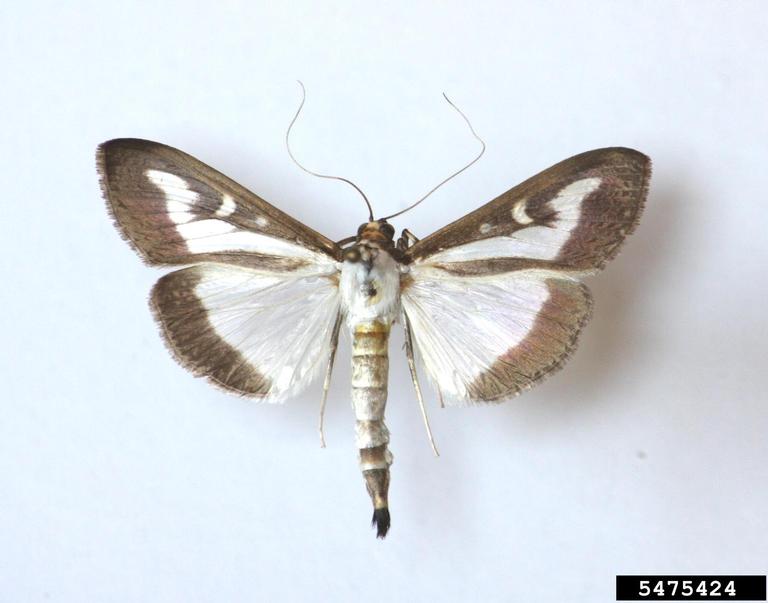
Adult moths are primarily night fliers, so they are less commonly observed during the day. Adults are typically white with broad brown wing borders and a distinctive white crescent-shaped marking within the brown band on the forewing (Fig. 4).
Resources:
ID That Tree, Purdue Extension – Forestry & Natural Resources (FNR) YouTube Playlist:
An Introduction to Trees of Indiana, The Education Store, Purdue Extension’s resource center
Native Trees of the Midwest, The Education Store
Shrubs and Woody Vines of Indiana and the Midwest, The Education Store
Forest Improvement Handbook, The Education Store
Invasive Species, Purdue Extension – FNR YouTube Playlist (Asian Bush Honeysuckle, Burning Bush, Callery Pear, Multiflora rose)
What are invasive species and why should I care?, Got Nature? Blog, Purdue Extension – FNR
Finding help from a professional forester, Indiana Forestry & Woodland Owners Association
Find an Arborist video, Trees are Good, International Society of Arboriculture (ISA)
Box Tree Moth (Cydalima perspectalis), Animal and Plant Health Inspection Service, U.S. Department of Agriculture
Beetle that attacks Tree-of-Heaven found in Indiana, Purdue Landscape Report, Got Nature? Blog, Purdue Extension – FNR
Sawflies: Caterpillar Pests but not Caterpillars – PLR, Got Nature? Blog, Purdue Extension – FNR
Prepared for Insects Waking Up? – PLR, Got Nature? Blog, Purdue Extension – FNR
Case Study: Maple Tree Pests – PLR, Got Nature? Blog, Purdue Extension – FNR
Alicia Kelley, Cooperative Agricultural Pest Survey (CAPS) State Survey Coordinator
Purdue Extension – Entomology

Recent Posts
- Disease May Cause Wilting and Eventual Death of Certain Trees and Shrubs, Purdue Landscape Report
Posted: October 5, 2026 in Disease, Forestry, Plants - October Is Firewood Month: Protect Indiana’s Forests by Making Smart Choices
Posted: October 1, 2026 in Forestry, Forests and Street Trees, How To, Invasive Insects, Urban Forestry - Minecraft Meets the Hellbender
Posted: September 22, 2026 in Aquaculture/Fish, Aquatic/Aquaculture Resources, Wildlife - Is It Too Early to Think About Christmas Tree Pests?
Posted: in Christmas Trees, Invasive Insects, Safety - What You Plant Matters to Wildlife
Posted: September 16, 2026 in Plants, Urban Forestry, Wildlife - Woodland Flowers of Late Summer
Posted: September 14, 2026 in Forestry, Gardening, Wildlife, Woodlands - Heavy August Rains Bring More Mosquitoes to Indiana
Posted: September 9, 2026 in How To, Invasive Insects, Safety, Wildlife - Question: Why Did the Shagbark Hickories Survive the Tornado?
Posted: August 27, 2026 in Forests and Street Trees, How To, Urban Forestry - New Indiana Woodland Steward Newsletter
Posted: August 12, 2026 in Forestry, Urban Forestry, Wildlife, Woodlands - Indiana Fall Hunting Licenses on Sale and New Mobile App Available
Posted: in Forestry, How To, Wildlife
Archives
Categories
- Alert
- Aquaculture/Fish
- Aquatic/Aquaculture Resources
- Ask the Expert
- Christmas Trees
- Community Development
- Disease
- Drought
- Forestry
- Forests and Street Trees
- Gardening
- Got Nature for Kids
- Great Lakes
- How To
- Invasive Animal Species
- Invasive Insects
- Invasive Plant Species
- Land Use
- Natural Resource Planning
- Nature of Teaching
- Plants
- Podcasts
- Ponds
- Publication
- Safety
- Spiders
- Timber Marketing
- Urban Forestry
- Webinar
- Wildlife
- Wood Products/Manufacturing
- Woodland Management Moment
- Woodlands