 Purdue University - Extension - Forestry and Natural Resources
Got Nature? Blog
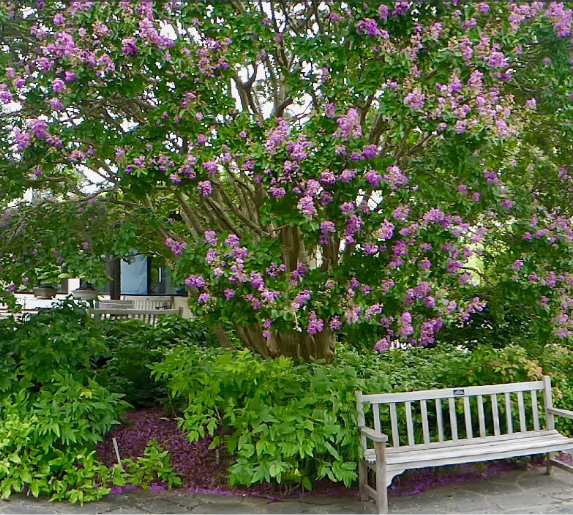 Question: We live near the Amazon Fulfillment Center in the Jeffersonville/Charlestown area. We have significant wind most days. We planted a dogwood tree in our front yard 2 years ago. It struggled through last spring and this year half is not going to make it. Is there a better, preferred tree for this area that we might choose to replace it? We prefer a short stature tree vs one that may reach 20 to 30 feet.
Answer: Dogwood trees can be a challenge to sustain in the landscape due to its environmental requirements. Cornus florida is a “woods edge” tree that like moist, well-drained soil. Most importantly, these trees require protection and at least partial shade to guard against the wind and sun. Recommended publication: Tree Selection, Tree Installation.
Resources
Tree Selection, The Education Store, Purdue Extension resource center
Ask an Expert: Tree Selection and Planting, Purdue Extension – FNR YouTube Channel
Tree Installation, The Education Store
Tree Pruning Essentials, Publication & Video The Education Store
Tree Selection, Tree Installation & Tree Pruning for Landscape, Webinars, Purdue Extension – Forestry and Natural Resources YouTube channel
Planting Problems: Trees Planted Too Deep, Purdue Extension – FNR YouTube Channel
ID That Tree, Purdue Extension – FNR Playlist
Lindsey Purcell, Urban Forestry Specialist
Purdue University, Department of Forestry and Natural Resources
Video series adds “spring bloom” to aid in the identification of different trees. With vivid pictures sharing what to look for regarding the leaves, bark and bloom, Purdue Extension Forester Lenny Farlee identifies these six trees and what to look for in the spring.
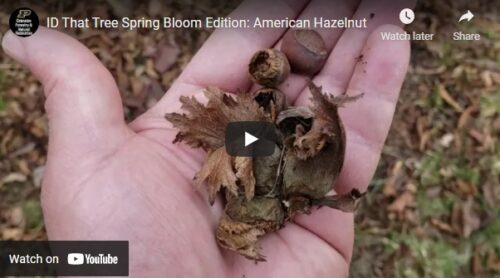 ID That Tree Spring Bloom: American Hazelnut
Did you know that the American hazelnut has male and female flowers? Learn about them and more about this Indiana shrub that produces a tasty treat for humans and wildlife alike in this edition of ID That Tree with Purdue Extension forester Lenny Farlee.
 ID That Tree Spring Bloom: American Plum
In this edition of ID That Tree, Purdue Extension forester Lenny Farlee introduces you to one of our beautiful spring bloomers, the American Plum. Learn how to identify this great alternative to the invasive callery pear by getting to know this species, which can be classified as a small tree or large shrub.
 ID That Tree Spring Bloom: Ohio Buckeye
On this edition of ID That Tree, learn about one of the first native trees to leaf out, the Ohio buckeye. This understory tree is know by its palmate leaves and clusters of yellow/green flowers. Learn more from Purdue Extension Lenny Farlee inside.
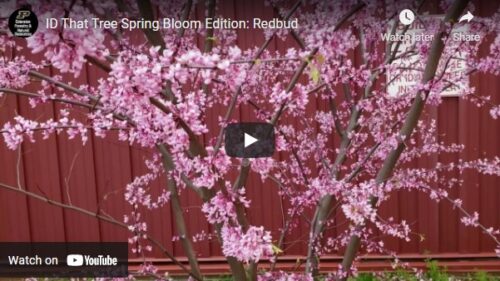 ID That Tree Spring Bloom: Redbud
In this edition of ID That Tree, Purdue Extension forester Lenny Farlee introduces you to the redbud in all of its spring glory. This native Indiana species is known for its pink, lavender and even red and white flowers, which bloom in early spring.
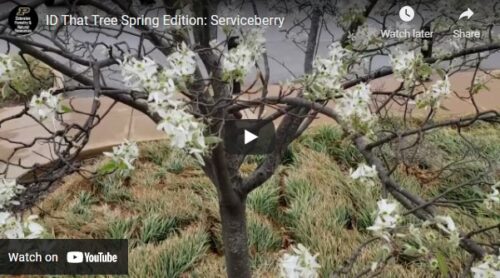 ID That Tree Spring Bloom: Serviceberry
In this spring edition of ID That Tree, Purdue Extension forester Lenny Farlee introduces you to the serviceberry, or juneberry tree. This small native tree is known by its tiny white, or pink, flowers and by its smooth gray bark. Learn more inside.
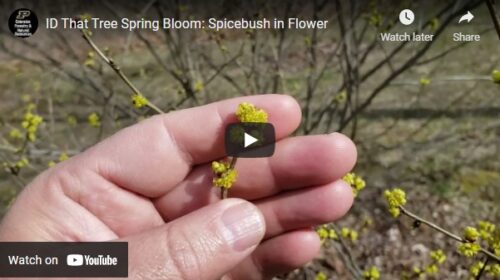 ID That Tree Spring Bloom: Spicebush in Flower
On this episode of ID That Tree, Purdue Extension forester Lenny Farlee introduces the Spicebush, a large native-Indiana shrub that brings early spring color with its clusters of small yellow flowers. This species prefers moist, high-quality soils and is common in forest understories, and brings an aromatic odor when its leaves are crushed or twigs are scraped.
If you have any questions regarding wildlife, trees, forest management, wood products, natural resource planning or other natural resource topics, feel free to contact us by using our Ask an Expert web page.
Resources:
The Education Store, Purdue Extension resource center for publications, videos and apps
The Purdue Arboretum Explorer
Shrubs and Woody Vines of Indiana and the Midwest, Purdue University Press
Native Trees of the Midwest, Purdue University Press
Investing in Indiana Woodlands, The Education Store
Forest Improvement Handbook, The Education Store
Lenny Farlee, Sustaining Hardwood Extension Specialist
Purdue University Department of Forestry and Natural Resources
This unit, part of the Nature of Teaching series, explores the effects of barriers and human assistance on wildlife gene flow. Students will learn about the effects of human-induced factors on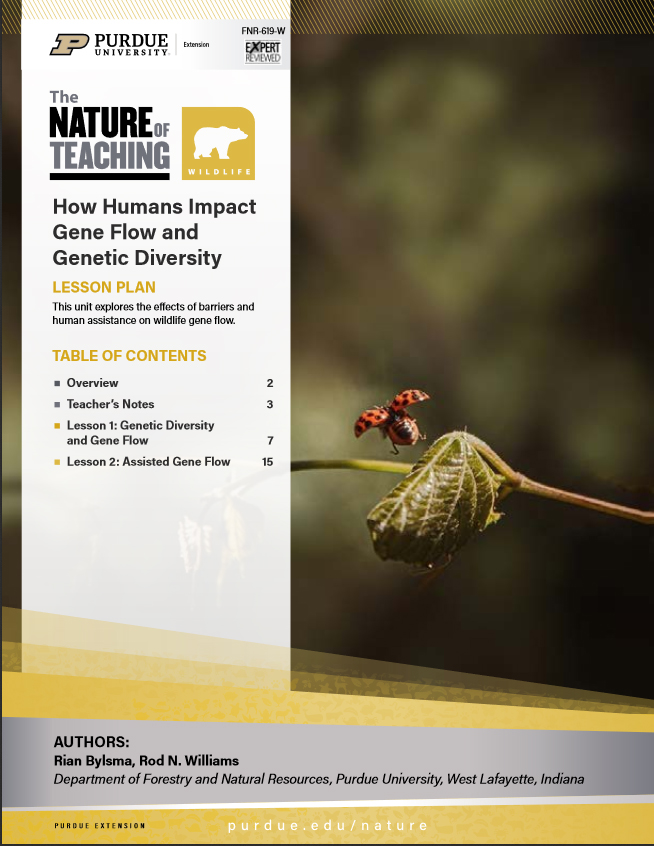 wildlife movement and gene flow, and the effectiveness of human interventions that promote gene flow among wildlife. You will find in the complete curriculum: teachers’ notes, vocabulary words, objectives and required materials for activities including gene flow simulation and estimating genetic variations in lady beetles.
The Nature of Teaching includes formal standards-based curricula and informal activity-based curricula all centered around getting youth outside. The three program areas of the formal curricula include: Wildlife, Health and Wellness, and Food Waste. Each program area provides standards-based lesson plans free as a downloadable PDF. Lesson plans are classroom ready for grades K-12.
Resources:
Nature of Teaching website and Nature of Teaching Youtube Channel
Ask An Expert: Anurans (Frogs and Toads) video, Got Nature?, Purdue Extension-Forestry and Natural Resources
The Nature of Teaching, Unit 3: Reptiles, Amphibians, and the Scientific Method, The Education Store, Purdue Extension resource center
The Nature of Teaching: Ecotoxicology and Environmental Health, The Education Store
Introduction to Nature of Teaching Sneak Peek Videos, Got Nature? Blog, Purdue Extension – Forestry and Natural Resources
Rod Williams, Professor of Wildlife Science
Purdue University Department of Forestry and Natural Resources
Jason Hoverman, Professor of Vertebrate Ecology
Purdue University Department of Forestry and Natural Resources
 Did you know that the majority of tilapia grown in the Midwest region of the United States are sold live in ethnic markets? And the majority of tilapia eaten in the United States are imported from Asia and Latin America?
Farmed tilapia is considered safe to eat. In fact, they are identified as a “Best Choice” fish for pregnant women, breastfeeding mothers and children according to the EPA and FDA.
This publication, “Tilapia Farmed Fish Fact Sheet“, is the third in a series of consumer guides that describe fish and shellfish farmed in the Midwest region of the United States. The fact sheet also includes culinary characteristics, cooking tips and a recipe for Sauteed Tilapia.
To view other consumer guide publications and video resources, check out Purdue Extension’s The Education Store website.
Resources:
Fish: Healthy Protein Handout, The Education Store, Purdue Extension resource center
Walleye Farmed Fish Fact Sheet, The Education Store
Yellow Perch Farmed Fish Fact Sheet, The Education Store
Salmon and Trout of the Great Lakes: A Visual Identification Guide, The Education Store
Eat Midwest Fish, Illinois-Indiana Sea Grant online resource hub
Amy Shambach, Aquaculture Marketing Outreach Associate
Purdue Department of Forestry and Natural Resources
Join Purdue FNR’s own professor of wildlife science, Dr. Rod Williams, along with Mike Lodato, member of the Indiana Technical Advisory Committee for Herpetology, and Nate Engbrecht, herpetologist for the Indiana Department of Natural Resources, to learn tips on the how’s, when’s and where’s of herping in Indiana, including what gear to take, where to go and what you might see in different parts of the state.
If you have any questions regarding wildlife, trees, forest management, wood products, natural resource planning, or other natural resource topics, feel free to contact us by using our Ask an Expert web page.
Resources:
What’s a Herp? Indiana Department of Natural Resources YouTube Channel
Appreciating Reptiles and Amphibians in Nature, The Education Store, Purdue Extension resource center
The Nature of Teaching, Unit 3: Reptiles, Amphibians, and the Scientific Method, The Education Store
A Moment in the Wild: Eastern Newt Video, Purdue Extension – FNR YouTube Channel
Help the Hellbender, Purdue Extension
Rod Williams, Professor of Wildlife Science
Purdue Department of Forestry and Natural Resources
Nate Engbrecht, Herpetologist
Indiana Department of Natural Resources
Mike Lodato, Member of the Indiana Technical Advisory Committee for Herpetology
Illinois-Indiana Sea Grant (IISG), serving communities in the Great Lakes region, has largemouth bass workshops now available as videos on the IISG YouTube Channel. Presenters from Illinois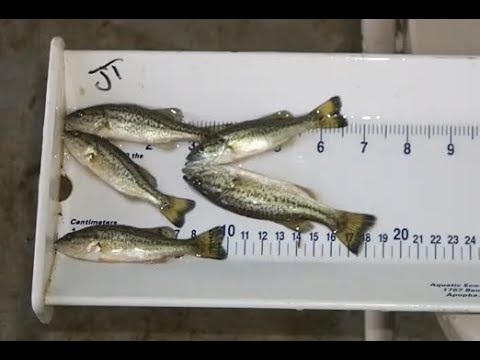 and Kentucky share their expertise with largemouth bass production, marketing trends and best management practices.
Indoor Larval Largemouth Bass Rearing Video
Presenter: Giovanni Molinari, Research Assistant, Center for Fisheries, Aquaculture and Aquatic Science, Sothern Illinois University-Carbondale
Learn about larval largemouth bass rearing in an indoor recirculating aquaculture system from Southern Illinois University graduate student Giovanni Molinari.
Largemouth Bass Production Video
Presenter: Dr. James H. Tidwell, Chair for School of Aquaculture and Aquatic Sciences, Aquaculture Research Center, Kentucky State University
Gain an overview of largemouth bass production from Dr. Tidwell, including stocking and food fish production.
Largemouth Bass Fingerling Production Video
Presenter: Shawn Coyle, Research Associate with the School of Aquaculture and Aquatic Sciences, College of Agriculture, Kentucky State University
Learn about the production of feed trained largemouth bass fingerlings through the first year.
Largemouth Bass Market Trends Video
Presenter: Paul Hitchens, Aquaculture Specialist, Southern Illinois University
Learn about the marketing trends to the food fish market and live market. Paul shares what they gather and how they analyze the numbers there at SIU.
Through workshops, educational materials, and one-on-one interactions, Illinois-Indiana Sea Grant provides people with the tools they need to help incorporate fish into their diet, aid aquaculture producers in defining markets and create value-added opportunities for their products.
Resources:
Eat Midwest Fish website launches fresh fish finder, Illinois – Indiana Sea Grant
Walleye Farmed Fish Fact Sheet: A Guide for Seafood Consumers, The Education Store, Purdue Extension resource center
Yellow Perch Farmed Fish Fact Sheet, The Education Store
Tilapia Farmed Fish Fact Sheet, The Education Store
Fish: Healthy Protein Handout, The Education Store
Fish Cleaning with Purdue Extension County Extension Director, Got Nature? Blog, Purdue Extension – Forestry and Natural Resources
Illinois-Indiana Sea Grant (IISG) YouTube Channel and IISG website, IISG grant combines research, education, and outreach to empower southern Lake Michigan communities to secure a healthy environment and economy.
Amy Shambach, Aquaculture Marketing Outreach Associate
Purdue Department of Forestry and Natural Resources/Illinois Indiana Sea Grant Program

Recent Posts
- ID That Tree: Sugarberry
Posted: December 12, 2025 in Forestry, Wildlife, Woodlands - Powering Rural Futures: Purdue’s Agrivoltaics Initiative for Sustainable Growth
Posted: December 9, 2025 in Community Development, Wildlife - Learn How to Control Reed Canarygrass
Posted: December 8, 2025 in Forestry, Invasive Plant Species, Wildlife - Benefits of a Real Christmas Tree, Hoosier Ag Today Podcast
Posted: December 5, 2025 in Christmas Trees, Forestry, Woodlands - Succession Planning Resource: Secure your Future
Posted: December 2, 2025 in Community Development, Land Use, Woodlands - A Woodland Management Moment: Butternut Disease and Breeding
Posted: December 1, 2025 in Forestry, Forests and Street Trees, Woodland Management Moment, Woodlands - Controlling Introduced Cool-Season Grasses
Posted: in Forestry, Invasive Plant Species, Wildlife - Red in Winter – What Are Those Red Fruits I See?
Posted: in Forestry, Plants, Urban Forestry, Wildlife, Woodlands - Managing Common and Cut Leaved Teasel
Posted: November 24, 2025 in Forestry, Invasive Plant Species, Wildlife - Extension Team Wins Family Forests Comprehensive Education Award
Posted: November 21, 2025 in Forestry, Urban Forestry, Wildlife, Woodlands
Archives
Categories
- Alert
- Aquaculture/Fish
- Aquatic/Aquaculture Resources
- Ask the Expert
- Christmas Trees
- Community Development
- Disease
- Drought
- Forestry
- Forests and Street Trees
- Gardening
- Got Nature for Kids
- Great Lakes
- How To
- Invasive Animal Species
- Invasive Insects
- Invasive Plant Species
- Land Use
- Natural Resource Planning
- Nature of Teaching
- Plants
- Podcasts
- Ponds
- Publication
- Safety
- Spiders
- Timber Marketing
- Uncategorized
- Urban Forestry
- Webinar
- Wildlife
- Wood Products/Manufacturing
- Woodland Management Moment
- Woodlands