 Purdue University - Extension - Forestry and Natural Resources
Got Nature? Blog
Purdue Extension forester Lenny Farlee introduces you to the Devil’s Walking Stick, a small tree from the ginseng family found in southern Indiana. It is identifiable by thorns or spikes along the stem, unique doubly compound leaves, and large clusters of small white flowers.
If you have any questions regarding trees, forests, wildlife, wood products or other natural resource topics, feel free to contact us by using our Ask an Expert web page.
Resources
Devil’s Walking Stick, Purdue Arboretum Explorer
Devil’s Walking Stick, Native Trees of Indiana River Park, Purdue Fort Wayne
Investing in Indiana Woodlands, The Education Store
Tree Appraisal and the Value of Trees, The Education Store
Forest Improvement Handbook, The Education Store
ID That Tree, Playlist, Purdue Extension – Forestry and Natural Resources Youtube Channel
A Woodland Management Moment, Playlist, Purdue Extension – Forestry and Natural Resources Youtube Channel
Lenny Farlee, Sustaining Hardwood Extension Specialist
Purdue University Department of Forestry and Natural Resources
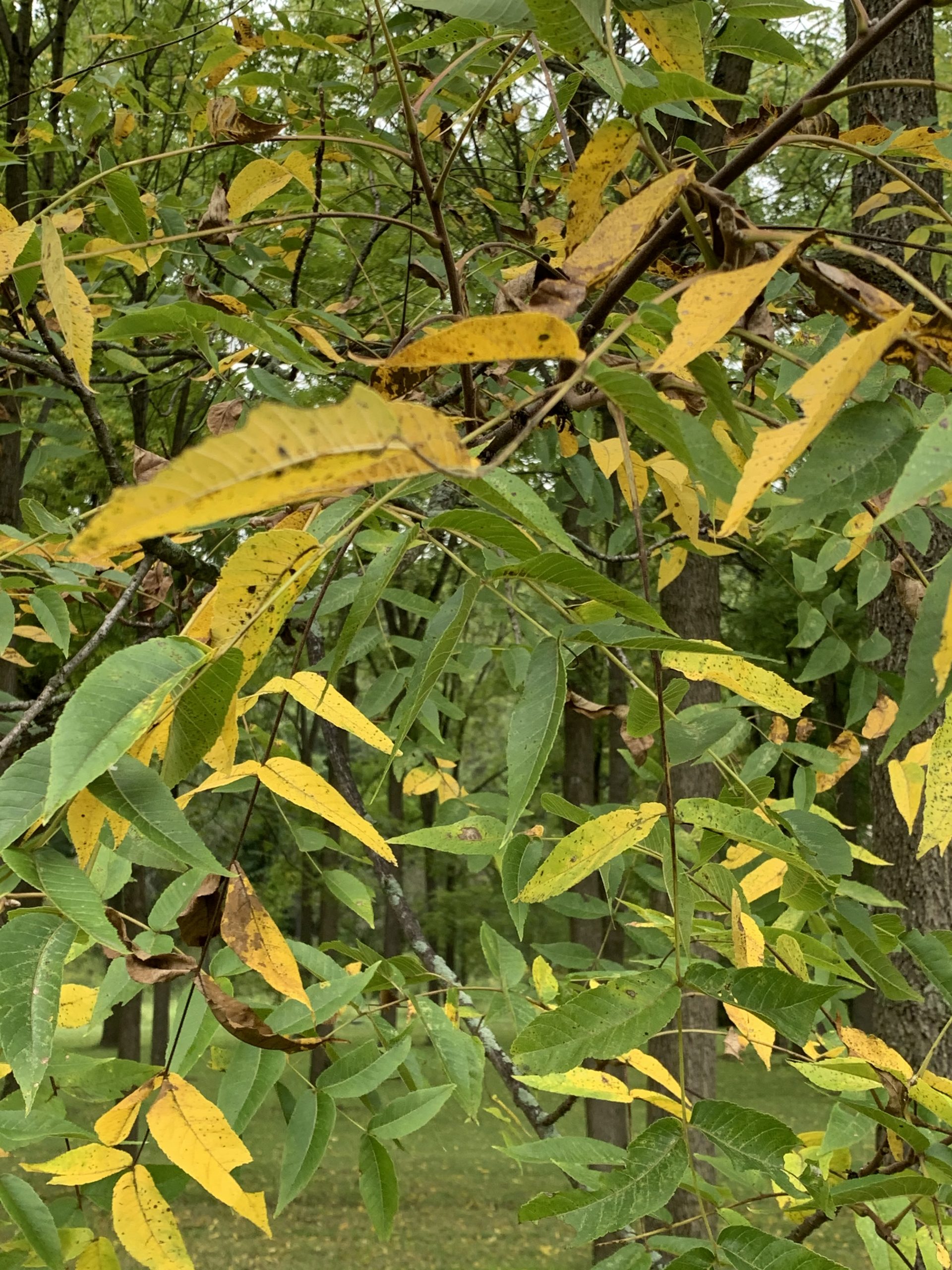
Brown or black spots with yellowing are signs of anthracnose.
This time of year, many black walnut trees’ leaves may have black spots, turn yellow and begin to drop. This is commonly known as anthracnose, a fungal disease that causes trees to drop their leaves prematurely.
Anthracnose is worsened by wet weather, and some trees are more genetically susceptible to anthracnose than others. It is not fatal but can look like a serious problem. The absence of leaves can slow a tree’s growth and can reduce the nut crop, although by this time of year growth may have slowed or stopped for the season.
Anthracnose generally begins as small circular brown to black areas on the leaflets. Over the season those spots expand and cause leaf drop. There are a few other leaf spot diseases of black walnut, see the references below for descriptions of those diseases.
Although unsightly, there is no need for further action if you are growing timber and have anthracnose in a plantation or woods. It can be an issue if you are growing walnuts for a nut crop, and there are resources and spray products to help manage the fungus in those situations.
If you have individual landscaping trees and want to limit anthracnose spread there are few things you can do:
- Gather fallen leaves and compost or remove them from the site.
- Control weeds which could carry the fungus.
- Plant walnut trees where there is good air circulation.
- Keep the trees healthy and vigorous by managing soil fertility and thinning competition as needed.
Resources
Walnut Anthracnose, Walnut Notes, U.S. Department of Agriculture, Forest Service, North Central Forest Experiment Station
Indiana Walnut Council, Industry Representatives include 45 states and 3 foreign countries
Diseases in Hardwood Tree Plantings, The Education Store, Purdue Extension resource center
Study: Fungus Behind Deadly Disease in Walnut Trees Mutates Easily, Complicating Control, Purdue Agriculture News
Indiana Walnut Council
Diseases in Hardwood Tree Plantings, The Education Store, Purdue Extension resource center
Why are my walnut trees dropping their leaves?, Purdue Extension – Forestry & Natural Resources (FNR) Got Nature? Blog
Invasive Species Walnut Twig Beetle Detected in Indiana, Purdue Extension – FNR Got Nature? Blog
Intro to Trees of Indiana: Black Walnut, Purdue Extension – FNR Got Nature? Blog
Planting Hardwood Seedlings in the Central Hardwood Region, The Education Store
Regenerating Hardwoods in the Central Hardwood Region: Soils, The Education Store
Fertilizing, Pruning, and Thinning Hardwood Plantations, The Education Store
Resources and Assistance Available for Planting Hardwood Seedlings, The Education Store
Liz Jackson, Manager Walnut Council / IN Forestry Woodland Owners Association (IFWOA) & Engagement Specialist
Purdue University Department of Forestry and Natural Resources
Purdue Extension forester Lenny Farlee introduces you to the quaking or trembling aspen. This tree is found in northern Indiana and typically identifiable by whitish to grayish bark with dark spots where the branches come out.
If you have any questions regarding trees, forests, wildlife, wood products or other natural resource topics, feel free to contact us by using our Ask an Expert web page.
Resources
Aspen, The Education Store, Purdue Extension resource center
Quaking Aspen, Purdue Fort Wayne
Investing in Indiana Woodlands, The Education Store
Investing in Indiana Woodlands, The Education Store
Tree Appraisal and the Value of Trees, The Education Store
Forest Improvement Handbook, The Education Store
ID That Tree, Playlist, Purdue Extension – Forestry and Natural Resources Youtube Channel
A Woodland Management Moment, Playlist, Purdue Extension – Forestry and Natural Resources Youtube Channel
Lenny Farlee, Sustaining Hardwood Extension Specialist
Purdue University Department of Forestry and Natural Resources
On this edition of ID That Tree, Purdue Extension forester Lenny Farlee introduces you to the northern white cedar, a native conifer that is used for ornamental, windbreak and reforestation purposes. This evergreen has distinct scale like foliage which is soft to the touch. He shares how to distinguish it from the eastern red cedar.
If you have any questions regarding trees, forests, wildlife, wood products or other natural resource topics, feel free to contact us by using our Ask an Expert web page.
Resources
ID That Tree, Playlist, Purdue Extension – Forestry and Natural Resources Youtube Channel
ID That Tree: Eastern Red Cedar, Video
Thuja occidentalis, The Purdue Arboretum Explorer
Investing in Indiana Woodlands, The Education Store
Tree Appraisal and the Value of Trees, The Education Store
Forest Improvement Handbook, The Education Store
Lenny Farlee, Sustaining Hardwood Extension Specialist
Purdue University Department of Forestry and Natural Resources
Purdue Landscape Report: Homeowners can easily become injured – often fatally – while attempting to trim trees near overhead electrical wires. Though it is tempting to try to save money with this “do-it-yourself” approach, the potential for electrocution is not worth the risk. It is important to recognize when to call a professional arborist.
Terrible accidents can happen when a homeowner uses any type of cutting tools and/or ladders when attempting to trim backyard trees and shrubs. Overhead wires are often unnoticed and is touched by directly or indirectly, causing injury or death.
Examples include:
- A homeowner climbed a ladder to trim a tree branch that was dropping leaves into his above ground swimming pool and causing a nuisance. A branch came in contact with the power line, shocking the man with a jolt of electricity and sending him into cardiac arrest. He fell 20 feet to the ground but was revived by medics at the scene.
- MATTHEWS, N.C. — A man trimming trees in a neighborhood was shocked Wednesday morning after a limb fell on power lines, authorities said. Nearby resident Margie Owens knows the man and said he does odd jobs around the neighborhood. According to officials, after the limb fell from pruning, the tree continued to be energized by the power line, leaving the man stuck.
- A Charlotte County man was electrocuted trimming trees in a backyard. The victim was part of a landscaping crew and came in direct contact with a utility line.
Preventable Accidents
Tree limbs can conduct electricity. When trees grow near overhead wires, they can contact the wires and become energized. Trees and wires are dangerous, full of electrical power that can injure or kill humans. How do we know which lines are energized? WE DON’T! Assume all are carrying dangerous electrical current and should be avoided when working around them.
A common house switch carries 120 volts, but the electric flow is usually limited to 10, 15 or 20 amps. A common “house drop” (service wire) contains 240 volts and up to 20 amps or more. Given the right set of circumstances, even the shock a person gets from a common light switch can kill, but at the same time, it is easier to break electrical contact while standing inside a house. If a person is climbing a ladder or is in the tree, it may be more difficult to break contact with the energized wire. This means that the service line over a typical yard could easily kill a person.

Utility service providers can help select a tree which is compatible with nearby lines and reduce the need for excessive pruning to maintain safety and reliability

These powerlines could be “energizing” the tree creating a potential shock hazard for anyone touching the tree. Notice the burning on the new growth.
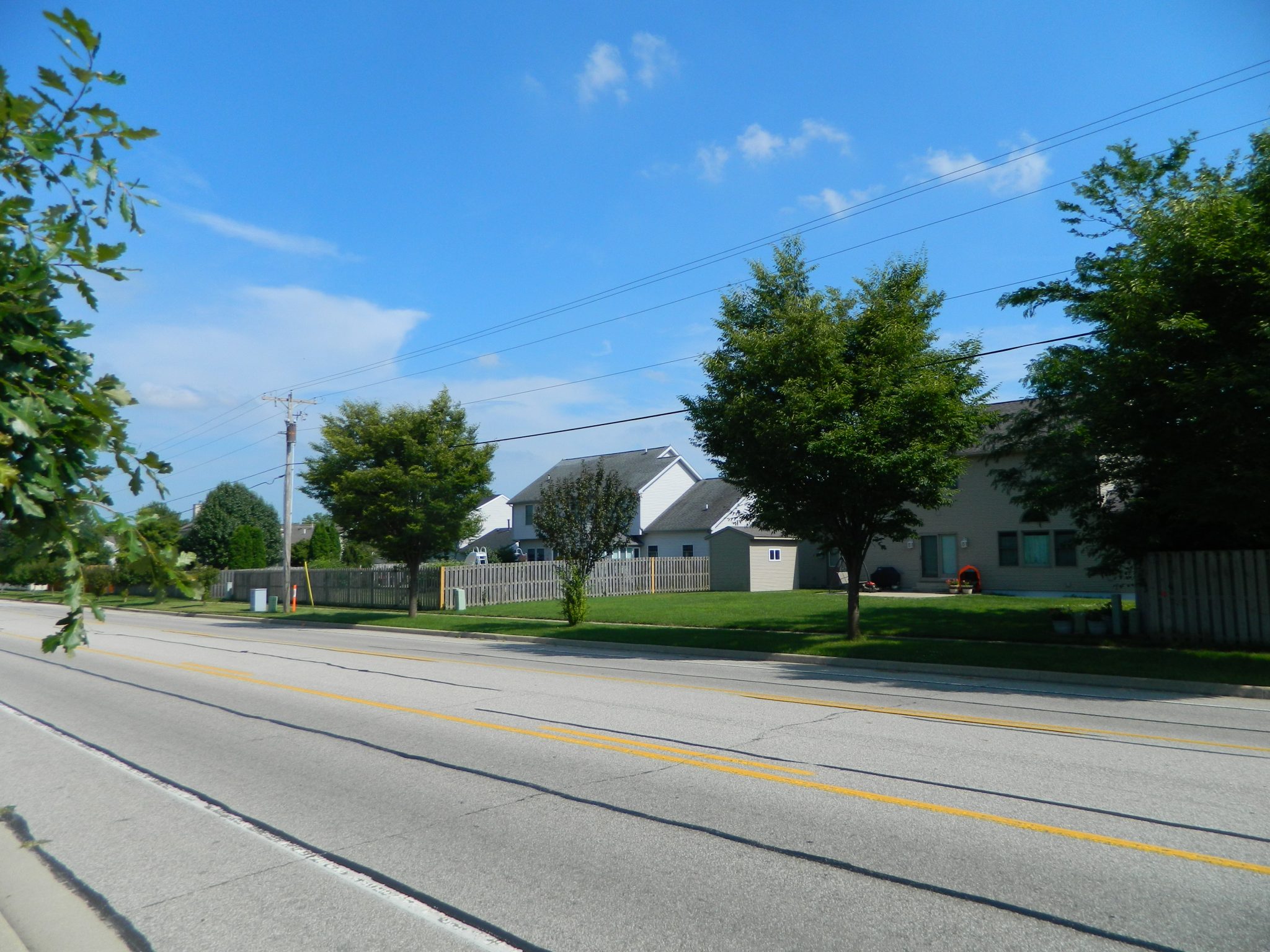
Trees growing into utility lines should be pruned by a qualified arborist.
Here are a few tips to avoid trees in wires:
- Look for power lines before pruning trees and large shrubs. If lines are anywhere near the tree within 10 ft. don’t attempt any tree work. Tree care professionals have the training and equipment needed to perform these tasks safely.
- Never climb a tree in order to prune it. Even if the wires aren’t currently touching the tree, remember that the tree’s branches will shift once you begin climbing or removing limbs.
- Don’t move ladders or long-handled pruning tools around the yard without first looking up. Always read and heed ladder-use safety labels.
Find a professional
Be sure to always hire an insured, tree care professional, preferably and ISA Certified Arborist with the experience, expertise, and equipment to safely take down or prune trees in wires. Require proof of liability insurance to protect yourself as well.
Another easy way to find a tree care service provider in your area is to use the “Locate Your Local Tree Care Industry Association Member Companies” program. For more information refer to the publication Trees and Utilities at the Purdue Education Store.
Find a certified arborist in your area by going to Trees are good website.
Resources:
Tree Pruning for the Landscape, Video, Purdue Extension – Forestry and Natural Resources YouTube Channel
Tree Pruning Essentials, Video & Publication
Tree Appraisal and the Value of Trees, The Education Store, Purdue Extension’s resource center
Tree Pruning: What Do Trees Think?, The Education Store
Mechanical Damage to Trees: Mowing and Maintenance Equipment, The Education Store
Tree Installation Process and Practices, The Education Store
In this edition of ID That Tree, Purdue Extension forester Lenny Farlee introduces you to the Eastern White Pine, Indiana’s only native five-needle pine. This species, which can grow to 150 feet tall, grows a ring of branches as it ages. Learn more inside.
If you have any questions regarding trees, forests, wildlife, wood products or other natural resource topics, feel free to contact us by using our Ask an Expert web page.
Resources
ID That Tree, Playlist, Purdue Extension – Forestry and Natural Resources Youtube Channel
A Woodland Management Moment, Playlist, Purdue Extension – Forestry and Natural Resources Youtube Channel
White Pine and Salt Tolerance, The Education Store, Purdue Extension resource center
Tree Diseases: White Pine Decline in Indiana, The Education Store
Investing in Indiana Woodlands, The Education Store
Tree Appraisal and the Value of Trees, The Education Store
Forest Improvement Handbook, The Education Store
Lenny Farlee, Sustaining Hardwood Extension Specialist
Purdue University Department of Forestry and Natural Resources
Purdue Extension forester Lenny Farlee tells you where to find and how to identify a species that clings to many of our trees, poison ivy. Protect yourself from the itch by recognizing this species before it is a problem.
If you have any questions regarding trees, forests, wildlife, wood products or other natural resource topics, feel free to contact us by using our Ask an Expert web page.
Resources
Poison Ivy, Purdue Landscape Report
Poison Ivy, Purdue Extension
Poison Ivy, The Education Store, Purdue Extension resource center
Investing in Indiana Woodlands, The Education Store
Tree Appraisal and the Value of Trees, The Education Store
Forest Improvement Handbook, The Education Store
ID That Tree, Playlist, Purdue Extension – Forestry and Natural Resources Youtube Channel
A Woodland Management Moment, Playlist, Purdue Extension – Forestry and Natural Resources Youtube Channel
Lenny Farlee, Sustaining Hardwood Extension Specialist
Purdue University Department of Forestry and Natural Resources
Join Purdue Extension forester Lenny Farlee as he introduces you to the Sassafras in this edition of ID That Tree. The Sassafras is well known for the tree made from its bark and also for having a variety of shaped leaves from zero to three lobes.
If you have any questions regarding trees, forests, wildlife, or other natural resource topics, feel free to contact us by using our Ask an Expert web page.
Resources
ID That Tree, Playlist, Purdue Extension – Forestry and Natural Resources Youtube Channel
A Woodland Management Moment, Playlist, Purdue Extension – Forestry and Natural Resources Youtube Channel
Sassafras albidum, Purdue Arboretum Explorer
Sassafras, The Education Store, Purdue Extension resource center
Investing in Indiana Woodlands, The Education Store
Tree Appraisal and the Value of Trees, The Education Store
Forest Improvement Handbook, The Education Store
Lenny Farlee, Sustaining Hardwood Extension Specialist
Purdue University Department of Forestry and Natural Resources
In this edition of ID That Tree, Purdue Extension forester Lenny Farlee introduces you to the American Sycamore, one of Indiana’s largest deciduous trees. You can identify the tree from the upper part of the canopy, which glows with smooth white/light green bark.
If you have any questions regarding trees/forests, or other natural resource topics, feel free to contact us by using our Ask an Expert web page.
Resources
Sycamore, The Education Store, Purdue Extension resource center
Investing in Indiana Woodlands, The Education Store
Tree Appraisal and the Value of Trees, The Education Store
Forest Improvement Handbook, The Education Store
American Sycamore, The Purdue Arboretum
What is happening to the local sycamore trees?, Purdue Extension
Sycamore Anthracnose, Purdue Extension
ID That Tree, Playlist, Purdue Extension – Forestry and Natural Resources Youtube Channel
A Woodland Management Moment, Playlist, Purdue Extension – Forestry and Natural Resources Youtube Channel
Lenny Farlee, Sustaining Hardwood Extension Specialist
Purdue University Department of Forestry and Natural Resources
Join Purdue Extension forester Lenny Farlee as he introduces you to one of our more common Indiana tree species, the white oak. This tree gets to be one of our largest and longest lived oak trees in Indiana.
If you have any questions regarding trees/forests, or other natural resource topics, feel free to contact us by using our Ask an Expert web page.
Resources
ID That Tree, Playlist, Purdue Extension – Forestry and Natural Resources Youtube Channel
A Woodland Management Moment, Playlist, Purdue Extension – Forestry and Natural Resources Youtube Channel
White Oak, The Education Store, Purdue Extension resource center
White Oak, The Purdue Arboretum Explorer
Many possible reasons for early loss of white oak leaves / Marestail Control, Indiana Yard & Garden-Purdue Consumer Horticulture
Investing in Indiana Woodlands, The Education Store
Tree Appraisal and the Value of Trees, The Education Store
Forest Improvement Handbook, The Education Store
Lenny Farlee, Sustaining Hardwood Extension Specialist
Purdue University Department of Forestry and Natural Resources

Recent Posts
- Opportunities for Prescribed and Wildland Fire Training
Posted: November 4, 2026 in Forestry, How To, Wildlife, Woodlands - Wildlife Issues and Solutions: A New Online Series
Posted: in Forestry, How To, Wildlife, Woodlands - Burning for Benefits: Where Fire Belongs in Indiana
Posted: in Forestry, Safety, Wildlife, Woodlands - Residents, Alumni Invited to Share Indiana Natural Resource, Spaces, Species Memories
Posted: in Forestry, Forests and Street Trees, Gardening, Urban Forestry, Wildlife - Now Is The Time To Control Non-Native Bush Honeysuckle
Posted: October 30, 2026 in Forestry, How To, Invasive Plant Species, Woodlands - Help Strengthen the Future of Indiana Maple Syrup
Posted: October 29, 2026 in Forestry, How To, Woodlands - Popular Landscape Shrub is Invasive
Posted: October 15, 2026 in Alert, Forestry, Forests and Street Trees, Invasive Plant Species, Plants, Woodlands - Purdue Extension’s Regional Teams Are Here: Connecting Communities with Expertise and Opportunity
Posted: October 14, 2026 in Community Development, Forestry, Forests and Street Trees, Gardening, How To, Timber Marketing, Urban Forestry, Wildlife, Woodlands - Why Do Our Trees Go From Green Leaves to Different Colors?
Posted: in Forestry, Forests and Street Trees, Urban Forestry, Woodlands - Deer and Turkey Archery Seasons Opening Soon, MyDNR
Posted: October 13, 2026 in Alert, Safety, Wildlife
Archives
Categories
- Alert
- Aquaculture/Fish
- Aquatic/Aquaculture Resources
- Ask the Expert
- Christmas Trees
- Community Development
- Disease
- Drought
- Forestry
- Forests and Street Trees
- Gardening
- Got Nature for Kids
- Great Lakes
- How To
- Invasive Animal Species
- Invasive Insects
- Invasive Plant Species
- Land Use
- Natural Resource Planning
- Nature of Teaching
- Plants
- Podcasts
- Ponds
- Publication
- Safety
- Spiders
- Timber Marketing
- Urban Forestry
- Webinar
- Wildlife
- Wood Products/Manufacturing
- Woodland Management Moment
- Woodlands