 Purdue University - Extension - Forestry and Natural Resources
Got Nature? Blog
Purdue Landscape Report: When talking about invasive species, specialists are most commonly talking about some kind of plant or insect that is making an impact on landscape plants, soil, or hardwood. Most of these species are relatively easy to understand, with a biology that typically resembles that of a native counterpart. Wood-boring insects, vining plants, and fast-growing shrubs all have similar native species that landowners deal with on a regular basis. And then, some invasive species are just plain weird, like the invasive hammerhead worm!
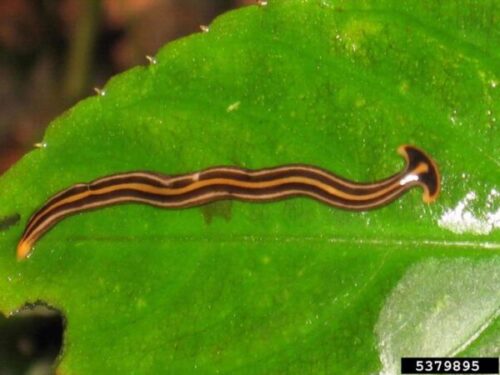
Hammerhead worm (photo from Arun T P, Bugwood.org)
Hammerhead worms, sometimes called shovel-headed garden worms, are a type of land planarian, or flatworm. Flatworms are worm-like organisms that lack the segmentation of earthworms and have the ability to regenerate from parts and pieces. Hammerhead worms belong to a subset of planarians, the genus Bipalium; while there are a few native species of Bipalium, most are from tropical regions. It is believed that hammerhead worms have been present in North America for long time, preferring environments that stay warm and moist through most of the year. Hammerhead worms are named for their spade-shaped head and typically have bright colors with dark lines running the length of their bodies. They are often found in indoor spaces and greenhouses that are temperature controlled and maintain humid conditions. Hammerhead worms can also be found living under rocks, fallen trees, or anywhere that can maintain a high enough relative humidity. While some flatworms are able to live in drier conditions, Bipalium need moisture in order to survive.
Members of Bipalium are predatory, consuming invertebrates like earthworms, snails, slugs, and some soft-bodied insects. Once they capture a prey item, they envelop it in a mouth-like organ located on the underside of their bodies. The primary issue with hammerhead worms is the potential damage they can do by preying on beneficial organisms that maintain soil and plant health. Hammerhead worms, and all other planarians, lack a closed body plan that uses a one-way digest system. Once they eat something, it is digested and waste is excreted through that same mouth-like opening. Some members of Bipalium can also use a toxin called tetrodotoxin to subdue their prey; however, they only produce a small amount and lack a way to use it on a larger organism. While they are often confused for more dangerous species, the Bipalium in North America do not represent a human health concern. Just keep any pets or children away from them, and if found, and use gloves if you’re forced to handle them.
As mentioned above, one of the more unique traits of Bipalium, and planarians in general, is their capacity to regenerate new individuals from parts and pieces. A piece as small as 1/279th of the whole can regenerate into a new individual. Do not attempt to chop up or crush hammerhead worms, or you may be dealing with several dozen when new worms develop in two weeks. However, even though it seems like hammerhead worms could reproduce very quickly, it’s still fairly uncommon to see one. If found, place it in a bag or bucket with either salt, alcohol, or vinegar until the worm is dead. As long as you do not cut or chop up the worms, it is very unlikely you’ll have to deal with more than one at any given time. Just keep your eyes open and remember to report any sightings to 1-866-NOEXOTICS!
View the original article on the Purdue Landscape Report website: Keep an eye out for hammerhead worms!.
Subscribe and receive the newsletter: Purdue Landscape Report Newsletter.
Resources:
Gardeners Asked to be Vigilant This Spring for Invasive Jumping Worm, Purdue Extension – FNR Got Nature? Blog
Fall webworms: Should you manage them?, Purdue Landscape Report
Mimosa Webworm, The Education Store, Purdue Extension resource center
Sod Webworms, Turf Science at Purdue University
Bagworm caterpillars are out feeding, be ready to spray your trees, Purdue Extension Forestry & Natural Resources (FNR) Got Nature? Blog
Landscape & Ornamentals: Bagworms, The Education Store
Purdue Plant Doctor, Purdue Extension-Entomology
Find an Arborist website, Trees are Good, International Society of Arboriculture (ISA)
ID That Tree – Video Playlist, Purdue Extension – Forestry and Natural Resources (FNR) YouTube Channel
Fifty Common Trees of Indiana, Purdue FNR web page list
Indiana Department of Natural Resources: Invasive Species
Indiana Invasive Species Council
Cooperative Invasive Species Management Area (CISMA)
Report Invasive, Purdue Extension
Native Trees of the Midwest, Purdue University Press
Report INvasive Facebook
Subscribe – Purdue Extension – FNR YouTube Channel
Bob Bruner, Exotic Forest Pest Educator
Purdue Entomology

Recent Posts
- Keep An Eye Out for Hammerhead Worms, Purdue Landscape Report
Posted: April 2, 2026 in Invasive Animal Species, Wildlife, Woodlands - When is the Peak Migration For Hummingbirds and How Can You Attract Them?
Posted: in How To, Wildlife - ID That Tree Featured in National Woodland Owners Association Newsletter
Posted: April 1, 2026 in Urban Forestry, Wildlife, Woodlands - New 2026 Indiana Woodland Steward Newsletter
Posted: March 30, 2026 in Urban Forestry, Wildlife, Woodlands - A Woodland Management Moment: Why Aspect Matters
Posted: in Urban Forestry, Woodland Management Moment, Woodlands - 2026 Winter Bat Survey In Progress, MyDNR
Posted: March 27, 2026 in How To, Wildlife - Fast-Growing Trees for the Landscape, Purdue Landscape Report
Posted: March 26, 2026 in Forestry, Urban Forestry, Woodlands - Urban Tree Spotlight: Planting Deciduous Shade Trees, Purdue Landscape Report
Posted: March 25, 2026 in Forests and Street Trees, Urban Forestry, Woodlands - Beetle that attacks Tree-of-Heaven found in Indiana, Purdue Landscape Report
Posted: March 20, 2026 in Invasive Insects, Wildlife, Woodlands - ID That Tree: Dwarf Chinkapin Oak
Posted: in Forestry, Urban Forestry, Wildlife, Woodlands
Archives
Categories
- Alert
- Aquaculture/Fish
- Aquatic/Aquaculture Resources
- Ask the Expert
- Christmas Trees
- Community Development
- Disease
- Drought
- Forestry
- Forests and Street Trees
- Gardening
- Got Nature for Kids
- Great Lakes
- How To
- Invasive Animal Species
- Invasive Insects
- Invasive Plant Species
- Land Use
- Natural Resource Planning
- Nature of Teaching
- Plants
- Podcasts
- Ponds
- Publication
- Safety
- Spiders
- Timber Marketing
- Uncategorized
- Urban Forestry
- Webinar
- Wildlife
- Wood Products/Manufacturing
- Woodland Management Moment
- Woodlands