 Purdue University - Extension - Forestry and Natural Resources
Got Nature? Blog
 There are 36 species of snakes and lizards in Indiana and about 8,000 species worldwide. Lizards are the most taxonomically diverse and speciose group of reptiles with approximately 5,000 species. Serpentes represents the second most diverse and successful group of reptiles with approximately 3,000 species. Assistant Professor Rod Williams and Extension Wildlife Specialist Brian MacGowan of Purdue Forestry and Natural Resources have authored a book that provides information on the identification, ecology and behavior of snakes and lizards. This colorful resource with maps and photos expands upon their food habits, reproduction and conservation.
For more information about Indiana snakes and lizards, view The Education Store’s Snakes and Lizards of Indiana.
Resources:
Turtles of Indiana, The Education Store
Appreciating Reptiles and Amphibians in Nature, The Education Store
Forestry Management for Reptiles and Amphibians: A Technical Guide for the Midwest, The Education Store
The Nature of Teaching, Unit 3: Reptiles, Amphibians, and the Scientific Method, The Education Store
Snakes of Indiana, The Education Store
IDNR list of Endangered, Threatened & Rare Species
Indiana Herp Atlas
Partners in Amphibian and Reptile Conservation (PARC)
A Moment in the Wild: Black Racer, Video, Purdue Extension – Forestry and Natural Resources YouTube channel
A Moment in the Wild: Eastern Kingsnake, Purdue Extension – FNR Video
A Moment in the Wild: Eastern Hognose, Purdue Extension – FNR Video
Ask An Expert: Turtles and Snakes, Purdue Extension – FNR Video
Ask An Expert, Purdue Extension – FNR Playlist
Brian MacGowan, Wildlife Extension Specialist
Department of Forestry and Natural Resources, Purdue University
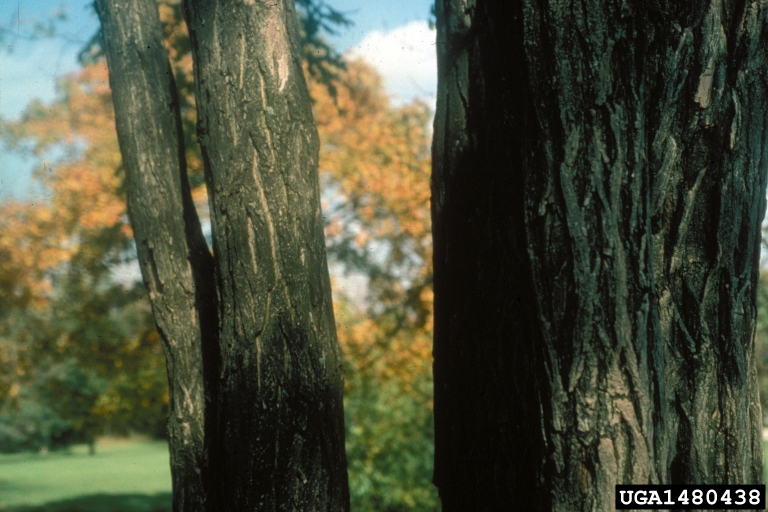
Black locust
Credit: Richard Webb, Bugwood.org
I recently received an email from a private landowner:
I had a question for you about Black Locust and the Indiana’s Most Unwanted website. I saw Black Locust is listed on there even though another site says it’s native range includes Indiana. I see invasives.org mentions that it can become invasive in prairie and savanna areas. Can you shed a little light on this? I mean, I see it all over but not to the point of other invasives. Is it invasive in woodlands or just open areas? What is the deal?
Also on the Most Unwanted site, I see a lot of the plants say something like “Note – do not buy, sell or plant Asian bush honeysuckles,” but Black Locust does not. Any idea why? This site doesn’t really give a good feel for their classification as invasive, aggressive, noxious, etc. I didn’t know if there was a better site that could give me an idea for that or not as well.
I guess mainly I’m confused since it’s a native, it wouldn’t seem to me that it should be an invasive.
Thank you for your assistance.
This landowner has some really good questions regarding a tree species that is found across the state of Indiana. Now I have been talking on and off with this landowner about various species over the past year or so as he is fighting the good fight and trying to eliminate invasive and non-native species from his property but is also attempting to re-vegetate with native species. This is not the first time that I have had this discussion, so I thought why not answer his question so that others could also get to the information?
The websites this landowner provided are all great sites with tons of information for a bunch of different species. So inevitably when you get lots of great information about one species, it is easy to skip or unintentionally omit some details for other species. I hope the folks behind sites like these continue to build these great sources of information, update them with current best management practices and add new species as they become problematic.
Now, onto the questions.
Black locust, Robinia pseudoacacia, is native to the state of Indiana (Deam 1940, Flora of Indiana). However, when we talk about species that are native to the state, they may not be native to the whole state. With the settlement of the Midwest, it is thought that European settlers brought black locust with them as they traveled due to its fast growth, wood quality and even perhaps for its nitrogen-fixing capabilities. There are numerous species which may be native to one part of the state but not others. One example of this, bald cypress, Taxodium distichum, is native to southwestern portions of the state where bald cypress swamps can be found, but it wasn’t historically found in the dunes of northwestern Indiana. A map of its native range can be found here.
I commonly have the discussion of the “official definitions” of invasive, non-native, exotic, aggressive, noxious, weed, etc., with folks. These definitions are an area of much debate in scientific literature and among professionals that regularly work to manage these species. It is my belief that “invasive” species can be both exotic (not from the geographical region in question) and native (belonging to the geographical region in question), just like exotic species don’t have to be invasive (grow and spread aggressively). Noxious plants (“any plant, or plant product, that can directly or indirectly injure or cause damage to….”) can fit into each of those descriptions, and then of course, there is the definition of a weed…a plant that grows in an area that we don’t want it to. Everyone has their own opinion though, right?
There are many places to look up species-specific information on a state-to-state as well as a county-to-county level. For example, I like to use two websites: www.bonap.org and plants.usda.gov. Unfortunately, there are so many species and so many records that are needed to update these types of databases that they may not accurately represent what is truly out there. Plus there are the differences between historical records and current records which can bring about another debate.
So to wrap this thing up and provide short answers to Scott’s questions:
Q: Is black locust native to the state?
A: Yes.
Q: Can black locust be invasive in prairie and savanna habitats?
A: Absolutely! It spreads aggressively into these environments, especially in the absence of disturbance (another topic for another posting…).
Q: Is it invasive in woodlands or just open areas or what is the deal?
A: Mostly in open areas. It doesn’t tolerate high shade very well.
Q: Any idea why websites don’t suggest to “buy, sell or plant” even though they list it as an invasive (paraphrased)?
A: No, I don’t. That said, I am not familiar with where to buy seedlings, but then again, I don’t have an interest in planting them!
In closing, would I plant black locust? No, I wouldn’t unless I intended to use the trees as a crop. Black locust makes great firewood and great fence posts, and the flowers taste pretty good in the spring. However, they can grow and spread quite aggressively through root suckers as well as by seed. Commonly the little patch of a few trees turns into acres and acres!
Resources:
ID That Tree – Video Playlist, Purdue Extension – Forestry and Natural Resources (FNR) YouTube Channel
ID That Tree of Indiana: Black Locust, Purdue Extension – FNR blog post
Purdue Arboretum Explorer
Conservation Tree Planting: Steps to Success, Purdue Extension – FNR YouTube Channel
A Woodland Management Moment, Playlist, Purdue Extension – FNR YouTube Channel
Woodland Stewardship for Landowners, Playlist, Purdue Extension – FNR YouTube Channel
Indiana Department of Natural Resources: Invasive Species
Indiana Invasive Species Council
Cooperative Invasive Species Management Area (CISMA)
Report Invasive, Purdue Extension
101 Trees in Indiana, Amazon
Episode 11 – Exploring the challenges of Invasive Species, Habitat University-Natural Resource University
Shrubs and Woody Vines of Indiana and the Midwest, The Education Store
An Introduction to Trees of Indiana, The Education Store
Professional Forester, Indiana Forestry Woodland Owners Association
Forest Improvement Handbook, The Education Store
Find an Arborist, International Society of Arboriculture
Lenny Farlee, Extension Forester
Hardwood Tree Improvement and Regeneration Center
Purdue Department of Forestry & Natural Resources
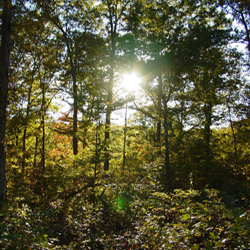 As this long, hot summer heads toward fall, trees will be doing their best to place some new offspring on the landscape. Some tree seed gets a lift on wind or water to new growing locations. Some seed will count on being eaten and then excreted by a bird. We are perhaps most familiar with the activities of squirrels in gathering and storing seed like acorns, hickories and walnuts. Foresters are rather fond of gray and fox squirrels – they collect seed and bury it in scattered locations around their home range for later excavation and use. What the forester likes is the squirrels don’t always re-find all the buried nuts, so a new tree may result. If you have an interest in growing trees or just want to get in touch with the world of squirrels, you could consider gathering and planting some tree seed.
Oaks, walnuts and hickories are a good starting point for using seed to grow new trees. Start scouting for seed on the trees in your neighborhood, local parks or even cemeteries. Be sure you have permission to pick up seed if it is private property. Some seed is already being eaten by squirrels or falling from trees, so now is a good time to start looking, although prime seed collection time is usually mid-September to October. Acorns, walnuts and hickory nuts will drop from the trees when ripe, so keep an eye on the ground. Before collecting a lot of seed, check the quality of the seed by cutting or cracking a few sample seed. You may need pruning shears, or in the case of walnuts and hickories, a hammer to open the seed. Viable seed should be firm and white or light tan inside with no signs of insect infestation. Weevil grubs are fairly common in oak seed, so discard seed that has obvious small holes from weevils or with the cap still attached (with the exception of bur oak which retains its caps).
Figure a percentage of good seed from your test lot to see how many total seed you need to collect to get the number of good seed you want. Keep your collected seed cool and moist until you plant it. Plant as soon after collection as possible. A good general guide for planting depth is one to two times the diameter of the seed, so a walnut would be planted one to two inches below ground surface. Squirrels can locate buried seed, so you may want to protect seed from squirrels by covering the planting spot with wire mesh sheets or cones anchored to the ground. Another easy protection method is a tin can with one end completely removed and an X cut in the middle of the other end with the corners pulled back to create a hole. Dig a hole approximately the size of the can. Place the seed and soil in the can and then push the open end of the can down until the cut end is flush with ground line. The seedling can then grow out through the hole in the cut end.
The screens and cans can be removed at the end of the first growing season once leaves have fallen, or if they are steel, simply left to rust away. Aluminum screen or cans will not rust away, so they must be removed. If you are willing to share with the squirrels, just plant a lot more seed. You can also start seed in containers. Half-gallon or gallon milk jugs with a drain hole cut in the bottom would work as would deep planters. Over winter, you should bury or heavily mulch the pots to insulate them from rapid temperature fluctuation.
Many other tree and shrub species may be grown from seed including persimmon, redbud, dogwoods, maples and tulip tree. The particular requirements for best germination and growth for tree seeds varies by species. A great reference for growing almost any native or common introduced tree species from seed is the Woody Plant Seed Manual produced by the U.S. Forest Service. An online version is available at http://www.nsl.fs.fed.us/nsl_wpsm.html.
Resources
Hardwood Seedling Production/Propagation (click Publications, then Research Publications), Hardwood Tree Improvement and Regeneration Center
Germination of Tree Seed, Iowa State University Extension and Outreach
Woody Plant Seed Manual (pdf), U.S. Forest Service
Planting Forest Trees and Shrubs in Indiana, The Education Store
Tree Seedling Nurseries, Indiana Department of Natural Resources
ID That Tree, Playlist, Purdue Extension – Forestry and Natural Resources (FNR) YouTube Channel
Report Invasive, Purdue Extension
Professional Forester, Indiana Forestry Woodland Owners Association
District Forester 10+acres of woodlands, Indiana Department of Natural Resources
Forest Improvement Handbook, The Education Store
Lenny Farlee, Extension Forester, Hardwood Tree Improvement and Regeneration Center
Forestry and Natural Resources, Purdue University
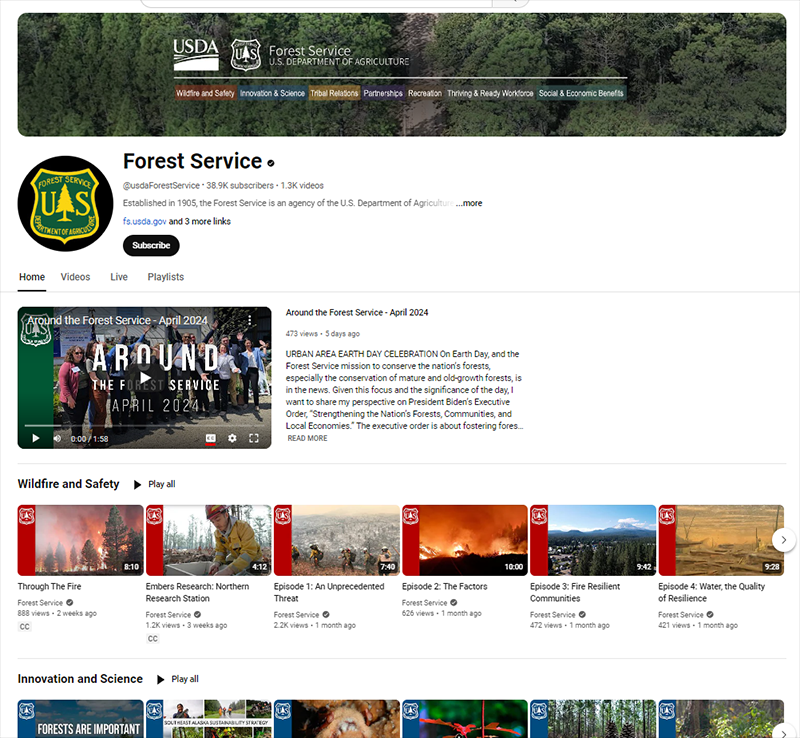 There are 210,076 video clips. Just subscribe to the U.S. Forest Service Channel, and you can search for the video that will share an exclusive insight of forestry that you have not seen before. You will find videos about forest firefighters, wildlife biologists, climate change, national forests, drought conditions, recreation benefits and teaching our youth about watershed.
Established in 1905, the Forest Service is an agency of the U.S. Department of Agriculture. The Forest Service manages public lands in national forests and grasslands. Gifford Pinchot, the first Chief of the Forest Service, summed up the mission of the Forest Service— “to provide the greatest amount of good for the greatest amount of people in the long run.” National forests and grasslands encompass 193 million acres of land, which is an area equivalent to the size of Texas.
USDA is an equal opportunity provider and employer.
Resources:
USDA Forest Service
U.S. Forest Service Facebook
USDA Forest Service X, @forestservice
U.S. Forest Service Instagram, @u.s.forestservice
Forestry Major, Purdue University – Forestry and Natural Resources
 After the winter, many people’s thoughts turn to getting outside and pursuing some of our favorite hobbies. For some, that includes getting their farm pond back in order for any number of recreational activities. Depending on what you need, there are valuable resources available on the Internet that can assist you in making good management decisions to utilize your pond for maximum enjoyment. Two of the best management resources available have to do with aquatic weed management and farm pond management for recreational fishing.
Aquatic weeds can deter any owner from enjoying the recreational benefits of owning a pond. Be it swimming, fishing or just aesthetics, a pond choked with weeds will benefit no one. A great resource to identify aquatic weeds and learn management techniques to control them is the Aquatic Plant Management brochure. Now is the time to use preventative measures to reduce or control aquatic weeds that can overrun your pond during the heat of the summer. There are mechanical, biological and chemical means of controlling weeds in your pond. If using aquatic herbicides, please read and follow the label direction, or if you are uncomfortable applying chemicals, there are several companies who can do the job for you. Please contact your local county extension office for contact information.
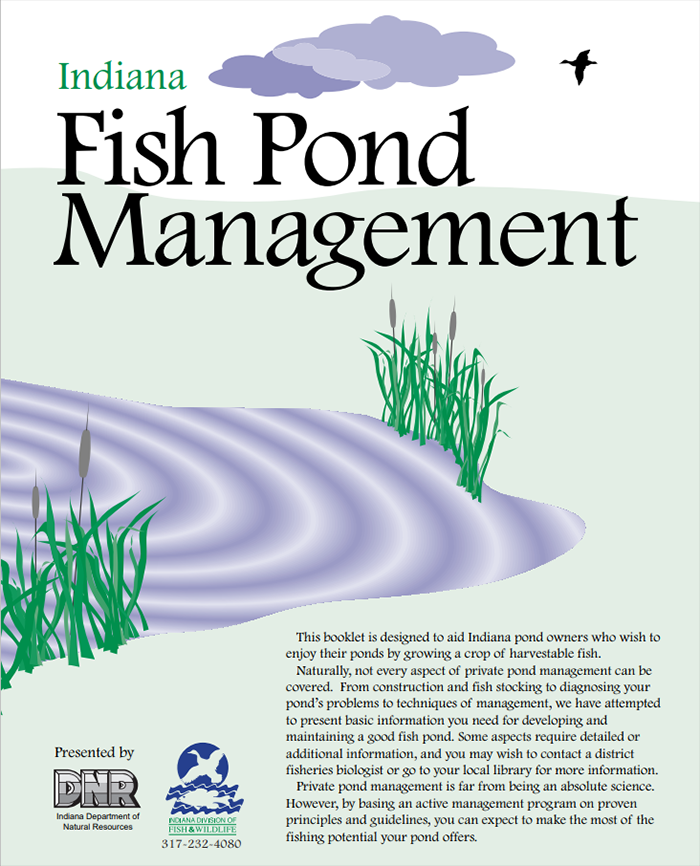
Likewise, if you have a pond that you want to manage for recreational fishing, there is a resource for you. The Indiana Department of Natural Resources has an online booklet, Indiana Fish Pond Management, for managing smaller recreational farm ponds with species and techniques applicable to Indiana. It is always best to start with a new or reclaimed pond when stocking fish and developing a management plan. If you have an existing pond with fish, the information may help you change management or realize you need to start over.
Lastly, we always get a lot of calls in the spring asking where to purchase fish. The INDNR keeps an up-to-date listing of commercial fish suppliers. This is not only for those seeking fish for recreational purposes but also for grass carp that are used for aquatic weed control. These fish need to be triploid, and only licensed suppliers are allowed to handle them in the state.
Resources:
Ask an Expert: Managing Your Property for Fish & Wildlife, Purdue Extension – Forestry and Natural Resources (FNR) YouTube Channel
Pond and Wildlife Management, Purdue Extension website
Pond Management: Stocking Fish in Indiana Ponds, Purdue Extension – FNR
A Pond Management Plan Template, The Education Store
The Nature of Teaching: Adaptations for Aquatic Amphibians, The Education Store
Illinois & Indiana Sea Grant, using research, outreach, and education to bring the latest science to communities and their residents.
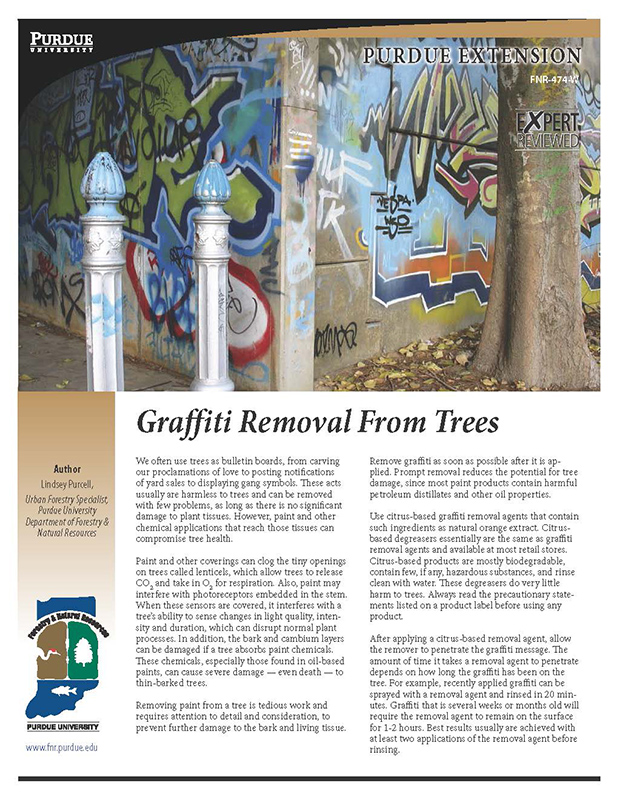 Trees are often the unwilling recipients of proclamations of love, notifications, for sale advertisements and tagging. Most of these activities are relatively harmless to tree health unless there is a significant amount of physical damage to sensitive plant tissue. Fortunately, most of these items can be removed without much problem.
However, paint and other chemical applications can cause additional damage. Paint may clog the tiny openings on trees called lenticels, preventing gas exchange such as CO2 produced by respiration getting out and O2 needed for respiration getting into the tree. Also the paint may interfere with photoreceptors embedded in the stem. When these sensors are covered, it interferes with the tree’s ability to sense changes in light quality, intensity and duration which can disrupt normal plant processes. In addition, the bark and cambium layer can be damaged by absorption of the chemical properties in paints. These paint chemicals, especially those found in oil-based paints, can cause severe damage and even death on thin-barked trees.
The removal process of the paints on trees can create quite a headache in the corrective actions. However, it can be successful with careful work and consideration for the absorptive properties of the tree.
Try to remove graffiti as soon as possible after it is applied. Prompt removal reduces the damage to the tree as most paint products have harmful petroleum distillates and other oil properties in them. Use citrus-based graffiti removal agents that contain ingredients such as “natural orange extract.” Citrus-based degreasers are essentially the same as graffiti removal agents and are more readily available at local retailers. Citrus-based products are mostly biodegradable; they contain very few, if any, hazardous substances, and they rinse clean with water. These degreasers do very little harm to trees. Always read the precautionary statements listed on a product label before using any product.
After applying a citrus-based removal agent, it is usually best to allow the remover to penetrate the graffiti message for a variable amount of time, depending mostly on the length of time the graffiti has remained on the surface. For example, newly applied graffiti can be sprayed with a removal agent and rinsed with satisfactory results in 20 minutes. Graffiti that has been applied for several weeks or months will require the removal agent to sit on the surface for 1-2 hours. Best results are usually achieved by at least two applications of the removal agent before rinsing.
Use a hose with a high-pressure nozzle or better; use a pressure washer to rinse and remove graffiti that has been treated with a removal agent. Be sure to use the pressure washer carefully on tree trunks, especially thin, smooth barked trees to avoid any damage to the tree. High pressure spray can damage the bark and vital tree components if applied intensely in one area. When using a high pressure hose nozzle instead of a pressure washer, it may be helpful to agitate the treated graffiti with a stiff nylon or plastic brush to improve removal efforts. Wire brushes can be damaging to the tree without careful use.
Remember to be gentle and reduce damage to the tree trunk. If the removal process is unsuccessful at first, multiple applications over time may be required. Sometimes a simple, creative aerosol paint combination can be used to cover or disguise the tagging efforts if on a small scale. Be natural and use long, vertical spray strokes to match the tree color as best as possible. Water-based paints are not as harmful as oil-based covers. This is always the last course of action.
Good luck and hopefully the tree can be restored to its natural appearance.
Resources:
Graffiti Removal From Trees, The Education Store, Purdue Extension’s resource center
Find an Arborist website, Trees are Good, International Society of Arboriculture (ISA)
Caring for storm-damaged trees/How to Acidify Soil in the Yard, In the Grow, Purdue Extension
Moist soil and rotten roots makes it easy for trees to come crashing down, Fox 59 News
Why Is My Tree Dying?, The Education Store
Tree Risk Management, The Education Store
Mechanical Damage to Trees: Mowing and Maintenance Equipment, The Education Store
Construction and Trees: Guidelines for Protection, The Education Store
Trees and Electric Lines, The Education Store

Recent Posts
- 2026 Winter Bat Survey In Progress, MyDNR
Posted: March 27, 2026 in Wildlife - Fast-Growing Trees for the Landscape, Purdue Landscape Report
Posted: March 26, 2026 in Forestry, Urban Forestry, Woodlands - Urban Tree Spotlight: Planting Deciduous Shade Trees, Purdue Landscape Report
Posted: March 25, 2026 in Forests and Street Trees, Urban Forestry, Woodlands - Beetle that attacks Tree-of-Heaven found in Indiana, Purdue Landscape Report
Posted: March 20, 2026 in Invasive Insects, Wildlife, Woodlands - ID That Tree: Dwarf Chinkapin Oak
Posted: in Forestry, Urban Forestry, Wildlife, Woodlands - IN-PREPared: Essential Resources for Indiana’s Severe Weather Season
Posted: March 11, 2026 in How To, Safety - DNR Hiring for Indiana Conservation Officer Positions, MyDNR
Posted: March 9, 2026 in Urban Forestry, Wildlife, Woodlands - ID That Tree: Shumard Oak
Posted: in Plants, Urban Forestry, Wildlife, Woodlands - A Woodland Management Moment: Windbreak Around Walnut Plantings
Posted: March 3, 2026 in Forestry, Urban Forestry, Woodland Management Moment - Getting Certified as an Indiana Certified Prescribed Burn Manager
Posted: March 2, 2026 in How To, Urban Forestry, Woodlands
Archives
Categories
- Alert
- Aquaculture/Fish
- Aquatic/Aquaculture Resources
- Ask the Expert
- Christmas Trees
- Community Development
- Disease
- Drought
- Forestry
- Forests and Street Trees
- Gardening
- Got Nature for Kids
- Great Lakes
- How To
- Invasive Animal Species
- Invasive Insects
- Invasive Plant Species
- Land Use
- Natural Resource Planning
- Nature of Teaching
- Plants
- Podcasts
- Ponds
- Publication
- Safety
- Spiders
- Timber Marketing
- Uncategorized
- Urban Forestry
- Webinar
- Wildlife
- Wood Products/Manufacturing
- Woodland Management Moment
- Woodlands