 Purdue University - Extension - Forestry and Natural Resources
Got Nature? Blog
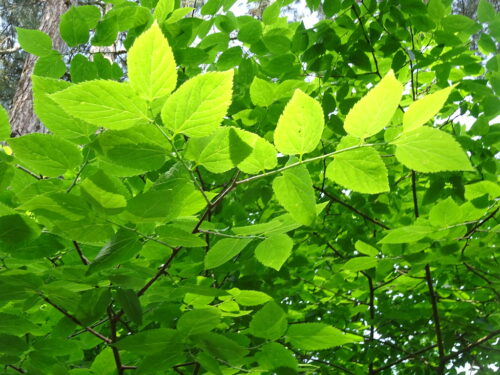 Question: My hackberry trees are dropping leaves for no apparent reason. The leaves look fine, no bugs or mold spots or discoloration of any kind. Do you have any idea what might be causing the leaf drop?
Answer: The loss of leaves on hackberries in spring is an occasional phenomenon in the Midwest. The exact cause has never been determined. In past years, no association was found between the leaf drop and insects or diseases. The most popular theory is that cold spring temperatures may have damaged the leaf buds or newly developing leaves, causing the leaf drop. Remember that blast of winter in April!? It’s likely the loss of leaves in spring is temporary. In past years, affected hackberries quickly developed new leaves and recovered completely. Just be patient and wait for the reflush of growth.
Leaves may be falling from your maple trees right now. This is a common spring issue caused by the maple petiole borer. Look closely at the fallen leaves for abnormally short petioles and examine the tree canopy for broken petioles that have remained attached. Although sugar maples are generally preferred, other maples may occasionally be infested. Fortunately, while the leaf drop may appear dramatic, the actual impact on the overall health of affected trees is minimal, so controls are not necessary. Also, a re-flush of leaves may be expected.
Resources:
Will My Tree Recover After Losing Their Leaves, Purdue Landscape Report
Planting Your Tree Part 1: Choosing Your Tree, Purdue Extension YouTube Channel
Planting Your Tree Part 2: Planting A Tree, Purdue Extension YouTube Channel
Tree Installation: Process and Practices, The Extension Store, Purdue Extension resource center
Ask an Expert: Tree Selection and Planting, Purdue FNR Extension YouTube Channel
Find a Certified Arborist, International Society of Arboriculture (ISA)-Trees Are Good
Lindsey Purcell, Urban Forestry Specialist
Purdue Department of Forestry and Natural Resources
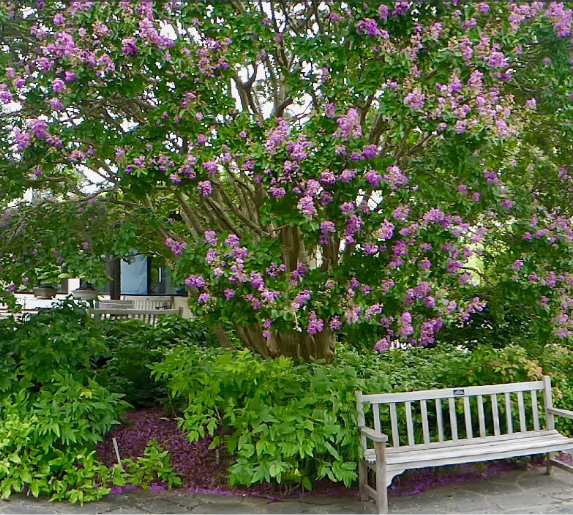 Question: We live near the Amazon Fulfillment Center in the Jeffersonville/Charlestown area. We have significant wind most days. We planted a dogwood tree in our front yard 2 years ago. It struggled through last spring and this year half is not going to make it. Is there a better, preferred tree for this area that we might choose to replace it? We prefer a short stature tree vs one that may reach 20 to 30 feet.
Answer: Dogwood trees can be a challenge to sustain in the landscape due to its environmental requirements. Cornus florida is a “woods edge” tree that like moist, well-drained soil. Most importantly, these trees require protection and at least partial shade to guard against the wind and sun. Recommended publication: Tree Selection, Tree Installation.
Resources
Tree Selection, The Education Store, Purdue Extension resource center
Ask an Expert: Tree Selection and Planting, Purdue Extension – FNR YouTube Channel
Tree Installation, The Education Store
Tree Pruning Essentials, Publication & Video The Education Store
Tree Selection, Tree Installation & Tree Pruning for Landscape, Webinars, Purdue Extension – Forestry and Natural Resources YouTube channel
Planting Problems: Trees Planted Too Deep, Purdue Extension – FNR YouTube Channel
ID That Tree, Purdue Extension – FNR Playlist
Lindsey Purcell, Urban Forestry Specialist
Purdue University, Department of Forestry and Natural Resources
Spring is here! It is the time of year for some of us to be planting new trees. In this Ask an Expert session, we welcome Lindsey Purcell, urban forestry specialist, as he teaches us how to plant and properly care for our trees. He goes over the tree selection process, including which invasive species trees we should avoid, and how to continue to take care of our trees once planted.
If you have any questions regarding wildlife, trees, forest management, wood products, natural resource planning, or other natural resource topics, feel free to contact us by using our Ask an Expert web page.
Resources:
Planting Your Tree Part 1: Choosing Your Tree, Purdue Extension YouTube Channel
Tree Planting Part 2: Planting a Tree, Purdue Extension – Forestry and Natural Resources YouTube Channel
Indiana Invasive Plant List, Indiana Invasive Species Council, Purdue Entomology
Alternatives to Burning Bush for Fall Color, Purdue Landscape Report
Invasive Plant Species: Callery Pear, Youtube, Purdue Extension
Equipment Damage to Trees, Purdue FNR Extension
Landscape Report Shares Importance of Soil Testing, Purdue FNR Extension
Lindsey Purcell, Urban Forestry Specialist
Purdue Department of Forestry and Natural Resources
Join Lenny Farlee, Purdue FNR Extension Forester, as he explains why the typical thinking of what is a tree and what is a shrub isn’t always simple as far as looking for the “single” trunk to call it a tree. There is some crossover. Lenny shares the different ways to identify if it is a shrub and then the various species in Indiana.
If you have any questions regarding wildlife, trees, forest management, wood products, natural resource planning, or other natural resource topics, feel free to contact us by using our Ask an Expert web page.
Resources:
Shrubs and Woody Vines of Indiana and the Midwest, Purdue University Press
Native Trees of the Midwest, Purdue University Press
101 Trees in Indiana, Amazon
ID That Tree, Purdue Extension – Forestry and Natural Resources YouTube Playlist
Lenny Farlee, Sustaining Hardwood Extension Specialist
Purdue Department of Forest and Natural Resources
Join Lenny Farlee, Purdue FNR Extension Forester, as he goes over the different principles used to identify various trees in Indiana. Lenny will provide examples of species to practice using those principles for identification.
If you have any questions regarding wildlife, trees, forest management, wood products, natural resource planning, or other natural resource topics, feel free to contact us by using our Ask an Expert web page.
Resources:
Shrubs and Woody Vines of Indiana and the Midwest, Purdue University Press
Native Trees of the Midwest, Purdue University Press
101 Trees in Indiana, Amazon
ID That Tree, Purdue Extension – Forestry and Natural Resources YouTube Playlist
Lenny Farlee, Sustaining Hardwood Extension Specialist
Purdue Department of Forest and Natural Resources
Curious about the upcoming cicada emergence? What is different about this species than the ones you see every summer? What effect can they have on wildlife or on your trees and shrubs? Find out from Purdue Extension wildlife specialist Jarred Brooke, forester Lenny Farlee and Purdue Entomology’s Elizabeth Barnes. Don’t miss the question and answer time with our experts discussing “all things cicadas”.
If you have any questions regarding wildlife, trees, forest management, wood products, natural resource planning or other natural resource topics, feel free to contact us by using our Ask an Expert web page.
Resources:
17-year Cicadas Are Coming: Are You Ready?, Purdue Landscape Report
17 Ways to Make the Most of the 17-year Cicada Emergence, Purdue College of Agriculture
Periodical Cicada in Indiana, The Education Store, Purdue Extension resource center
Cicada Killers, The Education Store
Purdue Cicada Tracker, Purdue Extension-Master Gardener Program
Dr. Elizabeth Barnes, Exotic Forest Pest Educator
Purdue Department of Entomology
Lenny Farlee, Sustaining Hardwood Extension Specialist
Purdue Forestry and Natural Resources
Jarred Brooke, Wildlife Extension Specialist
Purdue Forestry and Natural Resources
In this edition of ID That Tree, Purdue extension forester Lenny Farlee explains how to identify shellbark hickory without the help from its leaves. He also shares about how to distinguish this native Indiana species from its close cousin, the shagbark hickory.
If you have any questions regarding wildlife, trees, forest management, wood products, natural resource planning or other natural resource topics, feel free to contact us by using our Ask an Expert web page.
Resources
Hickory and Pecan Species, The Education Store, Purdue Extension resource center
Shellbark Hickory, Native Trees of Indiana River Walk, Purdue Fort Wayne
Shellbark Hickory, The Purdue Arboretum Explorer
ID That Tree Fall Color Edition: Shagbark Hickory, Video, Got Nature? Blog, Purdue Extension – Forestry and Natural Resources
ID That Tree, Playlist, Purdue Extension-FNR YouTube Channel
A Woodland Management Moment, Playlist, Purdue Extension-FNR YouTube Channel
Investing in Indiana Woodlands, The Education Store
Forest Improvement Handbook, The Education Store
Lenny Farlee, Sustaining Hardwood Extension Specialist
Purdue University Department of Forestry and Natural Resource
Purdue Landscape Report: J. Sterling Morton had a strong enthusiasm for trees and advocated intensely for individuals and civic groups to plant them. Once he became secretary of the Nebraska Territory, he further spread his message of the value of trees and Morton first proposed a tree planting holiday to be called “Arbor Day” at a meeting of the State Board of Agriculture.
The celebration date was set for April 10, 1872. Prizes were offered to counties and individuals for the largest number of properly planted trees on that day. It was estimated that more than 1 million trees were planted in Nebraska on the first Arbor Day.
Many other states also passed legislation to observe Arbor Day each year. By 1920, more than 45 states and territories were celebrating Arbor Day. The tree planting tradition became prominent in schools across the nation in 1882, with students were learning about the importance of trees as well as receiving a tree to plant in their own yard. They continue to do so today in many states.
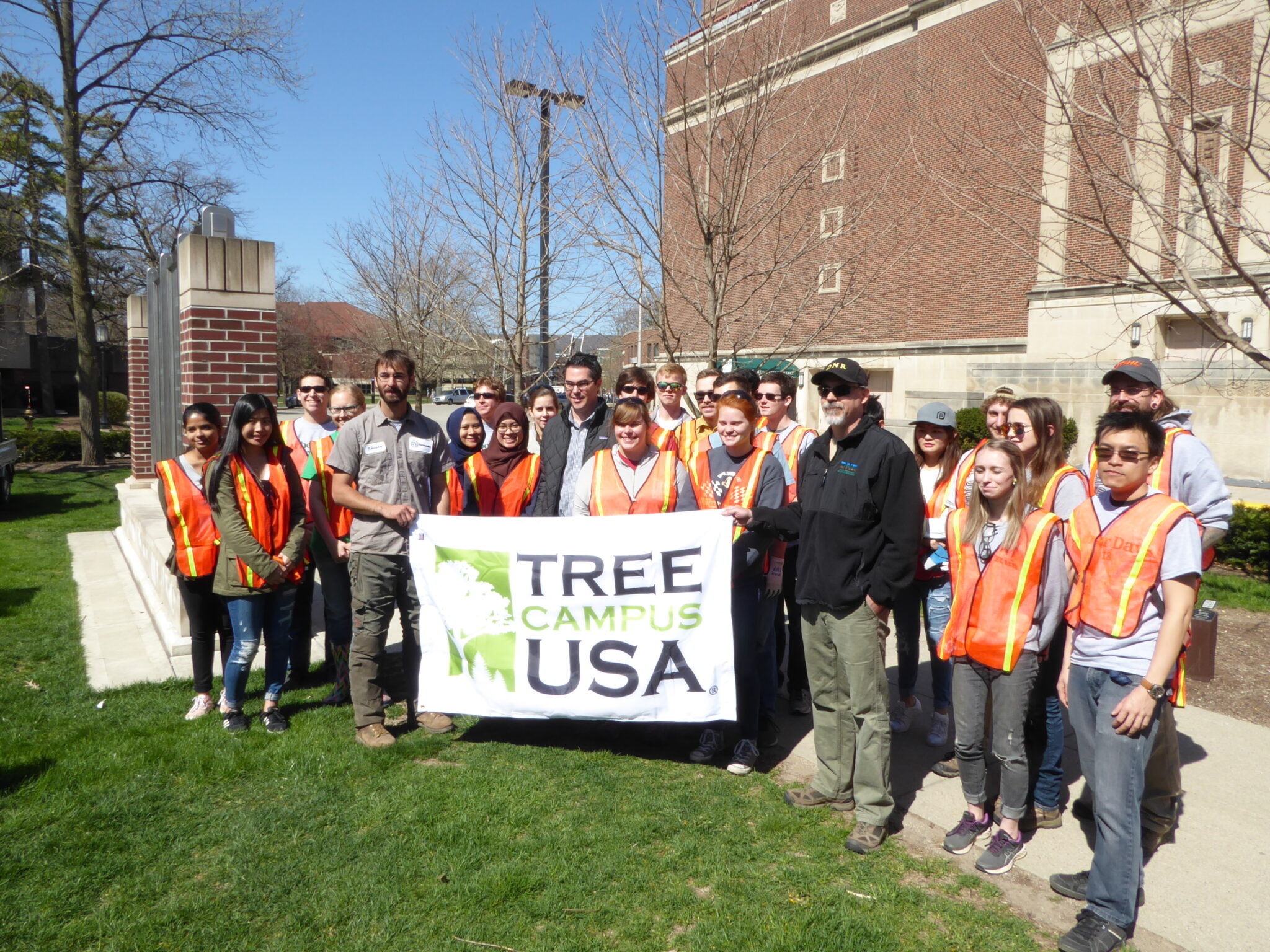
Celebrate arbor day by planting a tree!
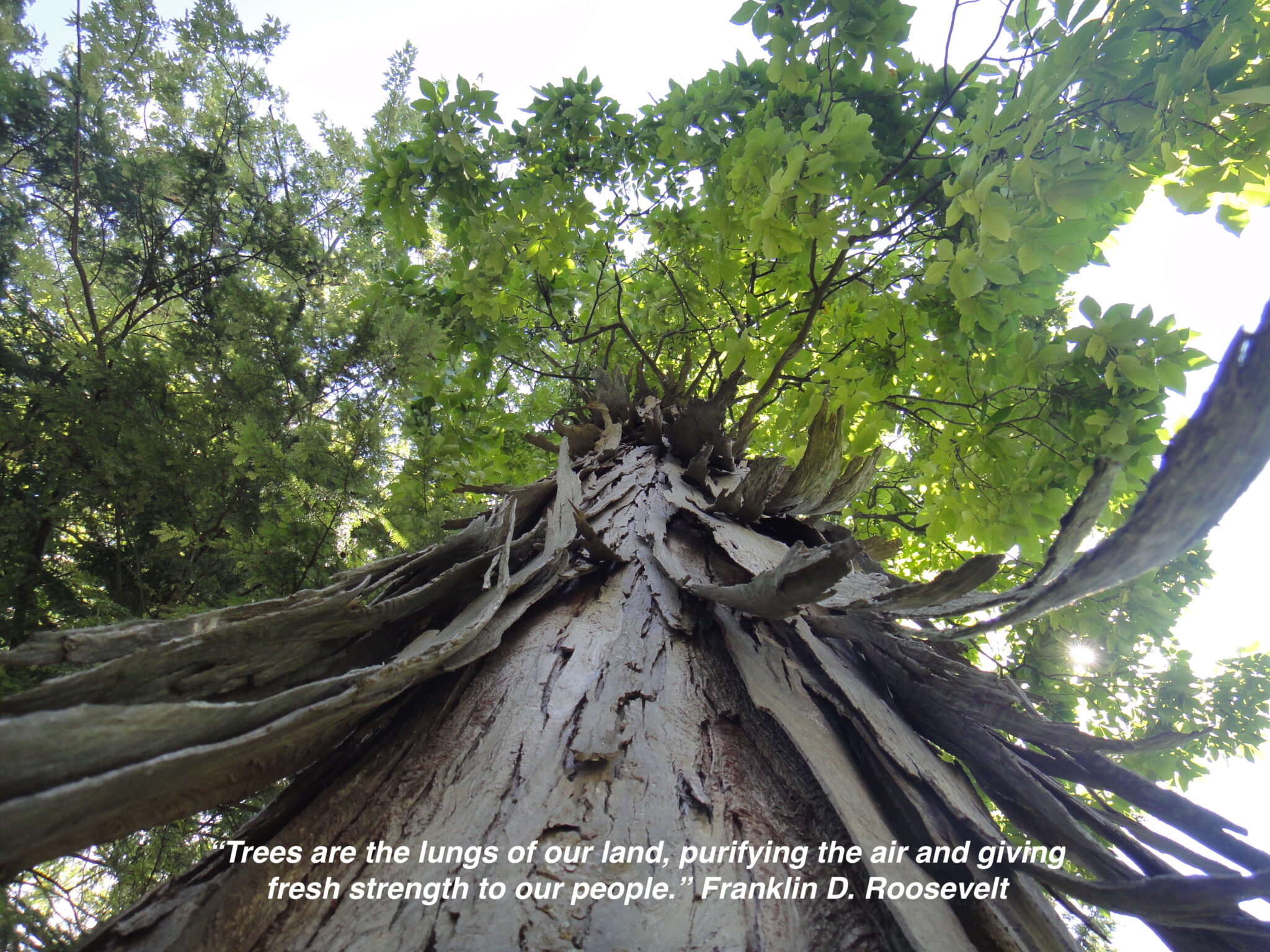
Trees make a difference in our lives, every day.
Currently, Arbor Day is celebrated in all 50 states. The most common date for the state observance is the last Friday in April — National Arbor Day — but a number of state Arbor Days are at other times to coincide with the best tree planting weather, from January and February in the south to May in the far north.
Find out when people in your state gather together to plant and celebrate trees.
So, just why do we celebrate trees? They are essential to our health and quality of life. Trees provide many benefits, called ecosystem services, that impact nearly every aspect of our daily life. Trees improve air and water quality, reduce heating and cooling costs, improve health outcomes, increase business, and so much more. Simply stated, we need trees.
How do we determine the value of those benefits trees provide where we live? Research and technology have made it much easier to quantify those ecosystem services. The value of your tree and the ecosystem services it provides can be found by visiting this web page. It’s fun and easy to find out just what your tree contributes to the urban forest.
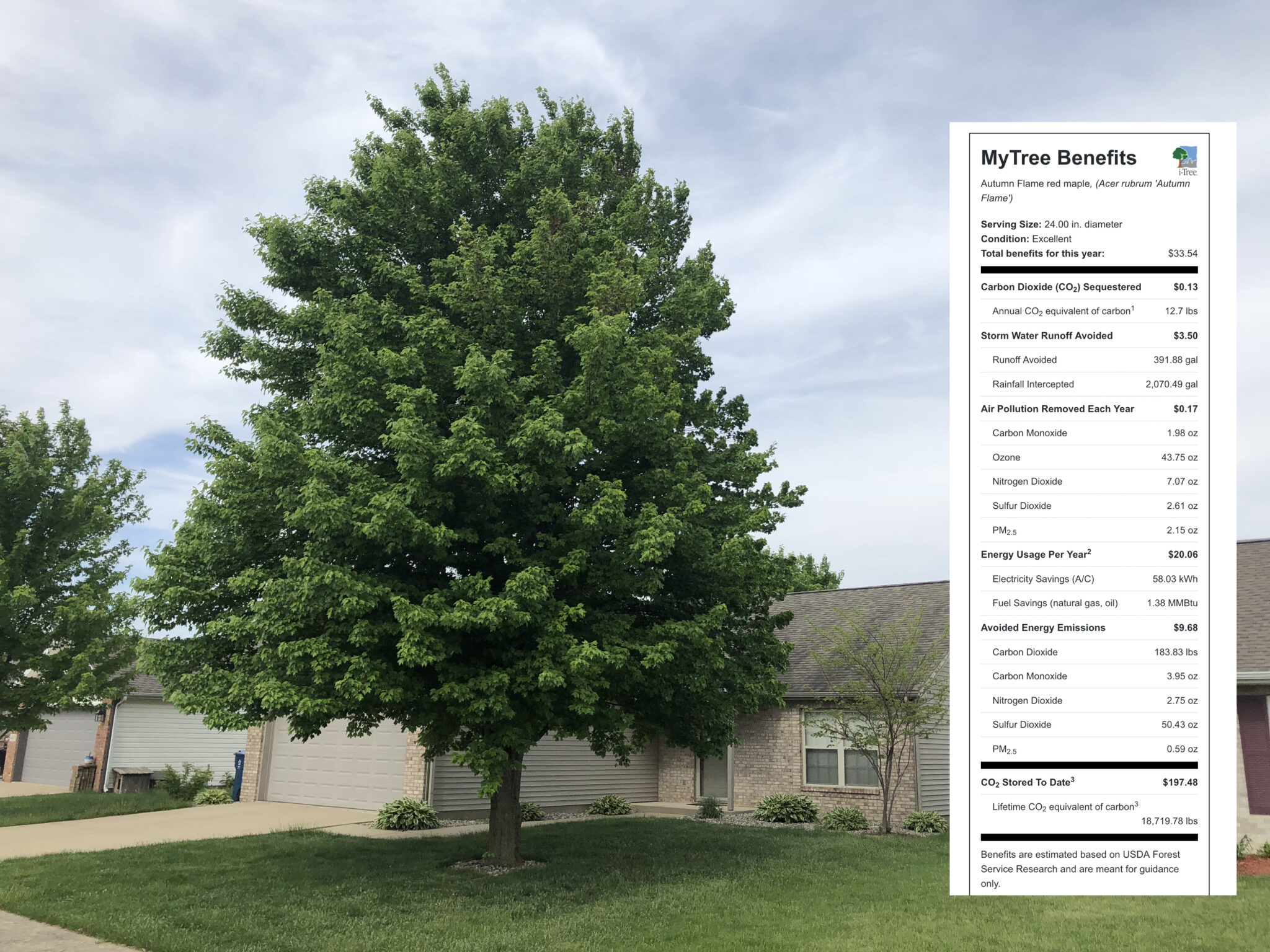
Find out what your tree is worth in benefits.

Trees provide ecosystem services including shade.
Join us in paying tribute to our trees which make up our urban forests by selecting and planting a tree where you live or taking part in a community tree planting. Learn how to choose and plant a tree properly to help improve the longevity and hopefully it will be providing those benefits in the future for your grandchildren and beyond. Trees can be a living legacy to great environmental stewardship. Plant trees not just for the future, but with a future. Some additional resources are available below:
For the best advice on tree planting and care, seek out a tree care professional with the experience and expertise to care for your trees. Search for a tree care provider in your area. Also, consider hiring an ISA Certified Arborist which can be found here.
Resources
Tree Appraisal and the Value of Trees, The Education Store, Purdue Extension resource center
Resources and Assistance Available for Planting Hardwood Seedlings, The Education Store
Tree Support Systems, The Education Store
Tree Planting Part 1: Choosing A Tree, Video, Purdue Extension YouTube channel
Tree Planting Part 2: Planting Your Tree, Purdue Extension Video
Planting Problems: Trees Planted Too Deep, Video, Purdue Extension – Forestry and Natural Resources
Tree Selection for Landscape, Purdue Extension – FNR Video
Tree Installation for the Landscape, Purdue Extension – FNR Video
Tree Pruning for the Landscape, Purdue Extension – FNR Video
Lindsey Purcell, Urban Forestry Specialist
Purdue University, Department of Forestry and Natural Resources
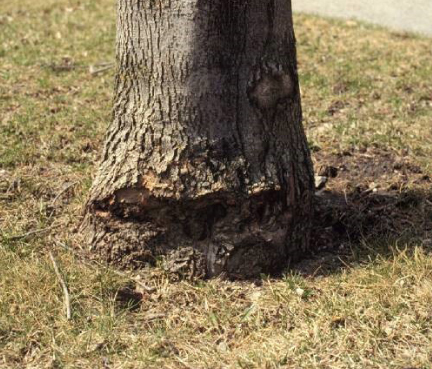
Photo from publication FNR-492-W
Question: I am actually a Master Gardner in Hamilton County and I need help with a tree bark damage question. We have a beautiful dogwood tree that is about 18’ tall and 6” in diameter. By accident my husband backed into the tree with his truck while unloading mulch – he did not see it! Now there is severe damage to the bark at the bumper height – about 3” wide and 14” long. All the way down the bark is gone.
What are the chances the tree will survive? What if anything should I do at this point?
My husband wanted to cover it with painter’s tape to protect it but I know that is not good for the tree. Please let me know your suggestions as I do hope to save the tree if possible.
Answer: Well, that is certainly an unfortunate accident for the tree! There may be a rescue treatment worth trying that research has shown promise in sealing the wound. The ability for the tree to seal and close off wounds is based on species, age and energy resources. Additionally, follow these instructions…
- Keep the tree healthy; mulch and supplemental watering during drought conditions.
- Trace the wound with a wood file and sharp knife, removing any loose bark to a clean wound.
- Take black plastic and attach it to the tree wound, just past the wound edge, using small, ¼” staples from a staple gun.
- Attach the plastic so that it forms a seal which will help to maintain a moist environment for parenchyma cells to do their work at compartmentalizing and creating wound wood on the perimeter of the damaged area.
- The plastic may need to be checked periodically to be sure it is attached well until removal.
- Leave the wound covered for about 12 months, then remove carefully.
This will not guarantee recovery, but research has indicated it does facilitate healing more quickly in many species. Continue to monitor for health and recovery.
Good luck!
Resources
Tree Wound and Healing, Got Nature? Blog, Purdue Extension – Forestry and Natural Resources
Equipment Damage to Trees, Got Nature? Blog
Tree Defect Identification, The Education Store, Purdue Extension resource center
Tree Pruning Essentials, Publication & Video, The Education Store
Tree Pruning: What Do Trees Think?, The Education Store
Mechanical Damage to Trees: Mowing and Maintenance Equipment, The Education Store
Tree Planting Part 1: Choosing a Tree, Video, Purdue Extension Channel
Tree Planting Part 2: Planting Your Tree, Purdue Extension Video
Lindsey Purcell, Chapter Executive Director
Indiana Arborist Association
It’s time to meet another native Indiana tree. This time Purdue Extension forester Lenny Farlee brings you the Umbrella Magnolia. This small tree is easily identified by the clusters of long simple leaves at the end of the twigs, which form an umbrella shape.
If you have any questions regarding wildlife, trees, forest management, wood products, natural resource planning or other natural resource topics, feel free to contact us by using our Ask an Expert web page.
Resources
Indiana’s Native Magnolias, The Education Store, Purdue Extension resource center
Umbrella Magnolia, Native Trees of Indiana River Walk, Purdue Fort Wayne
Umbrella Magnolia, Purdue Arboretum Explorer
ID That Tree, Playlist, Purdue Extension-FNR YouTube Channel
A Woodland Management Moment, Playlist, Purdue Extension-FNR YouTube Channel
Shrubs and Woody Vines of Indiana and the Midwest, Purdue University Press
Native Trees of the Midwest, Purdue University Press
Investing in Indiana Woodlands, The Education Store
Forest Improvement Handbook, The Education Store
Lenny Farlee, Sustaining Hardwood Extension Specialist
Purdue University Department of Forestry and Natural Resource

Recent Posts
- Purdue Extension’s Regional Teams Are Here: Connecting Communities with Expertise and Opportunity
Posted: October 14, 2026 in Community Development, Forestry, Forests and Street Trees, Gardening, How To, Timber Marketing, Urban Forestry, Wildlife, Woodlands - Why Do Our Trees Go From Green Leaves to Different Colors?
Posted: in Forestry, Forests and Street Trees, Urban Forestry, Woodlands - October Is Firewood Month: Protect Indiana’s Forests by Making Smart Choices
Posted: October 1, 2026 in Forestry, Forests and Street Trees, How To, Invasive Insects, Urban Forestry - Question: Why Did the Shagbark Hickories Survive the Tornado?
Posted: August 27, 2026 in Forests and Street Trees, How To, Urban Forestry - Jarred Brooke Receives Early Career Award for Prescribed Fire Work
Posted: July 20, 2026 in Forestry, Forests and Street Trees, Natural Resource Planning, Safety - Pruning Highlight; Espalier Pruning: Training Trees into Living Patterns
Posted: July 8, 2026 in Forestry, Forests and Street Trees, Gardening - Pruning Highlight-Pollarding Trees: A Traditional Pruning Practice with Modern Uses
Posted: June 11, 2026 in Forestry, Forests and Street Trees, Urban Forestry, Wildlife, Woodlands - Flat-Faced Longhorn Beetle Found in Hardwood Logs – IDNR Division of Entomology
Posted: June 8, 2026 in Alert, Forestry, Forests and Street Trees, Invasive Insects, Urban Forestry, Wildlife, Woodlands - Connecting Research to Practice: Natural Resources & Land Use Spring Training
Posted: June 5, 2026 in Forestry, Forests and Street Trees, How To, Invasive Animal Species, Invasive Plant Species, Land Use, Natural Resource Planning, Urban Forestry, Wildlife, Woodlands - Indiana Monarch and Pollinator Conservation
Posted: June 1, 2026 in Forestry, Forests and Street Trees, Gardening, How To, Natural Resource Planning, Plants, Urban Forestry, Wildlife
Archives
Categories
- Alert
- Aquaculture/Fish
- Aquatic/Aquaculture Resources
- Ask the Expert
- Christmas Trees
- Community Development
- Disease
- Drought
- Forestry
- Forests and Street Trees
- Gardening
- Got Nature for Kids
- Great Lakes
- How To
- Invasive Animal Species
- Invasive Insects
- Invasive Plant Species
- Land Use
- Natural Resource Planning
- Nature of Teaching
- Plants
- Podcasts
- Ponds
- Publication
- Safety
- Spiders
- Timber Marketing
- Urban Forestry
- Webinar
- Wildlife
- Wood Products/Manufacturing
- Woodland Management Moment
- Woodlands