 Purdue University - Extension - Forestry and Natural Resources
Got Nature? Blog
In this episode of ID That Tree, Purdue Extension forester Lenny Farlee introduces the White Spruce. This species is found in the North Woods of Northern Wisconsin and the Upper Peninsula of Michigan. This species has single needles attached to the twig that tend to be relatively angular and stout. The bark tends to be flaky and dark. The cones are two to three inches in length, have thin scales, and are cylindrical in shape.
If you have any questions regarding wildlife, trees, forest management, wood products, natural resource planning or other natural resource topics, feel free to contact us by using our Ask an Expert web page.
Resources:
ID That Tree, Playlist, Purdue Extension – Forestry and Natural Resources YouTube Channel (Invasive White Mulberry, Siberian Elm, Tree of Heaven)
Invasive Species Playlist, Playlist, Purdue Extension – FNR YouTube Channel (Asian Bush Honeysuckle, Burning Bush, Callery Pear, Multiflora rose)
A Woodland Management Moment, Playlist, Purdue Extension – FNR YouTube Channel (Against Invasives, Garlic Mustard, Autumn Olive)
Woodland Stewardship for Landowners, Playlist, Purdue Extension – FNR YouTube Channel (Common Buckthorn, Japanese Barberry)
Report Invasive Species, Purdue Invasive Species
The GLEDN Phone App – Great Lakes Early Detection Network
EDDMaps – Early Detection and Distribution Mapping System
How long do seeds of the invasive tree, Ailanthus altissima remain viable? (Invasive Tree of Heaven), USDA Forest Service
Indiana Department of Natural Resources: Invasive Species
Indiana Invasive Species Council
Cooperative Invasive Species Management Area (CISMA)
Aquatic Invasive Species, Illinois-Indiana Sea Grant (IISG)
Episode 11 – Exploring the challenges of Invasive Species, Habitat University-Natural Resource University
What are invasive species and why should I care?, Got Nature? Blog, Purdue Extension – FNR
Shrubs and Woody Vines of Indiana and the Midwest, The Education Store, Purdue Extension Resource Center
Native Trees of the Midwest, The Education Store
Investing in Indiana Woodlands, The Education Store
Forest Improvement Handbook, The Education Store
Lenny Farlee, Extension Forester
Hardwood Tree Improvement and Regeneration Center
Purdue Department of Forestry & Natural Resources
Purdue Landscape Report: Poison hemlock was introduced to North America as a garden/ornamental plant. It is a native of Europe, and it is a member of the Apiaceae (parsley) family.
Purdue experts Bill Johnson and Marcelo Zimmer wrote about poison hemlock in a Purdue Pest & Crop newsletter.
They wrote that poison hemlock can be noticed very early in the spring every year, as it is typically one of the first weeds to green up, usually in late February to early March if temperatures are favorable. They said the largest threat of this weed is the toxicity of its alkaloids if ingested by livestock or humans, but it can also reduce the aesthetic value of landscapes and has been reported to creep into no-till corn and soybean fields as well.
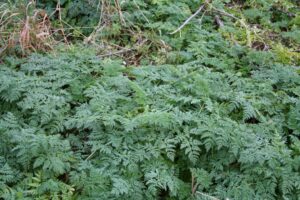
Poison Hemlock
Purdue Extension’s fact sheet on poison hemlock states that it can also be found along roads, streams, trails, ditches, forest edges, and waste areas.
The Purdue experts said that poison hemlock is a biennial weed that exists as a low-growing herb in the first year, and bolts to three to eight feet tall in the second year, when it produces flowers and seed. It is often not noticed until the bolting and reproductive stages of the second year. Poison hemlock is often confused with wild carrot, but can be distinguished by its lack of hairs and purple blotches that occur on the stems.
The experts pointed out that poison hemlock contains five alkaloids that are toxic to humans and livestock, and it can be lethal if ingested. They warn that the plant’s alkaloids may also be absorbed through the skin, so if you find yourself hand-pulling poison hemlock, it would be a good idea to wear gloves. All parts of the plants contain the toxic alkaloids with levels being variable throughout the year. Symptoms of toxicity include nervousness, trembling, and loss of coordination followed by depression, coma, and/or death. Initial symptoms will occur within a few hours of ingestion.
For history buffs, the Greek philosopher Socrates was sentenced to death by hemlock poisoning.
Cases of poisoning due to poison hemlock ingestion are rare as the plants emit a mousy odor that makes it undesirable and unpalatable to livestock and humans. Consumption and toxicity in animals usually occur in poorly managed or overgrazed pastures where animals are forced to graze poison hemlock because desirable forage is lacking.
To view this full article and other Purdue Landscape Report articles, please visit Purdue Landscape Report.
Subscribe and receive the newsletter: Purdue Landscape Report Newsletter.
Resources:
Recognizing and Managing Poison Hemlock, Purdue Landscape Report
Purdue Pest & Crop Newsletter
Invasive Plant Species Fact Sheets: Poison Hemlock, The Education Store, Purdue Extension Resource Center
Hemlock Woolly Adelgid: Distribution Update, Purdue Landscape Report
Be Careful Around Highly Toxic Poison Hemlock Plant This Summer, Purdue Extension – Forestry and Natural Resources (FNR)
Poison Hemlock (Conium maculatum), United States Department of Agriculture (USDA)
Invasive plants: impact on environment and people, The Education Store, Purdue Extension’s resource center
Woodland Management Moment: Invasive Species Control Process, Video, Purdue Extension – Forestry and Natural Resources (FNR) YouTube Channel
Invasive Species, Playlist, Purdue Extension – FNR YouTube Channel
What are invasive species and why should I care?, Got Nature? Blog, Purdue Extension – FNR
Report Invasive, Purdue College of Agriculture – Entomology
Purdue Pest and Plant Diagnostic Lab, send in photo or sample
John Woodmansee, Extension Educator, Whitely County
Purdue Extension
In this webinar hosted by Indiana Forestry & Woodland Owners Association, ecologist Michael Homoya discusses the many naturally occurring species of orchids in Indiana and their range, habitats and blooming seasons. This presentation will look at a selection of them and discuss their floral characteristics as well as range, habitat, and blooming seasons. Michael Homoya served as Botanist/Plant Ecologist for the Indiana Department of Natural Resources, Division of Nature Preserves for 37 years before retiring in 2019. He has written over 75 scientific papers, popular articles, and books about Indiana’s natural features, including Orchids of Indiana, Wildflowers and Ferns of Indiana Forests: A Field Guide, Wake Up, Woods, and Wildflowers of the Midwest.
Check out the Indiana Forestry & Woodland Association YouTube Channel for videos including: What is IFWOA?; A New Carbon Program for Hardwood Landowners Webinar, Indiana’s Native Orchids, Magnificent Trees of Indiana, Be Tick Aware and much more.
The Indiana Forestry & Woodland Owners Association (IFWOA) was founded in 1977 and is a non-profit organization dedicated to conservation and sustainable management of woodlands in Indiana. IFWOA advocates for scientific best practices for management to achieve objectives of clean water, wildlife habitat, soil protection, native species diversity, timber production, recreation, carbon sequestration and many others.
IFWOA is an affiliate of the National Woodland Owners Association. IFWOA is a partner, collaborator or is represented on leading National and State organizations. These memberships or collaborations are selected to advance Indiana Woodland owner’s interests. IFWOA monitors and influences legislation and economic trends impacting Indiana woodlands and landowners for our members. Membership in IFWOA provides a valuable network linkage to information and resources at the leading edge of science, industry and politics impacting Indiana woodlands.
Resources:
Orchids of Indiana, Google Books
Wildflowers and Ferns of Indiana Forests: A Field Guide, Google Books
Wildflowers of the Midwest, Google Books
Magnificent Trees of Indiana, Purdue University Press
Forest Improvement Handbook, The Education Store, Purdue Extension’s resource center
Planting Hardwood Seedlings – The Education Store
Ordering Seedlings from the State Forest Nursery System, Got Nature? – Purdue Extension-FNR
Importance of Hardwood Tree Planting – The Education Store, Purdue Extension Resource Center
Forest Improvement Handbook – The Education Store
Designing Hardwood Tree Plantings for Wildlife – The Education Store
ID That Tree – YouTube Playlist
Forest Management for Reptiles and Amphibians: A Technical Guide for the Midwest, The Education Store
Hardwood Ecosystem Experiment – Forest Birds , Purdue Extension – FNR YouTube Channel
Managing Woodlands for Birds , Purdue Extension – FNR YouTube Channel
Sustaining Our Oak-Hickory Forests , Purdue Extension – FNR YouTube Channel
Ask the Expert: Hardwood Ecosystem Experiment – Birds and Salamander Research, Purdue Extension – FNR
Subscribe to Purdue Extension-FNR YouTube Channel
Liz Jackson, Engagement Lead
Indiana Forestry & Woodland Association
In this episode of ID That Tree, Purdue Extension forester Lenny Farlee introduces the Balsam Poplar. This species is found in the North Woods of Northern Wisconsin and the Upper Peninsula of Michigan. This species can be quite tall and has gray bark with relatively prominent diamond shapes along it. These trees have a very vertical form and their leaves are elongated, sharply pointed, and have a shiny finish. Balsam Poplar also have very resinous sticky bud scales located below the leaves along the stem.
If you have any questions regarding wildlife, trees, forest management, wood products, natural resource planning or other natural resource topics, feel free to contact us by using our Ask an Expert web page.
Resources:
ID That Tree, Playlist, Purdue Extension – Forestry and Natural Resources YouTube Channel (Invasive White Mulberry, Siberian Elm, Tree of Heaven)
Invasive Species Playlist, Playlist, Purdue Extension – FNR YouTube Channel (Asian Bush Honeysuckle, Burning Bush, Callery Pear, Multiflora rose)
A Woodland Management Moment, Playlist, Purdue Extension – FNR YouTube Channel (Against Invasives, Garlic Mustard, Autumn Olive)
Woodland Stewardship for Landowners, Playlist, Purdue Extension – FNR YouTube Channel (Common Buckthorn, Japanese Barberry)
Report Invasive Species, Purdue Invasive Species
The GLEDN Phone App – Great Lakes Early Detection Network
EDDMaps – Early Detection and Distribution Mapping System
How long do seeds of the invasive tree, Ailanthus altissima remain viable? (Invasive Tree of Heaven), USDA Forest Service
Indiana Department of Natural Resources: Invasive Species
Indiana Invasive Species Council
Cooperative Invasive Species Management Area (CISMA)
Aquatic Invasive Species, Illinois-Indiana Sea Grant (IISG)
Episode 11 – Exploring the challenges of Invasive Species, Habitat University-Natural Resource University
What are invasive species and why should I care?, Got Nature? Blog, Purdue Extension – FNR
Shrubs and Woody Vines of Indiana and the Midwest, The Education Store, Purdue Extension Resource Center
Native Trees of the Midwest, The Education Store
Investing in Indiana Woodlands, The Education Store
Forest Improvement Handbook, The Education Store
Lenny Farlee, Extension Forester
Hardwood Tree Improvement and Regeneration Center
Purdue Department of Forestry & Natural Resources
In this episode of ID That Tree, Purdue Extension forester Lenny Farlee introduces the Pin or Fire Cherry. This species is found in the North Woods of Northern Wisconsin and the Upper Peninsula of Michigan, and highly associated with disturbances such as fire. This species has a smooth bark with a reddish bronze color. It also has a very shiny surface with horizontal lenticels. The leaves are alternately arranged and are elongated. There are also clusters of white flowers that grow from one point on the stem.
If you have any questions regarding wildlife, trees, forest management, wood products, natural resource planning or other natural resource topics, feel free to contact us by using our Ask an Expert web page.
Resources:
ID That Tree, Playlist, Purdue Extension – Forestry and Natural Resources YouTube Channel (Invasive White Mulberry, Siberian Elm, Tree of Heaven)
Invasive Species Playlist, Playlist, Purdue Extension – FNR YouTube Channel (Asian Bush Honeysuckle, Burning Bush, Callery Pear, Multiflora rose)
A Woodland Management Moment, Playlist, Purdue Extension – FNR YouTube Channel (Against Invasives, Garlic Mustard, Autumn Olive)
Woodland Stewardship for Landowners, Playlist, Purdue Extension – FNR YouTube Channel (Common Buckthorn, Japanese Barberry)
Report Invasive Species, Purdue Invasive Species
The GLEDN Phone App – Great Lakes Early Detection Network
EDDMaps – Early Detection and Distribution Mapping System
How long do seeds of the invasive tree, Ailanthus altissima remain viable? (Invasive Tree of Heaven), USDA Forest Service
Indiana Department of Natural Resources: Invasive Species
Indiana Invasive Species Council
Cooperative Invasive Species Management Area (CISMA)
Aquatic Invasive Species, Illinois-Indiana Sea Grant (IISG)
Episode 11 – Exploring the challenges of Invasive Species, Habitat University-Natural Resource University
What are invasive species and why should I care?, Got Nature? Blog, Purdue Extension – FNR
Shrubs and Woody Vines of Indiana and the Midwest, The Education Store, Purdue Extension Resource Center
Native Trees of the Midwest, The Education Store
Investing in Indiana Woodlands, The Education Store
Forest Improvement Handbook, The Education Store
Lenny Farlee, Extension Forester
Hardwood Tree Improvement and Regeneration Center
Purdue Department of Forestry & Natural Resources
In this episode of ID That Tree, Purdue Extension forester Lenny Farlee introduces the Paper Birch. This species is found in the North Woods of Northern Wisconsin and the Upper Peninsula of Michigan. This species has white chalky bark that peels and flakes off the sides of the tree. Under the bark, the tree tends to be a light tan to bronze color. They have alternate leaf arrangement, are catkins as part of their flowering structure, and have simple leaves.
If you have any questions regarding wildlife, trees, forest management, wood products, natural resource planning or other natural resource topics, feel free to contact us by using our Ask an Expert web page.
Resources:
ID That Tree, Playlist, Purdue Extension – Forestry and Natural Resources YouTube Channel (Invasive White Mulberry, Siberian Elm, Tree of Heaven)
Invasive Species Playlist, Playlist, Purdue Extension – FNR YouTube Channel (Asian Bush Honeysuckle, Burning Bush, Callery Pear, Multiflora rose)
A Woodland Management Moment, Playlist, Purdue Extension – FNR YouTube Channel (Against Invasives, Garlic Mustard, Autumn Olive)
Woodland Stewardship for Landowners, Playlist, Purdue Extension – FNR YouTube Channel (Common Buckthorn, Japanese Barberry)
Report Invasive Species, Purdue Invasive Species
The GLEDN Phone App – Great Lakes Early Detection Network
EDDMaps – Early Detection and Distribution Mapping System
How long do seeds of the invasive tree, Ailanthus altissima remain viable? (Invasive Tree of Heaven), USDA Forest Service
Indiana Department of Natural Resources: Invasive Species
Indiana Invasive Species Council
Cooperative Invasive Species Management Area (CISMA)
Aquatic Invasive Species, Illinois-Indiana Sea Grant (IISG)
Episode 11 – Exploring the challenges of Invasive Species, Habitat University-Natural Resource University
What are invasive species and why should I care?, Got Nature? Blog, Purdue Extension – FNR
Shrubs and Woody Vines of Indiana and the Midwest, The Education Store, Purdue Extension Resource Center
Native Trees of the Midwest, The Education Store
Investing in Indiana Woodlands, The Education Store
Forest Improvement Handbook, The Education Store
Lenny Farlee, Extension Forester
Hardwood Tree Improvement and Regeneration Center
Purdue Department of Forestry & Natural Resources
Join alumna Megan Benage, a regional ecologist for the Minnesota Department of Natural Resources, and Bee Redfield, a postgraduate research assistant, as they explore the world of pollinators. They cover the who’s, the what’s and how’s of pollination as well as how you can help bring pollinators to your yard and help the pollinator population in general. They also share about ongoing research and cool projects related to pollinators.
If you have any questions regarding wildlife, trees, forest management, wood products, natural resource planning or other natural resource topics, feel free to contact us by using our Ask an Expert web page.
Resources
Protecting Pollinators: Biology and Control of Varroa Mites in Bee Hives, The Education Store, Purdue Extension resource center
The Complex Life of the Honey Bee: Environmental, Biological, and Chemical Challenges to Colony Health, The Education Store
Pollinator Protection, Website, Purdue Extension
Gardening for Pollinators, Purdue Graden Articles
Megan Benage, Regional Ecologist
Minnesota Department of Natural Resources
Bee Redfield, Postgraduate Research Assistant
Purdue Forestry and Natural Resources
In this episode of ID That Tree, Purdue Extension forester Lenny Farlee introduces the Black Ash. This species is typically found in wetland environments within Indiana and the North Woods of Northern Wisconsin. This species has light gray flaky bark, opposite leaf arrangement, and compound leaves. These trees separate very easily along their growth rings and thus have a long tradition of native peoples creating baskets with them. This species is under is a major threat by the emerald ash borer.
If you have any questions regarding wildlife, trees, forest management, wood products, natural resource planning or other natural resource topics, feel free to contact us by using our Ask an Expert web page.
Resources:
ID That Tree, Playlist, Purdue Extension – Forestry and Natural Resources YouTube Channel (Invasive White Mulberry, Siberian Elm, Tree of Heaven)
Black Ash, Native Trees of Indiana River Walk, Fort Wayne-Purdue
Invasive Species Playlist, Playlist, Purdue Extension – FNR YouTube Channel (Asian Bush Honeysuckle, Burning Bush, Callery Pear, Multiflora rose)
A Woodland Management Moment, Playlist, Purdue Extension – FNR YouTube Channel (Against Invasives, Garlic Mustard, Autumn Olive)
Woodland Stewardship for Landowners, Playlist, Purdue Extension – FNR YouTube Channel (Common Buckthorn, Japanese Barberry)
Report Invasive Species, Purdue Invasive Species
The GLEDN Phone App – Great Lakes Early Detection Network
EDDMaps – Early Detection and Distribution Mapping System
How long do seeds of the invasive tree, Ailanthus altissima remain viable? (Invasive Tree of Heaven), USDA Forest Service
Indiana Department of Natural Resources: Invasive Species
Indiana Invasive Species Council
Cooperative Invasive Species Management Area (CISMA)
Aquatic Invasive Species, Illinois-Indiana Sea Grant (IISG)
Episode 11 – Exploring the challenges of Invasive Species, Habitat University-Natural Resource University
What are invasive species and why should I care?, Got Nature? Blog, Purdue Extension – FNR
Shrubs and Woody Vines of Indiana and the Midwest, The Education Store, Purdue Extension Resource Center
Native Trees of the Midwest, The Education Store
Investing in Indiana Woodlands, The Education Store
Forest Improvement Handbook, The Education Store
Lenny Farlee, Extension Forester
Hardwood Tree Improvement and Regeneration Center
Purdue Department of Forestry & Natural Resources
In this episode of ID That Tree, Purdue Extension forester Lenny Farlee introduces the Balsam Fir. This species is found in the North Woods of Northern Wisconsin and the Upper Peninsula of Michigan. It’s the primary fir found in the area and features soft and aromatic needles, which are flattened and have white stripes along the underside. Another notable characteristic is the three buds at the end of the twigs. This species can be easily identified from a distance due to its tight pointed spire like appearance.
If you have any questions regarding wildlife, trees, forest management, wood products, natural resource planning or other natural resource topics, feel free to contact us by using our Ask an Expert web page.
Resources:
ID That Tree, Playlist, Purdue Extension – Forestry and Natural Resources YouTube Channel (Invasive White Mulberry, Siberian Elm, Tree of Heaven)
Invasive Species Playlist, Playlist, Purdue Extension – FNR YouTube Channel (Asian Bush Honeysuckle, Burning Bush, Callery Pear, Multiflora rose)
A Woodland Management Moment, Playlist, Purdue Extension – FNR YouTube Channel (Against Invasives, Garlic Mustard, Autumn Olive)
Woodland Stewardship for Landowners, Playlist, Purdue Extension – FNR YouTube Channel (Common Buckthorn, Japanese Barberry)
Report Invasive Species, Purdue Invasive Species
The GLEDN Phone App – Great Lakes Early Detection Network
EDDMaps – Early Detection and Distribution Mapping System
How long do seeds of the invasive tree, Ailanthus altissima remain viable? (Invasive Tree of Heaven), USDA Forest Service
Indiana Department of Natural Resources: Invasive Species
Indiana Invasive Species Council
Cooperative Invasive Species Management Area (CISMA)
Aquatic Invasive Species, Illinois-Indiana Sea Grant (IISG)
Episode 11 – Exploring the challenges of Invasive Species, Habitat University-Natural Resource University
What are invasive species and why should I care?, Got Nature? Blog, Purdue Extension – FNR
Shrubs and Woody Vines of Indiana and the Midwest, The Education Store, Purdue Extension Resource Center
Native Trees of the Midwest, The Education Store
Investing in Indiana Woodlands, The Education Store
Forest Improvement Handbook, The Education Store
Lenny Farlee, Extension Forester
Hardwood Tree Improvement and Regeneration Center
Purdue Department of Forestry & Natural Resources
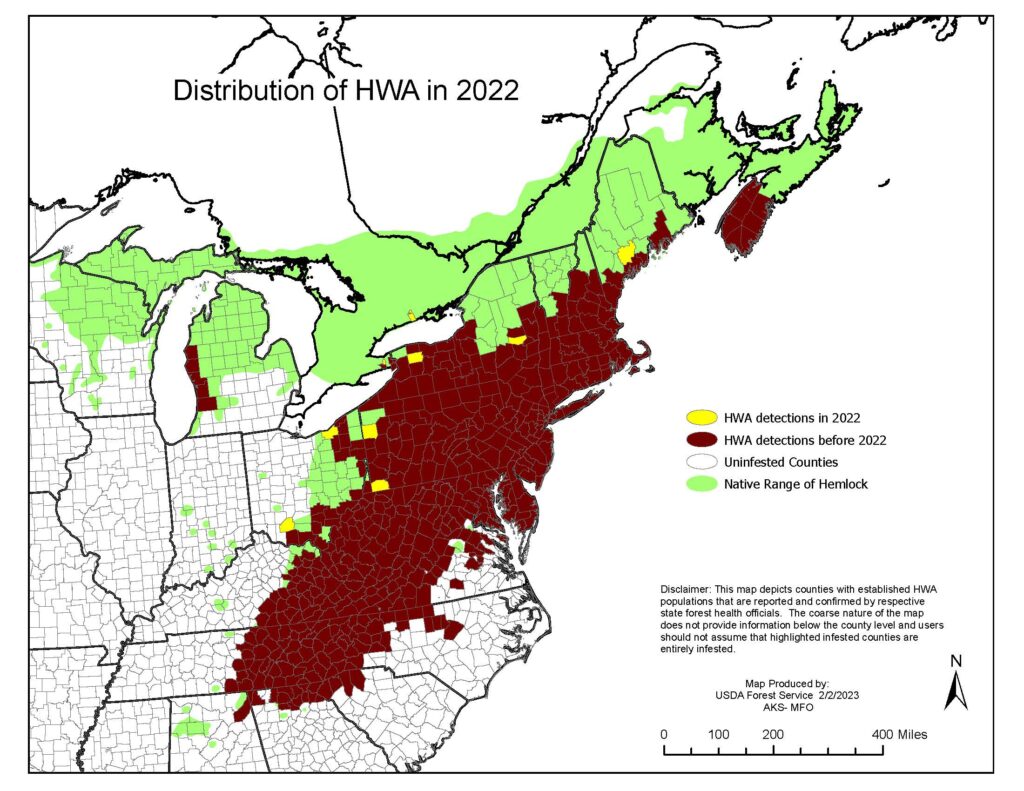
Photo of the distribution of hemlock woolly adelgid in 2022.
Purdue Landscape Report: The hemlock woolly adelgid (Adelges tsugae) continues its eastward spread across the US. In 2022, seven new counties were added to the distribution map of this invasive insect. While it is not present in Indiana yet, it is confirmed throughout the eastern USA from northern Georgia to Maine, extending west into Michigan, Ohio, and Kentucky.
Since its introduction in the 1950s, hemlock woolly adelgid has caused severe mortality of eastern hemlock in the United States. Not only is this a significant impact on our native tree diversity, hemlock losses are linked to a decline in several native bird species in the New England and mid-Atlantic forests (Ellison et al. 2018). In Indiana, eastern hemlock has a scattered native range in isolated locations of the west-central and southern regions of the state. It typically grows on steep slopes, canyons, and ravines. Hemlock woolly adelgid is also a threat to ornamental hemlocks, which are frequently used in landscaping.
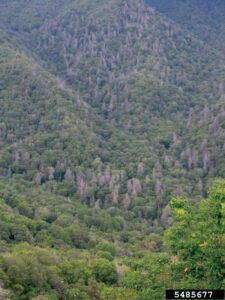
Photo of forest in hills, forest mortality, hemlock woolly adelgid.
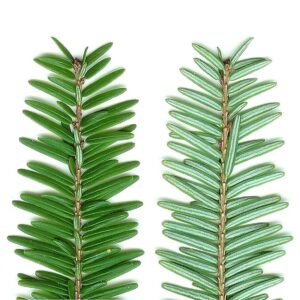
Photo of needles from eastern hemlock.
Identifying Eastern Hemlock
Hemlock woolly adelgid will only feed on hemlocks, so proper tree identification is crucial. If you’re not sure whether your conifer is hemlock, check the color, shape, and arrangement of the needles. The needles of eastern hemlock grow singly (not in clusters) in alternate or opposite positions. The needles are flattened, and have two white stripes on the underside. The cones are small (1-2 cm), and when dry, they can resemble a rosette.
Monitoring for Hemlock Woolly Adelgid
The white “wool” balls are the most tell-tale sign of this pest. Check the undersides of the branches at the base of the needles, and look for small, round, white cottony masses that cover the twig. These are actually the egg sacs of the hemlock woolly adelgid. You may also notice the “crawlers”, or the mobile nymphs, which are tiny, oval-shaped, reddish-brown insects.
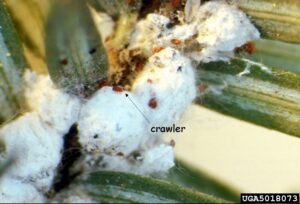
Photo of egg sacs of the hemlock woolly adelgid. These white “wool” balls are the most tell-tale sign of this pest.
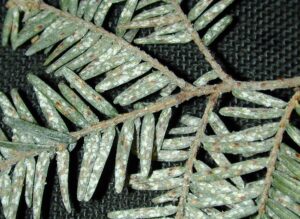
Photo of elongate hemlock scale with flattened white spots.
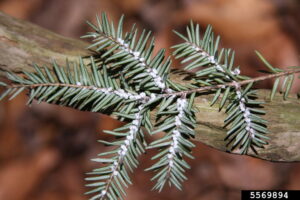
Photo of hemlock wooly adelgids with egg sacks along the twig.
If you frequently check hemlock trees, you may see other white spots that resemble the woolly adelgid. The cocoons of elongate hemlock scale are often confused with hemlock woolly adelgid. However, note how the white “spots” from the scale infestation are flattened and cover the needles. Hemlock wooly adelgids congregate at the base of the needles along the twig, not on the needles themselves, and the egg sacs are round in shape. Single, large egg sacs found throughout the branch are often spider egg sacs or oak skeletonizer cocoons.
Report any suspected findings of hemlock woolly adelgid at the Early Detection Distribution Map System (EDDMapS) website.
To view this original article and other Purdue Landscape Report articles, please visit Purdue Landscape Report.
Resources:
ID That Tree: Eastern Hemlock, video, Purdue Extension – Forestry and Natural Resources (FNR) YouTube Channel
Distinguishing Hemlock From Yew, The Purdue Landscape Report
Normal Needle Drop: Even Healthy Evergreens are not Evergreen, Purdue Plant & Pest Diagnostic Lab (PPDL)
Recognizing and Managing Poison Hemlock, Purdue Landscape Report
Be Careful Around Highly Toxic Poison Hemlock Plant This Summer, Purdue Extension – FNR
Phomopsis Dieback of Spruce, The Education Store, Purdue Extension resource center
Chlorosis of Pine Trees, The Purdue Landscape Report
Borers of Pines and Other Needle Bearing Evergreens in Landscapes, The Education Store
Stress-related Conifer Dieback, The Education Store
Certified Soil Testing Laboratories, Purdue Extension-Master Gardener Program
Tree Installation: Process and Practices, The Education Store
Planting Your Tree Part 1: Choosing Your Tree, video, Purdue Extension – FNR YouTube Channel
Tree Defect Identification, The Education Store
Shrubs and Woody Vines of Indiana and the Midwest, The Education Store
Tree Risk Management, The Education Store
Consumer Horticulture: Collecting Soil Samples for Testing, The Education Store
Find an Arborist website, Trees are Good, International Society of Arboriculture (ISA)
Purdue Pest and Plant Diagnostic Lab, send in photo or samples
Alicia Kelley, Cooperative Agricultural Pest Survey (CAPS) Coordinator
Purdue Extension – Entomology

Recent Posts
- ID That Tree: Shumard Oak
Posted: March 9, 2026 in Plants, Urban Forestry, Wildlife, Woodlands - ID That Tree: Fragrant Sumac
Posted: February 4, 2026 in Plants, Urban Forestry, Wildlife - It’s Not Too Late to Order Trees for Spring Planting
Posted: January 13, 2026 in Forestry, How To, Plants - Red in Winter – What Are Those Red Fruits I See?
Posted: December 1, 2025 in Forestry, Plants, Urban Forestry, Wildlife, Woodlands - Untangling and Identifying Vines, Purdue Landscape Report
Posted: September 29, 2025 in Invasive Plant Species, Plants, Wildlife - Control Management of Poison Hemlock
Posted: May 7, 2025 in Invasive Plant Species, Plants, Wildlife, Woodlands - Top 10 Spring Flowering Shrubs, Purdue Landscape Report
Posted: April 28, 2025 in Gardening, Plants, Urban Forestry - PPDL’s 2024 Annual Report – Enhancing Plant Health
Posted: March 21, 2025 in Forestry, Invasive Insects, Invasive Plant Species, Plants, Wildlife - What Are Invasive Species and Why Should I Care?
Posted: February 24, 2025 in Forestry, How To, Invasive Plant Species, Plants, Woodlands - Ask An Expert: Holidays in the Wild
Posted: December 9, 2024 in Christmas Trees, Forestry, Forests and Street Trees, How To, Plants, Wildlife, Woodlands
Archives
Categories
- Alert
- Aquaculture/Fish
- Aquatic/Aquaculture Resources
- Ask the Expert
- Christmas Trees
- Community Development
- Disease
- Drought
- Forestry
- Forests and Street Trees
- Gardening
- Got Nature for Kids
- Great Lakes
- How To
- Invasive Animal Species
- Invasive Insects
- Invasive Plant Species
- Land Use
- Natural Resource Planning
- Nature of Teaching
- Plants
- Podcasts
- Ponds
- Publication
- Safety
- Spiders
- Timber Marketing
- Uncategorized
- Urban Forestry
- Webinar
- Wildlife
- Wood Products/Manufacturing
- Woodland Management Moment
- Woodlands