 Purdue University - Extension - Forestry and Natural Resources
Got Nature? Blog
On May 5th, we held a Facebook LIVE: Ask an Expert with several FNR specialists and one of the questions that came in is a question I receive often.
One of the many benefits of interacting with farmers and land managers is I learn about the problems you face. A question came in around the 17:30 minute mark of how to deal with vole damage problems in their 3- to 5-acre pumpkin patch. I didn’t have an answer regarding registered pesticides (including taste repellents and toxicants) that are labeled for voles in pumpkins. Doing a broad search on the internet is helpful but it is hard to figure out what you can use in your state. Pesticides are often labeled for use in one state but not others. Luckily, anyone can search for registered pesticides online at on the National Pesticide Information Retrieval System. Most states, including Indiana, are included. You can search by EPA registration number, product name, company name, or active ingredient. A particular search can still yield many choices but this is a helpful way of finding out what is available. Each product has a link to the EPA website that includes product labels.
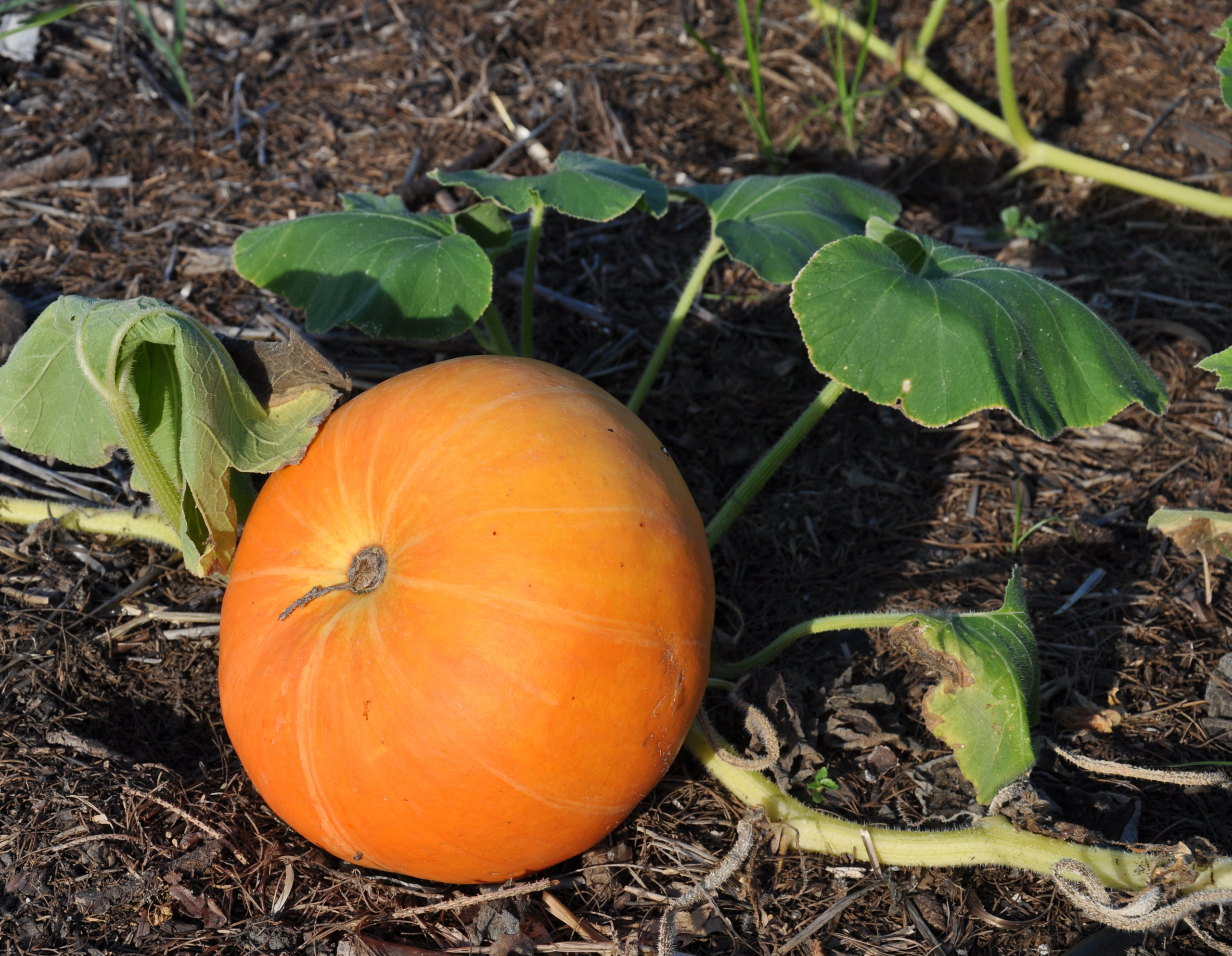
Since our program last week, I did some checking and found a product registered in Indiana labeled for voles in pumpkins as well as many other crops. Millers Hot Sauce is a taste repellent with an active ingredient of capsaicin (2.5% by weight), which is an irritant to animals, but one some people enjoy in hot peppers. Per label instructions adding an antitranspirant film former or a sticker may prolong the effectiveness of the product. Mix the product and additives with water according to label instructions. For heavy damage, start treatment after first true leaves appear and continue treatment every 7 days. If applying to transplants, start application one week after transplanting and continue every 7 days.
Always read the label completely before applying any pesticide. The efficacy of any repellent depends on a number of factors including animal population size and density, available food, and availability of cover. With voles, the year can be key because their populations tend to cycle. Combining other methods with repellents can often increase success. For example, soil cultivation within plant rows and in adjacent habitat can help reduce the habitat quality for voles. Cultivation can also directly kill some voles. There are of course tradeoffs and every situation is unique. Soil cultivation would not be an option in some cases (e.g., adjacent to water, steep slopes). I was unable to find a toxicant registered for voles in pumpkins. But depending on what the land cover is adjacent to the pumpkin patches, some of these may be appropriate in those areas.
With face-to-face Extension programs on hold for the foreseeable future, look for more live Q&A sessions and other programs on Facebook (PurdueFNR) or Twitter (@PurdueFNR).
Resources
National Pesticide Information Retrieval System
Midwest Fruit Pest Management Guide, The Education Store, Purdue Extension resource center
Hops Production in Indiana: Integrated Pest Management Guide for Hops in Indiana, The Education Store
Turfgrass Insects: Managing Black Cutworms in Turfgrass, The Education Store
Applied Research in Field Crop Pathology for Indiana – 2019, The Education Store
Managing Alfalfa Autotoxicity, The Education Store
Brian MacGowan, Wildlife Extensions Specialist
Purdue Forestry and Natural Resources
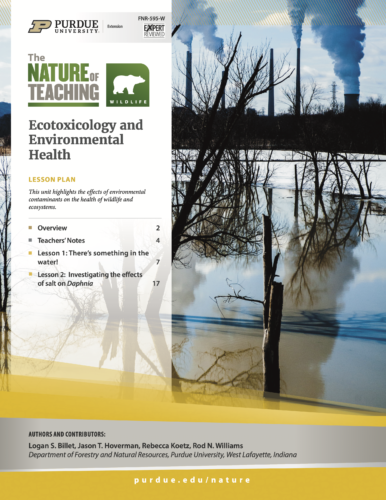 The Nature of Teaching: Ecotoxicology and Environmental Health is one unit in a series available from The Nature of Teaching – the place to go for teaching resources that focus on wildlife, food waste, health and wellness. In this series teachers can find free lesson plans, printables, posters, a photo library, information on upcoming workshops and more.
This unit highlights the effect of environmental contaminants on the health of wildlife and ecosystems with two lessons filled with worksheets, activities, lab report grading rubric sheet and more.
Lesson 1: There’s Something in the Water!
Lesson 2: Investigating the Effects of Salt Contamination on Daphnia
This 33-page PDF is written by Dr. Jason Hoverman; Logan Billet, Rebecca Koetz and Dr. Rod Williams.
For more resources, please check the Education Store.
Resources
Benefits of Connecting with Nature, The Education Store, Purdue Extension resource center
The Nature of Teaching: Disease Ecology, The Education Store
Resourceful Animal Relationships, The Education Store
The Nature of Teaching: Food Waste and the Environment, The Education Store
Adaptations for Aquatic Amphibians Activity 2: Water Quality Sneak Peak, Video, Purdue Extension YouTube channel
Rod Williams, Professor of Wildlife Science
Purdue University Department of Forestry and Natural Resources
Purdue Forestry & Natural Resources extension specialists gathered for a Facebook LIVE event held May 5th to answer questions on a wide range of topics from woodland management to wildlife habitat, ponds to invasive species and more.
Topics ranged from what to do about moles, voles and Canada geese causing damage in your yard, to how to pick the right tree for your landscape and how to measure the worth of your trees. The presentation also included segments on what to do about algae in your pond to how to know if you need to restock it as well as what to do about invasive plant species and how to protect your trees from deer damage.
Get advice from extension specialists Jarred Brooke, Lenny Farlee, Brian MacGowan, Lindsey Purcell, Rod Williams and Mitch Zischke in the video below.
If you have any further questions feel free to send your questions by submitting our Ask An Expert form.
Resources mentioned:
Purdue Extension – The Education Store
Purdue Report Invasive Species Website
Midwest Invasive Species Network Database
TreesAreGood.org
Find a Forester in Indiana
Improve My Property for Wildlife, Purdue Extension
Online Mole Program, Event May 14th, Purdue FNR Extension
Have you seen a hairless squirrel, Got Nature? Blog, Purdue FNR Extension
Stocking Fish, The Education Store, Purdue Extension Resource Center
Tree Selection for the “Un-natural” Environment, The Education Store
Selecting a Nuisance Control Operator, The Education Store
Forest Products Price Report (pdf), Indiana Department of Natural Resources (IDNR)
Indiana DNR Nuisance Goose Control Options (pdf), Indiana Department of Natural Resources (IDNR)
Turtles of Indiana, The Education Store
Salamanders of Indiana, The Education Store
Frogs and Toads of Indiana, The Education Store
Snakes and Lizards of Indiana, The Education Store
Aquatic Plant Management, The Education Store
Native Grasses, The Education Store
Preventing Deer Browsing on Trees/Shrubs, Video, Purdue Extension Youtube Channel
Brian MacGowan, Wildlife Extension Specialist
Purdue University, Department of Forestry and Natural Resources
For such a small creature, moles can cause big headaches. Their tunneling behavior can cause extensive damage to turf areas if left unchecked. While the damage is easy to identify, solving it can be tricky.

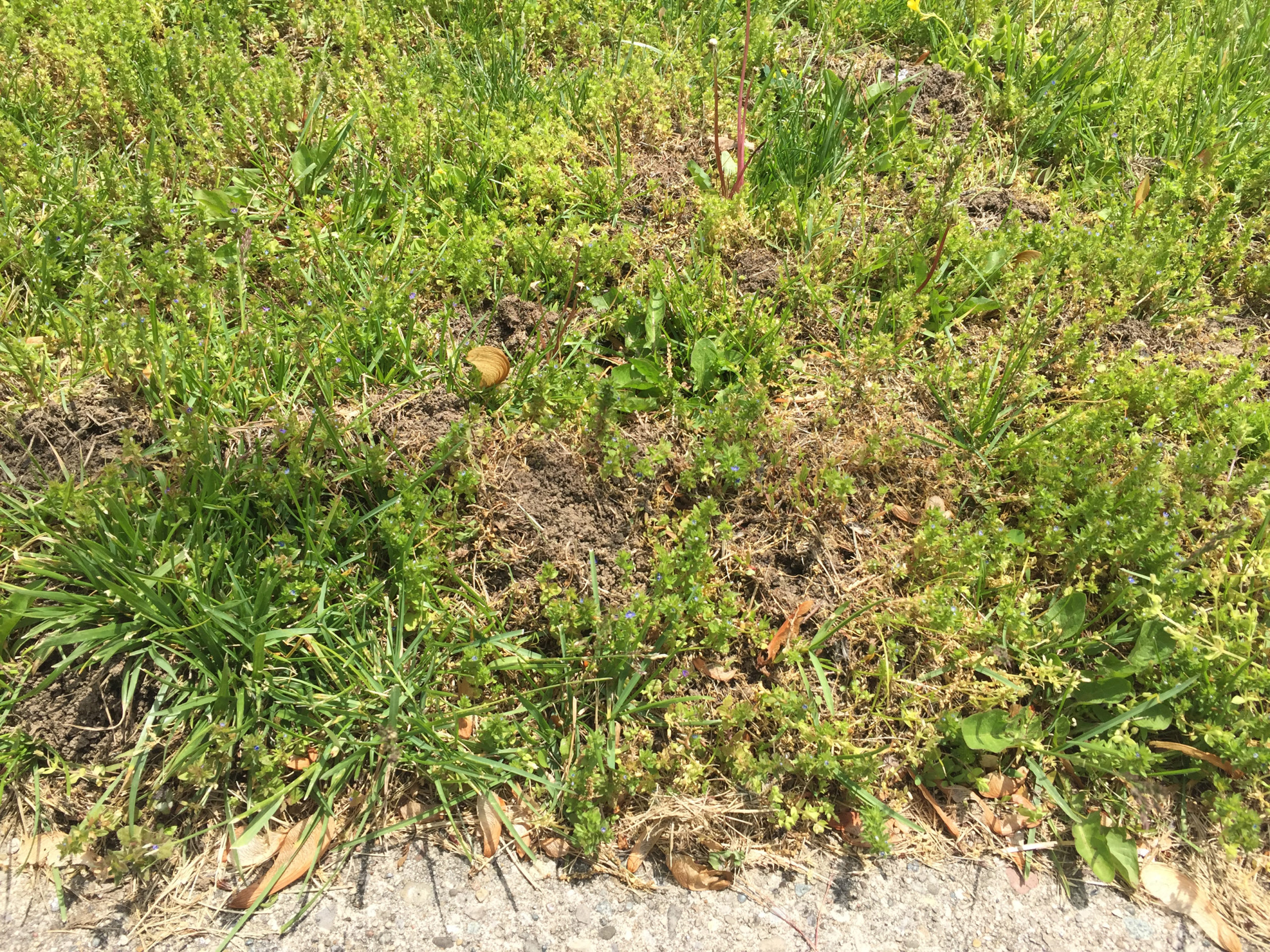
Purdue wildlife specialist, Brian MacGowan, shared tips and control techniques including trapping, repellents, toxicants, and cultural methods as well as answer your questions on the topic on Facebook LIVE, Thursday, May 14th.
You can view this topic along with question and answer time on the Purdue FNR Facebook page: https://www.facebook.com/PurdueFNR/videos/3372718849422210/.
If you have any further questions feel free to place your question in the comment section on our Purdue FNR Facebook page on the video link above or you can send your question by submitting an Ask An Expert form.
Resources
Moles, The Education Store, Purdue Extension resource center
Adjuvants and the Power of the Spray Droplet: Improving the Performance of Pesticide Applications, The Education Store
Preventing Wildlife Damage – Do You Need a Permit?, The Education Store
Attract Hummingbirds to Your Yard, Video, Purdue Extension Youtube Channel
How to Stop Woodland Animals from Digging in Your Flower Pots, Video, Purdue Extension Youtube Channel
Brian MacGowan, Wildlife Extension Specialist
Purdue Forestry and Natural Resources
 Mark your calendar for four upcoming Facebook LIVE events from Purdue FNR Extension specialists.
On April 30, tune in at 3 p.m. to expand your knowledge about the Hellbender husbandry program as Dr. Rod Williams chats live with Dr. Stephen Spear from The Wilds, who is going to talk about captive rearing, different age groups of hellbenders and some of their research using EDNA to sample for hellbenders across the country. This Facebook LIVE event will take place on the Help the Hellbender page. https://www.facebook.com/HelpTheHellbender
Check back in a few hours later at 6 p.m. for a live Q&A with extension wildlife specialist Jarred Brooke. He will offering habitat help and offering tips and tricks about establishing native grasses and forbs for wildlife. Tune in on the Purdue FNR Facebook page. https://www.facebook.com/PurdueFNR/
On May 5, a host of Purdue extension specialists will be available to answer your questions on a variety of topics during a noon ET Ask the Expert session on the Purdue FNR Facebook page . Have a question about woodlands, wildlife, fish, or ponds you want to ask a Forestry and Natural Resource Specialist? We will be discussing wildlife habitat management, prescribed fire, forest management, invasive plants, wildlife conflict management, wildlife damage, amphibian and reptile identification, wildlife ecology, pond management and fish ecology. This Q&A session will put you in touch with:
- Jarred Brooke, Extension Wildlife Specialist, wildlife habitat management, prescribed fire
- Lenny Farlee, Extension Forestry Specialist, forest management, invasive plants
- Brian MacGowan, Extension Wildlife Specialist, wildlife conflict management, wildlife damage
- Rod Williams, Extension Wildlife Specialist, amphibian and reptile identification, wildlife ecology
- Mitch Zischke, Extension Fisheries Specialist, pond management and fish ecology
On May 7 at 3 p.m., in Episode 3 of our Help the Hellbenders Facebook LIVE series, Dr. Rod Williams will talk with the keepers at the Mesker Park Zoo and Botanical Gardens about their efforts to breed hellbenders in captivity. Viewers will also have a tour of the facility and see interactive exhibits.
All Facebook LIVE sessions will be archived on Facebook. Go back and watch Episode 1 of the Help the Hellbender series.
To access a Facebook live feed, go to the page at the established time. When the event is live, a LIVE icon will show up next to the word video on the left hand side of the page. Click the video link and a new page will open. The video that is live will be the first video in the list. Click that to begin watching.
Resources:
Report Invasive, Purdue Extension
Effective Firebreaks for Safe Use of Prescribed Fire, Got Nature? Blog, Purdue University Forestry and Natural Resources Extension
Renovating native warm-season grass stands for wildlife: A Land Manager’s Guide, The Education Store, Purdue Extension resource center
Invasive plants: impact on environment and people, The Education Store
Pond and Wildlife Management, Purdue Extension
Forest Improvement Handbook, The Education Store, Purdue Extension resource center
Wendy Mayer, FNR Communications Coordinator
Purdue University Department of Forestry and Natural Resources
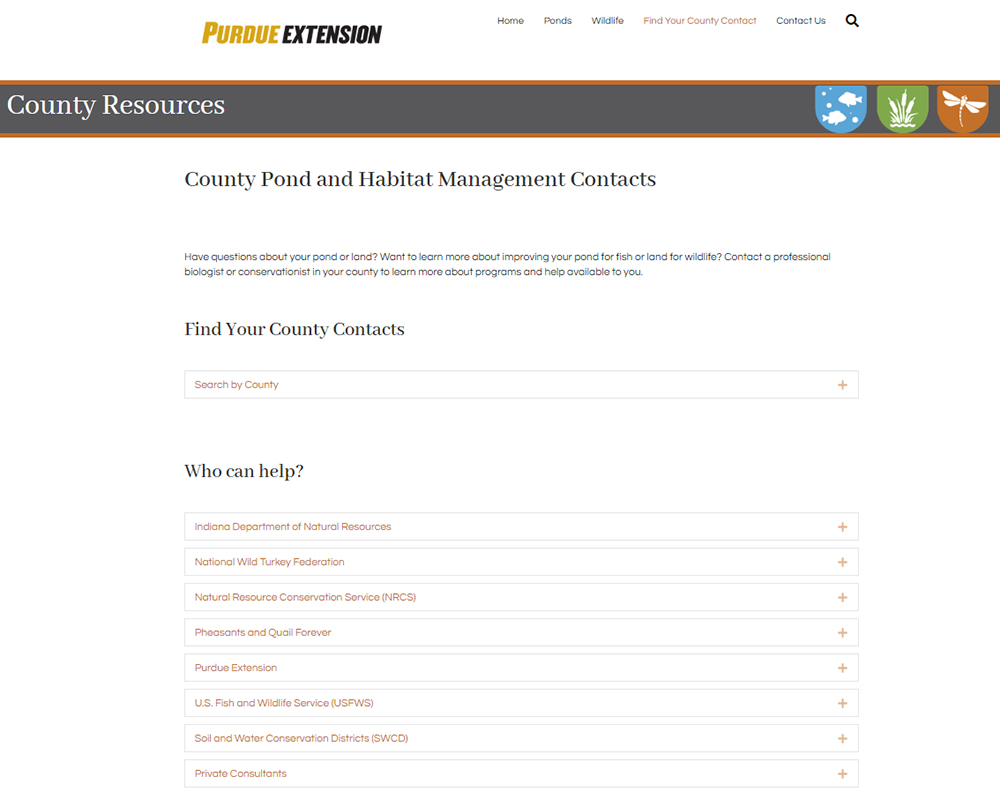 The Purdue Extension Pond and Wildlife Management website has been updated with a contact search function to better help you find the right professional biologist or conservationist in your county to serve your needs.
The newly created County and Habitat Management Contacts page allows individuals to search for experts within their county by simply selecting it from a dropdown menu. Within each individual county is a listing of Indiana Department of Natural Resources contacts, extension specialists and more.
In addition, the contacts page lists various agencies and services that can also help with questions about pond or habitat management. These resources include the Indiana DNR, the National Wild Turkey Federation, the Natural Resources Conservation Service (NRCS), Pheasants and Quail Forever, Purdue Extension, the U.S. Fish and Wildlife Service (USFWS), the Soil and Water Conservation Districts and event private consultants.
As fishing, hunting and other wildlife recreation continues to be popular in Indiana, Purdue Extension has developed this new program to help Indiana landowners manage their ponds and wildlife.
Along with the search features to help you find professional contacts, you will also find these topics and resources on the website:
- The Pond Ecosystem
- Fish Population Management
- Pond Construction and Maintenance
- Aquatic Vegetation Management
- Evaluating Your Property
- Forest Management
- Grassland Management
- Habitat Management Planning
To better understand and manage pond ecosystems in Indiana for fishing and wildlife habitat this website provides detailed information to help you reach your goals.
Resources:
Salmon and Trout of the Great Lakes: A Visual Identification Guide, The Education Store, Purdue Extension Resource Center
Pond Management: Stocking Fish in Indiana Ponds, The Education Store
The Nature of Teaching: Adaptations for Aquatic Amphibians, The Education Store
Illinois & Indiana Sea Grant, using research, outreach, and education to bring the latest science to communities and their residents
How to Score Your White-tailed Deer, Video, The Education Store
How to Build a Plastic Mesh Deer Exclusion Fence, The Education Store
Assessing Your Land’s Potential for Wildlife, The Education Store
Jarred Brooke, Extension Wildlife Specialist
Purdue Department of Forestry and Natural Resources
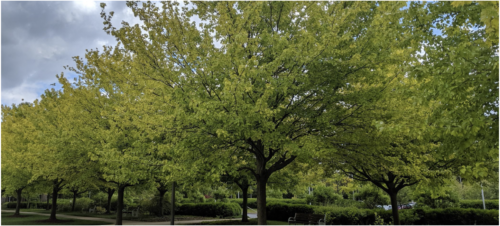 Many trees, shrubs, and other ornamental plantings in Indiana and throughout the Midwest suffer from iron deficiency caused by high pH (alkaline) soil. Soil pH affects plant growth directly and indirectly by affecting the availability of essential nutrients and microbial activity. One of these nutrients is iron, an essential plant nutrient that is required for the production of chlorophyll. Chlorophyll is necessary for photosynthesis and gives plants their green color. Iron (and manganese) deficiency results in leaf yellowing (chlorosis); over time, scorching of foliage, dieback and even death of the tree or shrub can result.
Iron Chlorosis of Trees and Shrubs talks about the symptoms, the cause and the managing of iron chlorosis. One of the authors is Lindsey Purcell, an urban forestry specialist from the Department of Forestry and Natural Resources at Purdue University.
This 5-page publication is part of the Plant Pathology in the Landscape Series and is a free download from the Purdue Extension resource center, The Education Store. View other tree disease publications and video resources as you place keywords in the search field located on The Education Store website.
Resources
Tree Diseases: Oak Wilt in Indiana, The Education Store, Purdue Extension resource center
Tree Diseases: White Pine Decline in Indiana, The Education Store, Purdue Extension resource center
Mechanical Damage to Trees: Mowing and Maintenance Equipment, The Education Store, Purdue Extension resource center
Surface Root Syndrome, The Education Store, Purdue Extension resource center
Tree Appraisal and the Value of Trees, The Education Store, Purdue Extension resource center
Lindsey Purcell, Urban Forestry Specialist
Purdue University, Department of Forestry and Natural Resources
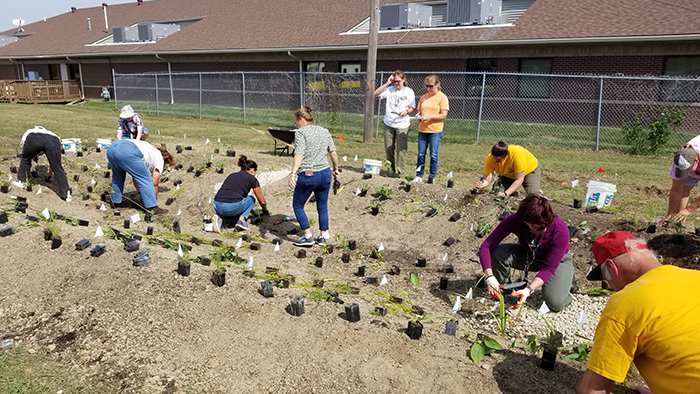
The Purdue Extension and Illinois-Indiana Sea Grant Rainscaping Education Program was highlighted in the National Oceanic and Atmospheric Administration’s Education Accomplishments Report (pdf) for fiscal year 2019.
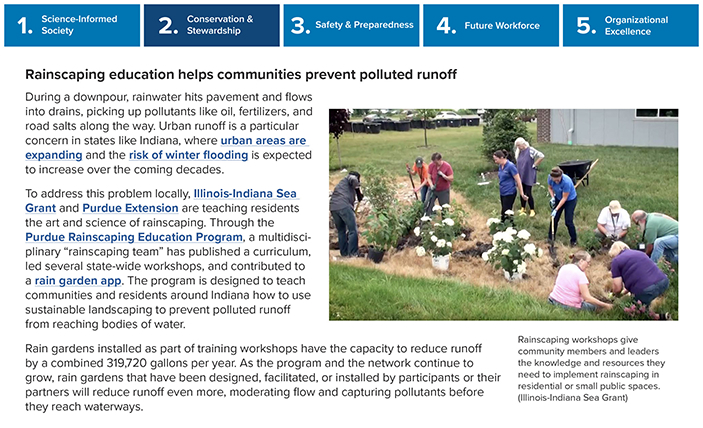
This report highlighted all of NOAA’s greatest accomplishments related to education in five main goal areas: science informed society, conservation and stewardship, safety and preparedness, future workforce and organizational excellence.
The Rainscaping Education Program was featured in the Conservation and Stewardship section of the report. The Purdue Rainscaping Education Program offers state-wide training for Purdue Master Gardeners, conservation agencies and organizations, stormwater professionals and landscape companies and consultants. Through two-day workshop sessions, the program provides an introduction to rainscaping and rain gardens, including segments on site selection, plant selection, garden design, installation, maintenance and community engagement.
“It is wonderful to have the innovative and collaborative work of the Purdue Rainscaping Education Team recognized for its efforts,” Kara Salazar, assistant program leader and extension specialist for sustainable communities said. “The team has been working together since 2013 to develop and implement the interdisciplinary program addressing the need for community education on sustainable landscape practices to prevent polluted runoff.”
Salazar and John Orick, Purdue Master Gardener State Coordinator, are co-leads on the project. View the full Rainscaping Team.
The featured segment on the Rainscaping program from the NOAA annual report is below.
Resources
What is Rainscaping? Purdue Rainscaping Education Program Video, Purdue Extension
Q&A About Drainage Water Recycling for the Midwest, The Education Store, Purdue Extension resource center
Become a Purdue Master Gardener, The Education Store
Plan Today For Tomorrow’s Flood, The Education Store
Kara Salazar, Assistant Program Leader and Extension Specialist for Sustainable Communities
Department of Forestry and Natural Resources
Just because the winter days are cold and dreary doesn’t mean the work to improve wildlife habitat on your property has to stop. In fact, now is a perfect time for a wide range of habitat projects. One such project is frost seeding native grasses and forbs. Here’s why you should brave the cold and consider sowing your seeds this winter.
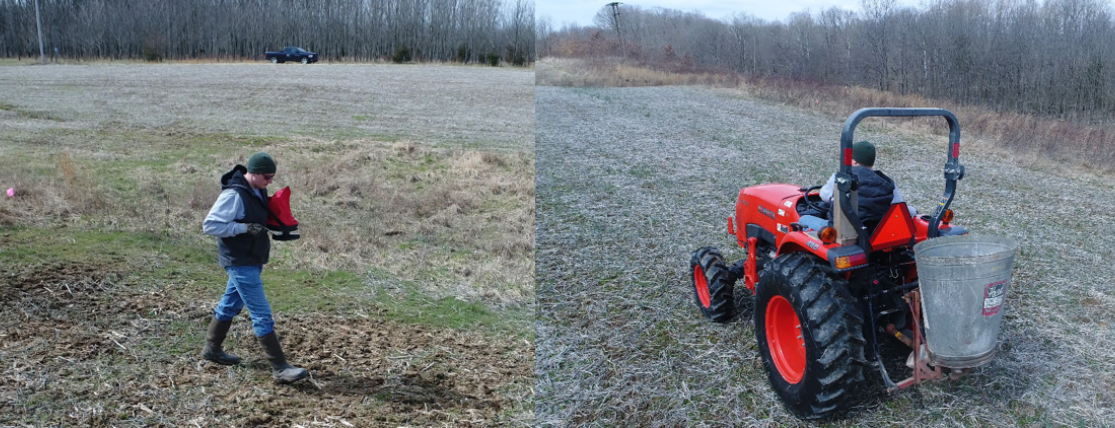
Picture 3. Smaller fields can be established with just a hand seed spreader (left), whereas an ATV or tractor-mounted spreader is better for larger fields (right).
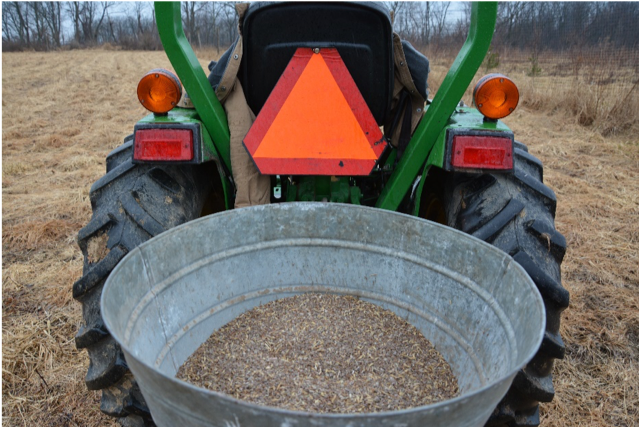
Picture 2. When broadcasting native seed, it should be mixed with a carrier (pelletized lime here) to help the seed flow through the spreader.
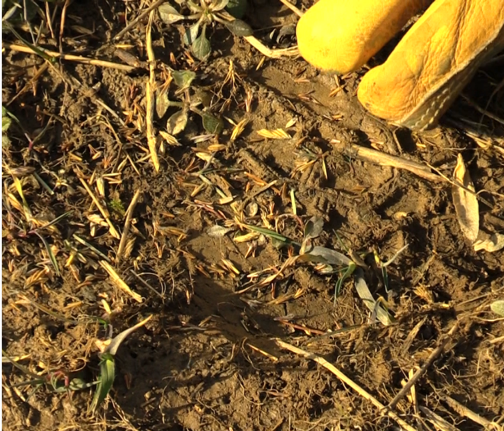
Picture 1. After frost seeding, the native grass and forb seed is visible on the ground, but the freezing and thawing of the soil will ensure good seed-to-soil contact.
Its natural
If you think about how a native prairie works, many of the seeds ripen in the late summer and early fall and drop to the ground throughout the fall and winter. So, sowing seeds from January through March or frost seeding is mimicking what would have occurred naturally. By doing such, you are taking advantage of the freezing and thawing cycles of the soil. The helps with a couple things.
First, many native plant seeds – forbs (wildflowers) especially – need that natural freezing and thawing cycles to break their dormancy. Thus, frost seeding can help increase the germination of many of these species. Second, the freezing and thawing of the soil helps to work the seed into the soil, which can improve seed-to-soil contact, an important factor in planting success (picture 1).
Less time to waste
Dormant seeding or seeding once the soil dips below a certain temperature (as early as November) is another viable option to establish a native grass and forb stand. But with frost seeding, the seed remains on the soil for less time before germination. Which may reduce the seeds’ exposure to soil pathogens, rodents, birds, or other critters that may eat the seed or reduce germination.
Minimalist-style
Frost seeding native grasses and forbs can be done will minimal equipment. All you need to frost seed is a hand or mechanical seed spreader, the seed, and a carrier (picture 2). Using a hand seed spreader works great for small fields, but you may consider using an ATV or tractor-mounted mechanical spreader for larger fields (picture 3).
Another option is to use a no-till seed drill. Of course, this will require more specialized equipment, but many Soil and Water Conservation Districts or Pheasants and Quail Forever Chapters have no-till drills that you can borrow or rent to help complete your project.
When it comes to establishing native grasses and forbs, there is more than one way to plant a field. But, frost seeding might be the option that is best suited for you and your site.
For a How-To on frost seeding, check out our Frost Seeding Video below:
Resources
Frost Seeding to Establish Wildlife Food Plots & Native Grass and Forb Plantings, video, The Education Store, Purdue Extension Resource Center
Calibrating a No-Till Drill for Conservation Plantings and Wildlife Food Plots, video, The Education Store
Renovating native warm-season grass stands for wildlife: a land manager’s guide, The Education Store
Purdue Extension Pond and Wildlife Management Website, Purdue Extension
Jarred Brooke, Wildlife Extension Specialist
Department of Forestry & Natural Resource, Purdue University
ArcGIS.com
Unmanned Aerial Systems and Burn Management Strategies
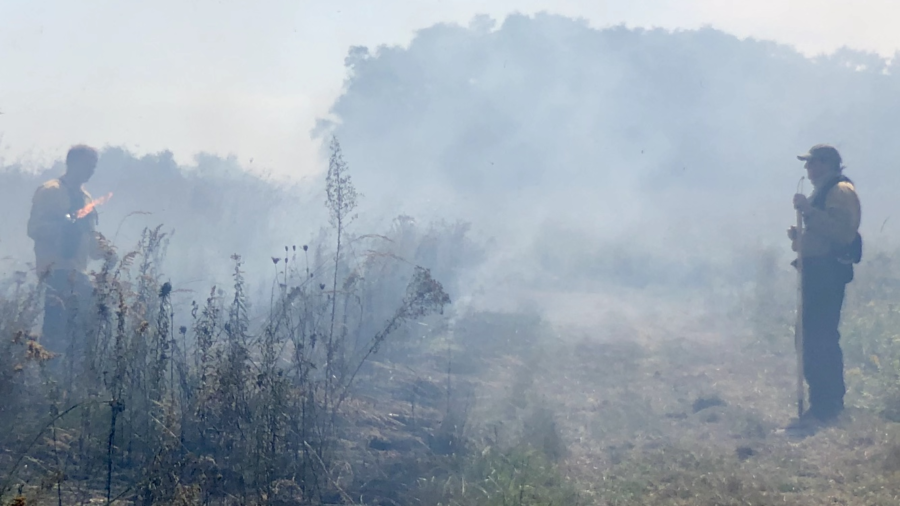
On September 19, 2019 a controlled burn was conducted on the Doak grassland and forest property, owned and managed by the Department of Forestry and Natural Resources at Purdue University. Burn events such as this one present a unique opportunity to demonstrate how UAS can be utilized as an effective tool to both monitor the burn events in real time, but also to effectively gather data before and after the burn to map and better manage vegetation. This collection of maps, videos, and images provide a narrative on how UAS can be used as an effective tool in controlled burn management practices. Beyond controlled burns, the story should demonstrate how UAS can be used to better monitor and inventory other disturbance events, whether they are planned or unexpected.
A Collaborative Effort
The data collected for this event represents a collaborative effort between multiple colleges at Purdue University and private industry. Employees with Purdue Forestry and Natural Resources (College of Agriculture) performed and managed the burn while data collection for the pre and post-burn mapping was conducted by student researchers and pilots from the Purdue School of Aviation and Transportation Technology (SATT; Polytechnic Institute). Peter Menet and Chris Johnson from MenetAero provided aerial monitoring support throughout the controlled burn. A total of three different aircraft were used during this event. The SATT student pilots deployed a C-Astral Bramor PPX equipped with a MicaSense Altum 6 band multispectral sensor at 121 meters before and after the event for mapping purposes. MenetAero deployed a C-Astral C4Eye to monitor the burn in real time using EO/Thermal IR video with real time geographic coordinates at 121 meters while SATT students monitored the burn with a DJI M600 equipped with a Zenmuse XT2 sensor at lower altitudes.
Monitoring the Burn:
The nimble nature of UAS makes them ideally suited to deploy rapidly, and into tight situations otherwise too dangerous for ground crews and manned aircraft. Add to this the aerial perspective offered by UAS via real-time video feed, and you have the perfect platform to assist in hazard events such as fire. The real-time video feed allows the UAS pilot and crew to communicate with ground-based fire crews, providing information on potential hazards and overall fire behavior patterns. For this aerial perspective to be effective, however, the video needs to have geospatial context so what the UAS operator is seeing is effectively communicated to ground-based fire crews. Full-Motion-Video, or video that has metadata with geospatial coordinate information, is a game changer in this regard. The video below shows how software such as Remote Geosystems Line Vision Ultimate can place video in a geospatial context. The video below is being played after the flight, but Pete Menet from MenetAero had the video live streaming to his Ground Station during the flight and was able to effectively serve as an ‘eye in the sky’ to provide real time information to ground based crews. This was all done in a controlled burn, but this same technology and method is used by MenetAero during Wild Fire Events where MenetAero provides UAS services as a contractor with the U.S. Department of Interior. Peter Menet and the MenetAero crew were kind enough to donate their services and time to the controlled burn event this day as part of a collaborative research effort between industry and Purdue.
A Before and After Comparison
Prior to recent advances in UAS technology, gathering imagery at sub-centimeter accuracy and resolution immediately before and after a planned burn event would prove difficult at best. The PPK technology on the C-Astral PPX allowed us to conduct the flights without the need to layout and survey ground control markers, but still achieve centimeter level accuracy by post-processing our data with a Continuously Operating Reference Stations in close proximity. Without UAS, getting satellite data within this time frame would have been pretty much impossible, and getting a manned aircraft to do this prohibitively expensive.
Making Sense of it all through Classification Analysis
Pre-Burn Land Cover Classification
When we think of disturbance events, we often think of the unplanned ones – fire, ice storms, wind storms, floods, etc. But what about planed disturbances such as a controlled burn, or a timber harvest operation? In the case of a planned disturbance, we have the ability to inventory land cover immediately before an event, and then with classification methods, quantify that land cover. Land Use/Cover classification methods are nothing new, and go back to the very beginnings of GIS/Remote Sensing, but new here is the ability to deploy a UAS to get this data in a way that is accurate and precise enough to classify down to resolutions of several square centimeters. Add to that the imagery was gathered less than an hour before the burn and you have some amazing potential for forestland management.
*Thank you to ArcGIS.com for sharing the great work of our FNR specialists as they continue to “strengthen lives and livelihoods” here in Indiana and around the world.
Resources
Unmanned Aerial Systems and Burn Management Strategies, Unmanned Aerial Systems and Burn Management Strategies webpage
Effective Firebreaks for Safe Use of Prescribed Fire, Got Nature? Blog, Purdue University Forestry and Natural Resources Extension
Prescribed fire: 6 things to consider before you ignite, Got Nature? Blog
Renovating native warm-season grass stands for wildlife: A Land Manager’s Guide, The Education Store, Purdue Extension resource center
Calibrating a No-Till Drill for Conservation Plantings and Wildlife Food Plots, The Education Store
Jarred Brooke, Extension Wildlife Specialist
Purdue Department of Forestry and Natural Resources

Recent Posts
- Succession Planning Resource: Secure your Future
Posted: December 2, 2025 in Community Development, Land Use, Woodlands - Kara Salazar and Team Win National Runner-up for Innovation & Creativity Award
Posted: September 29, 2025 in Community Development, Land Use, Natural Resource Planning - Hardwood Tree Improvement Regeneration Center (HTIRC) Shares Fall Newsletter, Research and Outreach
Posted: December 13, 2024 in Forestry, Land Use, Natural Resource Planning, Woodlands - Purdue Extension’s Showcase, Impacting Indiana
Posted: November 8, 2024 in Community Development, Forestry, Forests and Street Trees, Gardening, Land Use, Natural Resource Planning, Timber Marketing, Urban Forestry, Wildlife, Wood Products/Manufacturing, Woodlands - American Citizen Planner – Indiana Program Celebrating 4 Years of Impact
Posted: October 16, 2024 in Community Development, Land Use - Publication – Quality of Place and Community Development
Posted: July 18, 2024 in Community Development, Land Use, Publication, Urban Forestry - Publication – Introduction to White-tailed Deer Impacts on Indiana Woodlands
Posted: April 28, 2024 in Forestry, Land Use, Plants, Publication, Wildlife, Woodlands - Publication – Understanding White-tailed Deer and Their Impact on Indiana Woodlands
Posted: in Forestry, Land Use, Plants, Publication, Wildlife, Woodlands - Publication – Monitoring White-tailed Deer and Their Impact on Indiana Woodlands
Posted: in Forestry, Land Use, Plants, Publication, Wildlife, Woodlands - Publication – Managing White-tailed Deer Impacts on Indiana Woodlands
Posted: in Forestry, Land Use, Plants, Publication, Wildlife, Woodlands
Archives
Categories
- Alert
- Aquaculture/Fish
- Aquatic/Aquaculture Resources
- Ask the Expert
- Christmas Trees
- Community Development
- Disease
- Drought
- Forestry
- Forests and Street Trees
- Gardening
- Got Nature for Kids
- Great Lakes
- How To
- Invasive Animal Species
- Invasive Insects
- Invasive Plant Species
- Land Use
- Natural Resource Planning
- Nature of Teaching
- Plants
- Podcasts
- Ponds
- Publication
- Safety
- Spiders
- Timber Marketing
- Uncategorized
- Urban Forestry
- Webinar
- Wildlife
- Wood Products/Manufacturing
- Woodland Management Moment
- Woodlands