 Purdue University - Extension - Forestry and Natural Resources
Got Nature? Blog
 As this long, hot summer heads toward fall, trees will be doing their best to place some new offspring on the landscape. Some tree seed gets a lift on wind or water to new growing locations. Some seed will count on being eaten and then excreted by a bird. We are perhaps most familiar with the activities of squirrels in gathering and storing seed like acorns, hickories and walnuts. Foresters are rather fond of gray and fox squirrels – they collect seed and bury it in scattered locations around their home range for later excavation and use. What the forester likes is the squirrels don’t always re-find all the buried nuts, so a new tree may result. If you have an interest in growing trees or just want to get in touch with the world of squirrels, you could consider gathering and planting some tree seed.
Oaks, walnuts and hickories are a good starting point for using seed to grow new trees. Start scouting for seed on the trees in your neighborhood, local parks or even cemeteries. Be sure you have permission to pick up seed if it is private property. Some seed is already being eaten by squirrels or falling from trees, so now is a good time to start looking, although prime seed collection time is usually mid-September to October. Acorns, walnuts and hickory nuts will drop from the trees when ripe, so keep an eye on the ground. Before collecting a lot of seed, check the quality of the seed by cutting or cracking a few sample seed. You may need pruning shears, or in the case of walnuts and hickories, a hammer to open the seed. Viable seed should be firm and white or light tan inside with no signs of insect infestation. Weevil grubs are fairly common in oak seed, so discard seed that has obvious small holes from weevils or with the cap still attached (with the exception of bur oak which retains its caps).
Figure a percentage of good seed from your test lot to see how many total seed you need to collect to get the number of good seed you want. Keep your collected seed cool and moist until you plant it. Plant as soon after collection as possible. A good general guide for planting depth is one to two times the diameter of the seed, so a walnut would be planted one to two inches below ground surface. Squirrels can locate buried seed, so you may want to protect seed from squirrels by covering the planting spot with wire mesh sheets or cones anchored to the ground. Another easy protection method is a tin can with one end completely removed and an X cut in the middle of the other end with the corners pulled back to create a hole. Dig a hole approximately the size of the can. Place the seed and soil in the can and then push the open end of the can down until the cut end is flush with ground line. The seedling can then grow out through the hole in the cut end.
The screens and cans can be removed at the end of the first growing season once leaves have fallen, or if they are steel, simply left to rust away. Aluminum screen or cans will not rust away, so they must be removed. If you are willing to share with the squirrels, just plant a lot more seed. You can also start seed in containers. Half-gallon or gallon milk jugs with a drain hole cut in the bottom would work as would deep planters. Over winter, you should bury or heavily mulch the pots to insulate them from rapid temperature fluctuation.
Many other tree and shrub species may be grown from seed including persimmon, redbud, dogwoods, maples and tulip tree. The particular requirements for best germination and growth for tree seeds varies by species. A great reference for growing almost any native or common introduced tree species from seed is the Woody Plant Seed Manual produced by the U.S. Forest Service. An online version is available at http://www.nsl.fs.fed.us/nsl_wpsm.html.
Resources
Hardwood Seedling Production/Propagation (click Publications, then Research Publications), Hardwood Tree Improvement and Regeneration Center
Germination of Tree Seed, Iowa State University Extension and Outreach
Woody Plant Seed Manual (pdf), U.S. Forest Service
Planting Forest Trees and Shrubs in Indiana, The Education Store
Tree Seedling Nurseries, Indiana Department of Natural Resources
ID That Tree, Playlist, Purdue Extension – Forestry and Natural Resources (FNR) YouTube Channel
Report Invasive, Purdue Extension
Professional Forester, Indiana Forestry Woodland Owners Association
District Forester 10+acres of woodlands, Indiana Department of Natural Resources
Forest Improvement Handbook, The Education Store
Lenny Farlee, Extension Forester, Hardwood Tree Improvement and Regeneration Center
Forestry and Natural Resources, Purdue University
 After the winter, many people’s thoughts turn to getting outside and pursuing some of our favorite hobbies. For some, that includes getting their farm pond back in order for any number of recreational activities. Depending on what you need, there are valuable resources available on the Internet that can assist you in making good management decisions to utilize your pond for maximum enjoyment. Two of the best management resources available have to do with aquatic weed management and farm pond management for recreational fishing.
Aquatic weeds can deter any owner from enjoying the recreational benefits of owning a pond. Be it swimming, fishing or just aesthetics, a pond choked with weeds will benefit no one. A great resource to identify aquatic weeds and learn management techniques to control them is the Aquatic Plant Management brochure. Now is the time to use preventative measures to reduce or control aquatic weeds that can overrun your pond during the heat of the summer. There are mechanical, biological and chemical means of controlling weeds in your pond. If using aquatic herbicides, please read and follow the label direction, or if you are uncomfortable applying chemicals, there are several companies who can do the job for you. Please contact your local county extension office for contact information.
Likewise, if you have a pond that you want to manage for recreational fishing, there is a resource for you. The Indiana Department of Natural Resources has an online booklet, Indiana Fish Pond Management, for managing smaller recreational farm ponds with species and techniques applicable to Indiana. It is always best to start with a new or reclaimed pond when stocking fish and developing a management plan. If you have an existing pond with fish, the information may help you change management or realize you need to start over.
Lastly, we always get a lot of calls in the spring asking where to purchase fish. The INDNR keeps an up-to-date listing of commercial fish suppliers. This is not only for those seeking fish for recreational purposes but also for grass carp that are used for aquatic weed control. These fish need to be triploid, and only licensed suppliers are allowed to handle them in the state.
Resources:
Ask an Expert: Managing Your Property for Fish & Wildlife, Purdue Extension – Forestry and Natural Resources (FNR) YouTube Channel
Pond and Wildlife Management, Purdue Extension website
Pond Management: Stocking Fish in Indiana Ponds, Purdue Extension – FNR
A Pond Management Plan Template, The Education Store
The Nature of Teaching: Adaptations for Aquatic Amphibians, The Education Store
Illinois & Indiana Sea Grant, using research, outreach, and education to bring the latest science to communities and their residents.
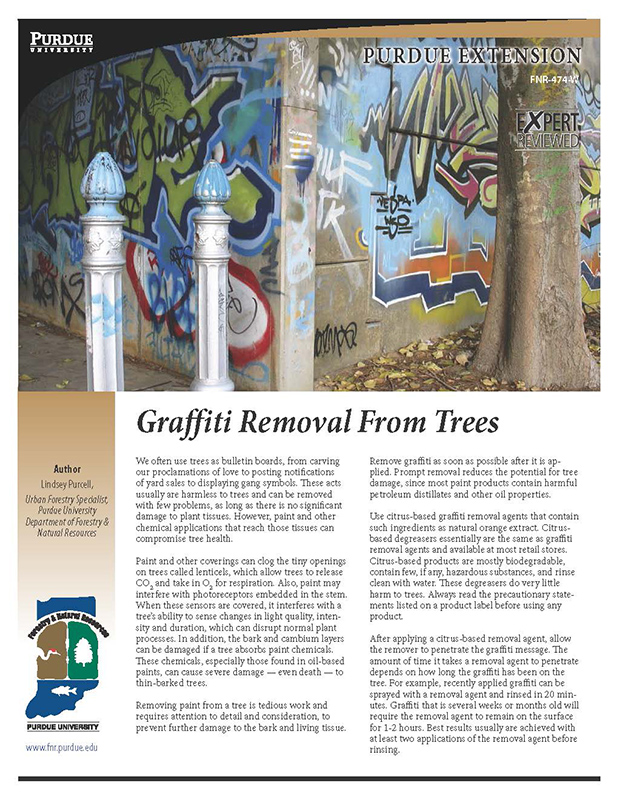 Trees are often the unwilling recipients of proclamations of love, notifications, for sale advertisements and tagging. Most of these activities are relatively harmless to tree health unless there is a significant amount of physical damage to sensitive plant tissue. Fortunately, most of these items can be removed without much problem.
However, paint and other chemical applications can cause additional damage. Paint may clog the tiny openings on trees called lenticels, preventing gas exchange such as CO2 produced by respiration getting out and O2 needed for respiration getting into the tree. Also the paint may interfere with photoreceptors embedded in the stem. When these sensors are covered, it interferes with the tree’s ability to sense changes in light quality, intensity and duration which can disrupt normal plant processes. In addition, the bark and cambium layer can be damaged by absorption of the chemical properties in paints. These paint chemicals, especially those found in oil-based paints, can cause severe damage and even death on thin-barked trees.
The removal process of the paints on trees can create quite a headache in the corrective actions. However, it can be successful with careful work and consideration for the absorptive properties of the tree.
Try to remove graffiti as soon as possible after it is applied. Prompt removal reduces the damage to the tree as most paint products have harmful petroleum distillates and other oil properties in them. Use citrus-based graffiti removal agents that contain ingredients such as “natural orange extract.” Citrus-based degreasers are essentially the same as graffiti removal agents and are more readily available at local retailers. Citrus-based products are mostly biodegradable; they contain very few, if any, hazardous substances, and they rinse clean with water. These degreasers do very little harm to trees. Always read the precautionary statements listed on a product label before using any product.
After applying a citrus-based removal agent, it is usually best to allow the remover to penetrate the graffiti message for a variable amount of time, depending mostly on the length of time the graffiti has remained on the surface. For example, newly applied graffiti can be sprayed with a removal agent and rinsed with satisfactory results in 20 minutes. Graffiti that has been applied for several weeks or months will require the removal agent to sit on the surface for 1-2 hours. Best results are usually achieved by at least two applications of the removal agent before rinsing.
Use a hose with a high-pressure nozzle or better; use a pressure washer to rinse and remove graffiti that has been treated with a removal agent. Be sure to use the pressure washer carefully on tree trunks, especially thin, smooth barked trees to avoid any damage to the tree. High pressure spray can damage the bark and vital tree components if applied intensely in one area. When using a high pressure hose nozzle instead of a pressure washer, it may be helpful to agitate the treated graffiti with a stiff nylon or plastic brush to improve removal efforts. Wire brushes can be damaging to the tree without careful use.
Remember to be gentle and reduce damage to the tree trunk. If the removal process is unsuccessful at first, multiple applications over time may be required. Sometimes a simple, creative aerosol paint combination can be used to cover or disguise the tagging efforts if on a small scale. Be natural and use long, vertical spray strokes to match the tree color as best as possible. Water-based paints are not as harmful as oil-based covers. This is always the last course of action.
Good luck and hopefully the tree can be restored to its natural appearance.
Resources:
Graffiti Removal From Trees, The Education Store, Purdue Extension’s resource center
Find an Arborist website, Trees are Good, International Society of Arboriculture (ISA)
Caring for storm-damaged trees/How to Acidify Soil in the Yard, In the Grow, Purdue Extension
Moist soil and rotten roots makes it easy for trees to come crashing down, Fox 59 News
Why Is My Tree Dying?, The Education Store
Tree Risk Management, The Education Store
Mechanical Damage to Trees: Mowing and Maintenance Equipment, The Education Store
Construction and Trees: Guidelines for Protection, The Education Store
Trees and Electric Lines, The Education Store

Recent Posts
- Purdue Extension: Empowering Indiana Through Innovation, Education and Community Impact
Posted: January 28, 2026 in Community Development, How To, Invasive Insects, Invasive Plant Species, Natural Resource Planning, Woodlands - Forest Landowners: Share Your Experience with Regeneration and Restoration
Posted: January 27, 2026 in Forestry, How To, Timber Marketing, Woodlands - It’s Not Too Late to Order Trees for Spring Planting
Posted: January 13, 2026 in Forestry, How To, Plants - Now Is The Time To Control Non-Native Bush Honeysuckle
Posted: October 30, 2025 in Forestry, How To, Invasive Plant Species, Woodlands - October Is Firewood Month: Protect Indiana’s Forests by Making Smart Choices
Posted: October 13, 2025 in Forestry, Forests and Street Trees, How To, Invasive Insects, Urban Forestry - ID That Tree: Smooth Sumac
Posted: October 2, 2025 in Forestry, How To, Wildlife - ID That Tree: Wild Grape Vine
Posted: August 12, 2025 in Forestry, How To, Urban Forestry, Wildlife - Publication – Sericea Lespedeza Control
Posted: July 7, 2025 in Forestry, How To, Invasive Plant Species, Wildlife - How to ID Asian Jumping Worms, Purdue Landscape Report
Posted: July 2, 2025 in How To, Invasive Insects, Wildlife - Alert – Water Your Trees, Watch Video
Posted: June 20, 2025 in Alert, Drought, Forests and Street Trees, How To, Urban Forestry, Wildlife, Woodlands
Archives
Categories
- Alert
- Aquaculture/Fish
- Aquatic/Aquaculture Resources
- Ask the Expert
- Christmas Trees
- Community Development
- Disease
- Drought
- Forestry
- Forests and Street Trees
- Gardening
- Got Nature for Kids
- Great Lakes
- How To
- Invasive Animal Species
- Invasive Insects
- Invasive Plant Species
- Land Use
- Natural Resource Planning
- Nature of Teaching
- Plants
- Podcasts
- Ponds
- Publication
- Safety
- Spiders
- Timber Marketing
- Uncategorized
- Urban Forestry
- Webinar
- Wildlife
- Wood Products/Manufacturing
- Woodland Management Moment
- Woodlands