 Purdue University - Extension - Forestry and Natural Resources
Got Nature? Blog
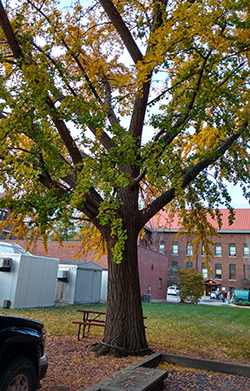 Ginkgo (Ginkgo biloba) trees also known as Maidenhair trees are slow-growing, relatively pest-free, wind-pollinated trees that can be found in all fifty of the contiguous United States. The only tree species within division Ginkgophyta to escape extinction, Ginkgo biloba is known as an ancient tree with prehistoric fossils dating back 270 million years found on every continent except Antarctica and Australia.
Ginkgo grow best in full sunlight and can reach heights greater than 35 m (115 ft). Ginkgo trees are valuable street trees because of their low susceptibility to smoke, drought, or low temperatures. These trees grow slowly and perform relatively well in most soil types provided they are well-drained. The leaves turn a vibrant yellow during autumn but drop soon after its brilliant fall color is observed.
Unfortunately, in late autumn, the dirty secret that female ginkgo trees hide is revealed. The “fruit” produced by female ginkgo trees is foul smelling (has been compared to rancid butter or animal excrement) and is cast in the fall following the first frost. Though immature when cast, the embryos within the fruit continue to mature on the ground for up to two months afterwards. This means that anyone unfortunate enough to step on the fruit during that time is exposed to its pungent odor.
Extreme caution should be used when selecting ginkgo trees for landscape ornamentals or for street trees since there is no way to discern a male from a female at the seedling stage. Several “Boys Only” cultivars have been developed such as ‘Autumn Gold’ or ‘Lakeview’ to ensure that you do not end up with a 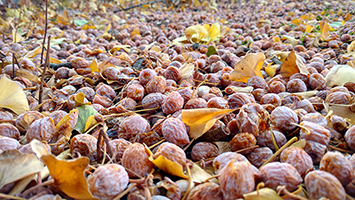 stinky yard or street when the trees begin to fruit. While the scent of the seed coat may be undesirable, the seed kernel is highly valued in Eastern Asia as a food product. In the United States, herbal extracts composed of ginkgo leaves are believed to improve short-term memory and concentration.
On the campus of Purdue University several ginkgo trees can be found although unfortunately for students the vast majority of these are female and the scent of crushed seed pods often follows many students to class on the bottoms of their shoes. A word of warning, the ginkgo trees planted near Pfendler Hall, Forestry, and the Cordova Center are all females. Watch your step this winter and this is the one rare example of when boys ARE better than girls.
Resources:
Ginkgo biloba – Purdue Arboretum Explorer
Ginkgo – Encyclopedia.com
Ginkgo biloba L. – USDA Forest Service
Shaneka Lawson, Plant Physiologist & Adjunct Assistant Professor
Purdue University Department of Natural Resources
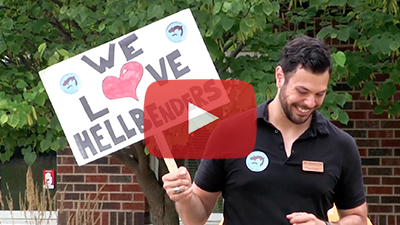 On August 29th, the Colombian Park Zoo in Lafayette hosted ‘Help the Hellbender Day’, an outreach event filled with fun and educational activities to promote awareness of this fascinating at-risk salamander. Partners in the community including Purdue University, Illinois – Indiana Sea Grant, Tippecanoe County Partnership for Water Quality, and the Wabash River Enhancement Corporation provided activities and booths to teach the community about water quality issues and how they can get involved to help the hellbender. The Salamander Tale exhibit featuring the Hellbender Havoc video game made an appearance as well.
To play the Hellbender Havoc video game visit:
Hellbender Havoc Game, Apple Store
Hellbender Havoc Game, Google Play
Perhaps the most interesting part of the day was the zoo sharing a rare glimpse of the juvenile hellbenders. As one of Purdue University’s partners the zoo is helping raise the hellbenders to increase their numbers. The three hellbenders showed in the video were hatched at the Purdue’s Aquaculture Research Lab by Professor of Wildlife Science Rod Williams and his team. They were then transferred to the zoo last spring, where they will be studied and raised until they are mature enough to be released in the wild.
Purdue FNR Extension’s Aaron Doenges filmed this exciting day at the zoo and put together a Help the Hellbender Day video featuring zoo director Ron Breeding, education coordinator Amber Frederick, and hellbender keeper Noah Shields. The FNR team returned to the zoo on October 21st for its annual Boo at the Zoo event sharing resources on hellbenders.
Resources:
Help the Hellbender Day at Columbian Park Zoo video – Purdue Extension
Help the Hellbender – Purdue Extension
Help the Hellbender Facebook page
Ask the Expert: Learn All About Hellbenders and Take a Tour, Subscribe Purdue Extension – Forestry & Natural Resources (FNR) YouTube Channel
Ask the Expert video: Help the Hellbender – Dr. Stephen Spear of The Wilds, Purdue Extension – FNR YouTube Channel
Ask the Expert video: Live with Mesker Park Zoo and Botanical Gardens – Hellbenders, Purdue Extension – FNR YouTube Channel
A Moment in the Wild video: Hellbender Hide, Purdue Extension – FNR YouTube Channel
A Moment in the Wild video: Release Moment of Hellbenders,
How Anglers and Paddlers Can Help the Hellbender video, Purdue Extension – FNR YouTube Channel
Eastern Hellbender ID Video, Purdue Extension – FNR YouTube Channel
Hellbenders Rock!, The Education Store, Purdue Extension’s resource center
Help the Hellbender, North America’s Giant Salamander, The Education Store
How Our Zoos Help Hellbenders, The Education Store
The Nature of Teaching: Adaptations for Aquatic Amphibians, The Education Store
Healthy Water, Happy Home – Lesson Plan, The Education Store
Purdue Expert: Hellbender Salamander, Purdue University News YouTube Channel
FNR Assists in First Natural Breeding of Eastern Hellbender in Captivity, Purdue FNR News & Stories
Helping the Hellbender: Mesker Park Zoo Begins Captive Breeding Efforts, Purdue Agriculture News
Purdue partners with Indiana zoos for hellbender conservation – Purdue Agriculture News
Purdue-Zoo Partnership Aims To Save The Hellbender – WFYI
Rod Williams, Professor of Wildlife Science and Assistant Provost for Engagement at Purdue University.
Purdue Department of Forestry & Natural Resources
The Wildlife Habitat Education Program (WHEP) is an environmental education program for youth ages 8-19 that teaches all about wildlife habitat and damage management through hands-on activities. This program is the largest of its kind in the nation, and has been awarded the Conservation Education Award by The Wildlife Society, the only professional organization that certifies wildlife biologists around the world.
Purdue Extension’s “WHEP – Wildlife Habitat Education Program” video takes a deeper look at the program through the testimonials of students and staff members involved with the program, including Extension Wildlife Specialist Rob Chapman and Professor of Wildlife Ecology Rod Williams.
Each year, WHEP has a national contest for its senior level (ages 14-19) youth consisting of three individual events and one team event. The first event, the wildlife challenge, consists of 30 general knowledge questions and 20 animal identifications based on skins and/or skulls. With only 30 minutes allowed for this event, it can be a challenging task.
Competitors can look to the WHEP manual for help studying for the general knowledge questions. The new publication “Wildlife Habitat Evaluation Program: Preparing for the Wildlife Challenge” assists further by providing flashcards for all of the species found on the identification questions, complete with pictures of the animal’s skins and a list of characteristics. Practicing with these flashcards is an extremely effective way to learn the material and perform better in the event.
This year’s event has come to a close, with 1st place going to Tennessee, 2nd place to Alabama, and 3rd to North Carolina. Study with the “Wildlife Habitat Evaluation Program: Preparing for the Wildlife Challenge” publication to prepare for next year!
Resources:
Wildlife Habitat Evaluation Program: Preparing for the Wildlife Challenge – The Education Store, Purdue Extension Resource Center
National WHEP Manual – Wildlife Habitat Education Program
Developing a Wildlife Habitat Management Plan – The Education Store
Wildlife Habitat Education Program – Teaching and Learning Wildlife Management Practices – The Education Store
Rod Williams, Professor of Wildlife Ecology
Purdue University Department of Forestry and Natural Resources
Rob Chapman, Extension Wildlife Specialist
Purdue University Department of Forestry and Natural Resources
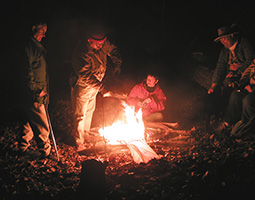 In the summer, it can be a lot of fun spending time outside and making campfires with friends and family. However, it can also be dangerous if you aren’t aware of proper safety techniques.
Smokey the Bear is here to help keep you and your family informed on the best practices while making a fire. On the Prevention How-Tos section of Smokey’s website, you can find tips on how to pick a good spot, how to build a fire pit, how to build and maintain your fire and how to extinguish it when you are done. There are also other bits of useful advice about burning debris, maintaining equipment to reduce wildfire risk and things to consider while indoors.
Take a look at Smokey’s website to make sure you are enjoying summer campfires safely!
Resources
Fire Prevention, Purdue Fire Department
Smokey Bear, National Association of State Foresters
Wildfire Prevention, National Association of State Foresters
Wildfire Safety Outreach Materials, United States Fire Administration
Let’s Have Fun with Fire Safety, United States Fire Administration
Smokey the Bear: Ad Council, National Association of State Foresters, USDA-U.S. Forest Service
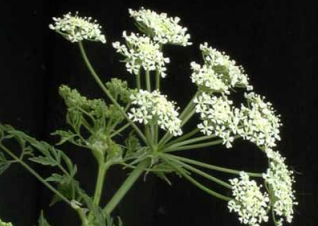
Photo credit: Pedro Tenorio-Lezama, Bugwood.org
Made infamous through the trial of Socrates, Shakespeare’s Hamlet and Macbeth, and several other works of classic literature, poison hemlock is an extremely toxic plant that will pose a risk this summer and should be handled with caution.
Poison hemlock is a biennial plant, meaning that it has a two year lifespan. Last summer, it went through vegetative growth and largely stayed out of sight. This summer, it will produce small white clusters of flowers and will be more likely to catch the attention of animals and people. Poison hemlock is a member of the parsley family and can sometimes be confused with wild carrot. However, its distinguishing feature is its hairless hollow stalks with purple blotches. If you see these, be careful!
The biggest risk with poison hemlock is ingestion. Lethal doses are fairly small, so it is important for animal owners or parents of young children to identify it in their area and remove it if possible. The toxins can also be absorbed through the skin and lungs, so be sure to wear gloves and a mask when handling these plants.
Symptoms of hemlock poisoning include dilation of the pupils, weakening or slowing pulse, blue coloration around the mouth and eventually paralysis of the central nervous system and muscles leading to death. Quick treatment can reverse the effects, so act quickly.
Resources
Invasive Plant Species Fact Sheets: Poison Hemlock, The Education Store, Purdue Extension Resource Center
Recognizing and Managing Poison Hemlock, Purdue Landscape Report
Poison Hemlock, Pest & Crop Newsletter, Purdue Extension – Entomology
Hemlock Woolly Adelgid: Distribution Update, Purdue Landscape Report
What are Invasive Species and Why Should I Care?, Purdue Extension – Forestry and Natural Resources (FNR)
Indiana Invasive Species Council
Report INvasive, Purdue Extension & Indiana Invasive Species Council
Poison Hemlock (Conium maculatum), United States Department of Agriculture (USDA)
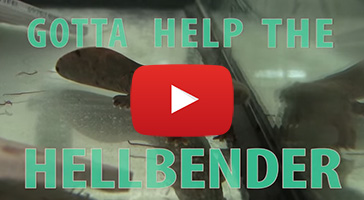 A new sing-along music video has been added to the Help the Hellbender website. This provides a fun and catchy way for teachers and students to learn about hellbenders and see the researchers hard at work helping add to their numbers.
The Help the Hellbender website also has other resources for teachers and students including lesson plans, coloring pages and a Hellbender Havoc video game. Check out the site and sing along with the hellbenders!
Resources
Help the Hellbender, Purdue Extension
Purdue Partners With Indiana Zoos for Hellbender Conservation, Purdue Agriculture News
The Nature of Teaching: Discovering the Watershed, The Education Store, Purdue Extension Resource Center
Amphibians & Reptiles, Indiana Department of Natural Resources
Purdue Extension-Forestry and Natural Resources
 Mussels are a critical part of the ecosystem and work hard to keep our rivers clean. The Tippecanoe River hosts over 45 species of mussels, including six endangered ones. Mussel populations are in decline after being harvested by the millions in the 19th and 20th centuries. In an effort to restore the mussel population and keep the Tippecanoe River clean for wildlife populations as well as recreational activity, Purdue Extension has launched a new website about mussels called Heart of the Tippy.
This site provides detailed information on mussels and what we can do to help them. For example, carrying your canoe instead of dragging it over rocky-bottomed shallow water can save mussels from being crushed. It also offers an area where visitors can take a pledge to improve the Tippecanoe’s water quality and protect its mussel habitat.
Take the pledge today and help to protect the mussels and keep the Tippecanoe clean!
Resources
Extension Website Presents Ways to Help Protect Indiana’s Endangered Mussels, Purdue Agriculture News
Tippecanoe River, Indiana Department of Natural Resources
 Indiana Department of Natural Resources (INDNR) recently received an inquiry asking what to do with an abandoned animal. The INDNR web resource titled Orphaned and Injured Animals has steps to follow as you decide if the animal is truly abandoned.
Got Nature? Orphaned Animals author Brian MacGowan, extension wildlife specialist, Purdue University, says, “In most cases, the young animal is simply ‘spreading its wings’ and exploring or mom simply left it to get something to eat. Fawn deer are programmed to hide and remain motionless while mom is away. The fact is wildlife rarely abandons their young. They may leave briefly only to return.
Remember that you should never handle wild animals unless absolutely necessary. Any animal can bite you, and many harbor diseases and pests that can be transmitted to people.
In Indiana, wildlife rehabilitators have necessary state and federal permits to house and care for sick or injured wild animals. If you think you have found a sick or injured animal, you can find a list of licensed Wild Animal Rehabilitators in your area on the DNR Division of Fish and Wildlife’s website.”
Resources
Mammals of Indiana, J.O. Whitker and R.E. Mumford
Common Indiana Mammals, R.N. Chapman and R.N. Williams, publication number FNR-413-W
Indiana DNR Orphaned and Injured Animals
The Education Store (search keywords to find the resources you need)
 The Indiana Department of Natural Resources (INDNR) has just released a new and updated application for iPhone and Android users. A successor to the previous app released in March 2011, this iteration introduces new features and DNR Director Cameron Clark calls it a “portable field guide.” The free app contains helpful information about any DNR-related properties such as forests, wildlife areas and state parks and serves as a helpful companion while planning outdoor activities. To download this app, visit iTunes for iPhone users or Google Play Store for Android users.
Resources
Indiana DNR Smartphone Apps, Indiana Department of Natural Resources
DNR Releases New, Improved Mobile Apps, WANE15
Publications and Maps, Indiana Department of Natural Resources
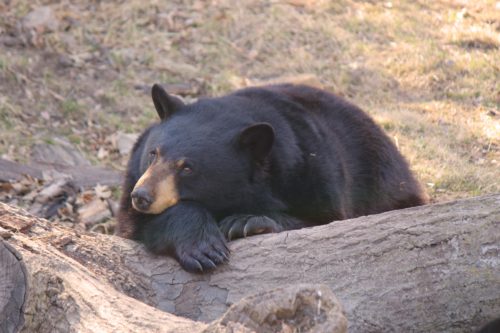 After being sighted in Indiana for the first time in 144 years on June 12 around South Bend, a second sighting of the bear has occurred in the Michigan City area, and this time, the bear has done a little bit of damage foraging for food. The bear had knocked over multiple bee hives and tore into some food at a local farm. It also bent poles holding up bird boxes, likely eating the baby birds inside.
The Department of Natural Resources is hoping the bear will return to upper Michigan on its own where the black bear population reaches around 15,000. However, they are continuing to monitor its movement and are prepared to trap it if needed.
While startling, it is important to note that black bears aren’t as dangerous as most people think. They are usually scared of humans, but it is a wise idea to move bird feeders, grills and trash cans out of your yard. If you encounter a bear, the DNR recommends standing your ground and making a lot of noise while slowly backing away. Do not turn and run. Black bears are also considered an exotic animal in Indiana, and shooting or killing one is a serious offense that can result in large fines or jail time.
Please report bear sightings to dfwinput@dnr.IN.gov or call 812-334-1137.
Resources
Black Bear, Indiana Department of Natural Resources
Black Bear Confirmed in Indiana For First Time in 144 Years, FOX59

Recent Posts
- Woodsy Owl Edition for Educational Learning, USDA – U.S. Forest Service
Posted: January 21, 2026 in Forestry, Forests and Street Trees, Got Nature for Kids, Urban Forestry, Wildlife - Unexpected Plants and Animals of Indiana: Nine-Banded Armadillo
Posted: October 27, 2025 in Got Nature for Kids, Wildlife - Question: Should You Feed Birds in Summer? Understanding the Impact on Migration
Posted: May 13, 2025 in Ask the Expert, Got Nature for Kids, Wildlife - Purdue Alumnus Magazine Highlights FNR Graduate and Nature of Teaching Program
Posted: September 13, 2024 in Got Nature for Kids, Nature of Teaching, Wildlife - Magnificent Trees of Indiana Webinar
Posted: May 12, 2023 in Forestry, Forests and Street Trees, Gardening, Got Nature for Kids, Urban Forestry, Webinar, Woodlands - “Fifty Trees of Indiana” Now Has New Name and New Additional Trees
Posted: January 13, 2022 in Forestry, Forests and Street Trees, Got Nature for Kids, How To, Urban Forestry, Woodlands - Introduction to Nature of Teaching Sneak Peek Videos
Posted: November 2, 2020 in Aquaculture/Fish, Aquatic/Aquaculture Resources, Gardening, Got Nature for Kids, How To, Land Use, Nature of Teaching, Plants, Ponds, Urban Forestry, Wildlife, Woodlands - Nature of Teaching Program Receives Environmental Education Award
Posted: October 30, 2020 in Aquaculture/Fish, Aquatic/Aquaculture Resources, Disease, Drought, Forestry, Forests and Street Trees, Gardening, Got Nature for Kids, How To, Invasive Animal Species, Invasive Insects, Land Use, Natural Resource Planning, Nature of Teaching, Plants, Ponds, Safety, Wildlife - New Publication – The Nature of Teaching: Disease Ecology
Posted: May 20, 2020 in Disease, Forestry, Got Nature for Kids, How To, Nature of Teaching, Plants, Ponds, Publication, Wildlife - Join us on Facebook LIVE – Hellbender Virtual Tour
Posted: April 20, 2020 in Forestry, Got Nature for Kids, Wildlife, Woodlands
Archives
Categories
- Alert
- Aquaculture/Fish
- Aquatic/Aquaculture Resources
- Ask the Expert
- Christmas Trees
- Community Development
- Disease
- Drought
- Forestry
- Forests and Street Trees
- Gardening
- Got Nature for Kids
- Great Lakes
- How To
- Invasive Animal Species
- Invasive Insects
- Invasive Plant Species
- Land Use
- Natural Resource Planning
- Nature of Teaching
- Plants
- Podcasts
- Ponds
- Publication
- Safety
- Spiders
- Timber Marketing
- Uncategorized
- Urban Forestry
- Webinar
- Wildlife
- Wood Products/Manufacturing
- Woodland Management Moment
- Woodlands