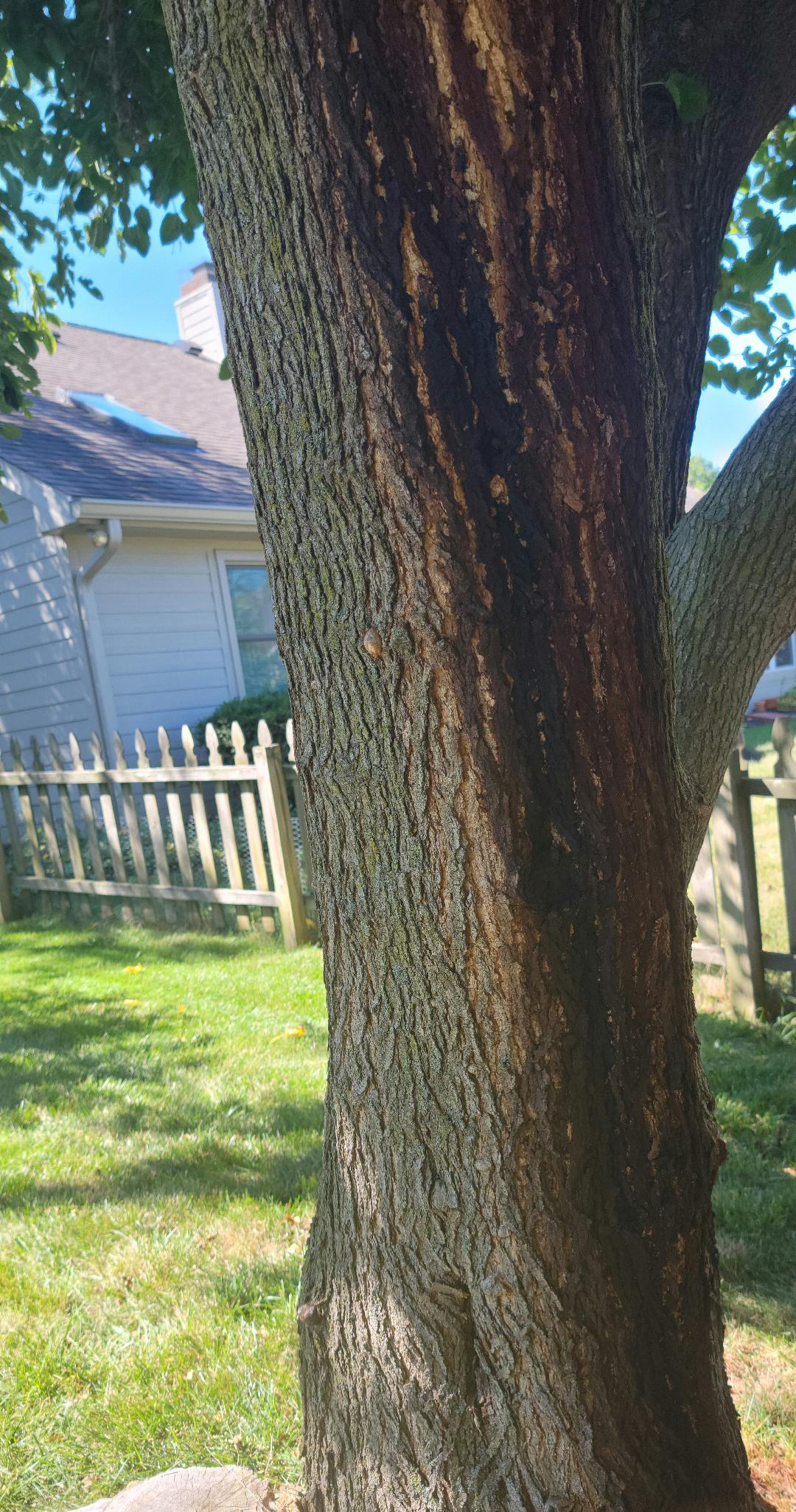
Question: We have a large 60+ foot mulberry tree in our backyard that is located by our pond. This is the first year I have seen these dark streaks on the bark of the tree. Should I have concerns?
Answer: From the photos, it looks like wet wood/slime flux is affecting your tree. It is a bacterial infection on trees and in most cases is not a serious issue, but unfortunately, there is nothing to be done about it. Many years ago they used to drill holes to try and allow gases and liquids drain from an area with the slime flux but through research and experience this practice is not recommended.
The Purdue Landscape Report titled Slime Flux of Trees shares more about this disease:
Slime flux (also known as wet wood) is a dark, foul-smelling and unsightly seepage of sap from tree trunks. The disease is not usually a serious problem but the appearance can be alarming. Slime flux is caused by common surface-inhabiting bacteria or yeast fungi that enter the trunk through wounds associated with improper pruning, stem breakage, injections, cracks from freeze injury or weak limb crotches. The bacteria and yeast may live on sap nutrients within injured trees for many years without any outward evidence.
Symptoms
The main symptom is the appearance of the dark sap oozing on the trunk exterior which happens when gasses produced by growth of the bacteria and yeast cause the internal pressure of the sap to become high enough to force the sap out through cracks in the bark. The dark streaks usually turn light gray or white upon drying. Oozing sap may be frothy and white at the point of exit. Airborne bacteria, yeasts, and fungi often colonize the wet oozing material, which ferments and releases a foul odor. Slime flux may delay wound healing (callus formation).
Lenny Farlee, sustaining hardwood Extension specialist for Purdue’s Department of Forestry and Natural Resources (FNR), has been named a 2024 Fellow of the Society of American Foresters (SAF). The SAF Fellow Award, one of the highest honors bestowed on an SAF member by their peers, recognizes long-standing service to forestry at the local, state, regional and national levels.
Farlee was honored with the award during the 2024 SAF National Convention, which took place in Loveland, Colorado from Sept. 17-20.
Zhao Ma accepts the 2024 Family Forests Education Award on behalf of Lenny Farlee and the other project team members.
“Being named a Fellow of the Society of American Foresters is particularly meaningful to me since it originates from a nomination by my peers at the state level,” Farlee said. “I am very grateful that my colleagues in forestry here in Indiana considered my service worthy of recognition, and I owe much of the credit to them for their support of me through my career. It has been my privilege to serve the people and the profession as an Extension forester here at Purdue.”
Farlee educates people about forestry in many ways, including through the popular Extension YouTube series “ID That Tree,” which has over 100,000 views.
Farlee, Ronald Rathfon, Don Carlson, Jonathan Ferris,Dave Osborne and Phil Woolery worked together to develop the course. The course introduces forest landowners to the biology and management of forests and what resources and professional assistance are available. According to survey results from 2021 participants, “94.4% stated that the information was useful to help them make future decisions and 92.5% stated that the information was useful to help act to manage their property objectives.”
“We in FNR, along with forestry professionals in Indiana and the landowners who have communicated with Lenny and his colleagues through the ‘Forest Management for the Private Woodland Owner’ course, know how valuable this program has been to sustainable forest management in Indiana,” said Zhao Ma, interim department head and professor of forestry and natural resources. “So it is absolutely wonderful when others outside of our FNR community and beyond Indiana also recognize the excellent work that Lenny and his colleagues have been doing…, I would also like to share one more note about Lenny – not only has Lenny been a highly valued and respected member of FNR and the forestry profession for many years, but he is also one of the nicest people I have met. He is knowledgeable yet humble, effective yet gentle, serious about his work yet able to have fun, very busy yet always willing to help others and try to be present. We are lucky to have Lenny as our colleague in FNR.”
Purdue Landscape Report: August was National Check Your Tree Month, but this is something that every tree owner/manager should be doing year-round. As the last hot days of summer are finishing up and we look forward to cooler fall days, we can look to our trees for different signs of trouble.
Most people tend to look up at the canopy before anything else in trees. Check leaves for dieback, discoloration, stickiness or signs of chewing. Check branches and the main stem for damage like splits and breaks, peeling bark, tunneling patterns under the bark, oozing wet spots, or sawdust around the tree. These could be signs of issues in the root system, pathogens like bacteria or fungal organisms, insect problems, or structural damage.
This is not an exhaustive list and if you notice these or anything else that seems off, it could be time for a deeper dive into what might be wrong. If you know the species of your tree the Purdue Plant Doctor is a great tool to narrow down a diagnosis. You can also contact your local Extension office or an ISA Certified Arborist.
On a more positive side, you don’t have to be on the lookout for damage, decline, or signs of pathogens and pests. It is also a matter of enjoying the trees in your landscape. Take some time out of your day to sit in the shade especially as we transition from hot summer temperatures into the cooling of autumn. Revel in the color changes as chlorophyll production slows revealing the carotenoids (that give us yellows, oranges, and browns) and anthocyanin (that produces reds and purples). In winter, not only can you better see damage in the canopy hidden by leaves in the growing seasons, but also the structure and architecture of the canopies in different tree species and the differences in bark textures. And in Spring, new growth of leaves and flowers shows us Winter is nearing its end, bringing warmer days.
So check your trees throughout the year. But not only for potential issues and risk management but also for enjoyment. Trees offer us no many benefits and sometimes it takes a little reminder. If you do see any signs of decline or damage, again, be sure to contact your local Extension office or an ISA Certified Arborist.
Photo by Division of Entomology & Plant Pathology, Indiana Department of Natural Resources.
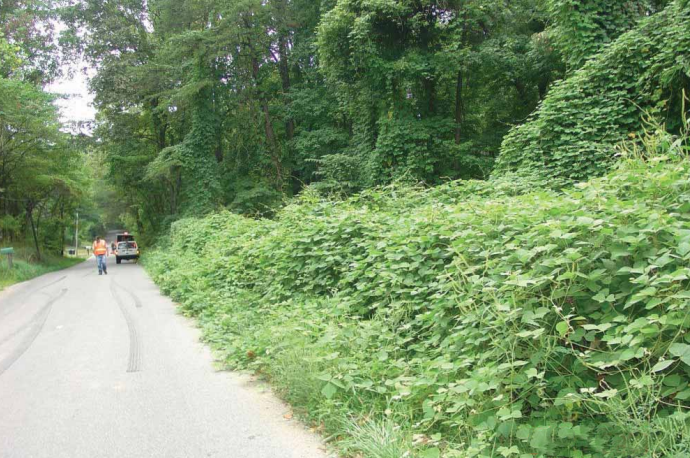
Weekly Review, Division of Entomology & Plant Pathology, Indiana DNR: Will Drews, Indiana Department of Natural Resources (DNR) Nursery Inspector & Compliance Officer with the DNR Division of Entomology & Pathology shares in September Weekly Review e-newsletter how staff will continue to help coordinate kudzu control throughout the state and expands upon the state funded kudzu control program.
As some of you may know, kudzu (Pueraria montana var. lobata) is an invasive woody vine that can now be found throughout the state of Indiana. It is referred to colloquially as “the vine that ate the south,” and if you took a drive through some southern states (e.g. Tennessee, Georgia, the Carolinas, etc.) right now, you’d see why. Kudzu has tremendous growth potential, sometimes as much as 1 foot per day. Some vines reach lengths of up to 100 feet. Because of this it is a detriment to Indiana’s natural resources, kudzu has been listed as a prohibited invasive plant under the DNR’s Administrative Code as per 312 IAC 18-3-16 Control of kudzu.
While part of the language includes that the landowner “must take efforts to eliminate this species in such a manner as is consistent with federal and state law,” the Division of Entomology & Plant Pathology have been leading a state funded control program where sites are treated on a rotating, priority basis to eradicate or suppress further spread with no cost to the landowner. Over the last month, around 40 kudzu sites in Indiana have been treated and we have seen some great progress from last year.
If you think you have seen a new kudzu population, please send me that information (photos and GPS coordinates or address) at my email address provided below. A couple of the sites treated this year are new reports from last year that we were able to address. With your help, we can try to reduce the impact of this incredibly invasive vine and protect our natural resources.
Will Drews, Nursery Inspector & Compliance Officer, Division of Entomology & Plant Pathology, WDrews@dnr.IN.gov
Indiana Department of Natural Resources (IN DNR)
MyDNR,Indiana’s Outdoor Newsletter: Hunters can apply for reserved hunts at on.IN.gov/reservedhunt, the one-stop information spot for the hunts. The online method is the only way to apply. No late entries will be accepted. Applicants must possess a hunting license that’s valid for the hunt for which they apply.
Applications must be submitted by 11:59 p.m. ET on Sunday, Sept. 15. More specific hunt information for individual properties is available on the website.
Hunters will be selected through a random computerized drawing. An email will be sent to all applicants when draws have been completed. Applicants will be able to view draw results online within two weeks after the application period closes.
Please note that only one application per hunt is allowed. No changes can be made once an application is submitted. The application process is now consolidated into the online services website along with licenses, CheckIN Game, and HIP registration. An online account is not required to apply, but a Customer ID number is needed.
In this system, hunts without a registration fee will follow the same process as those with a fee. Applicants must add a hunt to their cart and place an order to submit their application. If the transaction total is $0, the applicant will not be asked to enter credit card information.
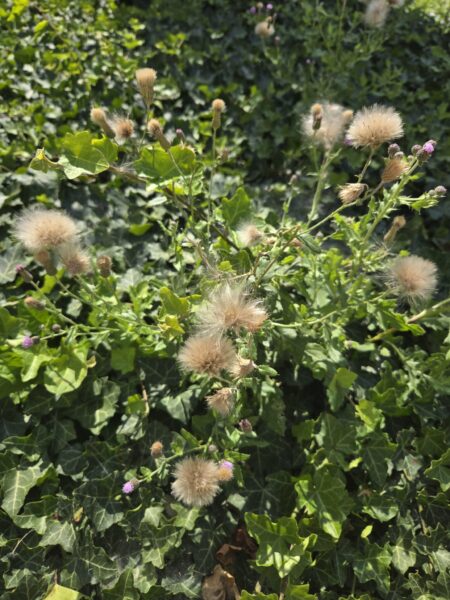
Purdue Landscape Report: As summer comes to a close, plants are rapidly releasing seeds and the most noticeable are the flying fluffy type. Thistles, asters and milkweed are just a few of the summer-flowering plants that depend on the wind to disperse their seeds, sometimes carrying them miles away to potentially suitable locations, though seeds typically land within a few meters of the mother plant. This may not be a concern if it’s a desirable plant, but can become extremely problematic when that seed comes from Canada Thistle (Cirsium arvense) (Fig. 1).
Figure 1. Canada thistle (Cirsium arvense), growing amongst common ivy (Hedera helix), produces a fluffy seed that is dispersed by wind.
Canada thistle is found on the list of Indiana Noxious Weeds (IC 15-16-7-2), which mandates that landowners take necessary steps to control and contain the spread of this highly invasive species. Formal enforcement of this Indiana Code falls to Township Trustees, though weed control is a responsibility that is often overlooked. Landowners and homeowners shouldn’t wait for a notice, or knock at the door, from a Township Trustee to begin controlling Canada thistle. It’s listed as a noxious weed for good reason.
Canada thistle is a perennial plant that can reproduce from seed or rhizomes making it difficult to control and contain. Each plant can produce thousands of wind-blown seeds that may remain viable for up to 20 years in the soil. Rhizomes are horizontal underground stems that can grow several feet and put out new shoots (Fig. 2). To add insult to injury, if a rhizome is cut or tilled, a separate plant may grow from each piece of rhizome.
Mechanical and cultural control options for Canada thistle are limited and may reduce plant density, but are not effective at eradicating large, established populations in a landscape. A new population, without an established root system, may be controlled with frequent mowing to deplete food reserves and prevent seed production.Small, isolated populations may be controlled with hand-pulling, but this will need to be repeated every few weeks.
Figure 2. Canada thistle (Cirsium arvense) reproduces by growing horizontal underground stems called rhizomes. Rhizomes can send up new shoots several feet from the mother plant.
Chemical control options include pre- and post-emergent herbicides and, in many cases, applications of both types are needed for complete eradication. A pre-emergent herbicide, with an active ingredient of dichlobenil, is effective at preventing seed from germinating, but will not control established plants. A post-emergent herbicide with the active ingredient of clopyralid is the most effective option for home gardeners. Clopyralid is a selective herbicide for broadleaf weeds, but most vegetable and ornamental plants are susceptible. Precautions should be taken to avoid off-target damage. Read and understand the herbicide label before use. The label is the law.
Regardless of the method used, complete control of an established Canada thistle population will take persistence over multiple seasons. If the fluffy seed is beginning to fly from your thistle patch, it will likely take many more seasons to rid the garden of this pest, but it is possible. To win the battle against Canada thistle, it takes serious grit and an effective herbicide, or a good realtor.
Purdue Landscape Report: There have been a significant number of questions and problems regarding triclopyr that have come up this growing season.
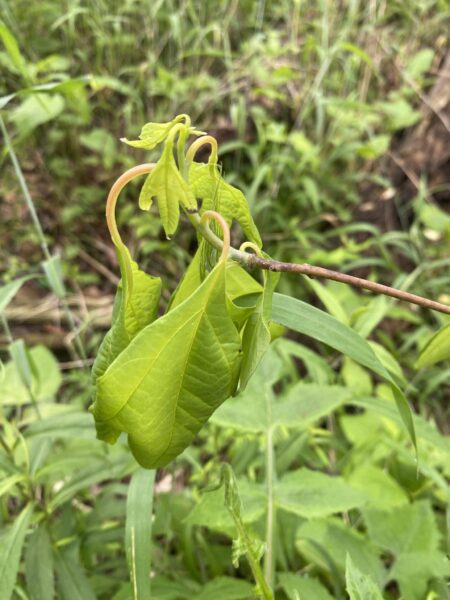
Figure 1. Confirmed damage from triclopyr on sassafras shows the growth regulator-type injury on leaves. Photo courtesy of the Office of the Indiana State Chemist.
General Information about Triclopyr Triclopyr is a selective systemic herbicide belonging to the pyridine class. It is primarily used to manage woody plants, vines, and some broadleaf weeds. Unlike glyphosate, a broad-spectrum herbicide, triclopyr specifically targets the growth hormones in dicotyledonous plants, making it effective in controlling species that are difficult to manage with other herbicides. It works by mimicking plant hormones, disrupting normal growth processes, and leading to the death of the treated plant (Fig. 1).
What Triclopyr Controls Triclopyr is utilized in various settings to control unwanted vegetation. It is effective against species such as:
Woody Plants: Includes trees like tree of heaven and callery pear and shrubs like autumn olive and honeysuckle (Fig. 2).
Vines: Particularly those that can outcompete native flora, such as kudzu or English ivy (Fig. 3).
Broadleaf Weeds: Some herbaceous plants that pose ecological or agricultural problems.
Figure 2. Invasive plants, such as, Pyrus calleryana (callery pear) can be controlled by triclopyr.
Figure 3. Invasive vines, such as Hedera helix (English ivy) can be controlled via multiple applications of triclopyr.
Where and When Triclopyr is Used Triclopyr is applied in a range of environments, including:
Forestry: To clear invasive species and manage forest regeneration.
Agriculture: To control weeds and shrubs that interfere with crop production.
Aquatic Areas: Formulations that are safe for aquatic environments help manage invasive species near water bodies.
Rights-of-Way: To maintain clear paths and prevent the spread of invasive plants.
Timing of application is crucial. Triclopyr is most effective when applied during the growing season when plants are actively taking up nutrients and can transport the herbicide throughout their system.
Figure 4. Hack and squirt treatments with triclopyr is a common method to control invasive trees. Photo by Lenny Farlee.
Movement in the Plant Triclopyr is absorbed through foliage and roots and is translocated systematically within the plant. Once inside, it moves upward through the xylem and downward through the phloem (ambimobile). This systemic movement allows triclopyr to affect not just the treated areas but also parts of the plant that are not directly sprayed. This attribute makes it effective for managing large, established plants, specifically through hack and squirt treatments (Fig. 4).
Purdue Landscape Report: Early June, we received a white pine sample at the Purdue University Plant and Pest Diagnostic Lab that showed early season needle loss lower in the tree canopy (Figure 1, 2). The majority of conifers hold onto their needles for multiple years, so loss of needles, even in the fall, can come as a shock to homeowners. In this particular case, we found multiple fungi that could be contributing to needle blight or needlecast.
Figure 1: Eastern white pine trees with early season needle loss.
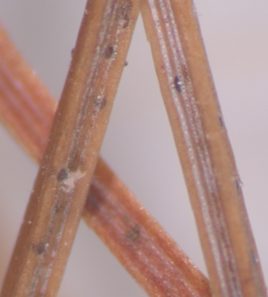
Figure 2: Closeup images of white pine with needlecast. Multiple fungi were present: Lophodermium, Lecanosticta, and, Septorioides. Note, primarily the older needles have been affected. New needles appear green and healthy.
The first two fungi were determined to be relatively common pathogens for Indiana: Lophodermium and Lecanosticta (brown spot). Symptoms appeared relatively typical for these pathogens where the needles turned brown over-time. However, there were other needles in the canopy and on the sample that had a lighter coloration. We found small black fungal structures dotted along the length of these needles producing light colored cirrhi (also called spore horns) (Figure 3). After examining the fungal spores, isolating the fungus, and performing DNA testing, we determined this third fungus to be Septorioides strobi, the causal agent of Septorioides needle blight of pines. This fungus has been determined to be a contributor to white pine needle damage/defoliation.
Figure 3: Black fungal structures developing on dead needles with white sporulation exuding from the top.
White pine needle damage/defoliation (WPND) was first observed in the state of Maine in 2010 and was attributed to three needle blight diseases, including Lecanosticta, and has since been observed throughout the Northeast US. However, researchers eventually determined that a new fungus, Septorioides strobi, was also found consistently in blighted needles and could be contributing to WPND.
This is the first time we have found this fungus in the state of Indiana, though it has been present for longer than a single season. We do not know how it will react to our climate nor if it will cause significant damage to affected trees. Like other needle blight pathogens, Septorioides has been observed to sporulate around the same time during humid, wet weather, but symptoms may not develop until the following year. White pines are the primary host for this needle cast disease, but it can also develop on 2, 3, and 5 needle pines. While we see white pine decline is a major problem, Septorioides will not likely be the final nail in the coffin for white pines in Indiana, though it certainly will not help us keep them healthy.
MyDNR,Indiana’s Outdoor Newsletter: As a result of Indiana’s positive detection of chronic wasting disease (CWD) in LaGrange County in April, Indiana DNR has restricted moving deer from any CWD Positive Area for rehabilitation purposes.
With the change, an individual who finds an orphaned, sick, or injured deer in a CWD Positive Area may only surrender the deer to a DNR-permitted wild animal rehabilitator that is located within a CWD Positive Area. This restriction is to help minimize the spread of CWD to new parts of the state, as deer can carry this disease without appearing sick.
Currently, there is one CWD Positive Area in Indiana. It includes LaGrange, Steuben, Noble, and DeKalb counties. While no CWD positive deer have been documented in Steuben, Noble, or DeKalb counties, those counties are considered part of the CWD Positive Area because of their proximity to where the state’s first CWD-positive deer was found in LaGrange County.
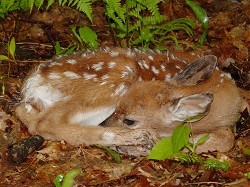
During their first few weeks of life, fawns often hide by themselves and stay motionless to avoid predators while the mother is looking for food. If you find a fawn alone, you can help it by letting it be, giving it space, and leaving the area. Its mother is likely nearby.
How does forest management affect wildlife, specifically birds? Which birds prefer which types of forest habitat? How can you help birds thrive on your property?
The Forestry for the Birds Virtual Tour is a new tool developed by Purdue Forestry and Natural Resources and Purdue Extension, which offers answers to those questions and more in an easily digestible and visual format. The virtual tour is based on The Nature Conservancy’s Forestry for the Birds program.
The virtual tour is an interactive guide to forest management techniques and birds in the forest that features 360-degree images, including several taken on eight Purdue FNR properties across the state. Bird identification resources from Cornell Lab of Ornithology’s Macaulay Library, forest management resources from Purdue Extension and more make the tour come to life and allow landowners to improve their identification and management skillsets.
Young conducted breeding bird surveys and made recordings of all the species she encountered whether audibly or visually last summer. She utilized a GoPro Max to capture 360-degree images of the properties she surveyed. Song Meter Mini acoustic monitors allowed her to capture various bird songs, which are incorporated into the background of some of the virtual scenes of the tour. Still camera images also provide stunning visuals of each property and bird type.
“I think my favorite thing about the tour is that when you are exploring each scene, it really feels like you are there,” Young explains. “I want folks who may not be able to visit our properties to feel like they are right there, inside the scene, while learning a thing or two about bird conservation and managing our forests for our rapidly declining feathery friends.”
Young is quick to note, however, that it is much easier to spot the birds she added to each scene of the tour than when trying to look for them during surveys, when they are often hiding behind the leaves in the canopy.
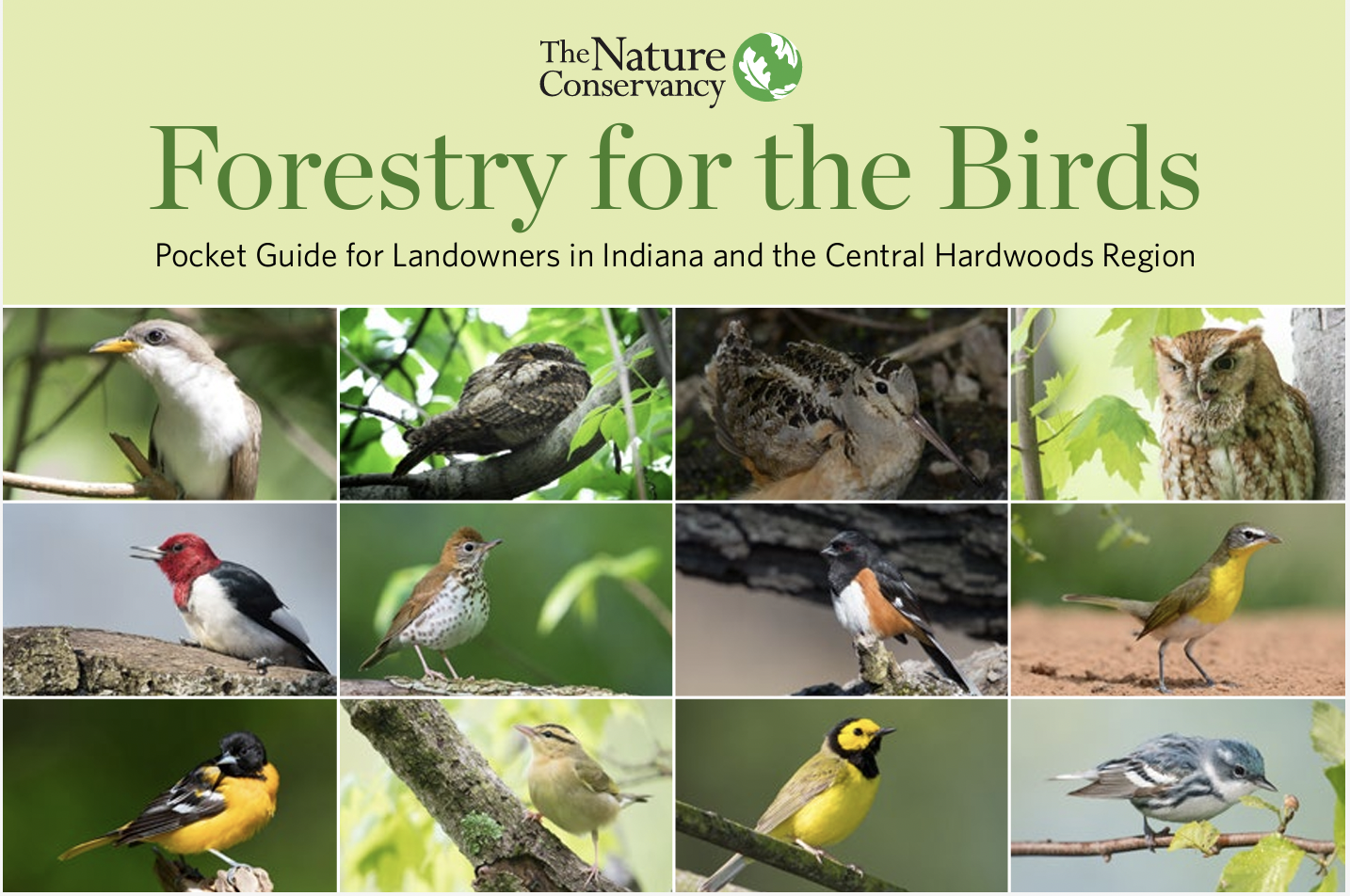
Forestry for the Birds is a project developed by the Indiana Chapter of The Nature Conservancy, which provides foresters and private landowners with the information and tools needed to enhance their forests in a way that fosters thriving bird communities. Many resources, including the Forestry for the Birds pocket guides, focus on the “Birders’ Dozen,” or 12 bird species which nest in the Central Hardwood ecoregion of Indiana that are easy to identify by sight and/or sound, and need conservation action to assist with range-wide or local population declines. The Birders’ Dozen species were selected by The Nature Conservancy and an independent group of birders, ornithologists and conservationists.
The virtual tour focuses on how different forest stewardship practices and forest types can benefit a variety of bird species, including the Birders’ Dozen. In each scene, there are three or more bird species to look for, recorded bird songs which are representative of what you could hear in that scene, interactive icons that link to images and videos and an audio description of the scene.
“I’m excited to see this virtual tour come to fruition – it provides some depth of information to complement the Forestry for the Birds Pocket Guide and Silvicultural Guide,” said Jessica Outcalt, Purdue Extension Educator, who helped develop the Forestry for the Birds materials for TNC. “I especially appreciate the visuals and audio that can’t be communicated via printed materials, and how this tour captures the sense of being in a forest that will make the material accessible to a wider audience.”
The properties shown illustrate a variety of forest stewardship techniques ranging from single tree selection to group tree selection, shelterwood, clearcut, oak woodland restoration and prescribed fire. The tour also highlights both young forests and mature closed-canopy forests.
*Bird species listed above with links will take you to the Indiana Woodland Steward website as they share highlights with this information in “The Birders’ Dozen Profile” written by Jessica Outcalt.
The American Woodcock, Wood Thrush and Cerulean Warbler are listed on the National Audubon Society watchlist, while the Cerulean warbler is state endangered in Indiana. The Eastern Whip-poor-will, American Woodcock, Worm-eating Warbler and Hooded Warbler have been noted as species of special concern by the Indiana Department of Natural Resources Division of Fish and Wildlife.