 Purdue University - Extension - Forestry and Natural Resources
Got Nature? Blog
In this edition of ID That Tree, meet River Birch. As its name implies, it is often found near waterways and in moist soil areas across the state of Indiana. It can be multi-stemmed, often in landscaping, or single stemmed, often in woodlands and bottomlands. Simple triangular-shaped leaves with doubly-serrated margins and flaking/peeling bark are key identifiers. In younger trees, the bark peels more and can range from chalky white to reddish brown. Bark on older trees is darker gray/brown and peeling is less prominent.
If you have any questions regarding wildlife, trees, forest management, wood products, natural resource planning or other natural resource topics, feel free to contact us by using our Ask an Expert web page.
Resources:
ID That Tree, Playlist, Purdue Extension – Forestry and Natural Resources YouTube Channel
A Woodland Management Moment, Playlist, Purdue Extension – FNR YouTube Channel
Shrubs and Woody Vines of Indiana and the Midwest, The Education Store, Purdue Extension Resource Center
Native Trees of the Midwest, The Education Store
Investing in Indiana Woodlands, The Education Store
Forest Improvement Handbook, The Education Store
River Birch-Native Trees of Indiana River Walk, Purdue University Fort Wayne
Lenny Farlee, Sustaining Hardwood Extension Specialist
Purdue University Department of Forestry and Natural Resources
Purdue Landscape Report – Tip Blights of Juniper: Junipers have to be my favorite group of evergreens, behind a select few pine species. They have a fantastic fragrance, are evergreen, many can tolerate drought, are an ingredient in gin (definitely a bonus), and work well in a variety of landscape uses, including as a barrier plant. They look great year round, except when they have tip blight.
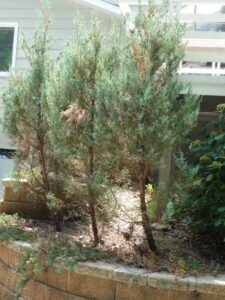
Juniper with tip blight symptoms in the landscape
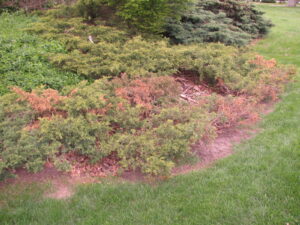
Phomopsis tip blight affecting multiple juniper branches
Tip blight is a common disease in nurseries and landscapes that cause branch tips to die back fairly quickly starting in the spring. Infected branches become chlorotic, progressing from light green to yellow, before turning brown as the season continues. Black fungal structures will develop in the transition zone between affected foliage and green, healthy tissue. Some of the infected scales may turn gray in color, surrounding these structures.
Two fungi cause tip blight, Kabatina and Phomopsis, and knowing which one you have is important to determine your management strategies. Both fungi produce similar symptoms and similar fungal structures,
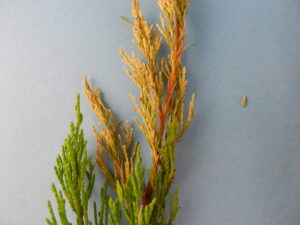
Branch tips turning pale yellow due to infection by Kabatina.
so the presence of tiny black dots cannot help separate these diseases. Both fungi also infect a range of hosts, including arborvitae, cypress, Douglas fir, true firs, yew, Cryptomeria, and Chamaecyparis, but these are not as susceptible as juniper species.
Kabatina infects young, new growth during the growing season, but infected twigs remain green until winter and the following spring . . .
Resources:
Borers of Pines and Other Needle Bearing Evergreens in Landscapes, The Education Store, Purdue Extension resource center
Ask an Expert Question: Blue Spruce dying, what can I do?, Got Nature? Blog, Purdue Extension – Forestry and Natural Resources
Why Spruce Trees Lose Their Needles, Purdue Extension
Diseases Common in Blue Spruce, Purdue Extension
Purdue University Invasive Species
John Bonkowski, Plant Disease Diagnostician
Purdue Botany and Plant Pathology
In this episode of ID That Tree, Purdue Extension forester Lenny Farlee introduces the blue ash. This native Indiana ash species can be differentiated from other members of the ash family by corky edges on the twig, more branches lower on the stem and a platy, ashy gray bark.
If you have any questions regarding wildlife, trees, forest management, wood products, natural resource planning or other natural resource topics, feel free to contact us by using our Ask an Expert web page.
Resources:
ID That Tree, Playlist, Purdue Extension – Forestry and Natural Resources Youtube Channel
A Woodland Management Moment, Playlist, Purdue Extension – FNR Youtube Channel
Shrubs and Woody Vines of Indiana and the Midwest, The Education Store, Purdue Extension Resource Center
Native Trees of the Midwest, The Education Store
Investing in Indiana Woodlands, The Education Store
Forest Improvement Handbook, The Education Store
Lenny Farlee, Sustaining Hardwood Extension Specialist
Purdue University Department of Forestry and Natural Resources
This native tree comes with its own defense system in very large thorns on the stems and trunk. Meet the honey locust. Purdue Extension forester Lenny Farlee explains that large, long yellow seed pods that resemble bean pods, the option of single or doubly compound leaves on the same tree and smooth gray bark also help identify this species.
If you have any questions regarding wildlife, trees, forest management, wood products, natural resource planning or other natural resource topics, feel free to contact us by using our Ask an Expert web page.
Resources:
ID That Tree, Playlist, Purdue Extension – Forestry and Natural Resources Youtube Channel
A Woodland Management Moment, Playlist, Purdue Extension – FNR Youtube Channel
Shrubs and Woody Vines of Indiana and the Midwest, The Education Store, Purdue Extension Resource Center
Native Trees of the Midwest, The Education Store
Investing in Indiana Woodlands, The Education Store
Forest Improvement Handbook, The Education Store
Lenny Farlee, Sustaining Hardwood Extension Specialist
Purdue University Department of Forestry and Natural Resources
This native Indiana tree species is found in three southwestern counties near the lower Wabash River. It is often found in wet or ponded locations where there is standing water or high water tables. Meet water locust. It has large multi-pronged thorns and compound leaves like its cousin the honey locust, but can be differentiated by its location, its much smaller seed pods and its flattened thorns along the branches.
If you have any questions regarding wildlife, trees, forest management, wood products, natural resource planning or other natural resource topics, feel free to contact us by using our Ask an Expert web page.
Resources:
ID That Tree, Playlist, Purdue Extension – Forestry and Natural Resources Youtube Channel
A Woodland Management Moment, Playlist, Purdue Extension – FNR Youtube Channel
Shrubs and Woody Vines of Indiana and the Midwest, The Education Store, Purdue Extension Resource Center
Native Trees of the Midwest, The Education Store
Investing in Indiana Woodlands, The Education Store
Forest Improvement Handbook, The Education Store
Lenny Farlee, Sustaining Hardwood Extension Specialist
Purdue University Department of Forestry and Natural Resources
If you have ever noticed acorns so numerous that you could not take a step without crushing several, you may be asking the question, “why are there so many acorns?” Some answers to this question can be found in the physiology and ecology of trees and their relationship to wildlife. Oaks and several other tree species occasionally produce enormous crops of seed. This is called “masting” or “mast events”. These events are periodic. In the case of many oak species, a large mast event may happen every two to five years, depending on the species of oak and several other factors. Masting events may be preceded and followed by small or moderate acorn crops, or complete crop failures in some cases. Why does this irregular seed production happen? These events may be tied to several aspects of the life of oaks.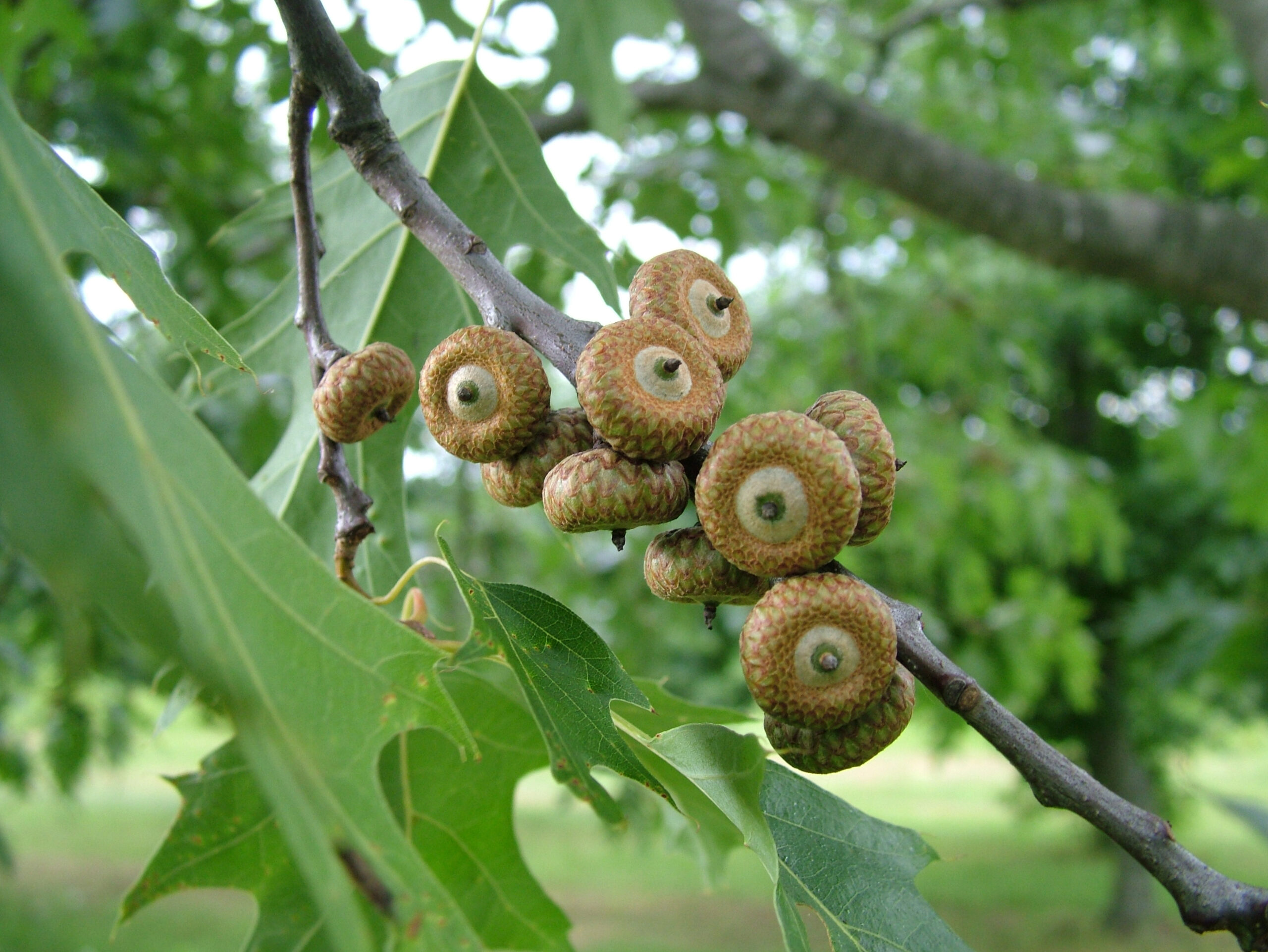
First, the production of a huge volume of a large seed like an acorn requires a lot of resources from the tree. This level of production may not be possible for the tree every year. Trees allocate energy to several different functions, so committing large amounts of energy to one area could mean deficits in others. This may mean there are advantages for the tree to produce occasional, rather than annual, mastings.
Second, weather does not always cooperate to provide the conditions for a bumper acorn crop. Unfavorable weather during pollination and seed development periods can result in reduced production of acorns. Late spring freezes, extremely high temperatures, summer droughts and other weather stresses can reduce acorn pollination and production.
Third, predation by seed-eaters like squirrels, deer, turkey and even weevil larvae can greatly reduce the number of viable acorns. It may take a very large acorn crop to have many acorns escape from the numerous species that depend on acorns for food.
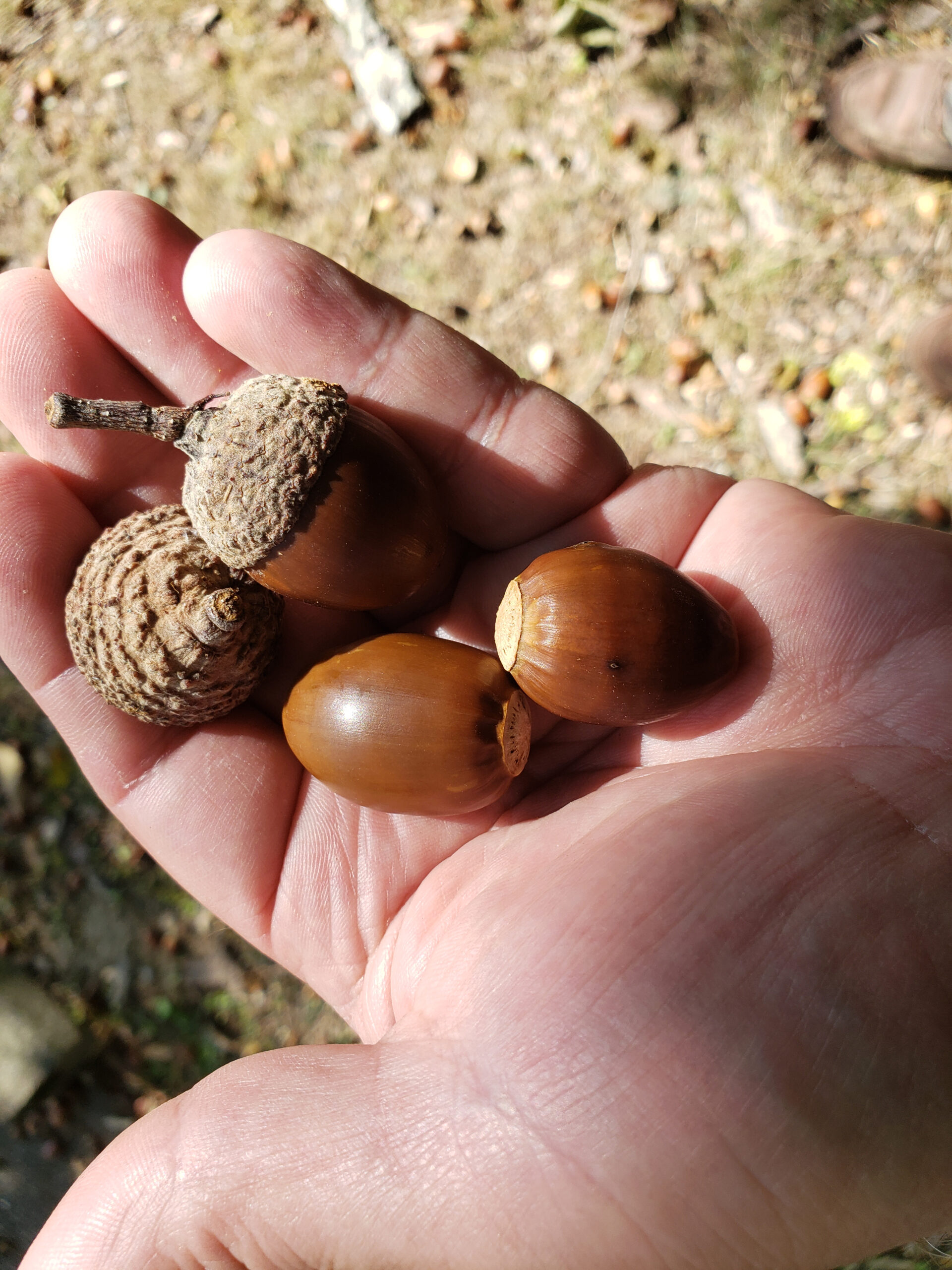
This irregular cycle of large crops can be beneficial for the oaks by overwhelming the seed eaters. Populations of wildlife that depend on acorns may eat most of the seed during normal seed crops, but may not be able to utilize all the seed produced during a masting. This surplus seed is available produce the next generation of oak seedlings.
However, some species will produce copious amounts of the mast if the developmental age of the tree is favorable, regardless of conditions.
Acorn production can vary by species and individual trees across the oak family, but masting is a way this important group of trees can continue to be a part or our Midwestern landscape.
Resources:
Woodland Management Moment: Direct Seeding, Purdue Extension – Forestry and Natural Resources (FNR) YouTube Channel
Ask an Expert: Tree Selection and Planting, Purdue Extension – Forestry and Natural Resources (FNR) YouTube Channel
Forest Improvement Handbook, The Education Store, Purdue Extension resource center
Native Trees of the Midwest, The Education Store
Investing in Indiana Woodlands, The Education Store
Tree Pruning Essentials, The Education Store
Lenny Farlee, Sustaining Hardwood Extension Specialist
Purdue University Department of Forestry and Natural Resources
Lindsey Purcell, Chapter Executive Director and Certificate Liaison
Indiana Arborist Association
On this edition of ID That Tree, Purdue Extension forester Lenny Farlee introduces you to one of our common bottomland trees, the Eastern Cottonwood. This tree stands out for its triangular or delta shaped leaves, often with prominent teeth along the edges, which extend from long flattened leaf stems. This native tree is named for its early season fruit, which is a little tuft of white hairs that holds a small seed that is produced in large quantities and often blown far from the parent tree.
If you have any questions regarding wildlife, trees, forest management, wood products, natural resource planning or other natural resource topics, feel free to contact us by using our Ask an Expert web page.
Resources:
ID That Tree, Playlist, Purdue Extension – Forestry and Natural Resources Youtube Channel
A Woodland Management Moment, Playlist, Purdue Extension – FNR Youtube Channel
Shrubs and Woody Vines of Indiana and the Midwest, The Education Store, Purdue Extension Resource Center
Native Trees of the Midwest, The Education Store
Investing in Indiana Woodlands, The Education Store
Forest Improvement Handbook, The Education Store
Lenny Farlee, Sustaining Hardwood Extension Specialist
Purdue University Department of Forestry and Natural Resources
Prescribed or targeted grazing has been used on Western rangelands for many years to manage range weeds and is also used to reduce fuel and maintain fire breaks in high fire hazard areas. It has also been used in the south to help control kudzu.
In a recent study, Purdue Extension forester Ron Rathfon tested goat grazing as a method to control a continuous stand of mature, dense multiflora rose in the understory of one of the timber stands at the Southern Indiana Purdue Agricultural Center (SIPAC). After the steep slope resisted a few rounds of prescribed fire and conventional methods like cutting and spraying were deemed impractical due to the terrain and the thick growth of thorny rose, Rathfon decided to give the animals a try at reducing the invasive species.
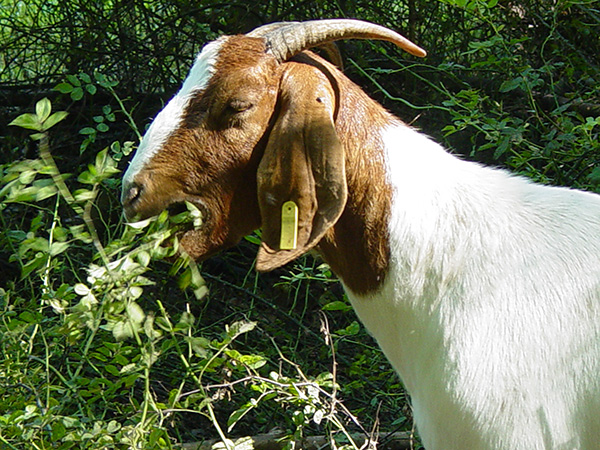
The results of Rathfon’s five-year experiment were recently published in the journal Restoration Ecology (Volume 29, Issue 4, May 2021) in an article titled “Effects of prescribed grazing by goats on non-native invasive shrubs and native plant species in a mixed hardwood forest.” Rathfon co-authored the publication with professor of forest ecology Dr. Mike Jenkins, and master’s degree alumna Skye Greenler.
“Although prescribed grazing is not new, no research has been published demonstrating its use for invasive brush species management in eastern hardwood forests and quantifying its impacts on native vegetation,” Rathfon explained. “The goal was to test the use of the goats to control invasive woody brush species as a first step in restoring degraded hardwood forests. I anticipated the goats would reduce understory plant cover. What I didn’t know is how long it would take or whether native vegetation would be more severely impacted than the targeted invasive plants.”
Rathfon and his cohorts varied the goat stocking rate (16 vs. 32-48 goats per acre) and also the number of times a plot was grazed during a growing season (once or twice). Goats were not left in the woods continuously throughout the growing season. When they consumed all green leaves, they were removed, to prevent serious long-term damage to the trees, which had occurred with past livestock grazing in woodlands.
Resources:
What are invasive species and why should I care?, Purdue Extension-Forestry and Natural Resources Blog
Invasive Plant Series: Swallow-worts, The Education Store, Purdue Extension resource center
Mile-a-Minute Vine, The Education Store
Planting Forest Trees and Shrubs in Indiana, The Education Store
Invasive Species Playlist, Purdue Extension-Forestry and Natural Resources YouTube Channel
Report Invasive Species, Purdue Invasive Species
The GLEDN Phone App – Great Lakes Early Detection Network
EDDMaps – Early Detection and Distribution Mapping System
Indiana Department of Natural Resources: Invasive Species
Indiana Invasive Species Council
Cooperative Invasive Species Management Area (CISMA)
Wendy Mayer, FNR Communications Coordinator
Purdue University Department of Forestry and Natural Resources
In this episode of A Woodland Management Moment, Purdue Extension forester Lenny Farlee talks about crop tree release, the process of selecting timber crop trees that help meet your management objectives and managing the area around them in order to allow your selected trees to thrive in the stand.
If you have any questions regarding trees, forests, wildlife, wood products or other natural resource topics, feel free to contact us by using our Ask an Expert web page.
Resources:
A Woodland Management Moment, Playlist, Purdue Extension – Forestry and Natural Resources (FNR) YouTube Channel
Shrubs and Woody Vines of Indiana and the Midwest, Purdue University Press
Native Trees of the Midwest, Purdue University Press
ID That Tree, Playlist, Purdue Extension – FNR YouTube Channel
Investing in Indiana Woodlands, The Education Store
Woodland Stewardship for Landowners Video Series, Playlist, Indiana Department of Natural Resources YouTube Channel
Ask an Expert: Tree Selection and Planting, Purdue Extension – Forestry and Natural Resources (FNR) YouTube Channel
Lenny Farlee, Sustaining Hardwood Extension Specialist
Purdue University Department of Forestry and Natural Resources
Like the rest of the red/black oak group, the Northern Red Oak has multi-lobed leaves with bristle tips. This native tree, however, has a group of buds at the terminal end of the stem that are smooth, shiny and reddish brown to brown in color. A strong identifier for this species is the bark, which looks like ski tracks or long running ridges that run up and down the sides of the tree. The acorns feature tight shallow caps with tight scales that resemble a beret.
For more on the red oak group, watch this video.
If you have any questions regarding wildlife, trees, forest management, wood products, natural resource planning, or other natural resource topics, feel free to contact us by using our Ask an Expert web page.
Resources:
ID That Tree, Playlist, Purdue Extension – Forestry and Natural Resources Youtube Channel
A Woodland Management Moment, Playlist, Purdue Extension – FNR Youtube Channel
Shrubs and Woody Vines of Indiana and the Midwest, Purdue University Press
Native Trees of the Midwest, Purdue University Press
Investing in Indiana Woodlands, The Education Store
Forest Improvement Handbook, The Education Store
Lenny Farlee, Sustaining Hardwood Extension Specialist
Purdue University Department of Forestry and Natural Resources

Recent Posts
- Opportunities for Prescribed and Wildland Fire Training
Posted: November 4, 2026 in Forestry, How To, Wildlife, Woodlands - Wildlife Issues and Solutions: A New Online Series
Posted: in Forestry, How To, Wildlife, Woodlands - Burning for Benefits: Where Fire Belongs in Indiana
Posted: in Forestry, Safety, Wildlife, Woodlands - Residents, Alumni Invited to Share Indiana Natural Resource, Spaces, Species Memories
Posted: in Forestry, Forests and Street Trees, Gardening, Urban Forestry, Wildlife - Now Is The Time To Control Non-Native Bush Honeysuckle
Posted: October 30, 2026 in Forestry, How To, Invasive Plant Species, Woodlands - Help Strengthen the Future of Indiana Maple Syrup
Posted: October 29, 2026 in Forestry, How To, Woodlands - Popular Landscape Shrub is Invasive
Posted: October 15, 2026 in Alert, Forestry, Forests and Street Trees, Invasive Plant Species, Plants, Woodlands - Purdue Extension’s Regional Teams Are Here: Connecting Communities with Expertise and Opportunity
Posted: October 14, 2026 in Community Development, Forestry, Forests and Street Trees, Gardening, How To, Timber Marketing, Urban Forestry, Wildlife, Woodlands - Why Do Our Trees Go From Green Leaves to Different Colors?
Posted: in Forestry, Forests and Street Trees, Urban Forestry, Woodlands - Distinguishing Dogwoods
Posted: October 13, 2026 in Forestry, Urban Forestry, Wildlife, Woodlands
Archives
Categories
- Alert
- Aquaculture/Fish
- Aquatic/Aquaculture Resources
- Ask the Expert
- Christmas Trees
- Community Development
- Disease
- Drought
- Forestry
- Forests and Street Trees
- Gardening
- Got Nature for Kids
- Great Lakes
- How To
- Invasive Animal Species
- Invasive Insects
- Invasive Plant Species
- Land Use
- Natural Resource Planning
- Nature of Teaching
- Plants
- Podcasts
- Ponds
- Publication
- Safety
- Spiders
- Timber Marketing
- Urban Forestry
- Webinar
- Wildlife
- Wood Products/Manufacturing
- Woodland Management Moment
- Woodlands