 Purdue University - Extension - Forestry and Natural Resources
Got Nature? Blog
The classic and trusted book “Fifty Common Trees of Indiana” by T.E. Shaw was published in 1956 as a user-friendly guide to local species. Nearly 70 years later, the publication has been updated through a joint effort by the Purdue Department of Forestry and Natural Resources, Indiana 4-H, and the Indiana Department of Natural Resources, and reintroduced as “An Introduction to Trees of Indiana.”
The full publication is available for download for $7 in the Purdue Extension Education Store. The field guide helps identify common Indiana woodlot trees.
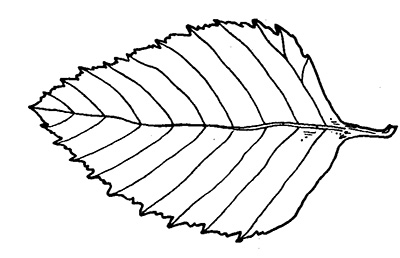
book, paired with an ID That Tree video from Purdue Extension forester Lenny Farlee to help visualize each species as it stands in the woods. Threats to species health as well as also insight into the wood provided by the species, will be provided through additional resources as well as the Hardwoods of the Central Midwest exhibit of the Purdue Arboretum, if available.
Each week, the Intro to Trees of Indiana web series will offer a sneak peek at one species from the
This week, we introduce River Birch or Betula nigra, which is also known as red birch.
As its name implies, it is found frequently in wet situations. It is often found need waterways and in moist soil areas across the state.
Full article also can be viewed with Purdue Forestry and Natural Resources News: Intro to Trees of Indiana: River Birch
Other Resources:
Birch – Hardwood Lumber and Veneer Series
Fifty Common Trees of Indiana
An Introduction to Trees of Indiana
Native Trees of the Midwest-The Education Store, Purdue Extension’s resource center
Shrubs and Woody Vines of Indiana and the Midwest– The Education Store
ID That Tree– YouTube playlist
Woodland Management Moment-YouTube playlist
Investing in Indiana Woodlands– The Education Store
Forest Improvement Handbook– The Education Store
Wendy Mayer, FNR Communications Coordinator
Purdue University Department of Forestry and Natural Resources
Lenny Farlee, Sustaining Hardwood Extension Specialist
Purdue University Department of Forestry and Natural Resources
Healthy trees can improve our quality of life by providing food, cleaner air and water, regulating temperatures, supporting pollination and providing recreational, health and spiritual benefits.
Here are some easy ways in which urban trees and woodlots contribute to making cities more environmentally sustainable and livable:
- Trees can contribute to the increase of local food and nutrition security, providing food such as fruits and nuts for wildlife and human consumption.
- Trees play an important role in increasing urban biodiversity, providing plants and animals with a proper habitat, food and protection.
- A mature tree can absorb up to 350 lbs. of CO2 per year. As a result, trees play an important role in climate change mitigation. In cities with high levels of pollution, trees can improve air quality making cities healthier places to live in.
- Strategic placement of trees in cities can help to cool the air between 30-40o F, thus reducing the urban “heat island” effect, helping reduce extreme heat conditions in summer weather.
- Large trees are great biological filters for urban pollutants and particulate pollution. They absorb pollutant gases (such as carbon monoxide, nitrogen oxides, ozone and Sulphur oxides) and filter fine particulates such as dust, dirt, or smoke out of the air by trapping them on leaves and bark.
- Research shows that living in close proximity of urban green spaces and having access to them, can improve physical and mental health, for example by decreasing high blood pressure and stress. Also, research indicates greatly improved neo-natal health as well. This, in turn, contributes to the well-being of urban communities.
- Mature trees regulate water flow and play a key role in preventing floods and reducing the risk of sewer overflow. Stormwater management is a crucial city infrastructure issue and trees help. A mature tree, for instance, can intercept more than 5,000 gallons of water per year and without trees, every rain would contribute floods.
- Trees also help to reduce carbon emissions by helping to conserve energy. For example, the correct placement of trees around buildings can reduce the need for air conditioning by 30 percent and reduce winter heating bills by 20-50 percent.
- Planning urban landscapes with trees can increase property value, by up to 15 percent, and attract tourism and business.
Planting trees is important, but their maintenance is equally as important. A way for homeowners to ensure their trees stay healthy is by hiring an arborist. Professional, trained arborists know how to properly maintain trees for the safety of the public and the health of the tree.
This brief tutorial shows how to use the Trees Are Good website to find an arborist near you, verify credentials and where to find more information on trees.
View the Indiana Arborist Association website for more certification resources along with planting, maintenance and preservation resources.
Resources:
Find an Arborist website, Trees are Good, International Society of Arboriculture (ISA)
Caring for storm-damaged trees/How to Acidify Soil in the Yard – In the Grow, Purdue Extension
Moist soil and rotten roots makes it easy for trees to come crashing down – Fox 59 News
Tree Risk Management – Got Nature? Blog, Purdue Extension – FNR
Mechanical Damage to Trees: Mowing and Maintenance Equipment – The Education Store
Trees and Electric Lines – The Education Store
Tree Support Systems, The Education Store
Corrective Pruning for Deciduous Trees, The Education Store
Tree Installation: Process and Practices, The Education Store
Lindsey Purcell, Chapter Executive Director
Indiana Arborist Association
Diana Evans, Extension & Web Communications Specialist
Purdue University Department of Forestry and Natural Resources
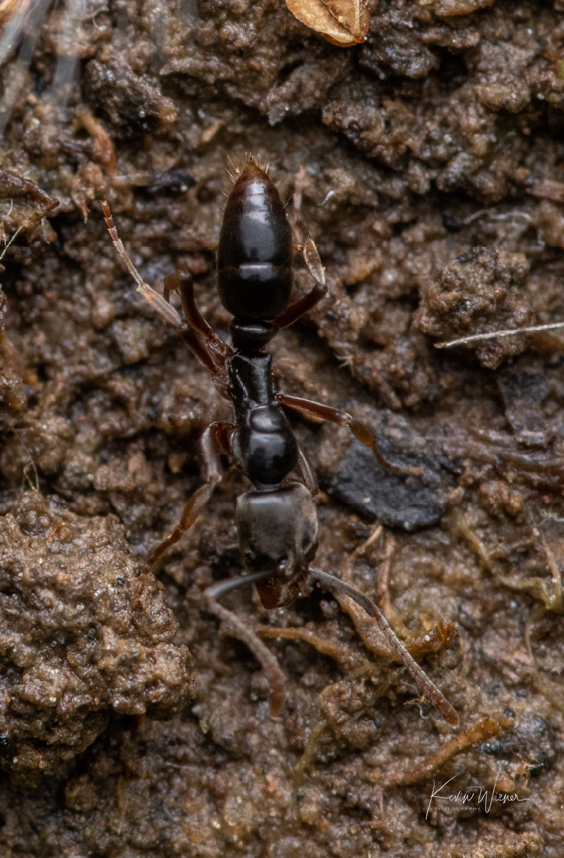
Asian needle ant in
natural setting. Photo by Kevin Weiner, Evansville, IN.
It is official. The Asian needle ant is our newest invasive insect pest and has now become a permanent resident, stinging ant. Two ant specimens taken from a wooded area in southern Indiana by an astute amateur entomologist, who observed their appearance and behavior as ‘out of the ordinary’, was submitted to the Indiana Department of Natural Resources and to the Purdue University Plant and Pest Diagnostic Laboratory for species identification in February, 2022. Both were confirmed to be Formicidae: Brachyponera chinensis, commonly known as the Asian needle ant, not previously recorded from Indiana.
Asian needle ants (ANAs), originally from Eastern Asia (China, Japan, and Korea), were first discovered in the United States in the early 1930s, but only recognized as a pest since 2006. They have been officially established in several states in the U.S. including North Carolina, South Carolina, Alabama and Georgia and, have been anecdotally reported as far north and west as New York, Tennessee and Kentucky.
Note that stings to humans will be moderately painful (potentially causing severe allergic reactions to susceptible individuals) much like fire ant or bee stings, but fortunately because these ants are much less aggressive in protecting their nests, the number of stings per encounter will be less.
The First Report of the Invasive Asian Needle Ant in Indiana pdf provides more details on their identification and biology.
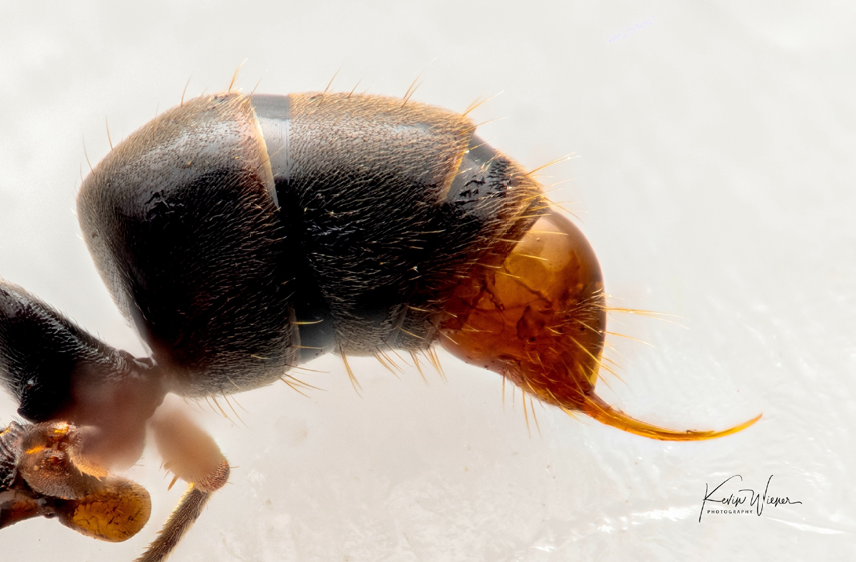
Asian needle ant stinger extended. Photo by Kevin Weiner, Evansville, IN.
If you want to confirm a sighting of the Asian needle ant please contact the Purdue University Plant and Pest Diagnostic Laboratory at this time. More information will be presented as experts monitor the spread.
Resources:
Thousand Cankers Disease, Indiana Department of Natural Resources
Thousand Cankers Disease: Indiana Walnut Trees Threatened, The Education Store, Purdue Extension’s resource center
Indiana Walnut Council
Spotted lanternfly: Everything You Need to Know in 30 Minutes, Video, Emerald Ash Borer University
Emerald Ash Borer, EAB Information Network
Report Invasive Species, Purdue Invasive Species
The GLEDN Phone App – Great Lakes Early Detection Network
EDDMaps – Early Detection and Distribution Mapping System
Indiana Department of Natural Resources: Invasive Species
Indiana Invasive Species Council
Cooperative Invasive Species Management Area (CISMA)
Invasive plants: impact on environment and people, The Education Store
Woodland Management Moment: Invasive Species Control Process, Video, Purdue Extension – Forestry and Natural Resources (FNR) YouTube Channel
Invasive Species, Playlist, Purdue Extension – FNR YouTube Channel
What are invasive species and why should I care?, Got Nature? Blog, Purdue Extension – Forestry and Natural Resources
Report Invasive
Indiana Department of Entomology and Plant Pathology
Tim Gibb, Insect Diagnostician and Extension Specialist
Purdue Department of Entomology
The classic and trusted book “Fifty Common Trees of Indiana” by T.E. Shaw was published in 1956 as a user-friendly guide to local species. Nearly 70 years later, the publication has been updated through a joint effort by the Purdue Department of Forestry and Natural Resources, Indiana 4-H, and the Indiana Department of Natural Resources, and reintroduced as “An Introduction to Trees of Indiana.”
 The full publication is available for download for $7 in the Purdue Extension Education Store. The field guide helps identify common Indiana woodlot trees.
Each week, the Intro to Trees of Indiana web series will offer a sneak peek at one species from the book, paired with an ID That Tree video from Purdue Extension forester Lenny Farlee to help visualize each species as it stands in the woods. Threats to species health as well as also insight into the wood provided by the species, will be provided through additional resources as well as the Hardwoods of the Central Midwest exhibit of the Purdue Arboretum, if available.
This week, we introduce the Blue Beech or Carpinus caroliniana.
The blue beech, also known as the American hornbeam, musclewood or the water beech, is an understory tree that stands out due to its gray bark and striations that resemble muscles and sinews as well as its doubly toothed leaves.
The small tree, which typically grows to a height of 20 to 35 feet, has oblong leaves with doubly toothed leaf margins, arranged alternately on very fine twigs. Lower leaf veins are seldom forked. The fruit is in clusters, consisting of small, seed-like nuts on small, three-lobed leaves. It’s bark and fruit help differentiate blue beech from its close relative, the ironwood.
Blue beech’s natural range is the majority of the midwestern and eastern United States, reaching as far south as Texas.
For full article and photos view Purdue Forestry and Natural Resources News: Trees of Indiana: Blue Beech.
Other Resources:
Beech – Hardwood Lumber and Veneer Series
Fifty Common Trees of Indiana
An Introduction to Trees of Indiana
Native Trees of the Midwest, The Education Store, Purdue Extension’s resource center
Shrubs and Woody Vines of Indiana and the Midwest
ID That Tree YouTube playlist
Woodland Management Moment YouTube playlist
Investing in Indiana Woodlands, The Education Store
Forest Improvement Handbook The Education Store
Wendy Mayer, FNR Communications Coordinator
Purdue University Department of Forestry and Natural Resources
Lenny Farlee, Sustaining Hardwood Extension Specialist
Purdue University Department of Forestry and Natural Resources
The classic and trusted book “Fifty Common Trees of Indiana” by T.E. Shaw was published in 1956 as a user-friendly guide to local species. Nearly 70 years later, the publication has been updated through a joint effort by the Purdue Department of Forestry and Natural Resources, Indiana 4-H, and the Indiana Department of Natural Resources, and reintroduced as “An Introduction to Trees of Indiana.”
The full publication is available for download for $7 in the Purdue Extension Education Store. The field guide helps identify common Indiana woodlot trees.
Each week, the Intro to Trees of Indiana web series will offer a sneak peek at one species from the book, paired with an ID That Tree video from Purdue Extension forester Lenny Farlee to help visualize each species as it stands in the woods. Threats to species health as well as also insight into the wood provided by the species, will be provided through additional resources as well as the Hardwoods of the Central Midwest exhibit of the Purdue Arboretum, if available. 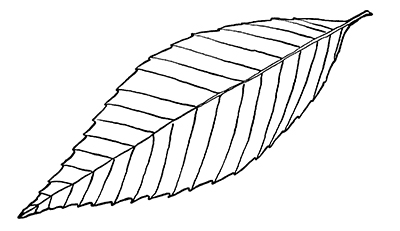
This week, we introduce the beech, or Fagus grandifolia.
The Beech is easily identified by its smooth gray bark and its simple leaves, which feature straight-line veins from the midrib to the small teeth on the margin. Beeches produce a 3/4-inch long fruit covered in spines, which typically holds two triangular-shaped nuts.
American beech is a shade tolerant species found in the understory often on moist but well-drained soils, that also reaches up into the forest canopy at around 70 to 80 feet tall. Beech is found throughout the Great Lakes region as well as the central and southeastern United States.
Beech is used to make items varying from wooden clothes pins to brush banks, handles and woodenware. Due to its strength and ease of turning, it is also used for chair production. Flooring, railroad ties, pallets and container veneer are other uses for this species.
For full article and photos view Purdue Forestry and Natural Resources: Trees of Indiana: Beech.
 View the Purdue Online Tour: Hardwoods of the Central Midwest and find out beech species workability, strength, if it can be steam bent, drying details and much more.
Resources:
Beech – Hardwood Lumber and Veneer Series
Fifty Common Trees of Indiana
An Introduction to Trees of Indiana
Native Trees of the Midwest, The Education Store, Purdue Extension’s resource center
Shrubs and Woody Vines of Indiana and the Midwest, The Education Store, Purdue Extension’s resource center
ID That Tree, YouTube playlist
Woodland Management Moment, YouTube playlist
Investing in Indiana Woodlands, The Education Store, Purdue Extension’s resource center
Forest Improvement Handbook, The Education Store, Purdue Extension’s resource center
Wendy Mayer, FNR Communications Coordinator
Purdue University Department of Forestry and Natural Resources
Lenny Farlee, Sustaining Hardwood Extension Specialist
Purdue University Department of Forestry and Natural Resources
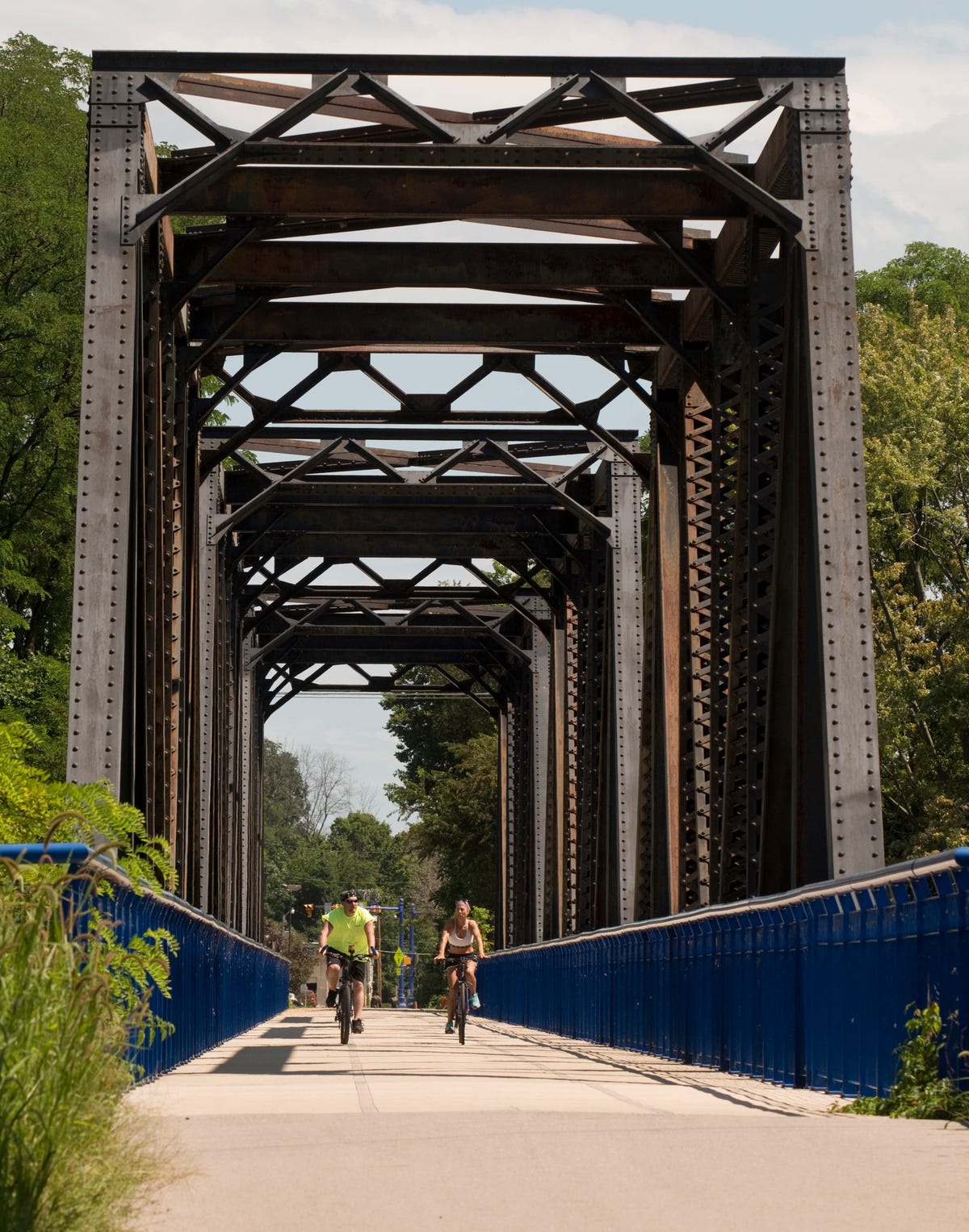 MyDNR Newsletter, Indiana Department of Forestry and Natural Resources: Gov. Eric J. Holcomb and DNR Director Dan Bortner recently announced 38 communities and non-profit organizations will receive a combined $65 million for 77 miles of new trail development.
“Trails connect communities together in such a personal way and are perfect pathways to good mental and physical well-being,” Gov. Holcomb said.
A $150 million grant program, Next Level Trails is the largest infusion of trails funding in state history. In rounds one and two, a total of $55 million was awarded to 35 communities. To date, $120 million has been awarded to build 190 miles of trails throughout Indiana. Ninety-four percent of Hoosiers live within five miles of a trail.
The grants awarded in the third round include 17 regional projects and 21 local projects. The list of awards, project descriptions, and a map are posted at on.IN.gov/NLT-round-3.
To read other news articles visit Indiana Department of forestry and Natural Resources website.
Resources:
Enhancing The Value of Public Spaces, Purdue Extension Forestry and Natural Resources
Enhancing The Value of Public Spaces: Creating Healthy Communities, The Education Store, Purdue Extension’s resource center
Fun Trail Event Days, Indiana Department of Natural Resources
Healthy and Wellness Videos, The Nature of Teaching YouTube Channel
Benefits of Connecting with Nature, The Education Store
Indiana Department of Natural Resources
 The classic and trusted book “Fifty Common Trees of Indiana” by T.E. Shaw was published in 1956 as a user-friendly guide to local species. Nearly 70 years later, the publication has been updated through a joint effort by the Purdue Department of Forestry and Natural Resources, Indiana 4-H, and the Indiana Department of Natural Resources, and reintroduced as “An Introduction to Trees of Indiana.”
The full publication is available for download for $7 in the Purdue Extension Education Store. The field guide helps identify common Indiana woodlot trees.
Each week, the Intro to Trees of Indiana web series will offer a sneak peek at one species from the book, paired with an ID That Tree video from Purdue Extension forester Lenny Farlee to help visualize each species as it stands in the woods. Threats to species health as well as also insight into the wood provided by the species, will be provided through additional resources as well as the Hardwoods of the Central Midwest exhibit of the Purdue Arboretum, if available.
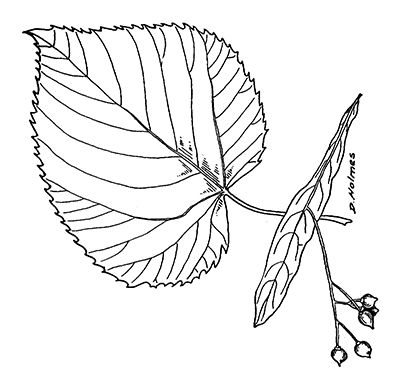
This week, we introduce the basswood or Tilia Americana.
The American basswood, which is also called linden, is commonly identified by its simple heart-shaped leaves with finely toothed margins, flat bark with long running lines up and down the trees, and possibly a ring of sprouts originating from the base of the tree. The clusters of small, nutlike seeds (⅓-inch in diameter)
are attached by a stem to a leaflike wing. 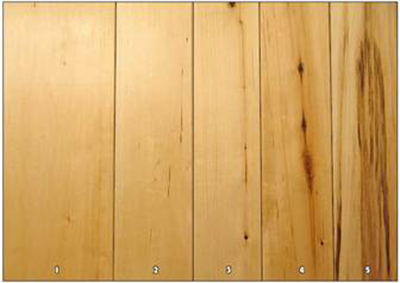
This species is often found on moist sites, deep, loamy soils, with its range stretching from the Great Plains east and from southern Canada through northern Arkansas, Kentucky and the mountains of North Carolina and Tennessee.
With heights reaching 70 to 80 feet tall, basswood can offer good shade. It also offers good flowering for bees. This species has a light colored, fine-grained wood varying from a white color to a very light brown or flesh color.
Due to its weight and stability, basswood has historically been used to make Venetian blinds and key stock in pianos. It also is a preferred species for carving, including items like hunting decoys, etc.
Full article also can be viewed with Purdue Forestry and Natural Resources News: Trees of Indiana: American Basswood.
Other Resources
Basswood – Hardwood Lumber and Veneer Series
Hardwoods of Central Indiana: American Basswood
Fifty Common Trees of Indiana
An Introduction to Trees of Indiana
Native Trees of the Midwest
Shrubs and Woody Vines of Indiana and the Midwest
ID That Tree YouTube playlist
Woodland Management Moment YouTube playlist
Investing in Indiana Woodlands
Forest Improvement Handbook
Wendy Mayer, FNR Communications Coordinator
Purdue University Department of Forestry and Natural Resources
Lenny Farlee, Sustaining Hardwood Extension Specialist
Purdue University Department of Forestry and Natural Resources
Spring is in full bloom and trees are beginning to look green again. Learning how to identify trees in yards, neighborhoods and local parks provides insight into the diversity and relationships found in nature. Lenny Farlee, Purdue Extension Forester, shares how to identify trees native to Indiana.
Leaf Arrangement
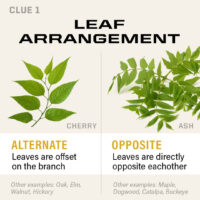 Leaf arrangement is one of the first characteristics to check for on deciduous (trees that lose their leaves annually) broadleaved trees that make up the majority of our native species. The two arrangements we commonly find are alternate and opposite.
Opposite arrangement means the leaves are held on the twig directly opposite of one another. Alternate leaf arrangement means the leaves are arranged on the twig in an offset manner. We have one leaf, then another in a zig-zag or spiral fashion.
There are only a few native tree families with opposite leaf arrangements: Maple, Ash, Dogwood, Catalpa, Buckeye. You can remember these from the anacronym MAD Cat Buck – Maple, Ash, Dogwood, Catalpa, Buckeye. Almost all other native trees have alternate leaf arrangements.
Leaf Types
The next characteristic to check is if the tree has simple or compound leaves. To do this, we need to understand the difference between a leaf and a leaflet. A leaf has a bud at the base of the stem. The entire structure after the bud is the leaf.
A simple leaf is singular and never divided into smaller leaflets. A compound leaf consists of several or many leaflets joined to a single stem after the bud.
Resources:
ID That Tree, Playlist, Purdue Extension – Forestry and Natural Resources YouTube Channel
A Woodland Management Moment, Playlist, Purdue Extension – FNR YouTube Channel
Purdue Extension, website
Shrubs and Woody Vines of Indiana and the Midwest, The Education Store, Purdue Extension Resource Center
Native Trees of the Midwest, The Education Store
Investing in Indiana Woodlands, The Education Store
Forest Improvement Handbook, The Education Store
Purdue College of Agriculture News
Lenny Farlee, Sustaining Hardwood Extension Specialist
Purdue University Department of Forestry and Natural Resources
The classic and trusted book “Fifty Common Trees of Indiana” by T.E. Shaw was published in 1956 as a user-friendly guide to local species. Nearly 70 years later, the publication has been updated through a joint effort by the Purdue Department of Forestry and Natural Resources, Indiana 4-H, and the Indiana Department of Natural Resources, and reintroduced as “An Introduction to Trees of Indiana.”
The full publication is available for download for $7 in the Purdue Extension Education Store. The field guide helps identify common Indiana woodlot trees.
 Each week, the Intro to Trees of Indiana web series will offer a sneak peek at one species from the book, paired with an ID That Tree video from Purdue Extension forester Lenny Farlee to help visualize each species as it stands in the woods. Threats to species health as well as also insight into the wood provided by the species, will be provided through additional resources as well as the Hardwoods of the Central Midwest exhibit of the Purdue Arboretum, if available.
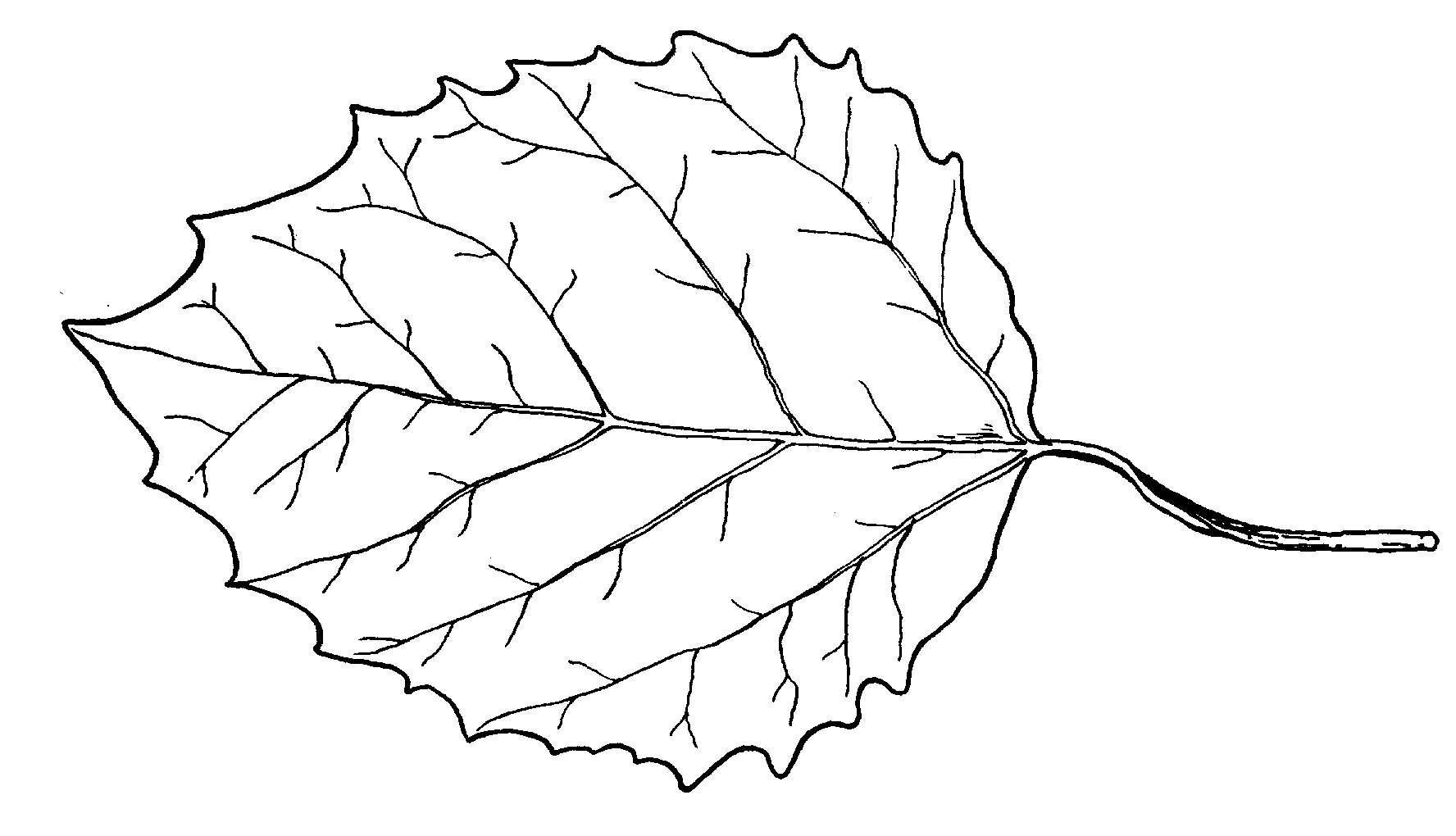
This week, we introduce the quaking aspen or populus tremuloides.
The quaking aspen, also known as the trembling aspen, is adaptable to a variety of soils, ranging from moist loamy sands and clay, but it is shade intolerant. It is often found on the edge of woodlands or where the site has been disturbed, giving it access to full sunlight.
This species is identifiable by its whitish to grayish bark with dark spots where the branches come out of the trunk. It has small rounded leaves with very small teeth along the margin. Like most aspens, it has long flat leaf steams that are known to flutter in the wind.
Quaking aspen is found int he northern part of the state of Indiana. This species is found from Nefoundland through Alaska in the West, and as far south as Arizona. In the Midwest, it ranges south to northeastern Iowa, northern Illinois and Pennsylvania. It is also found in some scattered areas in the Appalachian Mountains. It is the most widely distributed tree in the United States.
According to the Hardwood Lumber and Veneer Series, aspen is one of our lightest woods with a 12 percent moisture content and a weight of 26 to 27 pounds per cubic foot. It was at one time relegated to the pulp and paper industry as a weed tree, however it is now a favored species for the manufacturer of panel boards.
Full article also can be viewed with Purdue Forestry and Natural Resources News: Trees of Indiana: Quaking Aspen.
Other Resources
Aspen – Hardwood Lumber and Veneer Series
Why Fall Color Is Sometimes a Dud – Purdue Landscape Report
Fifty Common Trees of Indiana
An Introduction to Trees of Indiana
Native Trees of the Midwest, The Education Store, Purdue Extension’s resource center
Shrubs and Woody Vines of Indiana and the Midwest, The Education Store
ID That Tree YouTube playlist
Woodland Management Moment YouTube playlist
Investing in Indiana Woodlands, The Education Store
Forest Improvement Handbook , The Education Store
Wendy Mayer, FNR Communications Coordinator
Purdue University Department of Forestry and Natural Resources
Lenny Farlee, Sustaining Hardwood Extension Specialist
Purdue University Department of Forestry and Natural Resources
In this HEE Prescribed Fire video, Charlotte Owings, project coordinator on the Hardwood Ecosystem Experiment (HEE) explains the forest management technique of prescribed fire and how it is being utilized on the HEE.
What is HEE?
The focus of forest science is increasingly shifting to the management of forests as complex systems rather than as simple agricultural landscapes—with a much greater appreciation for the interactive ecosystem processes. In addition, now for many forest landowners, the ecological value of their land is at least as important as the economic return. It is, therefore, vital to understand how forest management affects not only timber production, but also the overall function of forested ecosystems.
The Hardwood Ecosystem Experiment (HEE) is a long-term, large-scale experimental study of forest management and its impacts. The project was initiated in 2006 with partners including: Ball State University, Drake University, Indiana State University, Purdue Entomology, Indiana Department of Natural Resources (IN DNR), and the Indiana Chapter of the Ruffed Grouse Society.
For information about study sites, harvesting treatments, sampling design, and more, see our Project Overview and Design page and US Forest Service General Technical Report NRS-P-108, The Hardwood Ecosystem Experiment: A Framework For Studying Responses to Forest Management.
Resources
Hardwood Ecosystem Experiment, Website
Hardwood Ecosystem Experiment (HEE), YouTube Playlist, Purdue Extension–Forestry and Natural Resources (FNR)
Ask an Expert: Hardwood Ecosystem Experiment (HEE) Birds and Salamander Research, Video, Purdue Extension-FNR YouTube Channel
Hardwood Ecosystem Experiment – Wildlife Responses to Timber Harvesting, The Education Store, Purdue Extension’s resource center
The Hardwood Ecosystem Experiment: Indiana Forestry and Wildlife, The Education Store
Charlotte Owings, Hardwood Ecosystem Experiment Project Coordinator
Purdue University, Department of Forestry and Natural Resources

Recent Posts
- Popular Landscape Shrub is Invasive
Posted: October 15, 2026 in Alert, Forestry, Forests and Street Trees, Invasive Plant Species, Plants, Woodlands - Purdue Extension’s Regional Teams Are Here: Connecting Communities with Expertise and Opportunity
Posted: October 14, 2026 in Community Development, Forestry, Forests and Street Trees, Gardening, How To, Timber Marketing, Urban Forestry, Wildlife, Woodlands - Why Do Our Trees Go From Green Leaves to Different Colors?
Posted: in Forestry, Forests and Street Trees, Urban Forestry, Woodlands - Distinguishing Dogwoods
Posted: October 13, 2026 in Forestry, Urban Forestry, Wildlife, Woodlands - It’s Not Too Early To Start Planning For Spring Tree Planting
Posted: in Forestry, How To - Can I Plant Trees in the Fall?
Posted: October 12, 2026 in Forestry, How To, Land Use, Plants, Urban Forestry, Wildlife - Burning for Benefits: Why Fire Belongs in Indiana
Posted: in Forestry, Safety, Woodlands - Disease May Cause Wilting and Eventual Death of Certain Trees and Shrubs, Purdue Landscape Report
Posted: October 5, 2026 in Disease, Forestry, Plants - October Is Firewood Month: Protect Indiana’s Forests by Making Smart Choices
Posted: October 1, 2026 in Forestry, Forests and Street Trees, How To, Invasive Insects, Urban Forestry - Woodland Flowers of Late Summer
Posted: September 14, 2026 in Forestry, Gardening, Wildlife, Woodlands
Archives
Categories
- Alert
- Aquaculture/Fish
- Aquatic/Aquaculture Resources
- Ask the Expert
- Christmas Trees
- Community Development
- Disease
- Drought
- Forestry
- Forests and Street Trees
- Gardening
- Got Nature for Kids
- Great Lakes
- How To
- Invasive Animal Species
- Invasive Insects
- Invasive Plant Species
- Land Use
- Natural Resource Planning
- Nature of Teaching
- Plants
- Podcasts
- Ponds
- Publication
- Safety
- Spiders
- Timber Marketing
- Urban Forestry
- Webinar
- Wildlife
- Wood Products/Manufacturing
- Woodland Management Moment
- Woodlands