 Purdue University - Extension - Forestry and Natural Resources
Got Nature? Blog
MyDNR, Indiana’s Outdoor Newsletter: There are many options for enjoying outdoor recreation across Indiana this fall, especially with deer hunting season upon us. Learn more about deer hunting, how to support healthy wildlife populations, important regulations and how your hunting can support Hoosiers in need. Pay special attention to deer regulation changes, season dates and the importance of purchasing your license.
- Reduction Zone Season: Sept. 15, 2025 – Jan. 31, 2026
- Archery Season: Oct. 1, 2025 – Jan. 4, 2026
- Firearms Season: Nov. 15 – Nov. 30, 2025
- Muzzleloader Season: Dec. 6- Dec. 21, 2025
Deer Hunting Regulation Changes
Indiana DNR has made big changes to Indiana’s deer hunting rules. These changes are in effect for the 2025-2026 hunting season. The changes were made, in part, to make Indiana’s hunting regulations easier to understand.
Rule changes include:
- The statewide bag limit is now 6 antlerless deer and 1 antlered deer.
- A newly created county antlerless bag limit replaces the season antlerless bag limits and county bonus antlerless quotas. Because of this change, the new multi-season antlerless license has replaced the bonus antlerless license.
- Antlerless deer cannot be taken with a firearm during firearms season at Fish & Wildlife areas.
- Only 1 antlered and 2 antlerless deer can be taken with the bundle license.
- The use of crossbow equipment is now allowed using the archery license.
- Portable tree stands and ground blinds can now be placed on DNR properties in Deer Reduction Zones between noon Sept. 1 and Feb. 8.
- State law prohibits the use of drones (unmanned aerial aircraft) to search for, scout, locate or detect a wild animal during the hunting season and for 14 days prior to the hunting season for that animal.
- Hunters can now use rifles with a centerfire cartridge that has a bullet diameter of .219 inches (5.56 mm) or larger on both public and private lands.
For questions about equipment, regulations or changes in them, or which license you need, contact the Deer Information Line at INDeerInfo@dnr.IN.gov or 812-334-3795.
View a webinar recording explaining deer regulation changes.
Hunting Safety Tips and Reminders
Indiana DNR reminds you to stay safe this deer season. Hunting injuries most commonly involve elevated platforms and tree stands, so stay safe by following the guidelines below.
Tree stand safety before the hunt:
- Read, understand, and follow the tree stand manufacturer’s instructions.
- Check tree stands and equipment for wear, fatigue, rust, and cracks or loose nuts/bolts, paying particularly close attention to parts made of material other than metal.
- Practice at ground level with a responsible adult. If you need to sight in your equipment, find a shooting range near you.
- Learn how to properly wear your full-body safety harness.
- Make a hunt plan and share it with someone before your hunt.
- Wear your full-body safety harness.
- Use a tree stand safety rope.
- Make certain to attach your harness to the tree or tree stand safety rope before leaving the ground and check that it remains attached to the tree or tree stand safety rope until you return to the ground.
- Maintain three points of contact during ascent and descent.
- Wear boots with nonslip soles.
- Use a haul line to raise and lower firearms, bows, and other hunting gear.
- Make sure firearms are unloaded, action is open, and safety is on before attaching them to the haul line.
General reminders:
- Hunter Orange – know when to wear it and how much is needed on a ground blind
- Hunter orange is required for all deer hunters during youth, firearms, and muzzleloader season. Hunter orange must be worn at all times during the hunt, including walking to and from the hunting location. Regardless of hunting equipment being used (archery, crossbow or firearm), if it is firearms season, you are required to wear hunter orange.
- A ground blind must have at least 144 square inches of hunter orange material that is visible from any direction during any season in which a hunter is already required to wear hunter orange.
- Firearm Safety – Treat every firearm as if it is loaded, keep the muzzle pointed in a safe direction, keep your finger off the trigger until you are ready to shoot, and be sure of your target and what is beyond it.
- Print and complete a Landowner Permission Form if hunting on private land that isn’t your own.
- Remember to complete and attach a deer transportation tag immediately upon taking a deer. The tag should be attached to the deer during transportation and any time the deer is unattended.
Always bring emergency equipment with you on your hunt, such as a cellphone, flashlight, small first aid kit and extra water.
Read more about the guidelines and property rules here: Fish & Wildlife Properties.
Deer Reduction Zones
For information or any questions, view: Deer Reduction Zones.
Deer Disease Updates
Chronic wasting disease (CWD), a fatal disease impacting white-tailed deer, has been detected in wild deer in two areas of Indiana: LaGrange County and Posey County. These detections resulted in a CWD Positive Area including LaGrange, Noble, Steuben, and DeKalb counties and a one-year CWD Enhanced Surveillance Zone including Posey, Vanderburgh, and Gibson counties.
DNR offers free, statewide CWD testing for hunters by either taking your deer to one of DNR’s drop-off coolers at select Fish & Wildlife areas (FWAs), state parks, state fish hatcheries (SFHs) or through advertised private businesses such as taxidermists. These options are available during all seasons. Find out more about how to get your deer tested here: Chronic Wasting Disease (CWD).
Resources:
Ask an Expert: Wildlife Food Plots, video, Purdue Extension – Forestry and Natural Resources (FNR) YouTube Channel
Handling Harvested Game: Episode 1, Field Dressing, video, Purdue Extension – FNR YouTube Channel
Handling Harvested Game: Episode 2, Hanging & Skinning, video, Purdue Extension – FNR YouTube Channel
Handling Harvested Game: Episode 3, Deboning, video, Purdue Extension – FNR YouTube Channel
Handling Harvested Game: Episode 4, Cutting, Grinding & Packaging, video, Purdue Extension – FNR YouTube Channel
Deer Harvest Data Collection, Got Nature? Blog, Purdue Extension – FNR
How to Score Your White-tailed Deer, video, Purdue Extension
White-Tailed Deer Post Harvest Collection, video, The Education Store
Age Determination in White-tailed Deer, video, Purdue Extension
Handling Harvested Deer Ask an Expert? video, Purdue Extension – FNR YouTube Channel
How to Build a Plastic Mesh Deer Exclusion Fence, The Education Store
Bovine Tuberculosis in Wild White-tailed Deer, The Education Store
Woodland Stewardship for Landowners: Managing Deer Damage to Young Trees, video, Purdue Extension – FNR YouTube Channel
Integrated Deer Management Project, Purdue FNR
New Deer Impact Toolbox, Purdue Extension-Forestry and Natural Resources (FNR)
Division of Fish and Wildlife, Indiana Department of Natural Resources
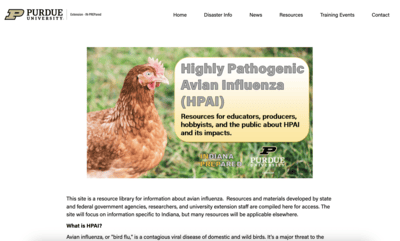
IN-PREPared: The Indiana State Board of Animal Health has confirmed cases of Highly Pathogenic Avian Influenza (HPAI) in northeast Indiana. As millions of wild birds traverse the state during peak migration, the risk of additional outbreaks remains high. To support awareness and preparedness, Indiana PREPared offers a comprehensive resource library with science-based information on avian influenza, biosecurity practices, and public health guidance.
 What is HPAI?
Avian influenza, or “bird flu,” is a contagious viral disease of domestic and wild birds. It’s a major threat to the poultry industry, animal health, trade, and the economy worldwide.
Caused by influenza type A viruses, the disease varies in severity depending on the strain and species affected. Highly pathogenic avian influenza (HPAI) strains are deadly to domestic poultry and can wipe out entire flocks within a matter of days. Low pathogenicity avian influenza (LPAI) strains typically cause few or no signs of illness. They occur naturally in wild birds around the world. However, some LPAI strains can become highly pathogenic in poultry. (USDA-APHIS)
According to the Centers for Disease Control and Prevention (CDC):
- H5 bird flu is widespread in wild birds worldwide and is causing outbreaks in poultry and U.S. dairy cows with several recent human cases in U.S. dairy and poultry workers.
- While the current public health risk is low, CDC is watching the situation carefully and working with states to monitor people with animal exposures.
To learn more, visit the webpage: Avian Influenza.
More Resources:
Avian Flu (Bird Flu), IN DNR, Fish and Wildlife
Question: Is there any risk of becoming infected with avian influenza virus by feeding backyard birds?, Purdue Extension – FNR Got Nature? Blog
Virtual Tour Brings Forest Management for Birds to Life, Purdue Extension – Forestry and Natural Resources (FNR) Got Nature? Blog
Breeding Bird Atlas, Indiana Department of Natural Resources
IN DNR Shares How to Keep Your Backyard Birds Healthy, Purdue Extension – FNR Got Nature? Blog
Breeding Birds and Forest Management: the Hardwood Ecosystem Experiment and the Central Hardwoods Region, The Education Store, Purdue Extension resource center
Forest Birds, Purdue Extension – FNR YouTube Channel
Managing Woodlands for Birds Video, Purdue Extension – FNR YouTube Channel
The Birders’ Dozen, Profile: Baltimore Oriole, Indiana Woodland Steward
Birds and Residential Window Strikes: Tips for Prevention, The Education Store, Purdue Extension resource center
No Room at the Inn: Suburban Backyards and Migratory Birds, Education Store
The National Audubon Society
Subscribe, Purdue Extension – FNR YouTube Channel
Ed Sheldon, Farm/Veteran Job Coach and Engagement Coordinator
Department of Agriculture & Biological Engineering, Purdue University
Purdue Landscape Report: By now, the emerald ash borer (EAB) invasion is an old story for landscapes and forests in the Midwest. Since EAB was first found in North America in 2002 more millions of ash trees than we can know have died and this tiny insect continues to kill ash in an ever widening zone that currently includes 37 US states and 6 Canadian provinces. Arborists and landscape managers continue to protect valuable ash trees by use of systemic insecticides, typically applied via trunk injection every 2-3 years.
While EAB is the overarching threat, ash survival may also be threatened by wood decay fungi, which may colonize insect exit holes, injections sites and other wounds. The most common decay fungi we see in the lab are Perenniporia and Fomitopsis.
Perenniporia fraxinophila is the most frequently reported wood decay fungus on ash and causes a heart rot that contributes to loss of structural integrity of the tree. Infection sites tend to be high on the tree and may be easily overlooked until decay is advanced. The fungal structure is perennial, expanding each year, and may be confused with Ganoderma applanatum, the artist’s conk. The upper surface turns black or brown with age and the underside is white with pores instead of gills.
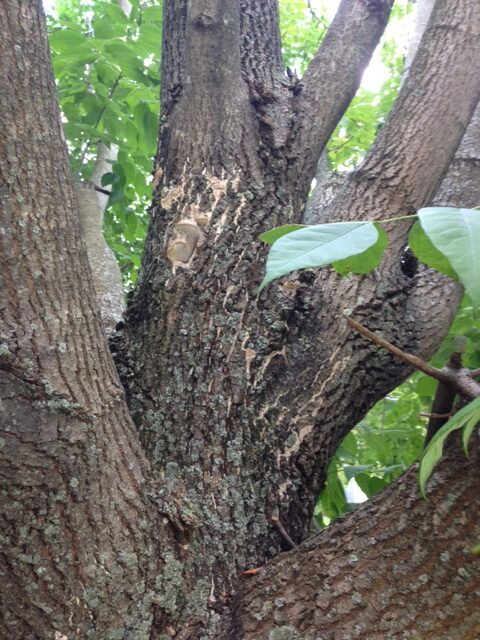

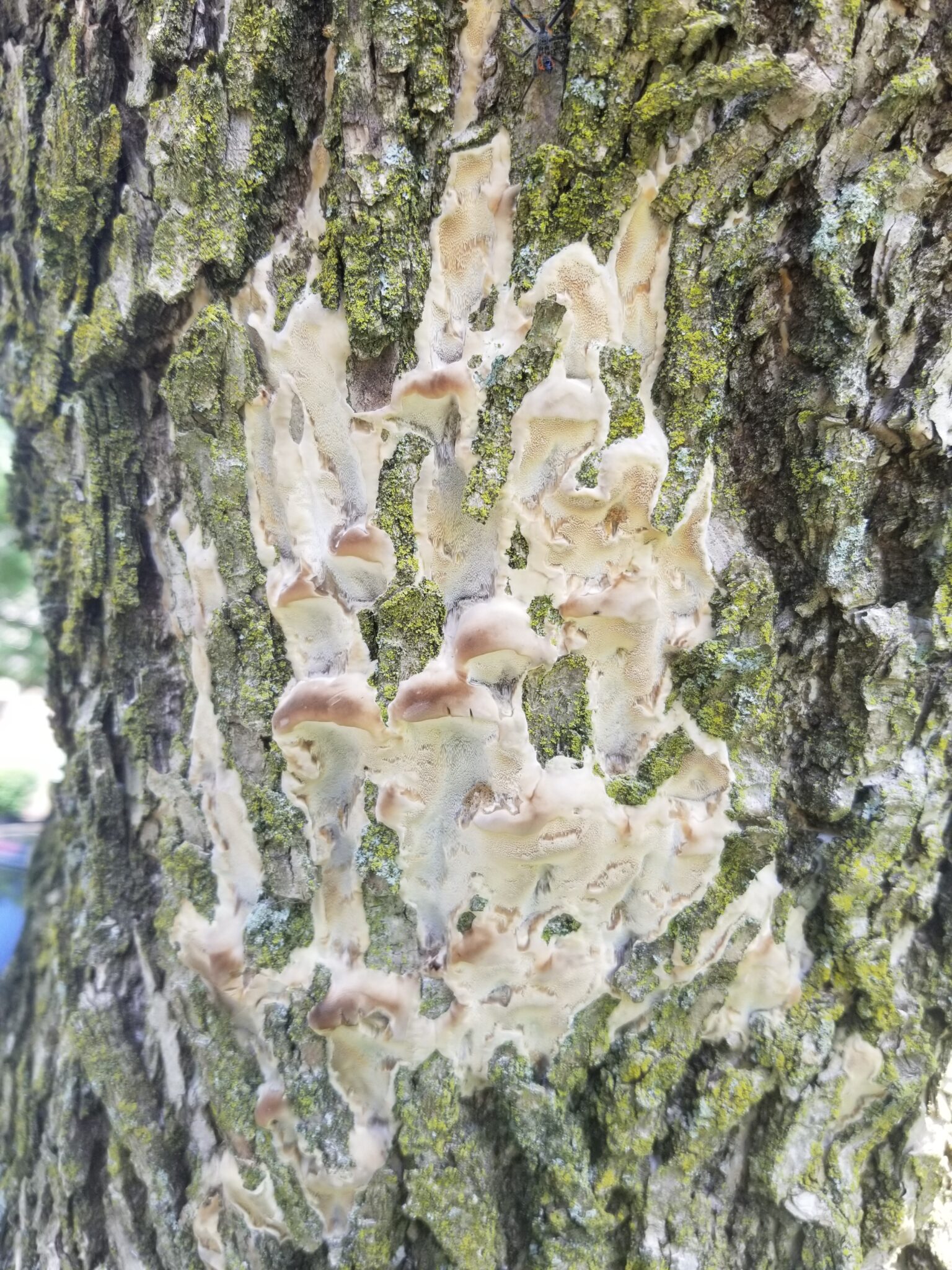
In the last few years, we have had a few samples of a similar fungus colonizing the trunk and base of ash trees, often near injection sites. Initially we were unable to identify the fungus, but DNA analysis revealed the fungus was a Fomitopsis species. This fungus develops a shallow shelf structure with white top and tan underside.
Fungal decay presents a greater risk to ash because it lacks the preservative enriched heartwood found in oak, walnut and other hardwoods that tends to slow down internal spread of fungi. Even fungi that initially invade dead areas of ash may rapidly colonize and degrade stem and trunk tissue.
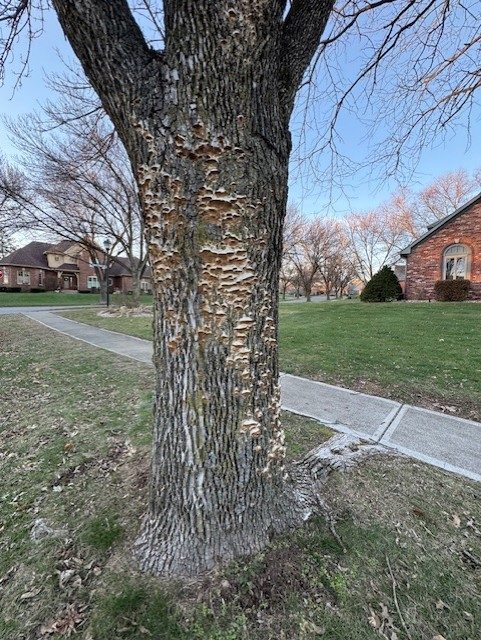
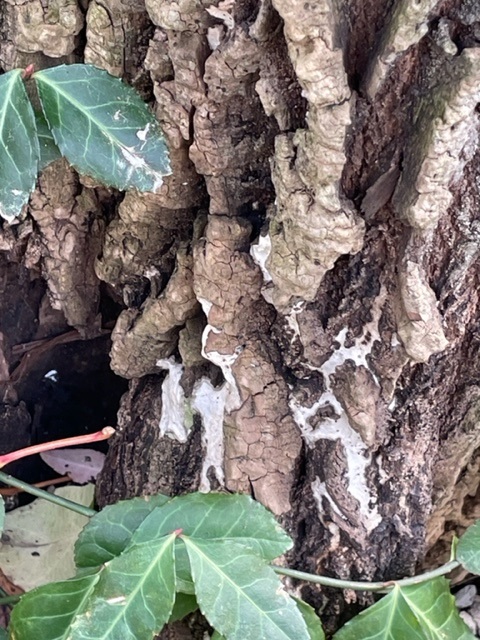
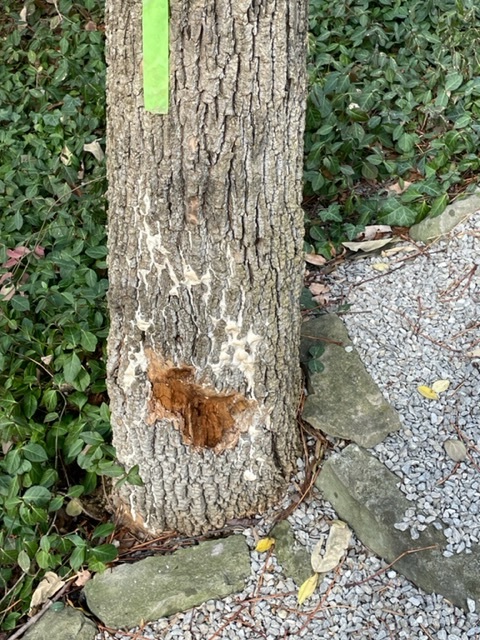
Fungal decay also disrupts vascular tissues in the stems and trunk, which further limits the movement and effectiveness of insecticide injections, so that infected trees may face greater damage from EAB. When found on small side branches the infection might be successfully pruned out, but in most cases the decay is in major branches or the trunk, which means the tree will need to be removed. If your ash trees that are being regularly treated for EAB but continue to show thinning and decline, check for these fungal invaders, they may be partly responsible.
View the original article on the Purdue Landscape Report website: Fungal Decay of Ash Trees.
Subscribe and receive the newsletter: Purdue Landscape Report Newsletter.
Resources:
Diplodia Tip Blight of Two-Needle Pines, The Education Store, Purdue Extension resource center
Boxwood Blight, The Education Store
Disease of Landscape Plants: Cedar Apple and Related Rusts on Landscape Plants, The Education Store
Planting Your Tree Part 1: Choosing Your Tree, Purdue Extension – Forestry & Natural Resources (FNR) YouTube Channel
Tree Planting Part 2: Planting a Tree, Purdue Extension – FNR YouTube Channel
Find a Certified Arborist, Trees are Good-International Society of Arboriculture (ISA)
Video: Step by Step to Find an Arborist, Trees are Good-International Society of Arboriculture (ISA)
Professional Forester, Indiana Forestry Woodland Owners Association
District Forester, Indiana Department of Natural Resources, 10+ acres
Trees and Storms – The Education Store
Why Is My Tree Dying? – Got Nature? Blog, Purdue Extension – Forestry and Natural Resources
Tree Risk Management – The Education Store
Tree Pruning Essentials, Publication & Video, The Education Store
Tree Wound and Healing, Got Nature? Blog, Purdue Extension – FNR
What are Invasives Species and Why Should I Care?, Got Nature? Blog, Purdue Extension – FNR
Subscribe – Purdue Extension-FNR YouTube Channel
Tom Creswell, Plant & Pest Diagnostic Laboratory Director
Purdue Botany and Plant Pathology
Purdue Landscape Report: Aspen, cottonwood, and poplar are all names for the fast-growing Populus tree species. Used widely for building materials, these trees are often located around ponds, riverbanks, and sloping areas toward water bodies (especially cottonwood). Cottonwood flowers produce little white tufted seeds that float through the air which a lot of people love (my kids included), unless it lands in their mouth. These beautiful trees are susceptible to a fungus that can cause significant damage under the right conditions: Marssonina (newer name is Drepanopeziza).
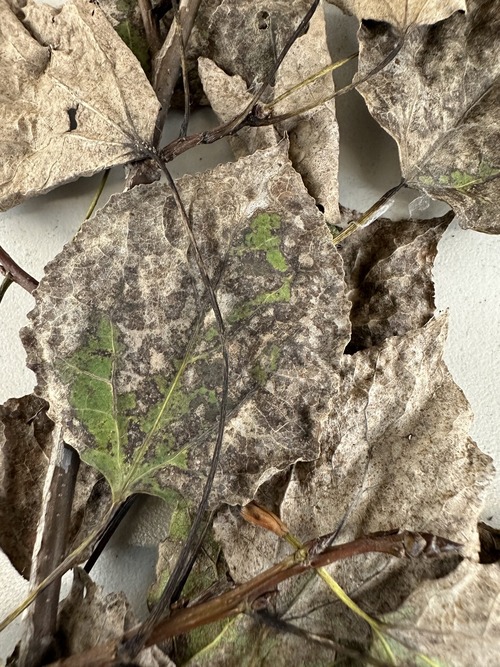
There are three species of Marssonina that can infect Populus – different tree species may only be susceptible to one of the Marssonina species. The fungi cause the same kind of disease and develop similarly on the host. Marssonina can infect the leaves, stems and seeds of Populus, which can lead to large amounts of leaf loss during wet weather, girdled stems and dieback, and aborted seeds. Since seeds can carry the fungus, the seed will take it with it to where it lands and can become infected immediately after germinating. It is common to see high disease severity in the canopy, but unless there is significant leaf loss (up to 70% defoliation) it may not reduce plant vigor. Leaf lesions typically develop as small black to brown dots or flecks which expand in size as time goes one. As the disease progresses, large areas of the leaf will become necrotic, creating odd dead blotches, potentially killing the majority of the leaf blade.
The fungus produces asexual spores in a small black pustule on the upper surface of the leaf which will eventually burst and release the spores during humid weather early in the spring. Marssonina will continue to produce spores and cause disease the whole season, creating repeat infections on the same tree. Symptoms tend to start lower in the canopy and ascend up the tree as the season progresses. The spores are spread by water splash, so rainfall will help spread this fungus in the landscape.
For trees planted in native landscapes, this disease will likely be inevitable and may make the foliage look less than stellar. That being said, removing leaves that drop or at the end of fall will reduce total inoculum for future seasons and can reduce total disease long-term. Similarly, trees that are stressed will typically develop increased disease severity, so if you are seeing large amounts of leaf spots or leaf loss, I would recommend employing stress mitigation strategies to keep the tree happy and healthy (fertilizer, mulch, irrigation as needed, etc.). If a tree appears to develop significant disease every year and has reduced limb growth, you may consider removing the tree if you are concerned it may die early and replace with a resistant clone, as disease susceptibility can vary greatly between clones of the same species.


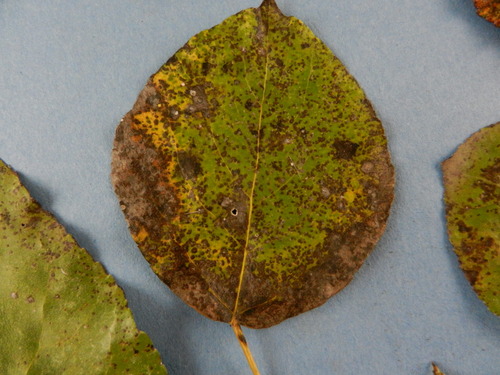
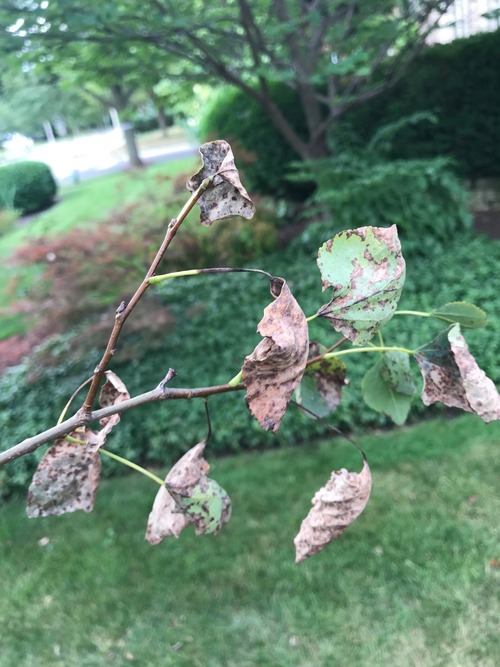
View the original article on the Purdue Landscape Report website: Marssonina leaf spot and blotch of Poplar.
Subscribe and receive the newsletter: Purdue Landscape Report Newsletter.
Resources:
ID That Tree, Playlist, Purdue Extension – FNR YouTube Channel (Invasive White Mulberry, Siberian Elm, Tree of Heaven)
Eastern Cottonwood, Article, Purdue Fort Wayne
Find a Certified Arborist, Trees are Good-International Society of Arboriculture (ISA)
Video: Step by Step to Find an Arborist, Trees are Good-International Society of Arboriculture (ISA)
Professional Forester, Indiana Forestry Woodland Owners Association
District Forester, Indiana Department of Natural Resources, 10+ acres
Trees and Storms – The Education Store, Purdue Education’s resource center
Why Is My Tree Dying? – Got Nature? Blog, Purdue Extension – Forestry and Natural Resources
Tree Risk Management – The Education Store
Tree Pruning Essentials, Publication & Video, The Education Store
Tree Defect Identification, The Education Store
Planting Your Tree, video, Purdue Extension
Tree Installation, The Education Store
A Woodland Management Moment, Playlist, Purdue Extension – FNR YouTube Channel (Against Invasives, Garlic Mustard, Autumn Olive)
Woodland Stewardship for Landowners, Playlist, Purdue Extension – FNR YouTube Channel (Common Buckthorn, Japanese Barberry)
Indiana Invasive Species Council
Indiana Department of Natural Resources: Invasive Species
Subscribe – Purdue Extension-FNR YouTube Channel
John Bonkowski, Lead Extension Administrator
Purdue Department of Botany and Plant Pathology
Wild Bulletin, IN DNR, Division of Fish & Wildlife: Epizootic hemorrhagic disease (EHD) is a naturally occurring viral disease commonly seen in the Indiana deer herd. Each year, typically in late summer, Indiana DNR receives reports of deer displaying signs of EHD throughout the state.
This year, DNR confirmed a significant EHD outbreak that began in the northern region of the Hoosier State. In some years, EHD can affect a larger-than-normal portion of the deer and becomes widespread across a county. In those instances, DNR lowers the County Bonus Antlerless Quotas (CBAQs) in the impacted counties to offset the effect of the counties’ EHD outbreak on the deer herd in that region.
EHD is transmitted by biting midges, also known as sand gnats or “no-see-ums.” Deer infected with EHD may display unusual behaviors such as lethargy, excessive salivation, or disorientation. EHD also causes fever in deer, which can cause deer to seek water. As a result, many deer that die from EHD are found in or near open water sources like ponds and rivers. Anyone who finds a deer showing signs of EHD or dead in water is asked to report it at on.IN.gov/sickwildlife.
County bonus antlerless quotas reduced in three counties for 2024-25
 Due to the number of reported deer mortalities and extent of EHD in the region, DNR has lowered the County Bonus Antlerless Quotas (CBAQs) in Wabash, Porter, and Allen counties from two bonus antlerless deer to one to help offset the effects of EHD on the deer herd in that region. During the winter, DNR biologists will fully evaluate the effects of EHD and will propose changes to bag limits as required. Hunters can stay informed about CBAQ changes at on.IN.gov/EHD-quotas.
To find out more view the Indiana Department of Natural Resources EHD Antlerless Bonus Quota Reductions.
Resources:
Be on the Watch for Epizootic Hemorrhagic Disease (EHD) in Deer, Got Nature? Blog, Purdue Extension – FNR
Report a Sick or Dead Deer, Indiana Department of Natural Resources (IN-DNR)
EHD Virus in Deer: How to Detect and Report video, Quality Deer Management Association
Epizootic Hemorrhagic Disease (pdf), Cornell University
How to Score Your White-Tailed Deer video, Purdue Extension – FNR YouTube Playlist
Deer Harvest Data Collection, Purdue FNR Got Nature? blog
Woodland Stewardship for Landowners: Managing Deer Damage to Young Trees, Purdue Extension-FNR YouTube Channel
Introduction to White-tailed Deer Impacts on Indiana Woodlands, Deer Impact Toolbox, Got Nature? Blog & The Education Store
Purdue Extension Pond and Wildlife Management
Managing White-tailed Deer Impacts on Indiana Woodlands, The Education Store
How to Build a Plastic Mesh Deer Exclusion Fence, The Education Store
Managing Your Woods for White-Tailed Deer, The Education Store
Deer Harvest Data Collection, Got Nature? Blog, Purdue Extension – FNR
Handling Harvested Deer Ask an Expert? video, Purdue Extension – FNR YouTube Channel
Subscribe to Purdue Extension-Forestry & Natural Resources YouTube Channel, Wildlife Playlist
A Woodland Management Moment – Deer Fencing, Purdue Extension – FNR YouTube Video
Division of Fish and Wildlife, Indiana Department of Natural Resources
Purdue Landscape Report: There have been a significant number of questions and problems regarding triclopyr that have come up this growing season.
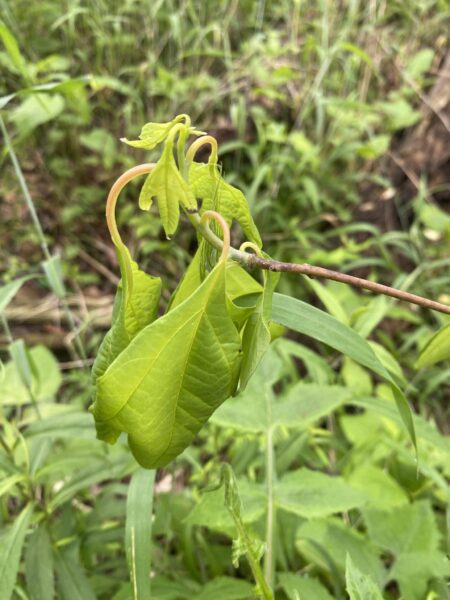
Figure 1. Confirmed damage from triclopyr on sassafras shows the growth regulator-type injury on leaves. Photo courtesy of the Office of the Indiana State Chemist.
Several of these problems have come through the Purdue Plant and Pest Diagnostic Laboratory from landscapers, nurseries, and property managers.
General Information about Triclopyr
Triclopyr is a selective systemic herbicide belonging to the pyridine class. It is primarily used to manage woody plants, vines, and some broadleaf weeds. Unlike glyphosate, a broad-spectrum herbicide, triclopyr specifically targets the growth hormones in dicotyledonous plants, making it effective in controlling species that are difficult to manage with other herbicides. It works by mimicking plant hormones, disrupting normal growth processes, and leading to the death of the treated plant (Fig. 1).
What Triclopyr Controls
Triclopyr is utilized in various settings to control unwanted vegetation. It is effective against species such as:
- Woody Plants: Includes trees like tree of heaven and callery pear and shrubs like autumn olive and honeysuckle (Fig. 2).
- Vines: Particularly those that can outcompete native flora, such as kudzu or English ivy (Fig. 3).
- Broadleaf Weeds: Some herbaceous plants that pose ecological or agricultural problems.

Figure 2. Invasive plants, such as, Pyrus calleryana (callery pear) can be controlled by triclopyr.

Figure 3. Invasive vines, such as Hedera helix (English ivy) can be controlled via multiple applications of triclopyr.
Where and When Triclopyr is Used
Triclopyr is applied in a range of environments, including:
- Forestry: To clear invasive species and manage forest regeneration.
- Agriculture: To control weeds and shrubs that interfere with crop production.
- Aquatic Areas: Formulations that are safe for aquatic environments help manage invasive species near water bodies.
- Rights-of-Way: To maintain clear paths and prevent the spread of invasive plants.
Timing of application is crucial. Triclopyr is most effective when applied during the growing season when plants are actively taking up nutrients and can transport the herbicide throughout their system.

Figure 4. Hack and squirt treatments with triclopyr is a common method to control invasive trees. Photo by Lenny Farlee.
Movement in the Plant
Triclopyr is absorbed through foliage and roots and is translocated systematically within the plant. Once inside, it moves upward through the xylem and downward through the phloem (ambimobile). This systemic movement allows triclopyr to affect not just the treated areas but also parts of the plant that are not directly sprayed. This attribute makes it effective for managing large, established plants, specifically through hack and squirt treatments (Fig. 4).
For the full article and conclusion sharing how Triclopyr is a valuable tool for managing invasive and woody plants view: The Summer of Triclopyr: Mounting evidence for off-target damage.
Subscribe and receive the newsletter: Purdue Landscape Report Newsletter.
Resources:
Find an Arborist video, Trees are Good-International Society of Arboriculture (ISA)
ID That Tree, Playlist, Purdue Extension – FNR YouTube Channel
Invasive Species Playlist, Playlist, Purdue Extension – FNR YouTube Channel
A Woodland Management Moment, Playlist, Purdue Extension – FNR YouTube Channel (Against Invasives, Garlic Mustard, Autumn Olive)
Woodland Stewardship for Landowners, Playlist, Purdue Extension – FNR YouTube Channel (Common Buckthorn, Japanese Barberry)
Report Invasive Species, Purdue Invasive Species
The GLEDN Phone App – Great Lakes Early Detection Network
Invasive Plants of the Eastern U.S.: An Introduction to the Problematic Non-Native Species, The Education Store, Purdue Extension’s resource center
EDDMaps – Early Detection and Distribution Mapping System
Episode 11 – Exploring the challenges of Invasive Species, Habitat University-Natural Resource University
What Are Invasive Species and Why Should I Care?, Purdue Extension-FNR Got Nature? Blog
Emerald Ash Borer Information Network, Purdue University and Partners
Aquatic Invasive Species, Illinois-Indiana Sea Grant (IISG)
Invasive plants: impact on environment and people, The Education Store, Purdue Extension’s resource center
Subscribe Purdue Extension-Forestry and Natural Resources YouTube Channel
Kyle Daniel, Commercial Landscape and Nursery Crops Extension Specialist
Purdue Horticulture & Landscape Architecture
Purdue Landscape Report: Early June, we received a white pine sample at the Purdue University Plant and Pest Diagnostic Lab that showed early season needle loss lower in the tree canopy (Figure 1, 2). The majority of conifers hold onto their needles for multiple years, so loss of needles, even in the fall, can come as a shock to homeowners. In this particular case, we found multiple fungi that could be contributing to needle blight or needlecast.


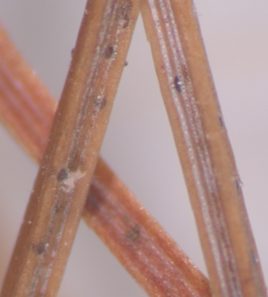
Figure 3: Black fungal structures developing on dead needles with white sporulation exuding from the top.
White pine needle damage/defoliation (WPND) was first observed in the state of Maine in 2010 and was attributed to three needle blight diseases, including Lecanosticta, and has since been observed throughout the Northeast US. However, researchers eventually determined that a new fungus, Septorioides strobi, was also found consistently in blighted needles and could be contributing to WPND.
This is the first time we have found this fungus in the state of Indiana, though it has been present for longer than a single season. We do not know how it will react to our climate nor if it will cause significant damage to affected trees. Like other needle blight pathogens, Septorioides has been observed to sporulate around the same time during humid, wet weather, but symptoms may not develop until the following year. White pines are the primary host for this needle cast disease, but it can also develop on 2, 3, and 5 needle pines. While we see white pine decline is a major problem, Septorioides will not likely be the final nail in the coffin for white pines in Indiana, though it certainly will not help us keep them healthy.
Original article posted: Septorioides Needle Blight of Pine.
Subscribe and receive the newsletter: Purdue Landscape Report Newsletter.
Resources:
ID That Tree: Virginia Pine
ID That Tree, Purdue Extension – FNR YouTube playlist
Borers of Pines and Other Needle Bearing Evergreens in Landscapes, The Education Store, Purdue Extension’s resource center
Tree Diseases: White Pine Decline in Indiana, The Education Store
Managing the Zimmerman Pine Moth, The Education Store
Purdue Arboretum Explorer
The Woody Plant Seed Manual, U.S. Forest Service
Native Trees of the Midwest, The Education Store
Root Rot in Landscape Plants, The Education Store, Purdue Extension resource center
Dead Man’s Fingers, Purdue Landscape Report
An Introduction to Trees of Indiana, The Education Store
Subscribe, Purdue Extension – FNR YouTube Channel
Tree Defect Identification, The Education Store
Tree Wound and Healing, Got Nature? Blog, Purdue Extension – FNR
Shrubs and Woody Vines of Indiana and the Midwest, The Education Store
Ask an Expert: Tree Selection and Planting, Purdue Extension – FNR YouTube playlist
Invasive Species, Playlist, Purdue Extension – FNR YouTube Channel
Report Invasive Species, Purdue Invasive Species
Find an Arborist, International Society of Arboriculture
John Bonkowski, Lead Extension Administrator
Purdue Department of Botany and Plant Pathology
MyDNR, Indiana’s Outdoor Newsletter: As a result of Indiana’s positive detection of chronic wasting disease (CWD) in LaGrange County in April, Indiana DNR has restricted moving deer from any CWD Positive Area for rehabilitation purposes.
With the change, an individual who finds an orphaned, sick, or injured deer in a CWD Positive Area may only surrender the deer to a DNR-permitted wild animal rehabilitator that is located within a CWD Positive Area. This restriction is to help minimize the spread of CWD to new parts of the state, as deer can carry this disease without appearing sick.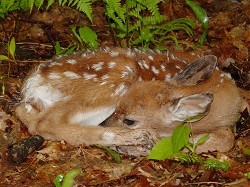
Currently, there is one CWD Positive Area in Indiana. It includes LaGrange, Steuben, Noble, and DeKalb counties. While no CWD positive deer have been documented in Steuben, Noble, or DeKalb counties, those counties are considered part of the CWD Positive Area because of their proximity to where the state’s first CWD-positive deer was found in LaGrange County.
During their first few weeks of life, fawns often hide by themselves and stay motionless to avoid predators while the mother is looking for food. If you find a fawn alone, you can help it by letting it be, giving it space, and leaving the area. Its mother is likely nearby.
For more information visit DNR: Chronic Wasting Disease (CWD).
To subscribe to the newsletter visit MyDNR Email Newsletter.
Resources:
Chronic Wasting Disease, USDA Animal and Plant Health Inspection Service (APHIS)
Bovine Tuberculosis in Wild White-tailed Deer, The Education Store, Purdue Extension resource center
Hunting & Trapping, Indiana Department of Natural Resources (DNR)
Designing Hardwood Tree Plantings for Wildlife , The Education Store
Wildlife Habitat Hint: Trail Camera Tips and Tricks, Got Nature? Blog
How to Score Your White-tailed Deer, video, The Education Store
White-Tailed Deer Post Harvest Collection, video, The Education Store
Age Determination in White-tailed Deer, video, The Education Store
How to Build a Plastic Mesh Deer Exclusion Fence, The Education Store
Ask the Expert: Hardwood Ecosystem Experiment – Birds and Salamander Research, Purdue Extension – FNR
A Template for Your Wildlife Habitat Management Plan, The Education Store
Managing Your Woods for White-Tailed Deer, The Education Store
Deer Impact Toolbox, Got Nature? blog, Purdue Extension-Forestry and Natural Resources (FNR)
Indiana Department of Natural Resources
Purdue Landscape Report: Recently a homeowner in Hamilton County posted on the Indiana Native Plant Society Facebook page with concerns about aphids, mites, and apple scab in her maple and oak trees. She asked for a second opinion and treatment options for these pests. I reached out to the homeowner and requested permission to collect samples from the trees. Let’s look at what I found (or didn’t find) and discuss when and if these issues should be treated.
Apple Scab on Maples?
First, we can eliminate the concern about apple scab because maple and oak trees are not hosts for this pathogen. Apple scab is caused by the fungus Venturia inaequalis, and hosts include apples, crabapples, hawthorn, mountain ash, firethorn, and loquat. There are other fungal diseases which cause leaf spotting in maples, such as Anthracnose, tar spot, and Phyllosticta leaf spot. To diagnosis these diseases, homeowners can submit a sample to the Purdue Plant & Pest Diagnostic Lab, or hire a certified arborist to assess the tree. However, all these diseases are primarily aesthetic issues. A healthy tree will not die from these pathogens and does not require treatment. You can find more information about maple diseases in this publication: Diseases in Hardwood Tree Plantings. You can also find a previous article on Tar Spot in Maple in the Purdue Landscape Report (Issue 18-12).

Fig. 1. Severe spider mite damage on maple leaves. (Photo: S. D. Frank, North Carolina State University)
Spider Mites
The next pest concern on these trees is spider mites. Out of the dozens of leaves I collected, I found only two immature mites on a couple of maple leaves I examined. This is a very small mite presence, and it is not recommended to treat for spider mites unless the populations threaten the health or appearance of the tree. Limiting pesticide usage will conserve the natural enemies, which are vital to keeping mite populations in check. In fact, improper pesticide applications can kill these important natural enemies and worsen mite infestations.
When do you know if the mite population is large enough to merit intervention? Check your trees for signs of heavy feeding damage, such as leaf stippling (Fig. 1), or dense webbing on the leaves. Mites can also be monitored by placing a sheet of paper (8.5×11”) beneath a branch and striking the limb. Chemical treatments should be considered when you count ≥24 mites per strike. You can find detailed management recommendations and a full list of pesticide options in this Purdue Extension publication: Spider Mites on Ornamentals.

Fig. 2: Adult painted maple aphids found on maple in Hamilton Co, Indiana. (Photo: Andrew Johnston, Purdue University).
Aphids
The aphids I found on the homeowner’s maple trees are Drepanaphis acerifoliae, or the painted maple aphid (Fig. 2). This species only feeds on maple trees, and is not a threat to the oak tree on this homeowner’s property. Painted maple aphid is a very common aphid in our region. I found only a few aphids on one of the maple trees I sampled, which is not enough to require treatment. In addition, one of the aphids was a “mummy”, or a carcass left behind from a parasitoid wasp. This indicates that natural enemies are already at work managing the aphid population. Aphids may rarely require chemical control if their numbers grow large enough to produce significant amounts of honeydew, which can result in sooty mold outbreaks.
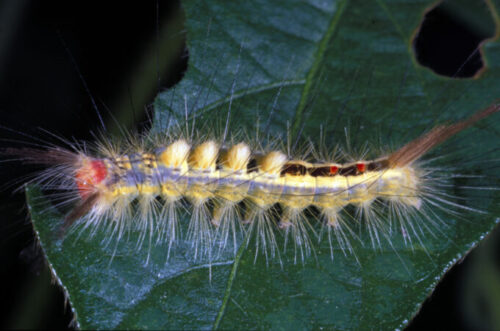
Fig. 3: White-marked tussock moth caterpillar. (Photo: John Obermeyer, Purdue University).
Tussock Moth
The only insect I found on the oak tree was a white-marked tussock moth caterpillar, Orgyia leucostigma (Fig. 3). This is the likely culprit for the minor feeding damage I noticed. These are not significant pests and do not require treatment. Don’t touch them, though! The setae of this caterpillar are irritating and may cause allergic reactions.
Overall, the pests I found were minimal and non-threatening to the trees. It’s normal to find some insect pressure in the landscape. Knowing when and if to treat requires accurate diagnosis and monitoring of pest levels. Check out PurduePlantDoctor.com for an easy-to-use diagnostic aid and treatment recommendations.
Original article posted: Purdue Landscape Report.
Subscribe and receive the newsletter: Purdue Landscape Report Newsletter.
Resources:
Large Spots on Maple Leaves that Look Like Tar, Purdue Extension News
Find an Arborist, International Society of Arboriculture
Diseases in Hardwood Tree Plantings, The Education Store, Purdue Extension’s resource center
Fifty Common Trees of Indiana
An Introduction to Trees of Indiana, The Education Store
Shrubs and Woody Vines of Indiana and the Midwest, The Education Store
Tree Installation: Process and Practices, The Education Store
Forest Improvement Handbook, The Education Store
Invasive Species, Playlist, Purdue Extension – FNR YouTube Channel
Report Invasive Species, Purdue Invasive Species
What are invasive species and why should I care?, Got Nature? Blog, Purdue Extension – Forestry and Natural Resources
Indiana Department of Natural Resources: Invasive Species
Indiana Invasive Species Council
ID That Tree, Purdue Extension-FNR YouTube playlist
Tree Defect Identification, The Education Store
Tree Wound and Healing, Got Nature? Blog, Purdue Extension – Forestry and Natural Resources
Alicia Kelley, Cooperative Agricultural Pest Survey (CAPS) Coordinator
Purdue Extension – Entomology
MyDNR, Indiana’s Outdoor Newsletter: Indiana DNR has confirmed the state’s first positive case of chronic wasting disease (CWD) in LaGrange County. CWD is a fatal infectious disease, caused by a misfolded prion, that affects the nervous system in white-tailed deer. It can spread from deer-to-deer contact, bodily fluids, or through contaminated environments.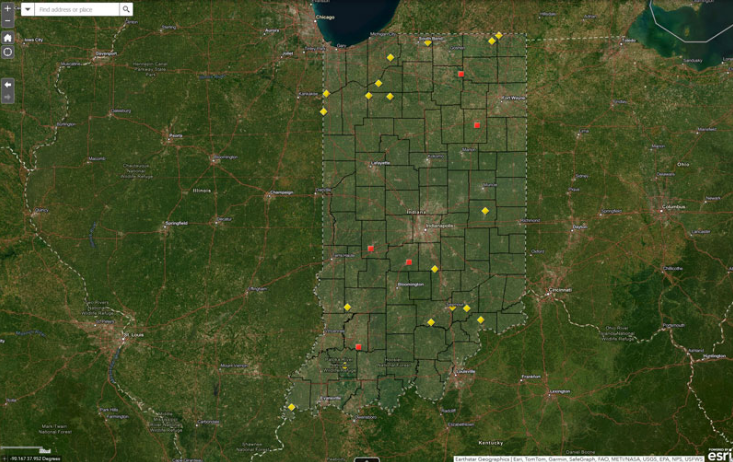
There have been no reported cases of CWD infection in people, but the Centers for Disease Control and Prevention (CDC) recommends that hunters strongly consider having deer tested before eating the meat. The CDC also recommends not eating meat from an animal that tests positive for CWD.
CWD has been detected in 33 states including the four bordering Indiana (Ohio, Michigan, Illinois, and Kentucky). Because CWD had been detected in Michigan near the Indiana border, a detection in LaGrange County was likely.
If you see any sick or dead wildlife, deer or otherwise, please report your observations on the DNR: Sick or Dead Wildlife Reporting page.
For more information visit DNR: Chronic Wasting Disease (CWD).
To subscribe to the newsletter visit MyDNR Email Newsletter.
Resources:
Chronic Wasting Disease, USDA Animal and Plant Health Inspection Service (APHIS)
Bovine Tuberculosis in Wild White-tailed Deer, The Education Store, Purdue Extension resource center
Hunting & Trapping, Indiana Department of Natural Resources (DNR)
Designing Hardwood Tree Plantings for Wildlife , The Education Store
Wildlife Habitat Hint: Trail Camera Tips and Tricks, Got Nature? Blog
How to Score Your White-tailed Deer, video, The Education Store
White-Tailed Deer Post Harvest Collection, video, The Education Store
Age Determination in White-tailed Deer, video, The Education Store
How to Build a Plastic Mesh Deer Exclusion Fence, The Education Store
Ask the Expert: Hardwood Ecosystem Experiment – Birds and Salamander Research, Purdue Extension – FNR
A Template for Your Wildlife Habitat Management Plan, The Education Store
Managing Your Woods for White-Tailed Deer, The Education Store
Deer Impact Toolbox, Got Nature? blog, Purdue Extension-Forestry and Natural Resources (FNR)
Indiana Department of Natural Resources

Recent Posts
- Deer Season Special – MyDNR
Posted: November 4, 2025 in Disease, Wildlife - Avian Flu in Birds, IN-PREPared
Posted: October 21, 2025 in Disease, Wildlife - Fungal Decay of Ash Trees, Purdue Landscape Report
Posted: October 9, 2025 in Disease, Forestry, Urban Forestry, Woodlands - Marssonina Leaf Spot and Blotch of Poplar, Purdue Landscape Report
Posted: October 1, 2025 in Disease, Forests and Street Trees, Urban Forestry, Woodlands - IN DNR Deer Updates – Epizootic Hemorrhagic Disease Detected in Several Areas in Indiana
Posted: October 16, 2024 in Alert, Disease, Forestry, How To, Wildlife, Woodlands - The Summer of Triclopyr – Purdue Landscape Report
Posted: August 21, 2024 in Disease, Forestry, Forests and Street Trees, Invasive Plant Species, Urban Forestry, Wildlife - Septorioides Needle Blight of Pine – Purdue Landscape Report
Posted: July 31, 2024 in Disease, Forestry, Plants, Wildlife - Wild Deer in Chronic Wasting Disease Positive Areas – MyDNR
Posted: July 29, 2024 in Disease, Forestry, Urban Forestry, Wildlife - Case Study: Maple Tree Pests – Purdue Landscape Report
Posted: June 26, 2024 in Disease, Forests and Street Trees, Plants, Spiders, Urban Forestry, Wildlife, Woodlands - MyDNR – First positive case of chronic wasting disease in Indiana
Posted: April 29, 2024 in Alert, Disease, How To, Safety, Wildlife
Archives
Categories
- Alert
- Aquaculture/Fish
- Aquatic/Aquaculture Resources
- Ask the Expert
- Christmas Trees
- Community Development
- Disease
- Drought
- Forestry
- Forests and Street Trees
- Gardening
- Got Nature for Kids
- Great Lakes
- How To
- Invasive Animal Species
- Invasive Insects
- Invasive Plant Species
- Land Use
- Natural Resource Planning
- Nature of Teaching
- Plants
- Podcasts
- Ponds
- Publication
- Safety
- Spiders
- Timber Marketing
- Uncategorized
- Urban Forestry
- Webinar
- Wildlife
- Wood Products/Manufacturing
- Woodland Management Moment
- Woodlands