 Purdue University - Extension - Forestry and Natural Resources
Got Nature? Blog
 A new educational exhibit aimed for kindergartners to fifth graders called “A Salamander Tale” is ready to be shipped around the country and spread amphibian awareness. This interactive attraction is roughly 300 square feet and helps educate visitors at all ages about hellbenders, other salamanders and amphibians in general. Built into the exhibit is a video game called “Hellbender Havoc,” which provides a fun and unique way to learn about hellbenders. “Hellbender Havoc” is also playable online using Chrome or Firefox browsers.
Rental fees do apply for reserving the exhibit. Indiana state and extension professionals, also including Purdue staff, can rent the exhibit for free after paying for shipping. For more information, please check out the Salamander Tale web page, or feel free to take a look at other current exhibits on the Purdue Traveling Exhibits page. Check out Herbie the Hellbender today and inspire the Herpetologists of tomorrow!
Resources
Purdue Traveling Exhibits, Purdue Agriculture
Help the Hellbender, Purdue Extension
Salamanders of Indiana Book, The Education Store
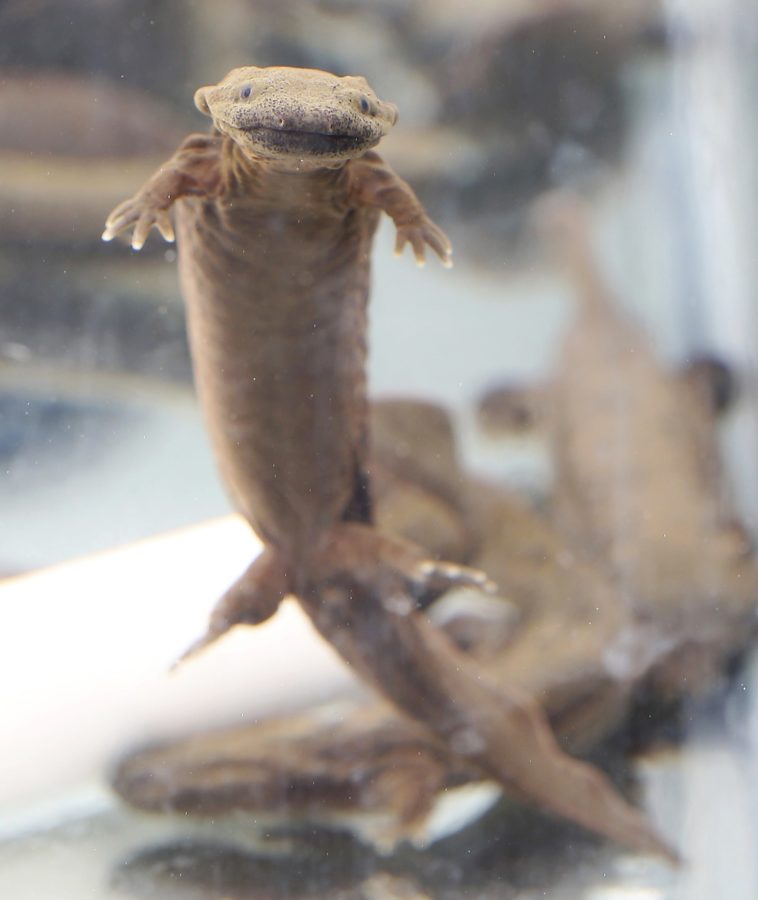 The next big step in the initiative to save the hellbenders of Indiana was completed on May 18, 2015, as three hellbenders were transferred from Purdue University’s Aquaculture Research Lab to the Columbian Park Zoo in Lafayette. This is the last of 50 hellbenders transferred from the lab to Columbian Park Zoo, Fort Wayne Children’s Zoo and Mesker Park Zoo in Evansville.
In 2013, Associate Professor of Wildlife Science Rod Williams and his team collected 300 eggs from the Blue River in Southern Indiana. These eggs grew into young hellbenders in the lab and were transferred to the three zoos to continue growing to adulthood. In the wild, hellbender mortality rate is extremely high, as high as 99%. The salamanders are at their most vulnerable state during their juvenile years, and being raised in captivity will greatly improve their chances of survival when they are released back into the wild in a couple years.
Once released, the hellbenders will be tracked via radio transmitters to monitor their movements, habitat preferences and survivorship. The last group of 18 hellbenders released into the wild had a 22.5% survival rate after one year, and Williams hopes to improve on that. A group of 80 more hellbenders will be released in 2016 with 130 in the following year. Williams’ goal of 40-50% survival rate would mark huge progress in saving the hellbenders of Indiana.
Resources
Help the Hellbender, Purdue Extension
The Nature of Teaching: Adaptations for Aquatic Amphibians, The Education Store, Purdue Extension resource center
How Our Zoos Help Hellbenders, The Education Store
Hellbenders Rock!, The Education Store
Help the Hellbender, North America’s Giant Salamander, The Education Store
How Anglers and Paddlers Can Help the Hellbender, Purdue Extension-FNR YouTube Video
Subscribe to Purdue Extension-FNR YouTube Channel
Rod Williams, Associate Professor of Wildlife Science
Purdue University Department of Forestry and Natural Resources
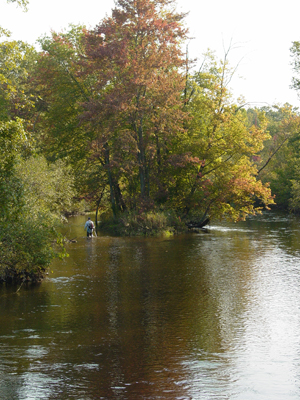 A couple years ago, I had an article on Got Nature about the benefits of eating recreationally-caught fish from waters in the state of Indiana. I’d like to expand on that and talk about the consumption of seafood in general as there seems to be a lot of confusion as to what seafood is healthy or harmful. This is particularly important as the USDA has advised that we should be consuming approximately two meals per week (8 ounces) of seafood as part of a healthy diet. One of the best sources of information on seafood consumption is the University of Idaho’s Seafood at Its Best website.
Given the brief nature of this blog and the complexity of the subject of seafood consumption, I will try to give some general advice and examples as to what to look for when choosing seafood as part of a healthy diet. The first generalization is that all seafood is good with the exception of a few species and sources. Seafood is nutrient dense, being low in fat and carbohydrates but high in protein, vitamins and minerals. There are a few species which are known to contain high levels of mercury (tilefish, shark, swordfish and king mackerel). Likewise, recreationally-caught fish from certain regions listed in advisories should not be considered healthy. When you consider the diversity of seafood, this is a very small minority.
There are varying degrees of benefits associated with different types of seafood. Perhaps the most publicized is the heart-healthy benefit of eating fish high in omega-3 fatty acids such as salmon, mackerel and anchovies. Although other fish may not contain as many omega-3s, they are still going to be nutrient dense and part of a healthy diet. One of the most popular and most misunderstood is tilapia.
Tilapia is a generic term for several species of fish originally from the Rift Valley of Africa which are now cultured all over the world including here in Indiana. They are a warm water fish, intolerant of temperatures less than about 55⁰F. They are an omnivorous fish eating mostly plant life and invertebrate animals in nature but readily take pelleted feeds when cultured. Here in the U.S., tilapia is grown almost exclusively for the live-fish ethnic market in metropolitan areas while processed tilapia is imported from farms in tropical areas all over the globe and readily available in the freezer case.
Tilapia has as much omega-3 as other popular seafood, including lobster, mahi-mahi and yellowfin tuna. Tilapia is also very low in fat. A 4-ounce serving of tilapia has about 1 gram of saturated fat, 29 grams of protein and around 200 mg of omega-3. There are several things you can look for when purchasing tilapia that help ensure you are getting a healthy product. Tilapia are cultured and not captured, so if reared properly, there should be no contaminants in the flesh. Since the majority is grown outside the borders of the U.S., only a small percentage (2-3%) is inspected by the USFDA upon entering the country. While the FDA feels this is sufficient to ensure food safety, many consumers and retailers would like additional oversight to ensure quality and reduce liability. Hence a number of third party certification agencies have stepped into this market. Basically, these agencies use criteria that producers, processors and importers must follow in order to be certified and labeled as such in the marketplace. There are more programs than can be mentioned here, but some of the most notable are:
Fish that have not been certified may not be reared using the best practices and may or may not have been inspected by the FDA.
Fish that are cultured here is the U.S. are inspected at both ends of the process. Feed mills that produce the main input to fish production are inspected by the USFDA. The FDA also oversees the HAACP program for processing fish with the exception of the USDA program for catfish.
So in summary, fish is a great component of a low-fat healthy diet. What type of fish and how it was grown or caught can be intimidating, but the bottom line is the benefits outweigh the risks. If you are still concerned, ask questions about the country of origin, third party certification and inspection process or even get to know your local producer. But the main thing is to eat more fish as part of a healthy lifestyle.
Resources
Fishing Guide and Regulations, Indiana Department of Forestry and Natural Resources
Tilapia, The Education Store
The Truth about Tilapia, Fox News
Bob Rode, Aquaculture Research Lab Manager
Department of Forestry and Natural Resources, Purdue University
Faculty and staff in the Department of Forestry and Natural Resources (FNR) are engaged in environmental planning around the state. Extension programs help managers and decision-makers improve Indiana’s natural resource management and environmental planning. We deliver programs to help communities consider how to plan for their unique and life-sustaining environmental resources and provide education and technical assistance to plan commissions. Programs are developed and delivered in collaboration with the Purdue Extension Community Development Program and Illinois-Indiana Sea Grant. Some of the programs FNR faculty and extension staff have developed in collaboration with our partners include:
American Citizen Planner – Indiana (ACP-IN)
American Citizen Planner – Indiana provides training to Indiana citizen planners who currently serve or plan to serve on area or advisory plan commissions. The program features 31 topics detailing core planning theories, practices, and processes. A comprehensive assessment and four virtual training events reinforce the content learned in the units. The program is hosted by a local Purdue Extension educator for either a county or a region.
Conservation Through Community Leadership (CCL)
Communities face many challenges, and many of these are their natural resources. The Conservation through Community Leadership program serves as a roadmap for communities tackling complex land use and natural resource management challenges. The program provides information, tools, and resources to help communities work with diverse stakeholders.
Enhancing the Value of Public Spaces (EVPS)
The Purdue University Extension program, Enhancing the Value of Public Spaces, addresses public spaces and their role in enhancing the quality of place by helping regions, communities and neighborhoods plan and prepare for a sustainable future. The Indiana-based curriculum is designed for use by decision makers and local leaders with oversight and management of community public spaces such as parks boards and planning commission members, public officials and their staff and members of organizations whose missions provide services related to programs or management of public spaces. The program provides a framework for collecting data on community assets and using that data to plan public spaces improvements.
Green Infrastructure and Hazard Mitigation
Communities face several challenges and complex decisions related to natural hazards, which are increasingly exacerbated by climate change. The program supports a collaborative community planning approach to evaluate the relevance and effectiveness of existing community policies and to identify goals, motivations, and barriers for hazard mitigation planning, focusing on water resources, flooding, and green infrastructure.
Land Use
The Purdue University Land Use Team provides research-based resources and educational programs for Extension professionals, government officials, citizen planners, and residents on land use issues impacting their communities. Land Use Team efforts are underpinned by a timely and rigorous professional development system that prepares Purdue Extension professionals to effectively serve on Plan Commissions.
Rainscaping Education Program
Rainscaping is a combination of sustainable landscape design and management practices that prevents polluted runoff from reaching water bodies — directing stormwater to be absorbed by plants and soils. The program provides training and resources on rainscaping practices that can be installed in residential settings or small-scale public spaces projects.
Renewable Energy
Renewable Energy for Community Planning brings resources for general renewable energy, solar and wind. This includes: community planning guidebooks for renewable energy, solar development, landowner leasing for solar, qualifications for a wind lease, wind farm impact statements and much more.
Sustainable Communities
Extension programs that support sustainable community development strategies are available to communities throughout Indiana. These support decision makers with evaluating, prioritizing, and implementing sustainability strategies for their communities.
Aquaculture Production
North Central Regional Aquaculture Center
The North Central Regional Aquaculture Center (NCRAC) is one of the five Regional Aquaculture Centers established by Congress. A network of aquaculture extension specialists has been established among states served by NCRAC. These individuals coordinate development and distribution of educational materials on all phases of aquaculture ventures and conduct training workshops for extension colleagues and members of the industry. Regional networks of each center in the U.S. are also linked to facilitate the flow of aquaculture information nationwide.
Aquaculture Economics and Marketing
Aquaculture Economics and Marketing Resources
The proximity of Illinois and Indiana to many major markets and the abundance of natural and agricultural resources provide tremendous long-term opportunities for aquaculture farms and businesses in these states. Whether you are an aquaculture producer or you are thinking of getting into an aquaculture business, resources listed here will provide you with science-based information and education to ensure a productive, innovative and profitable aquaculture business.
A Guide to Marketing for Small-Scale Aquaculture Producers
Small-scale aquaculture producers have income opportunities if they plan their production processes—and plan them
well. One of the fundamental principles in marketing is to make it part of the overall planning process. Consider marketing decisions as important as production decisions. No matter how small your aquaculture operation, developing a marketing plan for what you will produce is the best strategy because the fish have to be sold once they reach marketable sizes.
Invasive Species
Aquatic Invasive Species (AIS)
The Indiana Department of Natural Resources, Division of Fish & Wildlife has a list of aquatic species found in Indiana. Be aware as the species listed are concerning as they outcompete native species, threaten human health, change and degrade the ecosystem, and/or require intense maintenance and monitoring.
Aquatic Invasive Species (AIS), Programs & Initiatives
Non-native plants, animals, and pathogens can be introduced and spread through a variety of activities including those associated with boaters, anglers, water gardeners, aquarium hobbyists, and K-12 educators. IISG works with these groups to provide the tools they need to prevent the introduction and spread of these harmful organisms. Illinois-Indiana Sea Grant (IISG) has publications, programs, initiatives and news articles available to answer any questions you may have.
Aquaponics
Combination of Fish Farming and Hydroponics
Aquaponics combines the soil-less growing technique of hydroponics with fish farming. Fish farming is gaining popularity in the state of Indiana and this concept of plant growth along with the fish farming technique is a topic many are wanting to learn more about.
Fisheries Meetings
Fisheries Meeting Details
Illinois-Indiana Sea Grant (IISG) hosts annual fisheries meetings each spring and fall that highlight new and ongoing research related to fisheries and fishing on Lake Michigan. Workshops are held in the evening, with options for in-person at venues convenient for anglers in Illinois and Indiana as well as virtually. Anglers of all experience levels, ages, and backgrounds are encouraged to join to discuss topics such as how yellow perch use wetlands to forage, how the DNR decides how many fish to stock, and what contaminants to consider when preparing your catch for dinner.
Fisheries Data
Angler Archive & Fish Atlas
Illinois-Indiana Sea Grant (IISG) collate fisheries data from state fisheries agencies describing angling effort and species-specific catches for Lake Michigan. This work has resulted in more than 30 years of fisheries data published in two interactive websites: Angler Archive and Fish Atlas.
Fisheries
Eat Midwest Fish
Eat Midwest Fish is an online resource hub that educates consumers about sustainable aquaculture in the Midwest. Consumers have a lot of questions about water farming and farm-raised fish products. Eat Midwest Fish provides resources to inform and inspire consumers to eat more fish and shellfish, including resources focused on where to find locally grown products, what types of products are available, how to source and cook these products, and how farmers are growing both freshwater and marine animals in the Midwest. Information is provided on aquaculture and farm-raised products from the twelve states in the North Central Region: Illinois, Indiana, Iowa, Kansas, Michigan, Minnesota, Missouri, Nebraska, North Dakota, Ohio, South Dakota, and Wisconsin.
Buoys
Lake Michigan Buoys
Illinois-Indiana Sea Grant owns and maintains three real-time monitoring buoys that are deployed annually in nearshore Lake Michigan in the waters of Michigan City, Indiana, as well as Chicago and Wilmette, Illinois. The real-time buoy data is publicly available and used by a wide audience. The National Weather Service uses buoy data to forecast wave and weather conditions, observe current conditions, and change forecasts when observations are not as expected. Boaters, anglers, paddlers, and surfers use the data to assess conditions before traveling out for the day. Charter captains use the data to make decisions about the safety of their customers and crew, as well as which locations will be good for fishing. Scientists use real-time buoy data to improve Lake Michigan predictions for the near- or long-term future.
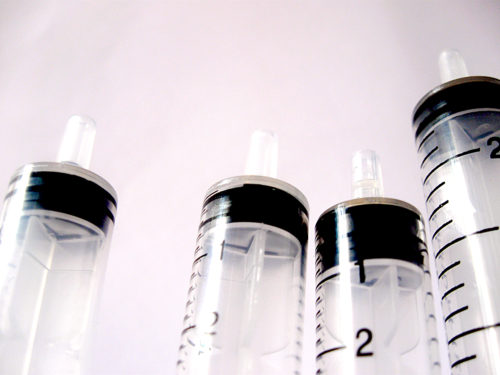 “Community medicine collection programs make it easy for people to rid their homes of unwanted pharmaceuticals, but they can be difficult to get off the ground. That’s where our Unwanted Meds team comes in. They have helped police departments across Illinois and Indiana establish collection programs and raise awareness of the importance of proper disposal.
How to Dispose of Unwanted Medicine and Personal Care Products, Illinois-Indiana Sea Grant
Unwanted Medicine, IN.gov
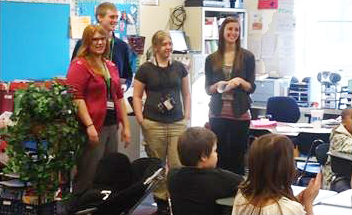 FNR is pleased to announce a new program that will provide undergraduate extension internship opportunities for qualified students this summer. This is an exciting program with the potential to build on an already strong set of FNR extension programs while providing valuable experience and training for undergraduates.
Purdue University’s Department of Forestry and Natural Resources seeks candidates for extension internship positions. The department extension program has a broad environmental scope including fisheries, forest management, invasive species, urban forestry, sustainability, wildlife and wood products. Student interns can enhance their career potential through practical, hands-on experience. Our extension internship program can help you:
- Develop leadership and decision-making skills in handling creative challenges
- Gain experience developing extension products including publications, online videos, presentations and/or more
- Participate in professional development opportunities
- Build professional references and contacts
- Clarify career goals
- Learn from a diverse and experienced group of natural resources professionals
Internships are open to non-Purdue students. Requirements for the position(s) include status as a junior or senior level college student in natural resources or related discipline, minimum 3.0 GPA, evidence of initiative, independence and commitment to conservation of natural resources. Internships are available for summer term (up to 40 hours/wk., up to 8 weeks) with pay at a rate of $12 per hour. Internship start dates and work hours are flexible depending on the applicant’s availability.
Resources
FNR Extension Internship Information, Purdue Forestry and Natural Resources (FNR)
Brian MacGowan, Extension Wildlife Specialist
Department of Forestry and Natural Resources, Purdue University
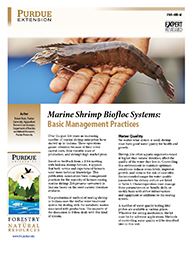 Over the past few years, an increasing number of marine shrimp enterprises have started up in Indiana. These operations garner attention because of their lower capital costs, their variable scale of production and shrimp’s high market price.
Based on feedback from a 2014 meeting with Indiana shrimp farmers, it appears that both novice and experienced farmers need more technical knowledge. This publication summarizes basic management practices for the majority of farmers raising marine shrimp (Litopenaeus vannamei) in Indiana based on the most current literature available. View it in The Education Store today!
Resources
The Education Store (Search”aquaculture” to find more publications available)
Aquaculture Industry in Indiana Growing, Purdue Today
Aquaculture and Aquatic Resources, Department of Forestry and Natural Resources
Farming Shrimp, and Changing the Industry, Far From an Ocean, article available by news service Aljazeera America
Purdue Extension Helps Rural Communities Reinvent, Revitalize, Purdue Agricultures Magazine
Video: Cage Culture and Aquaponics, FNR Youtube channel
Robert A. Rode, Aquaculture Research Lab Manager
Department of Forestry and Natural Resources
The Indiana Department of Natural Resources (INDR) has proposed an idea to the state of Indiana to begin work on a two-mile-long berm in northeast Indiana. The berm will restrict Asian carp from reaching the Great Lakes. It will prevent voracious invasive species from jumping from the Mississippi River watershed during floods to a Great Lakes tributary in Eagle Marsh southeast of Fort Wayne. INDR hopes that work will begin this fall and be completed by September 15, 2015.
View the full article, Work Near on Indiana Berm to Block Asian Carp, from greenbaypressgazette.com.
Resources
Indiana Department of Natural Resources
Asian Carp Movements Project, INDR
Eagle Marsh, Little River Wetlands Project
Invasive Asian Carp May Be Able To Spread Further Than Once Thought, Purdue News
Shocking Asian Carp Out of Midwest Rivers Not a Viable Option, Purdue News
Purdue Agriculture Research: Asian Carp, YouTube video
Got Nature? Podcasts
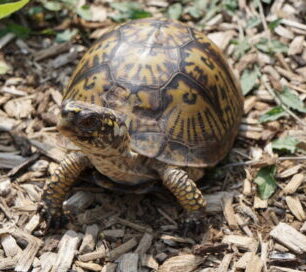
One of the most common questions people ask me is what to do with baby, orphaned wildlife that they find. Recently a homeowner from Carmel asked for advice regarding two hatchling box turtles that her family found in their yard. In early June, they saw the mother laying eggs. They watched the nest periodically throughout the summer only to find two hatchlings just before Labor Day. They wanted to help the young turtles survive but didn’t know what exactly they should do.
Much to the surprise of most people, my answer to this question is almost always “nothing,” regardless of the species. I can’t fault people for wanting to help. That shows me they care about wildlife and are concerned for their well-being. After all, that is a big reason why I got into my line of work. And when it comes to baby animals, we tend to really get concerned. Perhaps that is just the nurturing instinct of parents. We can sometimes forget that wildlife behave very differently than us.
Box turtles may mate anytime during the activity season. During field studies of box turtles in southern Indiana, I encountered pairs mating most often in late summer. After mating, females will store the sperm and delay fertilization up to four years. The following summer (usually late-May to early June), she will locate a nest site, dig the nest, deposit the clutch of eggs and subsequently conceal the nest. The selection of nest sites is unknown, but they generally return to the same area year after year. Some hypothesize they are returning to their own natal region since this is the case for other species of turtles. Once the female deposits her clutch of eggs, they are on their own – box turtles offer no parental care of eggs or hatchlings.
Our good-intended homeowner questioned if the hatchlings she found should be moved to a large state forest (some distance away), a local nature center or the park across the street where she thought the mother came from. Because hatchlings and juvenile box turtles are hard to find, there is very little information known about their movements. It really is not known if the hatching turtles would attempt to cross the street because that is the presumed home of their mother. However, since the wooded park clearly offers better habitat than the housing development, saving the young from a potentially perilous journey across the road is probably ok.
Moving them a long distance away is probably not a good idea and simply not necessary. Based on research of adult movements, we know adult box turtles are very familiar with their home range and are capable of finding this area if displaced from it by up to 3.3 km. Turtles moved a long distance away from their home range may establish a new home range but may also wander great distances looking for home. Similarly, taking the hatchling turtles to a nature center or wildlife rehabilitator isn’t really necessary. They are perfectly fine on their own as long as they have good habitat. Also maintaining a population of box turtles in the park depends on the influx of new turtles.
Resources
Turtles of Indiana, The Education Store
Eastern Box Turtle, Indiana Department of Natural Resources
Orphaned and Injured Animals, Indiana Department of Natural Resources
Brian MacGowan, Extension Wildlife Specialist
Department of Forestry and Natural Resources

Recent Posts
- Discover the Great Lakes, The 2025 Helm Magazine is Available
Posted: November 17, 2025 in Aquaculture/Fish, Aquatic/Aquaculture Resources, Wildlife - Illinois-Indiana Sea Grant Newsletter Shares New Resources
Posted: November 13, 2025 in Aquaculture/Fish, Aquatic/Aquaculture Resources, Wildlife - Publication – Fish Muscle Hydrolysate
Posted: September 15, 2025 in Aquaculture/Fish, Aquatic/Aquaculture Resources - Publication – Direct Marketing Guidebook for Small/Medium-Scale Aquaculture Businesses
Posted: March 7, 2025 in Aquaculture/Fish, Aquatic/Aquaculture Resources, Publication - Conservationists Unite for Snuffbox Mussels – Wild Bulletin
Posted: February 20, 2025 in Aquaculture/Fish, Aquatic/Aquaculture Resources, Wildlife - Publication – Handbook on Processing Fish for Small-Scale Fish Farmers
Posted: October 17, 2024 in Aquaculture/Fish, Aquatic/Aquaculture Resources, How To, Publication, Wildlife - IISG Adds New Water Safety Videos
Posted: May 8, 2024 in Aquaculture/Fish, Aquatic/Aquaculture Resources, Community Development, Great Lakes, Wildlife - Farmers Helping Hellbenders RCPP Program Accepting Applications
Posted: May 1, 2024 in Aquaculture/Fish, Forestry, How To, Wildlife, Woodlands - 2024-25 Fishing Guide now available – Wild Bulletin
Posted: April 4, 2024 in Alert, Aquaculture/Fish, Aquatic/Aquaculture Resources, How To, Ponds, Wildlife - Look Out for Invasive Carp in Your Bait Bucket – Wild Bulletin
Posted: March 31, 2024 in Alert, Aquaculture/Fish, Aquatic/Aquaculture Resources, Invasive Animal Species, Wildlife
Archives
Categories
- Alert
- Aquaculture/Fish
- Aquatic/Aquaculture Resources
- Ask the Expert
- Christmas Trees
- Community Development
- Disease
- Drought
- Forestry
- Forests and Street Trees
- Gardening
- Got Nature for Kids
- Great Lakes
- How To
- Invasive Animal Species
- Invasive Insects
- Invasive Plant Species
- Land Use
- Natural Resource Planning
- Nature of Teaching
- Plants
- Podcasts
- Ponds
- Publication
- Safety
- Spiders
- Timber Marketing
- Uncategorized
- Urban Forestry
- Webinar
- Wildlife
- Wood Products/Manufacturing
- Woodland Management Moment
- Woodlands