 Purdue University - Extension - Forestry and Natural Resources
Got Nature? Blog
Purdue College of Agriculture News: An armored mammal, once limited to the swamps and forests of the Deep South, is now burrowing its way through the backyards and woodlands of Indiana. The nine-banded armadillo—a 10 to 15 pound mammal often associated with Texas or Louisiana—has become an increasingly common sight in the Hoosier state.
Brian MacGowan, Purdue Extension wildlife specialist and coordinator in Purdue University’s Department of Forestry and Natural Resources, explains that while this isn’t a brand-new arrival, the armadillo population and range have grown steadily and moved north in recent years.
“The nine-banded armadillo was first discovered living in Indiana around 2003,” MacGowan said. “Since then, they have been found throughout most of the state, even into the far northeast corner of Steuben County.”
MacGowan explains that armadillos are known to establish themselves in woodland areas in search of their food source. “Their diet is generally ground insects,” he said. “If an animal wants to find loads of insects, they will find an abundance in decaying wood.”
Another distinct characteristic of the nine-banded armadillo is their burrowing tactics.
“In some studies, these armadillos have been known to use multiple burrows, sometimes over 30 in a single year,” MacGowan said. “If they run into trouble, their first response is often to jump up and run into their burrow as fast as they can.”
As a nocturnal animal with many burrows to call home, their chances of being seen by humans are diminished. However, occasionally homeowners and farmers will find signs of armadillos on their property, such as where they dig up insects and grubs or burrow under a deck.
While armadillos are not known to be dangerous, there is a risk of humans or animals stepping into their open burrows. MacGowan compares this concern with the challenge farmers face with groundhogs and ground squirrels.
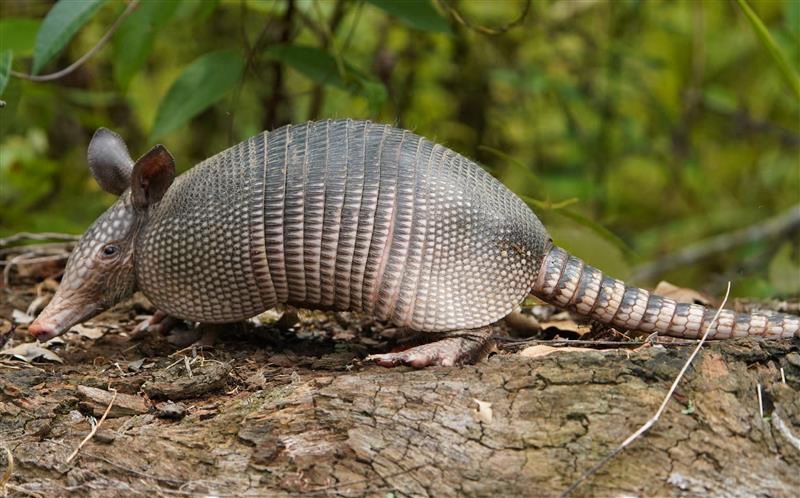 Rather than navigating by sight or sound, the nine-banded armadillos rely on smell, which could lead them to roadways while searching for food, MacGowan explains.
“The nine-banded armadillos also cannot curl up in a ball and protect their soft underbelly like other armadillo species can, so they’re vulnerable to predation by coyotes and other predators, said MacGowan.
Armadillo sightings are also influenced by the temperatures and moisture in an area. “If there’s a drought, it can kill off a lot of armadillos because the ground gets so hard and a lot of the insects and things they eat move below ground,” MacGowan said.
Typically, when it is cold out, the nine-banded armadillo adjusts its behavior to be more active during the day, partly because that helps them warm up. Also, some of the things they eat are more likely to be active when it’s warmer. MacGowan encourages people who encounter these animals to let them be.
“Armadillos are susceptible to a variety of diseases just like any wild animal,” he said. “You might have heard talk that armadillos can carry leprosy. That is generally an endemic issue for those animals specifically found in some regions in the south. While leprosy is quite deadly to armadillos, there is absolutely no evidence of transmission to people. However, they are wild animals, and the DNR will always caution people to keep their distance from any wild animal.”
The next time you spot this rare visitor in your backyard or scurrying across a Hoosier road, remember that you are witnessing history in motion. Reporting unusual animal sightings, like the nine-banded armadillo, not only helps the DNR track these shifts, but also deepens our understanding of a continually evolving ecosystem. After all, you never know what remarkable creature might be unexpectedly making its home in Indiana.
You can help the Indiana Division of Fish & Wildlife by submitting reports of certain mammals of interest. These mammals can potentially be seen from the comfort of your home, on your way to work, or while out biking, hiking, or camping. Reports can be made to the DNR here.
To view this article along with other news and stories posted on the Purdue College of Agriculture website view: Unexpected Plants and Animals of Indiana: The nine-banded armadillo.
Resources:
A Template for Your Wildlife Habitat Management Plan, The Education Store, Purdue Extension resource center
Wildlife Habitat Hint, Purdue Extension – Forestry & Natural Resources (FNR) YouTube Playlist
Woodland Stewardship for Landowners, Purdue Extension – FNR YouTube Playlist
Woodland Management Moment, Purdue Extension – FNR YouTube Playlist
Invasive Species, Playlist, Purdue Extension – FNR Youtube Channel
Invasive Plant Species Identification, Video, Purdue Extension – FNR Youtube Channel
Invasive plants: impact on environment and people, The Education Store, Purdue Extension’s resource center
Woodland Invaders, Got Nature? Blog, Purdue Extension – FNR
Preventing Wildlife Damage – Do You Need a Permit? – The Education Store, Purdue Extension resource center
Selecting a Nuisance Wildlife Control Professional, The Education Store
How to Construct a Scent Station, The Education Store
Question: How do I properly relocate raccoons from my attic?, Got Nature? Blog, Purdue Extension FNR
Nuisance Wildlife – Indiana Department of Natural Resources
Subscribe to our FNR Extension YouTube Channel with over 250 videos which include: aquatic, forestry, urban forestry, wildlife, community planning videos and much more.
Ericka Bethel, Digital Content Specialist
Purdue University Department of Forestry and Natural Resources
Dr. Brian MacGowan, Extension Wildlife Specialist
Department of Forestry & Natural Resources, Purdue University

Recent Posts
- New Indiana Woodland Steward Newsletter
Posted: August 12, 2026 in Forestry, Urban Forestry, Wildlife, Woodlands - Indiana Fall Hunting Licenses on Sale and New Mobile App Available
Posted: in Forestry, How To, Wildlife - Lighting a Spark: Prescribed Burn Associations
Posted: August 6, 2026 in Community Development, Forestry, Safety, Wildlife - ID That Tree: Nannyberry Viburnum
Posted: July 22, 2026 in Forestry, Plants, Wildlife, Woodlands - ID That Tree: Eastern Swamp Privet
Posted: in Forestry, Plants, Wildlife, Woodlands - Jarred Brooke Receives Early Career Award for Prescribed Fire Work
Posted: July 20, 2026 in Forestry, Forests and Street Trees, Natural Resource Planning, Safety - Bovine Tuberculosis in Wild White-tailed Deer: Background and Frequently Asked Questions
Posted: in Disease, Natural Resource Planning, Wildlife - ID That Tree: Carolina Buckthorn
Posted: July 15, 2026 in Forestry, Wildlife, Woodlands - Bat Roost Reporting Tool
Posted: July 8, 2026 in Alert, Community Development, Invasive Animal Species, Wildlife - Pruning Highlight; Espalier Pruning: Training Trees into Living Patterns
Posted: in Forestry, Forests and Street Trees, Gardening
Archives
Categories
- Alert
- Aquaculture/Fish
- Aquatic/Aquaculture Resources
- Ask the Expert
- Christmas Trees
- Community Development
- Disease
- Drought
- Forestry
- Forests and Street Trees
- Gardening
- Got Nature for Kids
- Great Lakes
- How To
- Invasive Animal Species
- Invasive Insects
- Invasive Plant Species
- Land Use
- Natural Resource Planning
- Nature of Teaching
- Plants
- Podcasts
- Ponds
- Publication
- Safety
- Spiders
- Timber Marketing
- Urban Forestry
- Webinar
- Wildlife
- Wood Products/Manufacturing
- Woodland Management Moment
- Woodlands