 Purdue University - Extension - Forestry and Natural Resources
Got Nature? Blog
In this episode of ID That Tree, Purdue Extension forester Lenny Farlee introduces a native Indiana species found in dry sites in Northern and Southern Indiana, the scarlet oak. Identify this member of the red oak family by its terminal buds with hairs and a red coloration, leaves with deep C-shaped sinuses, dark smooth bark and acorns with caps that cover half the acorn.
If you have any questions regarding wildlife, trees, forest management, wood products, natural resource planning or other natural resource topics, feel free to contact us by using our Ask an Expert web page.
Resources:
ID That Tree, Playlist, Purdue Extension – Forestry and Natural Resources YouTube Channel
A Woodland Management Moment, Playlist, Purdue Extension – FNR YouTube Channel
Shrubs and Woody Vines of Indiana and the Midwest, The Education Store, Purdue Extension Resource Center
Native Trees of the Midwest, The Education Store
Scarlet Oak, Native Trees of Indiana Riverwalk Purdue Fort Wayne
Investing in Indiana Woodlands, The Education Store
Forest Improvement Handbook, The Education Store
Lenny Farlee, Sustaining Hardwood Extension Specialist
Purdue University Department of Forestry and Natural Resources
Question: Often ginkgo trees will drop all of their leaves on a single day after a cold night. I thought that was going to be Monday at Purdue (left: leaves falling). But no, we’re at Wednesday now (right) and this one changed its mind. Anyone know how common that is?
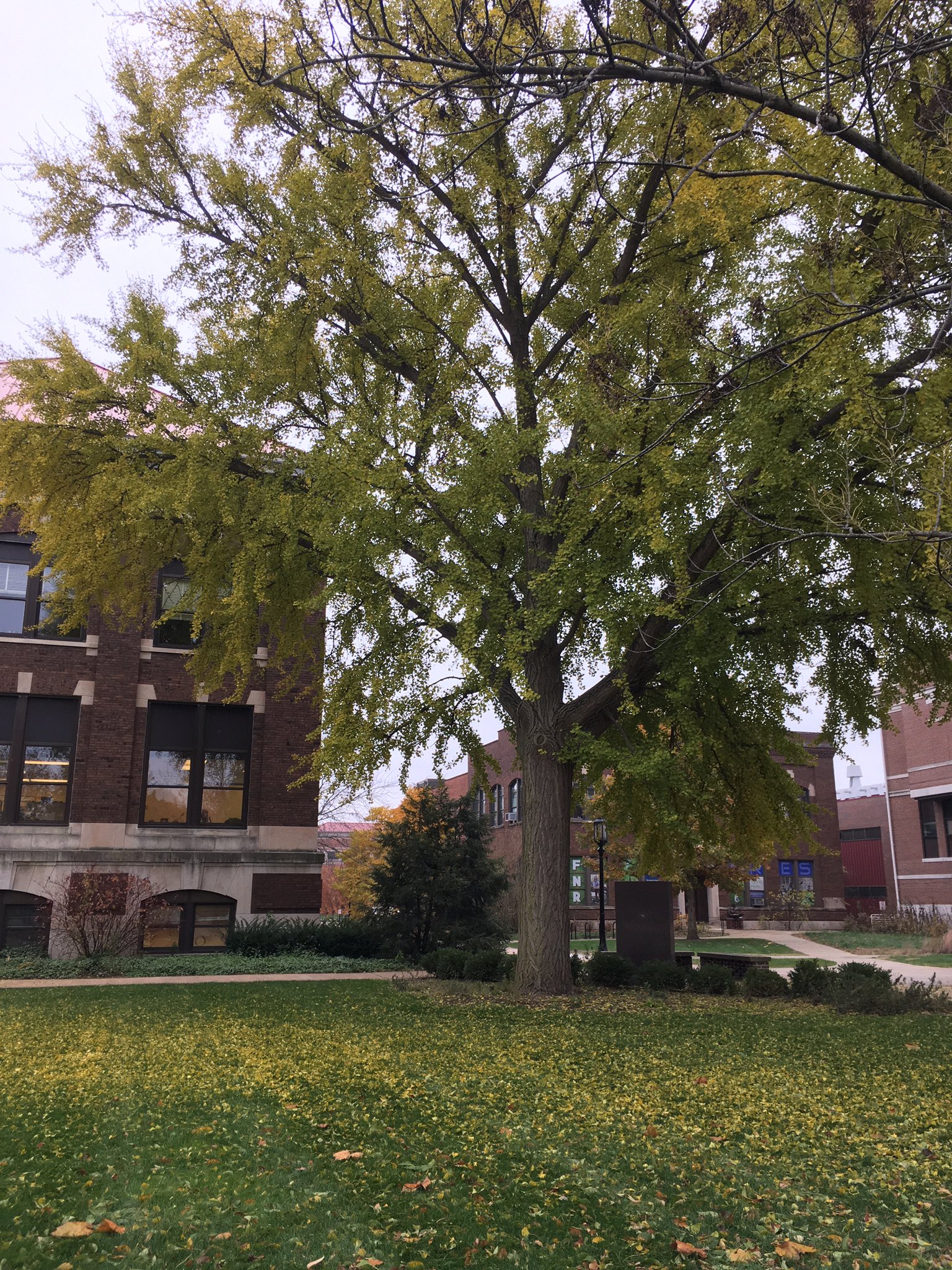
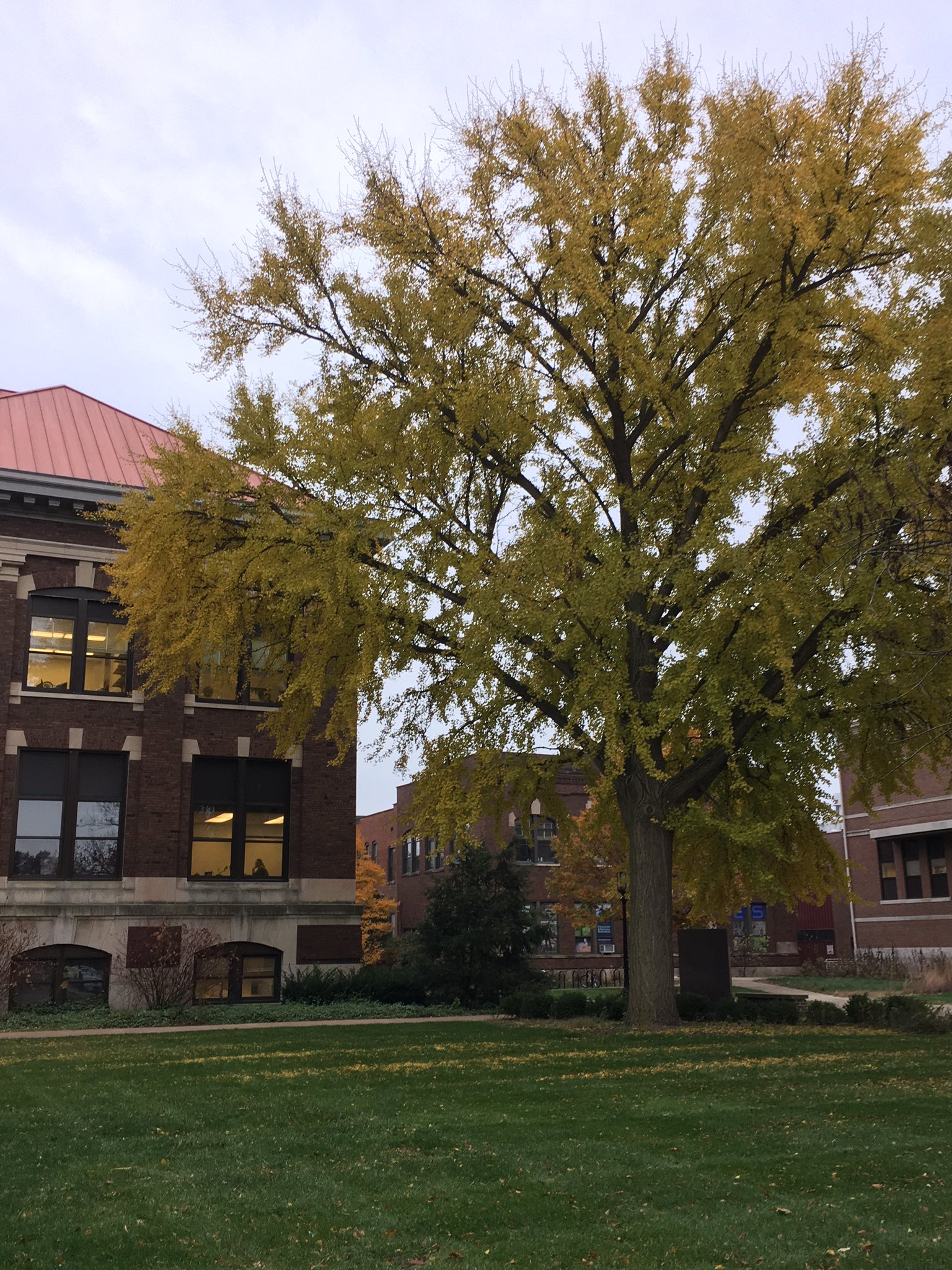
Answer: It was a very peculiar fall. The overall leaf drop was one to two weeks later than normal at least. An October with weather more like September has likely had some impact on this. Individual trees will vary some on their leaf drop timing, probably due to their geographic origin (for planted trees) and individual genetic variation. The severity and timing of frost/freeze also influences strongly. As you can see, lots of variables!
Leaf drop is not solely dependent on temperatures. There is a process of dormancy the tree follows to properly acclimate in preparation for winter. One of these is leaf drop, but it must go through the process of developing an abscission layer between the petiole base and branch. Most likely, the tree didn’t drop leaves yet because this separation layer of chemicals hasn’t fully responded yet. We often see frozen leaves on a tree and later they fall, but this is the result of sudden extreme cold ahead of proper dormancy routines.
Resources:
Fall Color Pigments, Purdue Extension YouTube Channel
Why Leaves Change Color – The Physiological Basis,
Oak Wilt in Indiana, Purdue Landscape Report
Dog Days of Summer Barking Early This Year, Purdue Landscape Report
Tulip Poplar Summer Leaf Drop, Purdue Landscape Report
Be on the Lookout for Defoliated Viburnums and Viburnum Leaf Beetle, Purdue Landscape Report
Will my Trees Recover After Losing Their Leaves?, Purdue Landscape Report
What Do Trees Do in the Winter?, Purdue Landscape Report
Why Fall Color is Sometimes a Dud, Purdue Landscape Report
Alternatives to Burning Bush For Fall Color, Purdue Landscape Report
Start Preparing Trees for Winter and Next Year, Purdue Landscape Report
ID That Tree Winter Edition: Opposite Leaf Arrangement – Ohio buckeye, Red Maple, Purdue Extension YouTube Channel
ID That Tree Winter Edition: Alternate Leaf Arrangement – Black Walnut, Eastern Cottonwood, Purdue Extension YouTube Channel
ID That Tree Winter Edition: Alternate Leaf Arrangement – Honey Locust, Burr Oak, Purdue Extension YouTube Channel
Lenny Farlee, Sustaining Hardwood Extension Specialist
Purdue University Department of Forestry and Natural Resources
Lindsey Purcell, Urban Forestry Specialist
Purdue University Department of Forestry and Natural Resources
Meet overcup oak, a species found on swampy ground and soils in southwestern Indiana. It is identifiable by its deeply sinused alternately arranged leaves as well as its acorns, which have a cap which encases nearly the entire acorn and typically don’t let go easily.
If you have any questions regarding wildlife, trees, forest management, wood products, natural resource planning or other natural resource topics, feel free to contact us by using our Ask an Expert web page.
Resources:
ID That Tree, Playlist, Purdue Extension – Forestry and Natural Resources YouTube Channel
A Woodland Management Moment, Playlist, Purdue Extension – FNR YouTube Channel
Shrubs and Woody Vines of Indiana and the Midwest, The Education Store, Purdue Extension Resource Center
Native Trees of the Midwest, The Education Store
Overcup Oak, Native Trees of Indiana Riverwalk Purdue Fort Wayne
Investing in Indiana Woodlands, The Education Store
Forest Improvement Handbook, The Education Store
Lenny Farlee, Sustaining Hardwood Extension Specialist
Purdue University Department of Forestry and Natural Resources
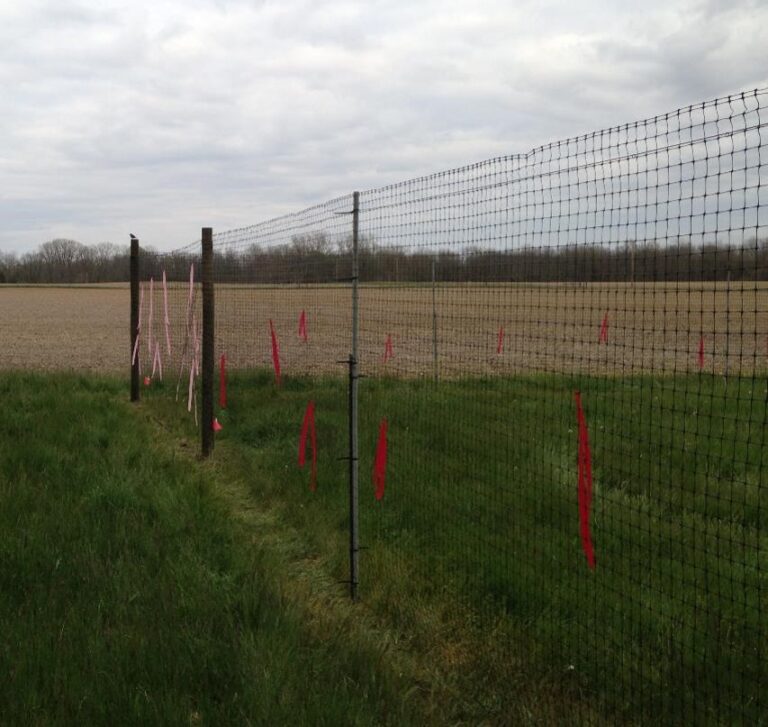 Hardwood Tree Improvement & Regeneration Center (HTIRC) Newsletter: USDA conservation programs provide technical and financial incentives for landowners to install and maintain conservation practices, including tree plantations. They are an important tool to help encourage landowners to make an investment in long-term activities like planting hardwood trees. Research across the eastern US, including work done by the HTIRC, demonstrates that deer browse can be one of the most significant barriers to establishment of a successful tree plantings. Deer may increase mortality, but more often they are preventing planted or naturally regenerating trees from growing in height due to repeated browsing. This damage can also deform trees, resulting in poor stem form and lower potential log quality. Plantations where deer selectively browse desirable species may lose important species like oaks due to overtopping by less favored, and therefore less browsed, species that become free to grow. Reducing the damage done by deer browse is an important, and in many locations the most critical step in successful tree planting establishment in many areas across the eastern US.
One of the primary purposes for these conservation tree plantings is developing forest wildlife habitat, but to successfully establish that habitat may require excluding deer for a few years, until the trees are tall enough to continue growing past the deer browse damage. Fortunately, many state Natural Resource Conservation Service offices are recognizing the impact that deer browse is having on establishing successful conservation tree plantings. To address this barrier to successfully establishing tree plantings and natural regeneration, new scenarios are being added to the Tree and Shrub Establishment practice:
-
- The “Planted Area with Protection” scenario provides cost assistance for tree and shrub planting and placement of a temporary perimeter fence to exclude deer until trees have grown above the height of deer browsing.
- The “Regeneration Area with Protection” scenario provides cost assistance for placement of a temporary fence to protect natural regeneration of tree and shrub species.
- Increased cost assistance payments may be available to help offset some of the additional cost a deer exclusion fence adds to a planting project. States may have differing cost assistance rates and practice requirements. These and other additions to the NRCS tree planting practices provide landowners and natural resource managers effective tools to establish tree plantings that can produce high quality hardwood trees in the future. Check with your local foresters and NRCS offices to see if this practice is available in your area and details on payment rates and requirements. If the practice is not available, work with your local resource management contacts to request addition of this practice for your area in the future.
The HTIRC has supported this fencing practice through research and demonstration plantings that have showcased the benefits deer exclusion fencing can provide for timely establishment and timber quality development in hardwood plantings.
Resources:
Woodland Stewardship For Landowners, Playlist, Purdue Extension – Forestry and Natural Resources YouTube Channel
Woodland Management Moment, Purdue Extension – FNR Playlist
A Woodland Management Moment – Deer Fencing, Purdue Extension – FNR Video
Wildlife Habitat Hint: Exclusion Cage, Purdue Extension – FNR Video
How to Build a Plastic Mesh Deer Exclusion Fence, The Education Store, Purdue Extension resource center
Ask An Expert: Handling Harvested Deer, Purdue Extension – FNR YouTube Channel
Forest Improvement Handbook, The Education Store
Finding help from a professional forester, Indiana Forestry & Woodland Owners Association
Lenny Farlee, Sustaining Hardwood Extension Specialist
Hardwood Tree Improvement & Regeneration Center (HTIRC)
Purdue University Department of Forestry and Natural Resources
In this edition of ID That Tree, Purdue Extension forester Lenny Farlee introduces you to a native Indiana tree that provided a substitute for coffee in its past. Meet the Kentucky coffee tree, which is known by its large pods, doubly-compound leaves and beautifully textured bark. Learn more inside.
If you have any questions regarding wildlife, trees, forest management, wood products, natural resource planning or other natural resource topics, feel free to contact us by using our Ask an Expert web page.
Resources:
ID That Tree, Playlist, Purdue Extension – Forestry and Natural Resources YouTube Channel
A Woodland Management Moment, Playlist, Purdue Extension – FNR YouTube Channel
Shrubs and Woody Vines of Indiana and the Midwest, The Education Store, Purdue Extension Resource Center
Native Trees of the Midwest, The Education Store
Investing in Indiana Woodlands, The Education Store
Forest Improvement Handbook, The Education Store
River Birch-Native Trees of Indiana River Walk, Purdue University Fort Wayne
Lenny Farlee, Sustaining Hardwood Extension Specialist
Purdue University Department of Forestry and Natural Resources
In this edition of ID That Tree, meet River Birch. As its name implies, it is often found near waterways and in moist soil areas across the state of Indiana. It can be multi-stemmed, often in landscaping, or single stemmed, often in woodlands and bottomlands. Simple triangular-shaped leaves with doubly-serrated margins and flaking/peeling bark are key identifiers. In younger trees, the bark peels more and can range from chalky white to reddish brown. Bark on older trees is darker gray/brown and peeling is less prominent.
If you have any questions regarding wildlife, trees, forest management, wood products, natural resource planning or other natural resource topics, feel free to contact us by using our Ask an Expert web page.
Resources:
ID That Tree, Playlist, Purdue Extension – Forestry and Natural Resources YouTube Channel
A Woodland Management Moment, Playlist, Purdue Extension – FNR YouTube Channel
Shrubs and Woody Vines of Indiana and the Midwest, The Education Store, Purdue Extension Resource Center
Native Trees of the Midwest, The Education Store
Investing in Indiana Woodlands, The Education Store
Forest Improvement Handbook, The Education Store
River Birch-Native Trees of Indiana River Walk, Purdue University Fort Wayne
Lenny Farlee, Sustaining Hardwood Extension Specialist
Purdue University Department of Forestry and Natural Resources
Purdue Landscape Report – Black Root Rot: Black root rot (BRR), caused by the fungus Thielaviopsis basicola,has a host range of several hundred plants. In the landscape, the most common hosts include pansies (Fig. 1), and vinca, along with calibrachoa and petunia. In perennial hosts, it often infects lavender, phlox, milkweed and butterfly-weed (Asclepius spp.). Even woody plants, like holly and elderflower (Sambucus spp.) can succumb.
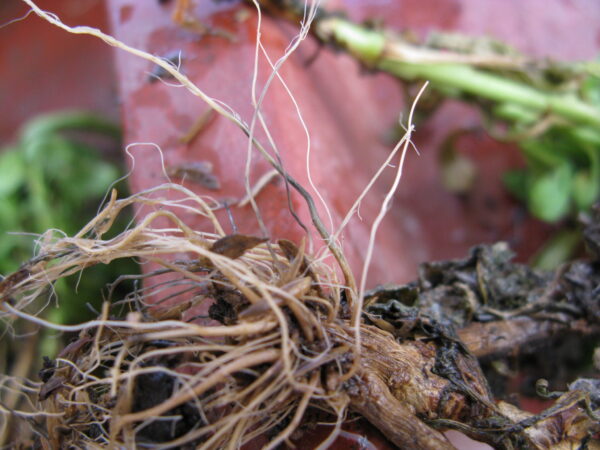
Figure 2. Clean roots showing the characteristic black root rot. Photo by Janna Beckerman.
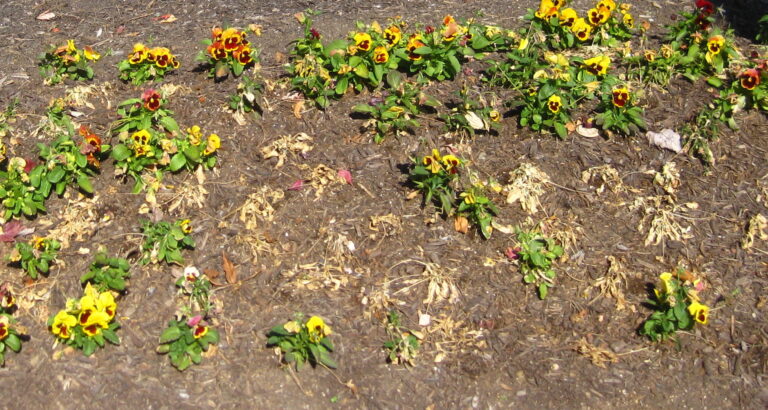
Figure 1. Pansies get a bad a rap for falling down in hot weather. Thielaviopsis is often the real culprit. Photo by Janna Beckerman.
Symptoms of black root rot are often mistaken for nutrient deficiencies. Older leaves may develop symptoms that look like iron chlorosis, while young leaves become stunted. Infected plants grow more slowly compared to healthy plants. Shoot length is reduced compared to healthy plants, and scattered dead shoots may be apparent. In pansy, one of the key symptoms of BRR is when seemingly ‘healthy’ plants may suddenly collapse when a brief hot spell occurs (Fig. 1).
Keep in mind that diagnosing any root rot requires observing the affected plant for symptoms, and collecting the infected tissue at the right time to culture out the pathogen or pathogens causing the problem.
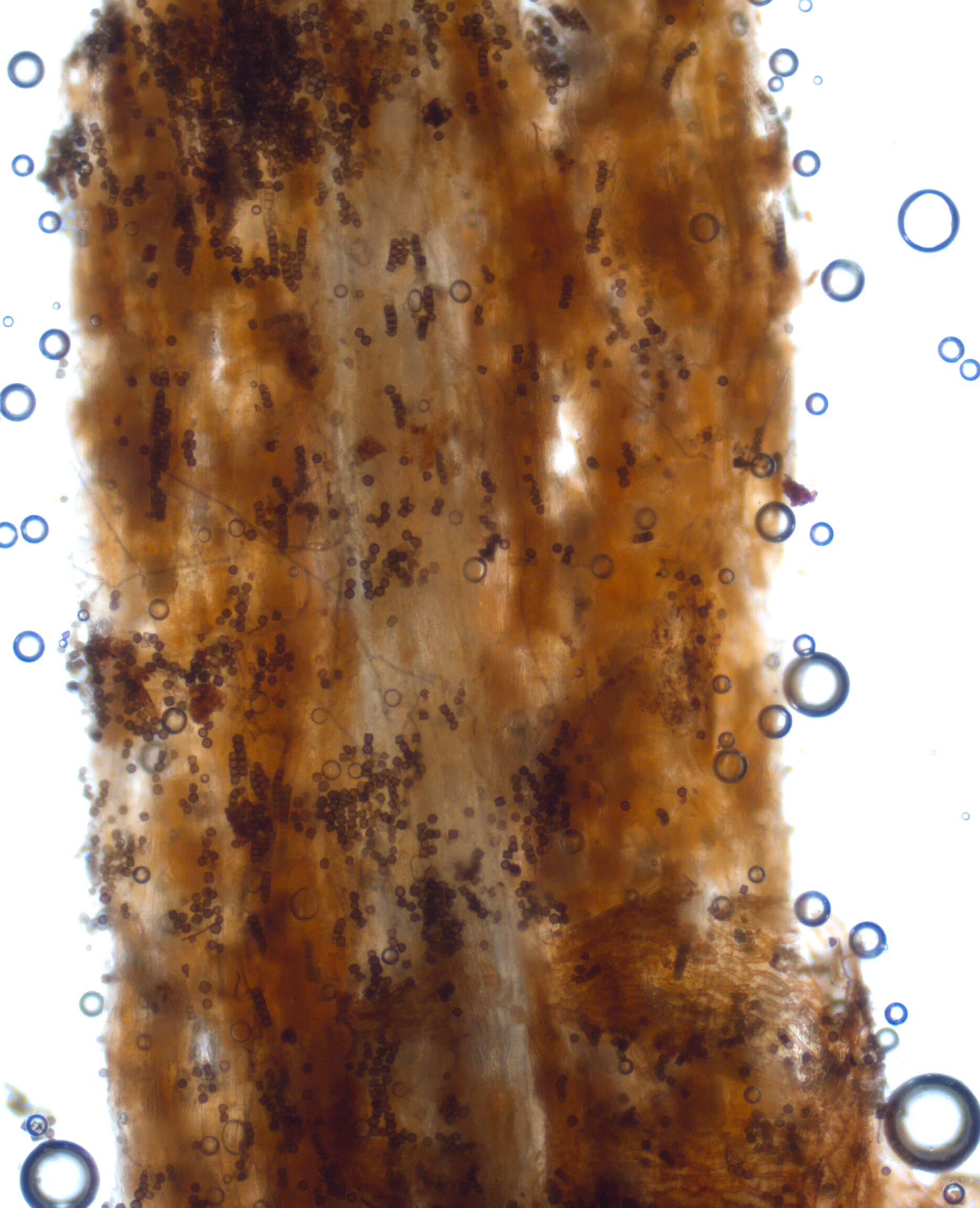
Figure 3. Looking at sectioned black root reveals numerous chlamydospores. Photo by Janna Beckerman.
Resources:
Purdue Landscape Report
Root Rot in Landscape Plants, The Education Store
Ask The Expert: Tree Inspection, Purdue Extension- FNR YouTube Channel
Ask The Expert: Tree Selection and Planting, Purdue Extension- FNR YouTube Channel
Janna Beckerman, Professor
Purdue Botany and Plant Pathology
In this edition of ID That Tree, learn how to tell Red Hickory apart from its cousins shellbark, shagbark and pignut hickory. Located typically in upland dry sites, red hickory stands out with compound leaves with seven leaflets, long running interlacing gray bark, buds and twigs free of hairs, and lastly nuts with a husk that separates all the way down the sides of the nut.
If you have any questions regarding wildlife, trees, forest management, wood products, natural resource planning or other natural resource topics, feel free to contact us by using our Ask an Expert web page.
Resources:
ID That Tree, Playlist, Purdue Extension – Forestry and Natural Resources Youtube Channel
A Woodland Management Moment, Playlist, Purdue Extension – FNR Youtube Channel
Shrubs and Woody Vines of Indiana and the Midwest, The Education Store, Purdue Extension Resource Center
Native Trees of the Midwest, The Education Store
Investing in Indiana Woodlands, The Education Store
Forest Improvement Handbook, The Education Store
Lenny Farlee, Sustaining Hardwood Extension Specialist
Purdue University Department of Forestry and Natural Resources
Purdue Landscape Report – Tip Blights of Juniper: Junipers have to be my favorite group of evergreens, behind a select few pine species. They have a fantastic fragrance, are evergreen, many can tolerate drought, are an ingredient in gin (definitely a bonus), and work well in a variety of landscape uses, including as a barrier plant. They look great year round, except when they have tip blight.
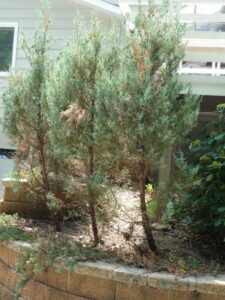
Juniper with tip blight symptoms in the landscape
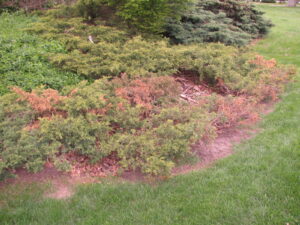
Phomopsis tip blight affecting multiple juniper branches
Tip blight is a common disease in nurseries and landscapes that cause branch tips to die back fairly quickly starting in the spring. Infected branches become chlorotic, progressing from light green to yellow, before turning brown as the season continues. Black fungal structures will develop in the transition zone between affected foliage and green, healthy tissue. Some of the infected scales may turn gray in color, surrounding these structures.
Two fungi cause tip blight, Kabatina and Phomopsis, and knowing which one you have is important to determine your management strategies. Both fungi produce similar symptoms and similar fungal structures,
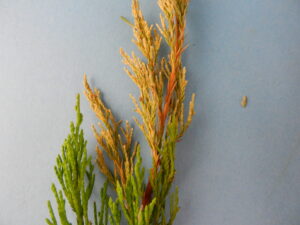
Branch tips turning pale yellow due to infection by Kabatina.
so the presence of tiny black dots cannot help separate these diseases. Both fungi also infect a range of hosts, including arborvitae, cypress, Douglas fir, true firs, yew, Cryptomeria, and Chamaecyparis, but these are not as susceptible as juniper species.
Kabatina infects young, new growth during the growing season, but infected twigs remain green until winter and the following spring . . .
Resources:
Borers of Pines and Other Needle Bearing Evergreens in Landscapes, The Education Store, Purdue Extension resource center
Ask an Expert Question: Blue Spruce dying, what can I do?, Got Nature? Blog, Purdue Extension – Forestry and Natural Resources
Why Spruce Trees Lose Their Needles, Purdue Extension
Diseases Common in Blue Spruce, Purdue Extension
Purdue University Invasive Species
John Bonkowski, Plant Disease Diagnostician
Purdue Botany and Plant Pathology
 Question: My husband and I love to build wildlife habitat areas and have built a large pond with a strategic filtering system in the pond. We had to place a net five to six feet up to keep leaves and acorns out of the filtering system and now the frogs are jumping on the net. One specialist said they are trying to get to the woods to hibernate for winter and one shared that they can stay in the pond as long as it doesn’t freeze. Which answer is correct?
Answer: Both of your answers could be correct. The following is from Michael Lannoo (2005) Amphibian Declines: The Conservation Status of United States Species. In summary, adults will hibernate in both water and on land, although underwater seems to be the most common site. The key is having available oxygen. However, hibernating amphibians when hibernating have extremely low oxygen requirements. So much so that most species get enough O2 from absorption through specialized patches of skin.
- Seasonal Migrations. Green frogs probably do not migrate en masse to breeding sites. Lamoureux and Madison (1999) tracked 23 green frogs and found that they made extensive movements in late fall away from summer breeding ponds to areas of flowing water in streams and seeps. They suggested that flowing water is used because it remains unfrozen and provides adequate oxygen.
- J. Torpor (Hibernation). Green frog tadpoles will typically, but not always, overwinter for 1 yr prior to metamorphosing the following spring (Martof, 1952; Richmond, 1964; Vogt, 1981). While overwintering, and despite cold temperatures, tadpoles remain active and likely feed (Getz, 1958). Tadpoles probably remain active and grow during the winter in Louisiana but do not transform until warm weather (Dundee and Rossman, 1989). In Maine, they remain under silt and dead vegetation during the winter (Hunter et al., 1999). Both tadpoles and adults require aquatic sites that do not completely freeze and that also maintain enough oxygen during the winter (Oldfield and Moriarty, 1994).
Green frog adults typically overwinter in water (Dickerson, 1906; Walker, 1946; Pope, 1947; Wright and Wright, 1949; Harding and Holman, 1999) but will occasionally overwinter on land (Bohnsack, 1951). The frog followed by Bohnsack (1951) was found beneath 5 cm (2 in) of compact leaf litter in an oak-hickory forest near Pickney, Michigan. Lannoo et al. (1998) cites an instance where a large number (25, including 4 gravid females) of green frogs were caught on land near a wetland during a cold snap in northern Wisconsin. Minton (1972) notes that adults near Indianapolis, Indiana, seek cover from early December to early March and that juveniles emerge earlier in the season than do adults. In Maine, green frogs hibernate either underwater or underground from October–March (Hunter et al., 1999). In Ohio, several hibernating individuals have been found in springs and in masses of leaves and aquatic vegetation on the bottom of small ponds (Walker, 1946).
Resources:
Mythbusters, Got Nature? Blog, Purdue Extension – Forestry and Natural Resources
Frogs and Toads of Indiana, The Education Store, Purdue Extension resource center
Appreciating Reptiles and Amphibians in Nature, The Education Store
Forestry Management for Reptiles and Amphibians: A Technical Guide for the Midwest, The Education Store
The Nature of Teaching, Unit 3: Reptiles, Amphibians, and the Scientific Method, The Education Store
Frogs and Toads of Indiana, The Education Store
Snakes and Lizards of Indiana, The Education Store
Ask the Expert: Turtles and Snakes video, Got Nature? post
Brian MacGowan, Wildlife Extension Specialist
Purdue University, Department of Forestry and Natural Resources

Recent Posts
- A Woodland Management Moment: Black Walnut in Pine Plantation
Posted: December 19, 2025 in Forestry, Forests and Street Trees, Urban Forestry, Woodlands - ID That Tree: Sugarberry
Posted: December 12, 2025 in Forestry, Wildlife, Woodlands - Powering Rural Futures: Purdue’s Agrivoltaics Initiative for Sustainable Growth
Posted: December 9, 2025 in Community Development, Wildlife - Learn How to Control Reed Canarygrass
Posted: December 8, 2025 in Forestry, Invasive Plant Species, Wildlife - Benefits of a Real Christmas Tree, Hoosier Ag Today Podcast
Posted: December 5, 2025 in Christmas Trees, Forestry, Woodlands - Succession Planning Resource: Secure your Future
Posted: December 2, 2025 in Community Development, Land Use, Woodlands - A Woodland Management Moment: Butternut Disease and Breeding
Posted: December 1, 2025 in Forestry, Forests and Street Trees, Woodland Management Moment, Woodlands - Controlling Introduced Cool-Season Grasses
Posted: in Forestry, Invasive Plant Species, Wildlife - Red in Winter – What Are Those Red Fruits I See?
Posted: in Forestry, Plants, Urban Forestry, Wildlife, Woodlands - Managing Common and Cut Leaved Teasel
Posted: November 24, 2025 in Forestry, Invasive Plant Species, Wildlife
Archives
Categories
- Alert
- Aquaculture/Fish
- Aquatic/Aquaculture Resources
- Ask the Expert
- Christmas Trees
- Community Development
- Disease
- Drought
- Forestry
- Forests and Street Trees
- Gardening
- Got Nature for Kids
- Great Lakes
- How To
- Invasive Animal Species
- Invasive Insects
- Invasive Plant Species
- Land Use
- Natural Resource Planning
- Nature of Teaching
- Plants
- Podcasts
- Ponds
- Publication
- Safety
- Spiders
- Timber Marketing
- Uncategorized
- Urban Forestry
- Webinar
- Wildlife
- Wood Products/Manufacturing
- Woodland Management Moment
- Woodlands