 Purdue University - Extension - Forestry and Natural Resources
Got Nature? Blog
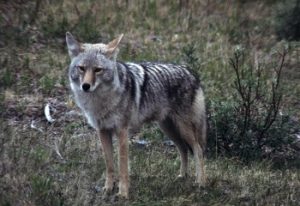
Coyote (Canis latrans) – Photo by Alfred Viola, Northeastern University, Bugwood.org
Question
Can you help me identify the canines that live on my farm? Are they “coyote” or “coywolf”? I have taken photos of the pups and have been confused on trying to identify them from articles I have found online. One article I found suggests a “coywolf” is something unusual; but another article I found suggests every canine we refer to in Indiana as “coyote” is actually a “coywolf” hybrid rather than a “true” coyote. I would like to know. Thank you.
Answer
Thanks for submitting this question. You are correct that many of the online articles we find are confusing and contradicting, and if I might add often just plain wrong. The truth is all coyotes east of the Mississippi River have some level of wolf genes as well as domestic dog genes. What is recent, is that this was discovered regarding wolf genes. Not because of a recent hybridization event, but that new genetic technologies (specifically, next gen sequencing) allowed researchers to detect this. Coyotes we have now are no different than they were 50 years ago. The term coywolf is a poor term at best. It is misleading and its use should be avoided. News outlets use it because it captures viewers attention.
In terms of variation in size and current hybridization, these things can happen but are very rare. The size of coyotes, as with people or any other animal species, can be extreme for a rare individual. However, the vast majority are within a normal range. Published weights of coyotes average 13 to 15 kg. So on average, coyotes in Maine are about 5 lbs heavier than those in Indiana. So, a typical adult coyote is 28 to 33 lbs, you do find one that is 40 lbs or even approaches 50 lbs total. Wolves are capable of breeding with coyotes, but they will most often run them off or kill them as competitors for shared resources. Also, we don’t have any wolves around either.
Stan Gerht is a researcher from Ohio State. His team has studied coyotes in the Chicagoland area for years. They have a lot of good information about them at the Urban Coyote Research website.
Resources
Coyotes, IN DNR
Coyotes (PDF), Wildlife Conflicts, Department of Entomology, Purdue University
Should I Be Worried About Coyotes in My Yard?, Purdue Extension – Forestry & Natural Resources (FNR) Got Nature? Blog
Coexisting With Coyotes, Wild Bulletin, Indiana Department of Natural Resources, Division of Fish and Wildlife
Ask the Expert: Coexisting with Coyotes , Purdue Extension – FNR Got Nature? Blog
Urban Coyotes – Should You Be Concerned?, Purdue Extension – FNR Got Nature? Blog
Pets Disappearing? The Cause May Be Coyotes, Purdue Extension – FNR Got Nature? Blog
Permitted Wildlife Rehabilitators, Indiana Department of Natural Resources
How do you eliminate a nuisance animal on your property?, Indiana Department of Natural Resources (IN DNR)-Fish and Wildlife
Urban Coyote Research Center, Urban Coyote Ecology & Management, Cook County, Illinois
Brian MacGowan, Wildlife Extension Specialist & Extension Coordinator
Purdue University Department of Forestry and Natural Resources Extension
 Fish stocking in a pond is like a retirement plan—you need to have a vision of your ultimate goal. You want to start off in the right direction or your long-term investment may not pay the dividends you had hoped for. Pond Management: Stocking Fish in Indiana Ponds is an 8-page publication written by our experts partnering together from Purdue’s Pesticide Programs, Forestry and Natural Resources and Purdue Weed Science. They share recommendations regarding fish types, numbers, and predator/prey relationships for new and renovated ponds.
Main topics include:
- Stocking new or renovated ponds with no fish present
- Assessment of ponds with existing fish populations
- Northern strain largemouth bass
- Stocking fathead minnows
- Stocking fish to control vegetation
- Dissolved oxygen – fish need it to live
- Fish health
Properly stocking your pond with the correct number of the recommended species at the right size are all important steps in creating a healthy and well-balanced pond that will provide good fishing into the future. For more information on pond management go to extension.purdue.edu/pondwildlife or contact Jarred Brooke at jmbrooke@purdue.edu.
Other resources:
Indiana Pond Fish, Species Identification Card Set, The Education Store, Purdue Extension Resource Center
Forestry and Water Quality: Pollution Control Practices, The Education Store
Marine Shrimp Biofloc Systems: Management Practices, The Education Store
The Nature of Teaching: Healthy Water, Happy Home – Lesson Plan, The Education Store
Aquaculture & Aquatics, Purdue Extension-Forestry & Natural Resources
Jarred Brooke, Wildlife Extension Specialist
Purdue University, Department of Forestry and Natural Resources
Proper disposal of medicine and personal care products is important not only  for you and your loved ones, but for the safety of the community around you. This article will walk you through methods of proper disposal for your area.
“Illinois-Indiana Sea Grant’s (IISG) Pollution Prevention Team is continually working with individuals, communities, and local governments to make the disposal of your unused, expired, or unwanted medicines convenient and safe. Since 2007, IISG has helped set up more than 70 new take-back programs, including more than 40 permanent take-back sites, collecting over 55 tons of unwanted medicines at collection events/locations in Illinois, Indiana, Michigan, and Wisconsin.” Read more and find out “Where to Dispose”. . .
Unwanted Medicine, Indiana Department of Environmental Management

Recent Posts
- ID That Tree: Sugarberry
Posted: December 12, 2025 in Forestry, Wildlife, Woodlands - Powering Rural Futures: Purdue’s Agrivoltaics Initiative for Sustainable Growth
Posted: December 9, 2025 in Community Development, Wildlife - Learn How to Control Reed Canarygrass
Posted: December 8, 2025 in Forestry, Invasive Plant Species, Wildlife - Benefits of a Real Christmas Tree, Hoosier Ag Today Podcast
Posted: December 5, 2025 in Christmas Trees, Forestry, Woodlands - Succession Planning Resource: Secure your Future
Posted: December 2, 2025 in Community Development, Land Use, Woodlands - A Woodland Management Moment: Butternut Disease and Breeding
Posted: December 1, 2025 in Forestry, Forests and Street Trees, Woodland Management Moment, Woodlands - Controlling Introduced Cool-Season Grasses
Posted: in Forestry, Invasive Plant Species, Wildlife - Red in Winter – What Are Those Red Fruits I See?
Posted: in Forestry, Plants, Urban Forestry, Wildlife, Woodlands - Managing Common and Cut Leaved Teasel
Posted: November 24, 2025 in Forestry, Invasive Plant Species, Wildlife - Extension Team Wins Family Forests Comprehensive Education Award
Posted: November 21, 2025 in Forestry, Urban Forestry, Wildlife, Woodlands
Archives
Categories
- Alert
- Aquaculture/Fish
- Aquatic/Aquaculture Resources
- Ask the Expert
- Christmas Trees
- Community Development
- Disease
- Drought
- Forestry
- Forests and Street Trees
- Gardening
- Got Nature for Kids
- Great Lakes
- How To
- Invasive Animal Species
- Invasive Insects
- Invasive Plant Species
- Land Use
- Natural Resource Planning
- Nature of Teaching
- Plants
- Podcasts
- Ponds
- Publication
- Safety
- Spiders
- Timber Marketing
- Uncategorized
- Urban Forestry
- Webinar
- Wildlife
- Wood Products/Manufacturing
- Woodland Management Moment
- Woodlands