 Purdue University - Extension - Forestry and Natural Resources
Got Nature? Blog
Institute for Sustainable Future News: Rural communities across the Midwest, whose agricultural economies and energy infrastructure are frequently threatened by extreme weather events such as hailstorms, heat waves and high winds, are getting a new lifeline through a National Science Foundation–funded project at Purdue University.
The NSF’s Regional Resilience Innovation Incubator (R2I2): Midwest Agrivoltaics for Resilient Communities (MARC), supported under grant #2519425, is designed to help these communities become more resilient by combining agriculture with solar energy — to improve resilience from local to national levels. This phase 1 grant positions the team to compete for a Phase 2 grant worth up to $15M for an additional 5 years.
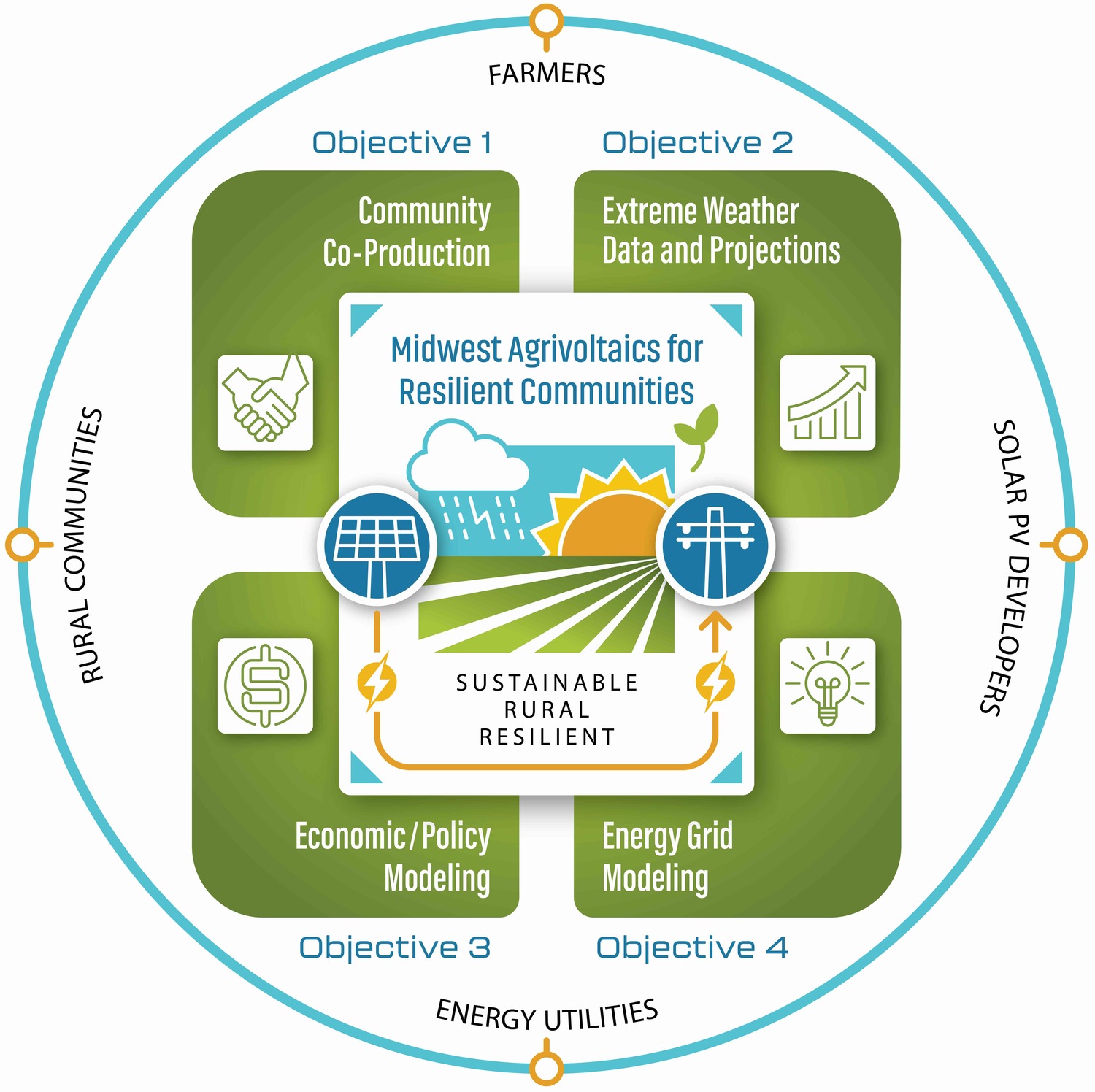
Image: Institute for a Sustainable Future
Agrivoltaics, which allows the dual use of land for agricultural production and solar energy generation, holds great promise to diversify farm income, reduce power outages, and increase energy production as energy demand soars. But agrivoltaics systems have seen slow adoption in the Midwest due to uncertainties about land use trade-offs, lack of trusted information about community impacts and benefits, and concerns from farmers and communities about economic viability and performance under extreme weather. The incubator intends to bring together community members, stakeholders and experts to fill those gaps.
“When hail ruins a harvest, heat strains livestock, or windstorms cut electricity, farmers and their communities are hit hard. Our goal is to understand how agrivoltaics can make our nation’s rural communities more resilient and prosperous,” stated Dr. Dan Chavas, principal investigator.
This project is an ambitious interdisciplinary effort that brings together experts across atmospheric science, agriculture, energy systems, economics, and social science – all housed here at Purdue University across the Colleges of Science, Engineering, Polytechnic and Agriculture, including Extension. Purdue’s Institute for a Sustainable Future (ISF) played an integral role in the development and continued support of the project. ISF provided strategic research teaming support, helping assemble an initial interdisciplinary team of faculty address the complex social, economic and technical aspects of agrivoltaics. This collaborative approach strengthened the project’s ability to meet NSF’s goals for resilience, innovation and community engagement.
The project is led by Purdue University experts across multiple disciplines:
Dr. Dan Chavas is a Professor of atmospheric science in the Department of Earth, Atmospheric, and Planetary Sciences at Purdue University and is part of the leadership team for the Purdue Institute for a Sustainable Future. Dan is the principal investigator and will lead the project’s effort on extreme weather and its risks to agriculture and solar energy systems.
Dr. Aaron Thompson is an Associate Professor in the Department of Horticulture and Landscape Architecture at Purdue University and Director of the Center for Community and Environmental Design. Dr. Thompson is also part of the leadership team for the Purdue Institute for a Sustainable Future. His research applies social-ecological science to sustainable landscape development, focusing on agricultural conservation and nature-based solutions. He teaches courses in ecological planning, research methods, and sustainable development.
Dr. Xiaonan Lu is an Associate Professor in the School of Engineering Technology and the Elmore Family School of Electrical and Computer Engineering (by courtesy) at Purdue University, also holding a joint appointment with Argonne National Laboratory. Xiaonan will lead the efforts of resilience quantification and energy modeling of rural electric power grids considering impacts of distributed energy resources and microgrids.
Dr. Kara Salazar is Assistant Program Leader for community development with Purdue Extension and sustainable communities extension specialist with Illinois-Indiana Sea Grant and the Department of Forestry and Natural Resources. Kara will co-lead community engagement and social science efforts.
Dr. Juan Sesmero is a Professor in the Department of Agricultural Economics at Purdue University. He will lead the economic modeling of agrivoltaics technology deployment and assess its economic impacts on community resilience.
The team is also comprised of additional Purdue and industry collaborators. Key project activities include:
- Building Trust & Community Engagement: Working directly with community, agriculture, and energy partners in co-designing strategies for agrivoltaics deployment to support local communities in the rural Midwest.
- Quantifying Extreme Weather Resilience Benefits: Analyzing how extreme weather events—hail, heat, wind—impact both agriculture and the power grid and how agrivoltaics may be able to reduce these impacts on communities.
- Economic and Power Grid Models & Community Tools: Developing tools, metrics and models that incorporate local conditions to help farmers, planners and communities understand risks and potential benefits to make informed decisions about agrivoltaics.
- Identifying Agrivoltaics Pathways: Evaluating which agrivoltaic configurations are suitable under different land, climatic, and economic conditions.
- Roadmap & Policy Framework: Producing a dynamic roadmap and a policy/planning framework aimed at facilitating broader, community-supported adoption of agrivoltaics.
By the end of the initial funding period, the incubator expects to deliver viable agrivoltaics models and pathways tailored to varying Midwest geographies and farming systems; decision-support tools for landowners, communities, and policymakers; as well as strengthened partnerships among academia, industry, government and local communities.
“For farmers, adapting to changing conditions, markets, and policies has always been crucial for success. Agrivoltaics offers an opportunity to maintain land in production while diversifying revenue by tapping into a growing segment of the energy market,” stated Dr. Aaron Thompson. “This initiative focuses on answering key questions about balancing reliable energy income with the production of food and fiber that are essential for maintaining the strength of Indiana’s agricultural economy.”
For more information about the NSF Regional Resilience Innovation Incubator, and the Midwest Agrivoltaics Incubator, visit the project website.
View the original article here: Purdue Leads NSF-Funded Midwest Agrivoltaics Incubator to Boost Rural Energy and Economic Resilience to Extreme Weather.
Resources:
Community Development, Purdue Extension
Wind Energy, Purdue Community Development
National Renewable Energy Laboratory (NREL)
Environmental Planning in Community Plans, The Education Store, Purdue Extension’s resource center
Enhancing the Value of Public Spaces Program, Purdue Extension YouTube Channel
Enhancing the Value of Public Spaces: Creating Healthy Communities, The Education Store
Conservation through Community Leadership, The Education Store
Conservation through Community Leadership, Purdue Extension You Tube Channel
Implementation Examples of Smart Growth Strategies in Indiana, The Education Store, Purdue Extension’s resource center
Conservation Through Community Leadership, The Education Store
Community Planning Playlist, Purdue Extension-Forestry & Natural Resources (FNR) YouTube Channel
One Water Approach to Water Resources Management, The Education Store
Rainscaping Education Program, Purdue Extension
Rainscaping and Rain Gardens, Purdue Extension YouTube Channel
Indiana Creek Watershed Project – Keys to Success, Partnerships and People, Purdue Extension You Tube Channel
Illinois-Indiana Sea Grant
Subscribe – Purdue Extension – Forestry and Natural Resources YouTube Channel
Purdue Extension-Forestry and Natural Resources Calendar, workshops and Conferences
Institute for a Sustainable Future
Purdue University

Recent Posts
- New Indiana Woodland Steward Newsletter
Posted: August 12, 2026 in Forestry, Urban Forestry, Wildlife, Woodlands - Indiana Fall Hunting Licenses on Sale and New Mobile App Available
Posted: in Forestry, How To, Wildlife - Lighting a Spark: Prescribed Burn Associations
Posted: August 6, 2026 in Community Development, Forestry, Safety, Wildlife - ID That Tree: Nannyberry Viburnum
Posted: July 22, 2026 in Forestry, Plants, Wildlife, Woodlands - ID That Tree: Eastern Swamp Privet
Posted: in Forestry, Plants, Wildlife, Woodlands - Jarred Brooke Receives Early Career Award for Prescribed Fire Work
Posted: July 20, 2026 in Forestry, Forests and Street Trees, Natural Resource Planning, Safety - Bovine Tuberculosis in Wild White-tailed Deer: Background and Frequently Asked Questions
Posted: in Disease, Natural Resource Planning, Wildlife - ID That Tree: Carolina Buckthorn
Posted: July 15, 2026 in Forestry, Wildlife, Woodlands - Bat Roost Reporting Tool
Posted: July 8, 2026 in Alert, Community Development, Invasive Animal Species, Wildlife - Pruning Highlight; Espalier Pruning: Training Trees into Living Patterns
Posted: in Forestry, Forests and Street Trees, Gardening
Archives
Categories
- Alert
- Aquaculture/Fish
- Aquatic/Aquaculture Resources
- Ask the Expert
- Christmas Trees
- Community Development
- Disease
- Drought
- Forestry
- Forests and Street Trees
- Gardening
- Got Nature for Kids
- Great Lakes
- How To
- Invasive Animal Species
- Invasive Insects
- Invasive Plant Species
- Land Use
- Natural Resource Planning
- Nature of Teaching
- Plants
- Podcasts
- Ponds
- Publication
- Safety
- Spiders
- Timber Marketing
- Urban Forestry
- Webinar
- Wildlife
- Wood Products/Manufacturing
- Woodland Management Moment
- Woodlands