 Purdue University - Extension - Forestry and Natural Resources
Got Nature? Blog
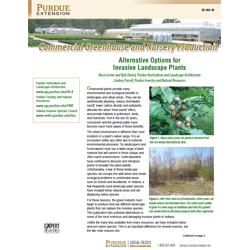 Ornamental plants provide many environmental and ecological benefits to landscapes and urban areas. They can be aesthetically pleasing, reduce stormwater runoff, lower carbon dioxide and pollutants, alleviate the urban “heat island” effect and provide habitats to pollinators, birds and mammals. And in the last 20 years, consumers and the general public have become much more aware of these benefits. The urban environment is different than most locations in a plant’s native range. It is an ecosystem unlike any other due to extreme environmental pressures, so landscapers and homeowners must use a wide range of plant material that will survive in these unique and often harsh environments. Horticulturalists have continued to discover and introduce plants to broaden the plant palette. Unfortunately, a few of these landscape species can escape into wild areas and create ecological problems in unintended areas such as forests and woodlands. In Indiana, a few frequently used landscape plant species have invaded these natural areas and are displacing native species.
For these reasons, the green industry must begin to produce and use different landscape plants that can replace the invasive species. This publication lists potential alternatives to some of the most notorious and damaging invasive plants in Indiana.
For a free download of the full publication, visit Commercial Greenhouse and Nursery Production: Alternative Options for Invasive Landscape Plants.
Resources
Native Trees of the Midwest, The Education Store
Shrubs and Woody Vines of Indiana and the Midwest, The Education Store
FNR/Purdue Extension YouTube Video Playlist, Asian Bush Honeysuckle, Burning Bush and Multiflora Rose
Purdue Plant & Pest Diagnostic Laboratory (PPDL) (Send in samples or photos)
Lindsey Purcell, Chapter Executive Director/Certificate Liaison
Indiana Arborist Association
Rosie Lerner, Horticulturist
Retired
 The Community & Urban Forestry’s Tree Steward Program is designed for homeowners, tree board members, municipal employees, community members, volunteers, students, Master Gardeners and anyone that has an interest in learning more about trees and giving back to their community forest.
Trainers include City Foresters, Certified Arborists, Foresters, Purdue Extension Agents, District Conservationists and other natural resource professionals.
Participants gain knowledge on a variety of community forestry and tree care-related topics, ideas on how to share their knowledge in their communities and an introduction to local and state tree care professionals.
Topics include:
- The Scoop on Soils
- How Does a Tree Grow? (Tree Physiology)
- Tree Identification
- The Right Tree for the Right Place (Tree selection and placement)
- Proper Tree Planting
- Caring for Your Trees
- Threats to Trees: Pests and Disease Diagnosis
- Pruning Do’s & Don’ts
- Identifying Tree Defects
- Benefits of the Urban Forest
- Why Urban Woodlots are Important
- Volunteer Opportunities
For more information, take a look at the Tree Stewards Handout or the Tree Stewards Brochure.
When: Thursday, May 28 and Friday, May 29, 2015, 8:30 am – 4:30 pm
Where: Hayes Arboretum, Nature Center, 801 Elks Rd., Richmond, IN 47374
Cost: $30, includes lunch and refreshments
Registration: Deadline to register is May 21, 2015. Register online using the Indiana DNR events registration form.
Resources
Plant For The Sun – Choose, Plant Trees Wisely for Energy Efficiency, Got Nature?
Indiana’s Urban Woodlots, The Education Store
Indiana Community Tree Selection Guide, Indiana Department of Natural Resources
Indiana Department of Natural Resources
Lindsey Purcell, Urban Forestry Specialist
Department of Forestry and Natural Resources, Purdue University
 Question: Weeping willow, six years old and 9″ diameter. Wet, clay ground and thriving. Late last summer, I noticed the leaves were dead suddenly, and the bark on the trunk was completely loose and falling off. No other trees or shrubs within 50 feet (black walnut, sycamore, maple or rose of Sharon) were affected. No obvious sign of insects, boring, trails, worms, etc. What happened?
Answer: When a tree starts to lose leaves, especially in the spring when they should be expanding for the new growing season, it can be puzzling. Often, this is a sign of trouble that can be caused by biotic or abiotic issues but not always a major cause for alarm. The dropping leaves can be a symptom of foliar diseases which weakens the tree, or it could be the results of an insect pest feeding on the petioles of the leaves. There are many pests which can cause leaf drop.
Another possible cause is the response to abiotic disorders which is typically a complex of issues. Leaf drop can occur on trees that have been exposed to prolonged wetness in heavy, clay soils. Some tree species like wet soils but not prolonged wetness without drainage. If trees are exposed to continual wetness, their roots can become diseased and cause the leaf drop. Additionally, it has been noted that trees that were planted improperly, especially if planted too deep, can result in several physiological issues such as decline and dieback.
If trees reveal symptoms of premature fall color, yellowing of leaves or unusual leaf drop, it may be necessary to send in a sample for diagnosis. The Purdue Plant and Pest Diagnostic Laboratory (PPDL) provides this service by a very capable team of pathologists, entomologists and extension specialists to analyze plant issues in the landscape. This is an inexpensive approach to investigate the issues and lead to the best possible curative measures. Protocol for submitting plant samples can be found on the PPDL website.
Resources
Hardwood Tree Improvement and Regeneration Center
Relationships Between Advance Oak Regeneration and Biotic and Abiotic Factors, Songlin Fei, Associate Professor of Measurements and Quantitative Analysis
Diseases of Landscape Plants: Leaf Diseases, The Education Store
Lindsey Purcell, Urban Forestry Specialist
Department of Forestry and Natural Resources, Purdue University
 Trees in Rice Cemetery in Elkhart, IN, were cut down due to verticillium wilt, a disease causing discoloration and wilt of branches. The fungus causing this disease spreads through roots. Many trees in the cemetery have been marked with a red dot and will be removed. If all goes well, new younger trees will take their place in the fall. If you have witnessed verticillium wilt, please notify the Indiana Department of Natural Resources.
Resources
Rice Cemetery Trees Cut Down Due to Verticillium Wilt as Elkhart Forestry Workers Fight to Save Those Left, The Elkhart Truth
Verticillium Wilt of Shade Trees, The Education Store, Purdue Extension’s resource center
Diseases in Hardwood Tree Plantings, The Education Store
Forest Health Informer, Indiana Department of Natural Resources
How to Check for Verticillium Wilt, July “In The Grow” (Q&A), Indiana Yard and Garden – Purdue Consumer Horticulture
What are Invasive Species and Why Should I Care?, (What to do if you see any disease) Purdue Extension-Forestry & Natural Resources Got Nature? Blog
Diana Evans, Extension and Web Communication Specialist
Purdue University Department of Forestry and Natural Resources
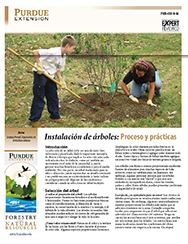 This is a Spanish-language version of our helpful how-to guide, Tree Installation: Process and Practices, which helps in choosing, planting and maintaining trees. It includes a 12-step planting process, Indiana native tree and utility-friendly tree charts, information on Midwest hardiness zones and detailed tree-planting graphics and photographs. View it in The Education Store today!
Resources:
Tree Installation: Process and Practices, The Education Store
Native Trees of the Midwest, The Education Store
Shrubs and Woody Vines of Indiana and the Midwest, The Education Store
Planting Forest Trees and Shrubs in Indiana, The Education Store
Lindsey Purcell, Chapter Executive Director
Indiana Arborist Association
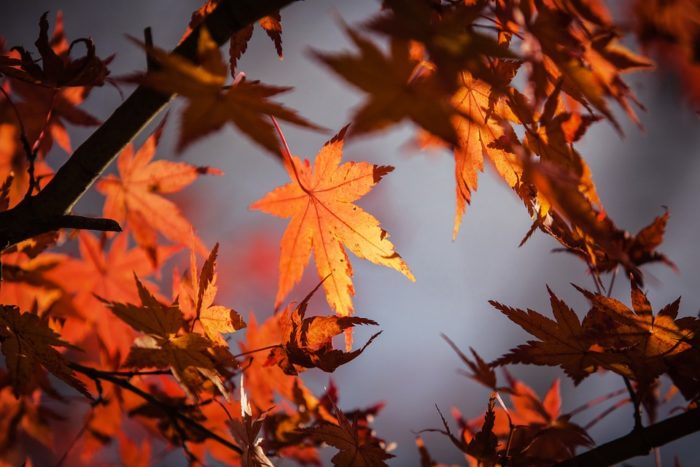 The display of color we enjoy each fall is explained by understanding plant pigments, the physiology and anatomy of leaves, and the influence of climate and seasonal weather conditions. Fall weather conditions favoring formation of bright red autumn color are warm sunny days followed by cool but not freezing nights. As days get shorter and temperatures cooler in the autumn, important physiological processes are triggered that make conditions for chlorophyll production less favorable.
Check out the Why Leaves Change Color publication for more details along with other hardwood tree information.
Resources:
Intro to Trees of Indiana videos, Purdue Extension – Forestry and Natural Resources (FNR)
An Introduction to Trees of Indiana, The Education Store, Purdue Extension’s resource center
Native Trees of the Midwest, Purdue University Press
Shrubs and Woody Vines of Indiana and the Midwest, Purdue University Press
Forest Improvement Handbook, The Education Store
Trees and Storms, The Education Store, Purdue Extension’s resource center
Tree Risk Management, The Education Store
Planting Problems: Trees Planted Too Deep, Video, Purdue Extension – Forestry and Natural Resources YouTube Channel
Lenny Farlee, Extension Forester
Hardwood Improvement Regeneration Center (HTIRC)
Purdue Department of Forestry and Natural Resources
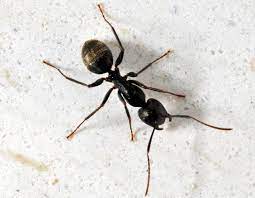 Carpenter ants are very common inside trees, especially on larger, mature trees that are hollow with cavities. They nest in rotted, decayed wood, although some nests may extend into sound heartwood in the center of the tree. Carpenter ant presence is an indication of rotting wood, and infested trees should be checked to determine whether the rot has weakened the tree enough that it has become a risk of failure.
Carpenter ants in trees are not directly harmful to the tree. Control is not necessary for the tree’s health; their presence indicates decay in the tree, and they only feed on dead wood fiber. Wood decay can set in if moisture is present; it is the wood decay that gives the carpenter ants the opportunity to colonize the tree. Carpenter ants use knots, cracks, holes and old insect tunnels to gain access to these areas.
Control of carpenter ants inside trees is difficult but can be done as a way to reduce invasion of the ants into adjacent structures and places where they are unwelcome. It is also possible for ant colonies located inside trees to form satellite colonies inside a nearby home wall. Available controls are not likely to permanently rid a tree of carpenter ants, so retreatment every year or so may be necessary. Dust insecticides (such as Sevin or Abamectin) labeled for use on trees in the landscape are suggested for control. Apply the dust directly into the nest cavity.
Sealing tree cavities or treating tree wounds with wound dressings is not advised. Such treatments are unnecessary and will not eliminate nor prevent decay or carpenter ant activity. Also cutting down otherwise viable trees that happen to be infested with carpenter ants is generally not necessary unless the tree poses a risk.
Resources:
Household & Structural, Department of Entomology, Purdue University
Who Let the Bugs Out?, 4-H Purdue Extension – Entomology
The Space Invaders of Summer, Purdue Agriculture News
Report Invasive Species, Purdue Invasive Species
The GLEDN Phone App – Great Lakes Early Detection Network
EDDMaps – Early Detection and Distribution Mapping System (Report Invasives)
Subscribe – Purdue Extension-FNR YouTube Channel, find videos for wildlife, forestry, urban forestry, community development and more.
Lindsey Purcell, Chapter Administrator & Master Arborist
Indiana Arborist Association
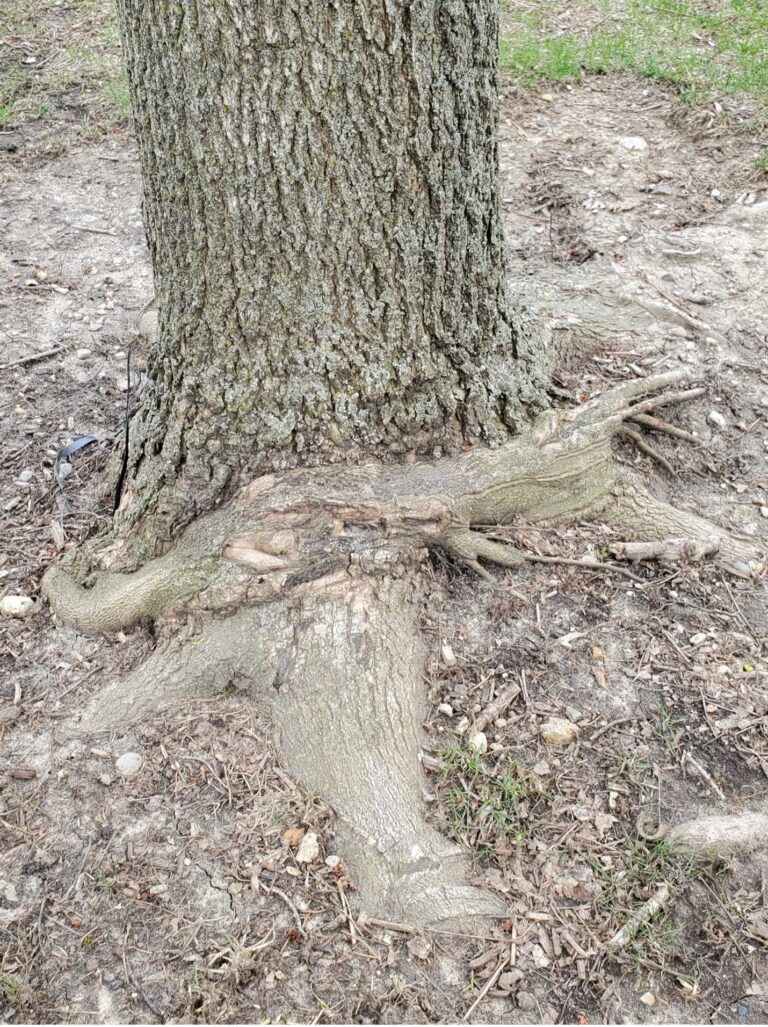 Tree roots wrapped around tree trunks or the lower stem can be very troublesome for tree health and safety. Stem Girdling Roots (SGR) are very common in maple trees and can eventually compress the stem so greatly that it creates a situation where the tree can be more prone to windthrow or blowing over. Additionally, it reduces the flow of water and nutrition to the tree, causing a slow decline and eventual death if not corrected or unable to be treated.
Roots that are not directed away from the trunk causes serious issues, and oftentimes, there is no good rescue treatment or mitigation of the issue. If the tree is small or juvenile and the roots have NOT compressed the stem, careful pruning of the circling roots can be accomplished. If these circling roots are less than one-third the trunk diameter and they can be removed without damaging the trunk, then carefully cut and remove them. This will stop the circling habit and allow roots and trunk under the girdling root to develop in the proper way. Some arborists have removed larger girdling roots with no adverse effects on the tree, and they often respond to removing girdling roots with increased vigor. However, roots that have embedded themselves into the trunk or stem should be left alone. There are no guarantees with this risky process. Any time roots are removed, there is a danger for reducing stability and health.
I would suggest contacting an International Society of Arboriculture Certified Arborist to complete the task and ensure the best possible results.
For resources on tree care, view FNR Extension Publications.
Resources:
Stem Girdling Roots, Purdue Landscape Report
Trees and Storms, The Education Store, Purdue Extension’s resource center
Tree Risk Management, The Education Store
Planting Problems: Trees Planted Too Deep, Video, Purdue Extension – Forestry and Natural Resources YouTube Channel
Planting Your Tree Part 1: Choosing Your Tree, Video, Purdue Extension YouTube Channel
Tree Planting Part 2: Planting a Tree, Video, Purdue Extension YouTube Channel
Tree Appraisal and the Value of Trees, The Educational Store, Purdue Extension resource center
Surface Root Syndrome, The Education Store
Iron Chlorosis of Trees and Shrubs, The Education Store
Tree Pruning Essentials, Publication & Video, The Education Store
Cold Injury to Trees, Got Nature? Post, Purdue FNR Extension
Lindsey Purcell, Executive Director
Indiana Arborist Association

Recent Posts
- Urban Tree Spotlight: Planting Deciduous Shade Trees, Purdue Landscape Report
Posted: March 25, 2026 in Forests and Street Trees, Urban Forestry, Woodlands - ID That Tree: Dwarf Chinkapin Oak
Posted: March 20, 2026 in Forestry, Urban Forestry, Wildlife, Woodlands - DNR Hiring for Indiana Conservation Officer Positions, MyDNR
Posted: March 9, 2026 in Urban Forestry, Wildlife, Woodlands - ID That Tree: Shumard Oak
Posted: in Plants, Urban Forestry, Wildlife, Woodlands - A Woodland Management Moment: Windbreak Around Walnut Plantings
Posted: March 3, 2026 in Forestry, Urban Forestry, Woodland Management Moment - Getting Certified as an Indiana Certified Prescribed Burn Manager
Posted: March 2, 2026 in How To, Urban Forestry, Woodlands - Have You Seen a Soaring Eagle Lately? Morning Ag Clips
Posted: February 25, 2026 in Urban Forestry, Wildlife - ID That Tree: Fragrant Sumac
Posted: February 4, 2026 in Plants, Urban Forestry, Wildlife - Tree Silvics and Succession Webinar: A Biological Basis for Management
Posted: January 30, 2026 in Forests and Street Trees, Urban Forestry, Woodlands - Southwest Damage, Scalding or Frost Cracking
Posted: in Forestry, Urban Forestry
Archives
Categories
- Alert
- Aquaculture/Fish
- Aquatic/Aquaculture Resources
- Ask the Expert
- Christmas Trees
- Community Development
- Disease
- Drought
- Forestry
- Forests and Street Trees
- Gardening
- Got Nature for Kids
- Great Lakes
- How To
- Invasive Animal Species
- Invasive Insects
- Invasive Plant Species
- Land Use
- Natural Resource Planning
- Nature of Teaching
- Plants
- Podcasts
- Ponds
- Publication
- Safety
- Spiders
- Timber Marketing
- Uncategorized
- Urban Forestry
- Webinar
- Wildlife
- Wood Products/Manufacturing
- Woodland Management Moment
- Woodlands