 Purdue University - Extension - Forestry and Natural Resources
Got Nature? Blog
Ornamental plants provide many environmental and ecological benefits to landscapes and urban areas. They can be aesthetically pleasing, reduce stormwater  runoff, lower carbon dioxide and pollutants, alleviate the urban “heat island” effect, and provide habitats to pollinators, birds, and mammals. Unfortunately, a few of these landscape species can escape into wild areas and create ecological problems in unintended areas such as forests and woodlands.
The Indy Star shares article titled, “Bradford pears and other backyard bullies to avoid in Indiana” listing some of the invasive species that are taking over Indiana woodlands. If you are planning on adding trees or shrubs to your property this spring, you will want to view this article before planting.
Author:
Cara Anthony, cara.anthony@indystar.com
Release date of article April 2, 2016.
IndyStar
Resources from The Education Store, Purdue Extension Resource Center:
Commercial Greenhouse and Nursery Production: Alternative Options for Invasive Landscape Plants
Invasive Plant Species in Hardwood Tree Plantations
Invasive Plant Species Fact Sheets: Poison Hemlock
Mile-a-minute Vine
Native Trees of the Midwest
Shrubs and Woody Vines of Indiana and the Midwest: Identification, Wildlife Values, and Landscaping Use
Videos:
Invasive Plant Species: Callery Pear
Invasive Plant Species: Oriental Bittersweet
Invasive Plant Species: Wintercreeper
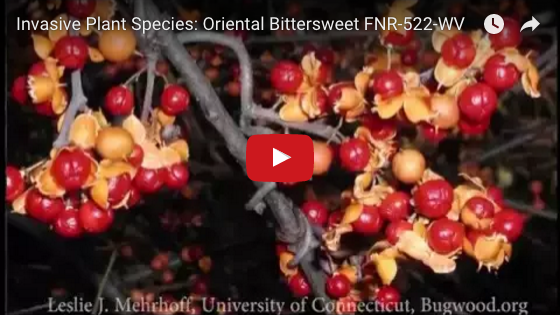 Purdue Extension-FNR now has two new expert-reviewed videos to help spread awareness of two significant invasive plant species in Indiana: the oriental bittersweet and wintercreeper. These videos share plant characteristics, their effect on forests, and alternative native species that can be utilized.
Oriental bittersweet is a vine that was brought over from Asia in the 1960’s. It is a pleasant looking plant that is popular in landscaping and home decor items. However, they can be harmful to trees as they wrap around them and cut off their access to light and are also problematic on the forest floor.
Wintercreeper was brought over as an ornamental ground cover in 1907 and is still planted for landscaping today. As birds eat its seeds, wintercreeper spreads from urban areas into the forests where it grows earlier in the spring than native plants and prevents new growth from emerging.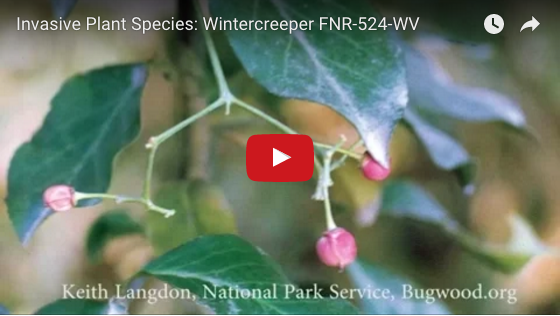
Check out the oriental bittersweet and wintercreeper videos to learn more about these invasive species and to how to join the fight to stop them from spreading further.
Resources:
Invasive Plants of the Eastern U.S.: An Introduction to the Problematic Non-Native Species – The Education Store
Invasive Plants – Purdue University, Department of Botany and Plant Pathology
Invasive Plants – Indiana Invasive Species Council
Purdue Extension-FNR Internship Program – Purdue University, Department of Forestry and Natural Resources
Danny Thomas, Purdue Extension-FNR intern
Purdue University Department of Forestry and Natural Resources
Lenny Farlee, Sustaining Hardwood Extension Specialist
Purdue University Department of Forestry and Natural Resources

Photo credit: Tom Campbell
As boats enter and exit public bodies of water, they risk transferring aquatic plants, mussels or invertebrates that attach themselves to the bottom of the boat. While this might seem pretty harmless at first, this spreading of aquatic species runs the risk of introducing invasive species into new environments.
Invasive species cause harm to local ecosystems by reproducing exponentially when they are outside of their usual habitat and the organisms that keep their populations in check. They can then cause great damage by feeding on local species and the food they depend on. Once an invasive species is detected, it is oftentimes very expensive and difficult to control. For example, around 1991, the U.S. and Canada spent an estimated $20 million per year to control invasive sea lampreys and restore the trout populations that were damaged by them. In Indiana alone, we spend around $800,000 a year to attempt to control the growth of Eurasian watermilfoil, another nuisance invasive species.
In an attempt to avoid more cases like this in the future, the Indiana Department of Natural Resources (INDNR) is looking for help. Volunteers can sign up to record information about boats and their potential aquatic hitchhikers entering and leaving lakes during times of heavy use. The DNR Division of Fish and Wildlife can take this data and use it for public outreach and planning species management.
Those interested are highly encouraged to sign up on INDNR’s Volunteer Program page.
Resources
Aquatic Invasive Species (AIS), Indiana Department of Natural Resources
DNR Seeks Help Gathering Info on Spread of Aquatic Species, WFYI
Indiana Invasive Species Council, Purdue Entomology Extension
Invasive Plants, Purdue Agriculture Weed Science
The Education Store, Purdue Extension Resource Center (search “invasive”)
Indiana Department of Natural Resources
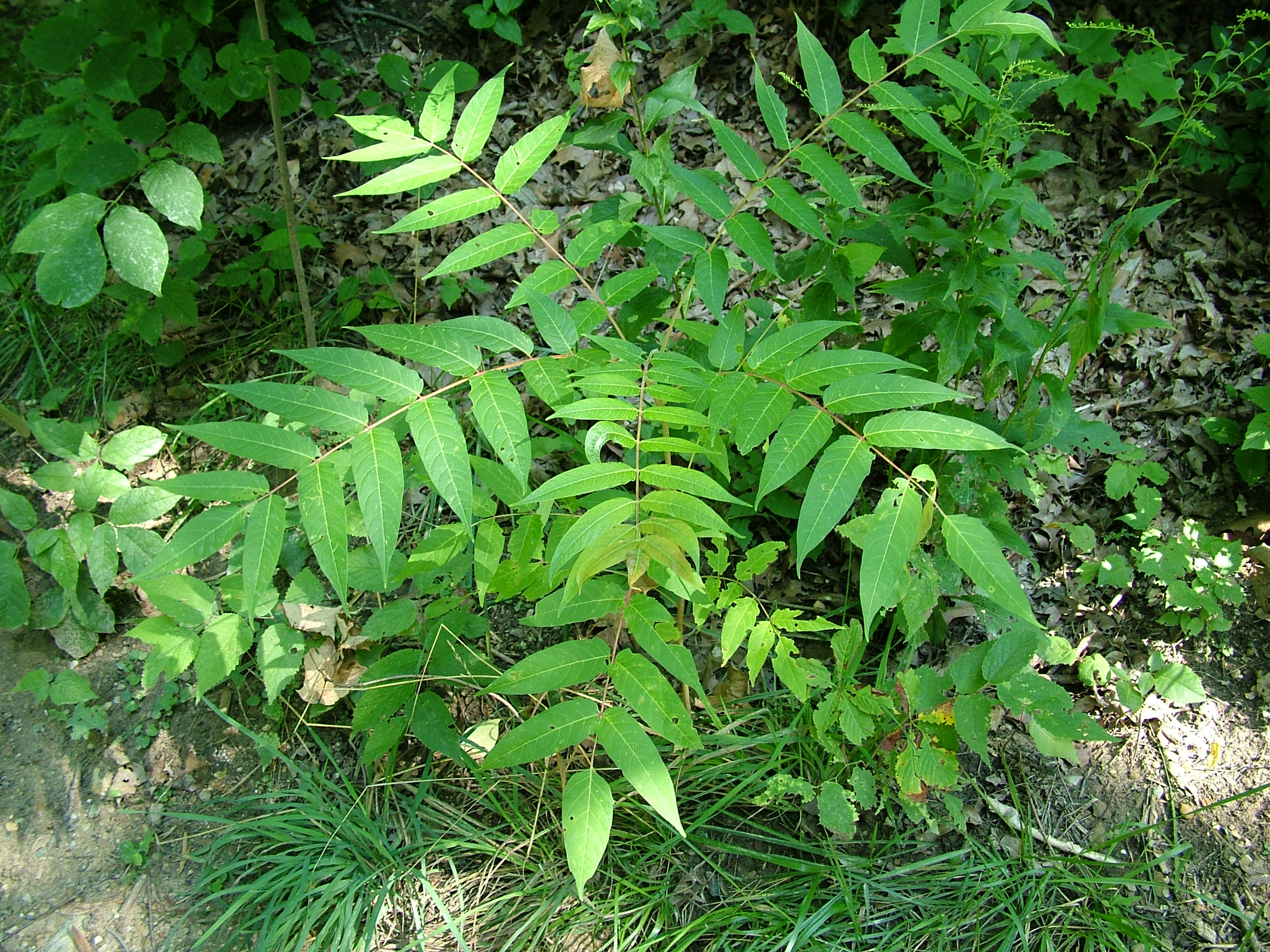
Tree-of-heaven seedling
Invasive plant species threaten many habitats including forests across Indiana. The introduced Asian tree-of-heaven (Ailanthus altissima) is one of these aggressive and troublesome invaders. Tree-of-heaven grows very quickly on a wide variety of sites from seed and sprouts and can rapidly out-compete native trees and shrubs. There are areas in Indiana forests already dominated by this unwelcome invader. Controlling large infestations of this tree can be very expensive and even dangerous. The sap and wet sawdust of this tree can trigger an allergic reaction in some people.
There is some hope on the horizon. Research work done by the U.S. Forest Service and universities in Pennsylvania and Ohio has identified a fungus that can kill tree-of-heaven and has minimal or no impact on surrounding plants. Verticillium nonalfalfae or Ailanthus verticillium wilt is a soil fungus that has been identified so far in Pennsylvania and Ohio that can rapidly kill large patches of tree-of-heaven. Tests with this naturally occurring soil fungus have shown it to be very effective at killing tree-of-heaven without having significant impacts on surrounding native plants.
This naturally-occurring killer of tree-of-heaven could be an important tool in managing this invasive problem in Indiana. The quickest way to get started with natural bio-control of tree-of-heaven is to locate the fungus here in Indiana. Citizens and resource professionals can help us locate ailanthus verticillium wilt by identifying patches of tree-of-heaven that are being impacted by the fungus. This requires familiarity with the identification of both tree-of-heaven and the symptoms of the wilt disease on the tree.
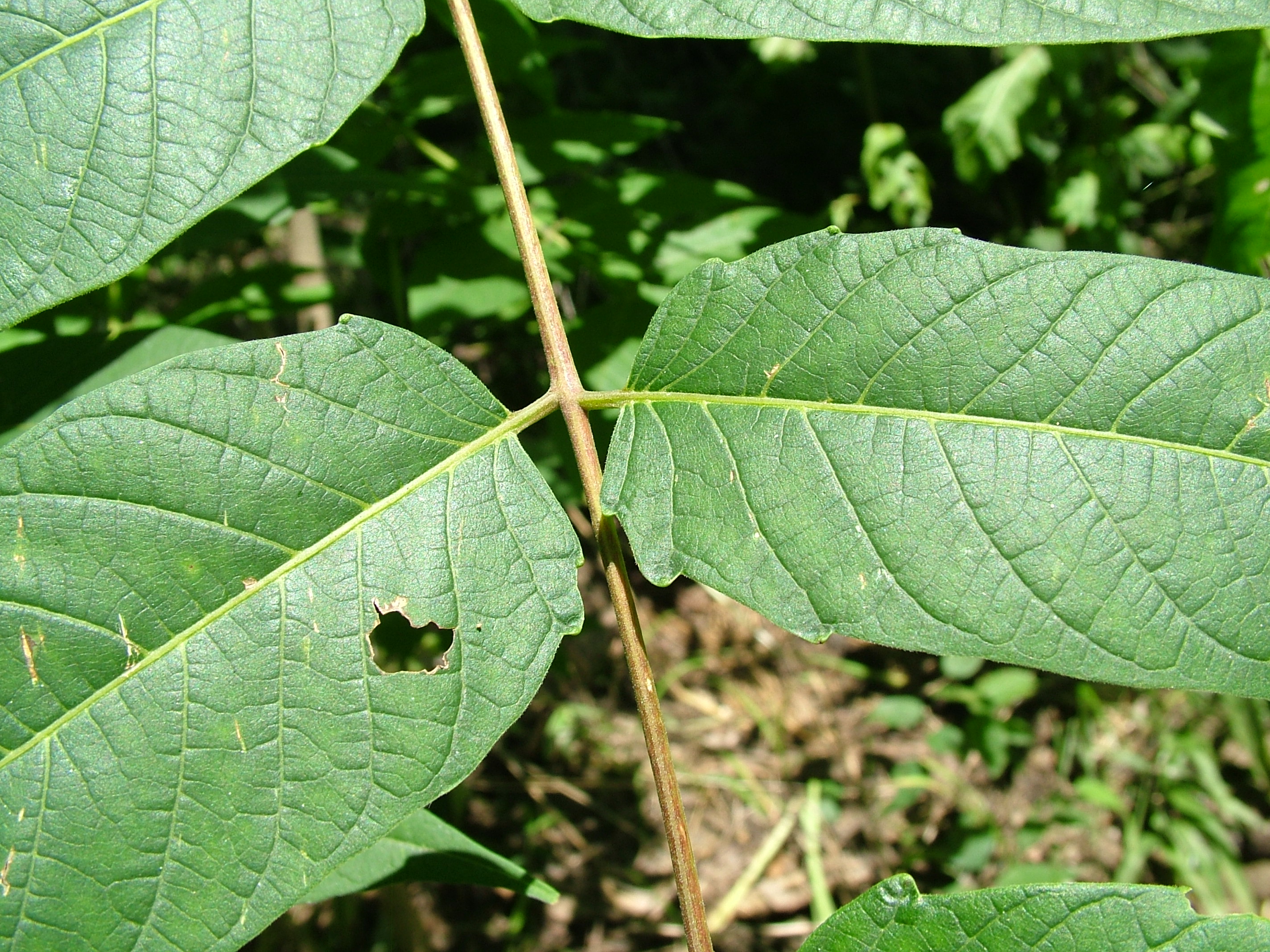
Close-up of the “teeth” on the leaves of tree-of-heaven
Tree of Heaven has long, compound leaves resembling sumac or black walnut but possessing small notches or teeth at the base of the leaflets. The plant parts have a very unpleasant burnt nut odor when crushed or bruised. The bark is smooth and grey with light grey or white fissures running vertically in the bark. Twigs are very stout with a light tan spongy pith in the center.
Ailanthus wilt causes rapid death of the tree, often within one season, so look for patches of tree-of-heaven where most trees are showing wilting foliage or are already dead. The mortality will often be radiating out from a central group of dead or dying trees. Trees with wilt will have a yellow to yellow-brown discoloration of the wood directly beneath the bark. Healthy tree-of-heaven will have nearly white wood under the bark. The mortality will almost always be groups of trees, not scattered individuals. Several resources are included below to help you identify tree-of-heaven and ailanthus wilt.
If you encounter what you think is ailanthus wilt in Indiana, please contact:
Lenny Farlee, Hardwood Ecosystem Extension Specialist
Purdue Forestry and Natural Resources
Email: lfarlee@purdue.edu
Phone: 765-494-2153
Joanne Rebbeck, Plant Physiologist
USFS, Northern Research Station
Email: jrebbeck@fs.fed.us
Phone: 740-368-0054
Resources
Tree-of-heaven Images, Center for Invasive Species and Ecosystem Health
Scientists Using Fungi to Stop an Invader, The Columbus Dispatch
Verticillium nonalfalfae, USDA Forest Service
Invasive Species, Purdue Extension
The Education Store, Purdue Extension Resource Center (search “invasive”)
Lenny Farlee, Hardwood Ecosystem Extension Specialist
Department of Forestry and Natural Resources, Purdue University
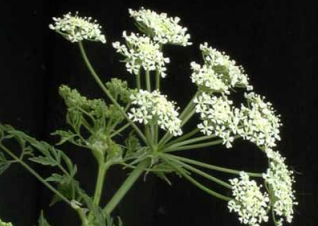
Photo credit: Pedro Tenorio-Lezama, Bugwood.org
Made infamous through the trial of Socrates, Shakespeare’s Hamlet and Macbeth, and several other works of classic literature, poison hemlock is an extremely toxic plant that will pose a risk this summer and should be handled with caution.
Poison hemlock is a biennial plant, meaning that it has a two year lifespan. Last summer, it went through vegetative growth and largely stayed out of sight. This summer, it will produce small white clusters of flowers and will be more likely to catch the attention of animals and people. Poison hemlock is a member of the parsley family and can sometimes be confused with wild carrot. However, its distinguishing feature is its hairless hollow stalks with purple blotches. If you see these, be careful!
The biggest risk with poison hemlock is ingestion. Lethal doses are fairly small, so it is important for animal owners or parents of young children to identify it in their area and remove it if possible. The toxins can also be absorbed through the skin and lungs, so be sure to wear gloves and a mask when handling these plants.
Symptoms of hemlock poisoning include dilation of the pupils, weakening or slowing pulse, blue coloration around the mouth and eventually paralysis of the central nervous system and muscles leading to death. Quick treatment can reverse the effects, so act quickly.
Resources
Invasive Plant Species Fact Sheets: Poison Hemlock, The Education Store, Purdue Extension Resource Center
Recognizing and Managing Poison Hemlock, Purdue Landscape Report
Poison Hemlock, Pest & Crop Newsletter, Purdue Extension – Entomology
Hemlock Woolly Adelgid: Distribution Update, Purdue Landscape Report
What are Invasive Species and Why Should I Care?, Purdue Extension – Forestry and Natural Resources (FNR)
Indiana Invasive Species Council
Report INvasive, Purdue Extension & Indiana Invasive Species Council
Poison Hemlock (Conium maculatum), United States Department of Agriculture (USDA)
 Ornamental plants provide many environmental and ecological benefits to landscapes and urban areas. They can be aesthetically pleasing, reduce stormwater runoff, lower carbon dioxide and pollutants, alleviate the urban “heat island” effect and provide habitats to pollinators, birds and mammals. And in the last 20 years, consumers and the general public have become much more aware of these benefits. The urban environment is different than most locations in a plant’s native range. It is an ecosystem unlike any other due to extreme environmental pressures, so landscapers and homeowners must use a wide range of plant material that will survive in these unique and often harsh environments. Horticulturalists have continued to discover and introduce plants to broaden the plant palette. Unfortunately, a few of these landscape species can escape into wild areas and create ecological problems in unintended areas such as forests and woodlands. In Indiana, a few frequently used landscape plant species have invaded these natural areas and are displacing native species.
For these reasons, the green industry must begin to produce and use different landscape plants that can replace the invasive species. This publication lists potential alternatives to some of the most notorious and damaging invasive plants in Indiana.
For a free download of the full publication, visit Commercial Greenhouse and Nursery Production: Alternative Options for Invasive Landscape Plants.
Resources
Native Trees of the Midwest, The Education Store
Shrubs and Woody Vines of Indiana and the Midwest, The Education Store
FNR/Purdue Extension YouTube Video Playlist, Asian Bush Honeysuckle, Burning Bush and Multiflora Rose
Purdue Plant & Pest Diagnostic Laboratory (PPDL) (Send in samples or photos)
Lindsey Purcell, Chapter Executive Director/Certificate Liaison
Indiana Arborist Association
Rosie Lerner, Horticulturist
Retired
 Sustainable Forests Roundtable will be hosting a Invasive Plant Best Management Practices webinar. Best Management Practices (BMP) help you identify effective and realistic practices that can be integrated into any behavior. Whether you’re a gardener, a landowner, a forester or a logger, the movement of invasive species is always a concern. A BMP can be as simple as cleaning your shoes or as complex as pressure washing your bulldozer. Regardless of your practice, the goal is always to minimize the spread of invasive species.
Learn how to create best management practices that help identify and minimize the spread of invasive species. The presenters for the webinar are Bernie Williams, Invasive Plants and Earthworms Outreach Specialist, Wisconsin Department of Natural Resources; Brad Herrick, Ecologist and Research Manager, University of Wisconsin Arboretum; and Judy Kingsbury, Volunteer Coordinator, University of Wisconsin Arboretum.
Who: Sustainable Forests Roundtable
What: Invasive Plant Best Management Practices webinar
Where: On the Sustainable Forests Roundtable website
When: March 24, 2015, 1 pm US/Eastern
Details: No registration is required. View the Sustainable Forests Roundtable website to see how to join the webinar.
Resources
Got Nature? Blog (Click on “Invasive Plant Species”), Department of Forestry and Natural Resources (FNR)
Invasive Plants, Purdue Agriculture Weed Science
Invasive Plant Species, Indiana Department of Natural Resources
Sustainable Forests Roundtable
Partners include: North Carolina State University’s Extension Forest Resources, Texas AgriLife Extension Service and the USDA Natural Resources Conservation Service.
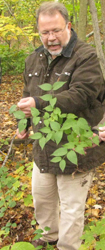
Lenny Farlee pointing out invasive Jet Bead at a Purdue Extension invasive plant training program.
If you have ever taken a walk through a forest, a woodland or a park, then you have likely encountered exotics plants. What may be difficult to distinguish, however, is whether or not those exotic plants are invasive. Unfortunately, most of us think that if it’s green, it’s good, but being green could be misleading. Invasive exotic plants are consuming growing space at an alarming rate and replacing our native species. These changes in plant species can have dramatic impacts, both economically and ecologically, to landowners and the ecosystem. Invasive species are such a problem that we are devoting an entire Podcast series to this topic.
In Part I of the Got Nature? Podcast mini-series on Invasive species, our host, Rod Williams, will be interviewing Lenny Farlee, an extension forester with the Hardwood Tree Improvement and Regeneration Center at Purdue University. Lenny will be the first expert in a series of podcasts devoted to the topic of invasive species, both terrestrial and aquatic. Lenny will be introducing our listeners to the topic of invasive species, identifying which species pose the greatest threats to the woodlands within Indiana and discussing the ecological and economic impacts that invasive plants pose to landowners. This podcast will also highlight methods that can be used to manage woodlands infested with invasive plants.
Resources
Midwest Invasive Plant Network
Indiana “Most Unwanted” Invasive Plant Pests
Purdue Extension Agriculture & Natural Resources
iTunes-Got Nature?
Got Nature? Podcasts
Lenny Farlee, Sustaining Hardwood Extension Specialist
Department of Forestry and Natural Resources, Purdue University
Rod Williams, Associate Professor of Wildlife Science
Department of Forestry and Natural Resources, Purdue University
According to the USDA Forest Service, an invasive species is defined as “a species that is non-native to the ecosystem under consideration and whose introduction causes or is likely to cause economic or environmental harm or harm to human health.” Invasive species, along with habitat loss and pollution, are the most severe threats to biodiversity and ecosystem function. Why are they such a problem? One factor that my colleague, Lenny Farlee, points to is that people don’t know they have a problem. That is, they are all around us, and most folks don’t even know it. People must first be able to recognize invasive species from non-invasive species. One of the more recent invaders is tree-of-heaven (Ailanthus altissima).
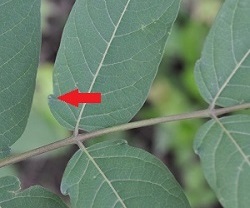
Figure 1. Tree-of-heaven have pinnately compound leaves with 11 to 27 leaflets. Each leaflet has one to several glandular teeth near the base. These are lacking on other trees and shrubs.
Don’t be fooled by the name. They are far from heaven for us. It’s actually been around for a couple hundred years. However, only over the past 10-20 years has it really begun to expand its range. This pattern is very typical of invasive species invasion. Mid-summer is one of the best times to identify and control this tree. Ohio State produced a publication on control methods, and this is linked at the end of this article. I want to focus on identification here.
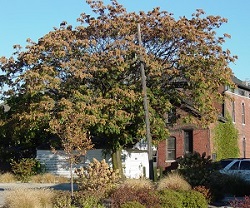
Figure 2. The fruit of tree-of-heaven are winged samaras. They can be green, red or brown in color. Numerous clusters of fruit are easily observed on tree-of-heaven during the summer.
Tree-of-heaven may be confused with similar-sized sumacs or even black walnut to the untrained eye. Because tree-of-heaven can grow very rapidly, they will often have several feet between branching along the main trunk. Some have also described the strong odor from tree-of-heaven similar to rotting peanuts. For most folks, the leaflets and fruit are the easiest features to go by. Each leaflet has one or more glandular lobes or teeth near the base. This is the best feature to differentiate it from similar species of similar size. On older trees, numerous fruit clusters will begin to form towards the end of June and will be present throughout most of July or longer. Black walnuts and other native trees with compound leaves lack these seed clusters.
Resources
Controlling Non-Native Invasive Plants in Ohio Forests: Ailanthus
Indiana Invasive Species Council
Dr. Brian MacGowan, Extension Wildlife Specialist
Department of Forestry & Natural Resources, Purdue University
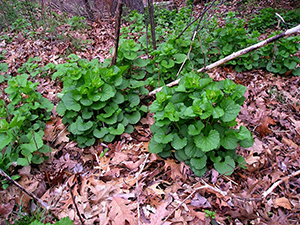
Early spring brings the emergence of new life in the forest. Unfortunately, not all that life actually belongs there. Several invasive plants are encroaching on woodlands and crowding out the desirable native plants we enjoy and wildlife depend upon for food and shelter. One of the characteristics of some invasive plants is early leaf emergence and growth, which allows us to scout for their presence more easily, while native species are still waking up from winter. Two species that start growing very early in the spring are garlic mustard and Asian bush honeysuckles. Both plants are rapidly greening up and growing as I speak. Look for the kidney to heart shaped leaves of garlic mustard on the forest floor. This biennial will soon be sending up flower stalks from the second season plants that will have white four-petaled flowers. The flower stalks can be up to three feet tall or more depending on the health of the plant and the quality of the growing site.
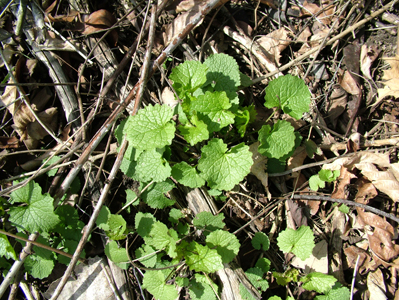
Early spring leaves of garlic mustard.
Asian bush honeysuckle is a medium to large bush that also inhabits the forest understory and edge or disturbed areas. Leaves and twigs area arranged opposite each other. If you slice the stems open, they are hollow inside with fuzzy brown or tan lining. Flowers are yellow, white or even pinkish and tube-shaped. The fine twigs and stems have a light tan or gray-tan color. Leaves are rapidly expanding now, so they will be easily detected until our native plants catch up with leaf cover.

Early growth of Asian bush honeysuckle.
Controlling these plants helps native plants continue to thrive and provide habitat for our wildlife. Garlic mustard can be pulled from moist soil. If seed pods are present, remove the plants from the area and burn or bury them. Foliar herbicides like glyphosate products may be used to spray garlic mustard. If the plants have already set seed pods, the seed may become viable even if the plant has been sprayed, so removal may be the only effective treatment at that time.
Asian bush honeysuckle can be controlled in several ways, depending on the size of the plants. Small plants can be pulled from moist soil. Foliar sprays with herbicides like glyphosate can be effective. Large bushes may be cut and the stumps treated with a brush-killing herbicide. For any herbicide application, read and follow label directions.
Purdue University has invasive species information resources at FNR Extension and Indiana’s ‘Most Unwanted’ Invasive Plant Pests/Indiana Cooperative Agricultural Pest Survey (CAPS) Program.
Lenny Farlee, Sustaining Hardwood Extension Specialist
Hardwood Tree Improvement and Regeneration Center (HTIRC)
Forestry and Natural Resources, Purdue University

Recent Posts
- Connecting Research to Practice: Natural Resources & Land Use Spring Training
Posted: June 5, 2026 in Forestry, Forests and Street Trees, How To, Invasive Animal Species, Invasive Plant Species, Land Use, Natural Resource Planning, Urban Forestry, Wildlife, Woodlands - As the spring wildflowers emerge, so do the woodland invaders
Posted: April 16, 2026 in Forestry, Forests and Street Trees, Invasive Plant Species - Replace Invasives with Natives: 2026 Plant Swap Program
Posted: April 13, 2026 in Invasive Plant Species, Urban Forestry - Control Management of Poison Hemlock
Posted: February 24, 2026 in Ask the Expert, Forestry, How To, Invasive Plant Species - Purdue Extension: Empowering Indiana Through Innovation, Education and Community Impact
Posted: January 28, 2026 in Community Development, How To, Invasive Insects, Invasive Plant Species, Natural Resource Planning, Woodlands - Learn How to Control Reed Canarygrass
Posted: December 8, 2025 in Forestry, Invasive Plant Species, Wildlife - Controlling Introduced Cool-Season Grasses
Posted: December 1, 2025 in Forestry, Invasive Plant Species, Wildlife - Managing Common and Cut Leaved Teasel
Posted: November 24, 2025 in Forestry, Invasive Plant Species, Wildlife - Crownvetch, Sweetclover and Birdsfoot Trefoil Control
Posted: November 17, 2025 in Forestry, Invasive Plant Species, Wildlife - Now Is The Time To Control Non-Native Bush Honeysuckle
Posted: October 30, 2025 in Forestry, How To, Invasive Plant Species, Woodlands
Archives
Categories
- Alert
- Aquaculture/Fish
- Aquatic/Aquaculture Resources
- Ask the Expert
- Christmas Trees
- Community Development
- Disease
- Drought
- Forestry
- Forests and Street Trees
- Gardening
- Got Nature for Kids
- Great Lakes
- How To
- Invasive Animal Species
- Invasive Insects
- Invasive Plant Species
- Land Use
- Natural Resource Planning
- Nature of Teaching
- Plants
- Podcasts
- Ponds
- Publication
- Safety
- Spiders
- Timber Marketing
- Urban Forestry
- Webinar
- Wildlife
- Wood Products/Manufacturing
- Woodland Management Moment
- Woodlands