 Purdue University - Extension - Forestry and Natural Resources
Got Nature? Blog
 Article shared in NASF May 15, 2015, E-Newsletter
Lloyd Alter, Managing Editor
TreeHugger.com
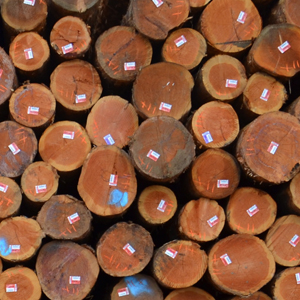
As we continue to burn through our nonrenewable resources at an alarming rate, it is important that we never underestimate what we can do with our resources that can be replenished. One of these, wood, is an extremely valuable material but has been underutilized in construction for one big reason: fires. Every so often, a wood structure like the 188-unit apartment complex in Richmond, BC, burned down in 2010 goes up in a blaze and hinders the support of timber construction in a big way. While this is a valid concern, there are several things to consider before abandoning hope. Most of the big building fires covered by the news have been on uncompleted buildings still under construction. This means that fire suppression systems haven’t been installed yet, and oftentimes incomplete floors lacking fire-retardant drywall, or walls of any kind, give the fire huge ventilated areas to spread. This is hardly fair to mark these fires as a failure of wooden construction. In completed buildings, close to 80 percent of fires are contained to the rooms they are started in.
Furthermore, fire damage isn’t limited to wooden buildings. Structures made of concrete, steel or other construction materials can still weaken and collapse under the heat of a fire. In fact, heavy timber resists fire very well, burning slowly and creating a layer of char that helps to preserve the structural integrity of the inside wood.A recent advancement in timber technology to note is Cross-Laminate Timber, or CLT. CLT is made from stacks of industrially dried and fully glue-coated lumber. It is exceptionally strong, multi-purpose and lightweight. Construction using CLT is quick because it is easy to prefabricate and transport. Like heavy timber, CLT produces a layer of char when burned, and when used in construction, engineers factor in this layer and use enough wood to allow charring to form while still maintaining enough internal wood to be structurally sound. Also cosmetically, CLT looks pleasing and can be left exposed, reducing building cost. CLT has been considered the future of wood-based construction and for good reason.
So with some of the negative stigma of wooden construction debunked and the values of timber buildings explained, this leaves the biggest value of it all to think about: renewability. Timber is the only 100% renewable material for building construction. One billion cubic meters of logs are produced each year in North America and Europe alone, creating 200 million cubic meters of engineered timber and done in a careful way so that forests maintain their size. This is enough material to build 150,000 offices a year. Timber also locks up carbon that was absorbed by the tree during its growth, reducing pollution. As we look to the future, we should look to the trees. It’s time for timber construction.
Resources
NASF May 15, 2015 E-Newsletter, National Association of State Foresters
Making the Case for Wood Construction, Treehugger
Timber Offices: The Time Has Come, ARUP
The Education Store, Purdue Extension Resource Center (search “timber”)
What is Cross Laminated Timber? American Wood Council
2014 Indiana Forest Products Price Report and Trend Analysis, Indiana Department of Natural Resources
National Association of State Foresters
 Indiana Department of Natural Resources (INDNR) recently received an inquiry asking what to do with an abandoned animal. The INDNR web resource titled Orphaned and Injured Animals has steps to follow as you decide if the animal is truly abandoned.
Got Nature? Orphaned Animals author Brian MacGowan, extension wildlife specialist, Purdue University, says, “In most cases, the young animal is simply ‘spreading its wings’ and exploring or mom simply left it to get something to eat. Fawn deer are programmed to hide and remain motionless while mom is away. The fact is wildlife rarely abandons their young. They may leave briefly only to return.
Remember that you should never handle wild animals unless absolutely necessary. Any animal can bite you, and many harbor diseases and pests that can be transmitted to people.
In Indiana, wildlife rehabilitators have necessary state and federal permits to house and care for sick or injured wild animals. If you think you have found a sick or injured animal, you can find a list of licensed Wild Animal Rehabilitators in your area on the DNR Division of Fish and Wildlife’s website.”
Resources
Mammals of Indiana, J.O. Whitker and R.E. Mumford
Common Indiana Mammals, R.N. Chapman and R.N. Williams, publication number FNR-413-W
Indiana DNR Orphaned and Injured Animals
The Education Store (search keywords to find the resources you need)
 As we turn back time and take a look at the first eight years of this 100 year project, we can then help the existence and growth of Indiana trees and wildlife in the future. This new publication, The Hardwood Ecosystem Experiment: Indiana Forestry and Wildlife, shares imperative information to aid in the growth of tree species that are producing no seedlings.
Many of Indiana’s forests, especially in the southern part of the state, have been dominated by oak and hickory trees for thousands of years. In recent decades, forest researchers and managers in the east-central United States have recognized that these tree species are not replacing themselves with new seedlings. Recognizing this issue, many stakeholders concerned with the status of Indiana’s forests convened in the late 1990s to determine the best approach to understanding this transition and to develop strategies for maintaining our oak-hickory ecosystems. As a result of the meetings of this working group, the Hardwood Ecosystem Experiment (HEE) was initiated in 2006. The HEE is intended to last for 100 years because many of the changes that occur in these forests happen over decades. In fact, many of the strongest effects of the transition from oak and hickory forests may not even be observable until we near the end of the project. This is an analysis of the first eight years of the project.
Resources
Hardwood Ecosystem Experiment
Hardwood Tree Improvement and Regeneration Center (HTIRC)
The Education Store, Purdue Extension Resource Center
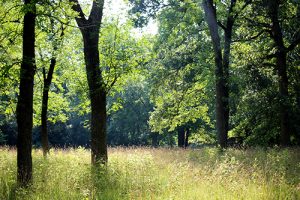 The Indiana Department of Natural Resources (INDNR) has just released a new and updated application for iPhone and Android users. A successor to the previous app released in March 2011, this iteration introduces new features and DNR Director Cameron Clark calls it a “portable field guide.” The free app contains helpful information about any DNR-related properties such as forests, wildlife areas and state parks and serves as a helpful companion while planning outdoor activities. To download this app, visit iTunes for iPhone users or Google Play Store for Android users.
Resources
Indiana DNR Smartphone Apps, Indiana Department of Natural Resources
DNR Releases New, Improved Mobile Apps, WANE15
Publications and Maps, Indiana Department of Natural Resources
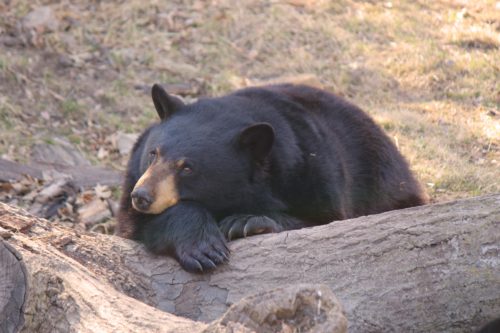 After being sighted in Indiana for the first time in 144 years on June 12 around South Bend, a second sighting of the bear has occurred in the Michigan City area, and this time, the bear has done a little bit of damage foraging for food. The bear had knocked over multiple bee hives and tore into some food at a local farm. It also bent poles holding up bird boxes, likely eating the baby birds inside.
The Department of Natural Resources is hoping the bear will return to upper Michigan on its own where the black bear population reaches around 15,000. However, they are continuing to monitor its movement and are prepared to trap it if needed.
While startling, it is important to note that black bears aren’t as dangerous as most people think. They are usually scared of humans, but it is a wise idea to move bird feeders, grills and trash cans out of your yard. If you encounter a bear, the DNR recommends standing your ground and making a lot of noise while slowly backing away. Do not turn and run. Black bears are also considered an exotic animal in Indiana, and shooting or killing one is a serious offense that can result in large fines or jail time.
Please report bear sightings to dfwinput@dnr.IN.gov or call 812-334-1137.
Resources
Black Bear, Indiana Department of Natural Resources
Black Bear Confirmed in Indiana For First Time in 144 Years, FOX59
 A new educational exhibit aimed for kindergartners to fifth graders called “A Salamander Tale” is ready to be shipped around the country and spread amphibian awareness. This interactive attraction is roughly 300 square feet and helps educate visitors at all ages about hellbenders, other salamanders and amphibians in general. Built into the exhibit is a video game called “Hellbender Havoc,” which provides a fun and unique way to learn about hellbenders. “Hellbender Havoc” is also playable online using Chrome or Firefox browsers.
Rental fees do apply for reserving the exhibit. Indiana state and extension professionals, also including Purdue staff, can rent the exhibit for free after paying for shipping. For more information, please check out the Salamander Tale web page, or feel free to take a look at other current exhibits on the Purdue Traveling Exhibits page. Check out Herbie the Hellbender today and inspire the Herpetologists of tomorrow!
Resources
Purdue Traveling Exhibits, Purdue Agriculture
Help the Hellbender, Purdue Extension
Salamanders of Indiana Book, The Education Store
The sound of cicadas is one of the more distinguishable nature sounds of the Midwestern summer. Whether you love it or hate it, the call of the cicadas will be returning this summer in a different and likely louder way than in the past couple years in Indiana.
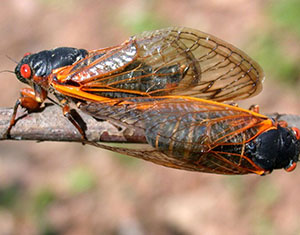
Photo credit: John Obermeyer
Cicadas are interesting insects, living the vast majority of their lives underground as larvae for several years before emerging to the surface to shed their shells and become adults for around a month and reproduce before dying. In general, there are two types of cicadas: annual and periodical.
Annual cicadas are about two inches long and are greenish in color. They are found in vast numbers in the late summer and early autumn. Unlike their name suggests, they live as larvae for two to three years before emerging, but due to overlapping generations, they can be heard every year. They produce their loud, buzzing and ticking calls from their abdomen to attract mates.
In contrast, the periodical cicadas emerge much less frequently. There are two groups of periodical cicadas, one that emerges from its larval state after 13 years and another that emerges after 17. There are 23 observed broods of these that have been well documented by entomologists for decades. These insects are different visually and audibly from their annual relatives. The periodical cicadas have red eyes and orange and black bodies, as opposed to the annual cicada’s green appearance. As well as a buzzing sound, they can also produce a unique, high-pitched tone sounding like “weeee-ooh” or “pharoah.”
Brood XXIII of the 13-year periodic cicadas will emerge this June, and it is expected to be a big one. While loud, these insects are fairly harmless. They don’t pose a risk to humans as they don’t bite or sting. However, the egg laying process can be harmful to young trees with branches less than 3/4 of an inch thick. These trees can be covered with screens to allow sunlight to still reach the trees while keeping the cicadas out. Pesticides are typically avoided since the adult cicadas do not feed on the trees and will not ingest the chemicals.
If you see the periodical cicada emerge in your area, you can email LCaplan@purdue.edu or call 812-435-5287 to help continue to monitor and document these insects.
Resources
Periodical Cicada Reports From Southern Indiana, Purdue Extension
Periodical Cicada In Indiana, Indiana Department of Natural Resources
Periodical Cicada In Indiana, The Education Store
Larry Caplan, Horticulture Educator
Purdue Extension
This is the time of year that many homeowners start their annual battle with nuisance wildlife. While trapping animals is not always required or desirable, it may be necessary in some cases to alleviate damage. Homeowners will typically use a box-style or cage “live” trap. Before you take action, there are a few key points you should first consider.
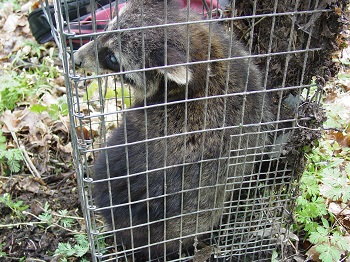
What permits, if any, are required?
Some animals require a permit prior to trapping. Raccoons, skunks, opossums, groundhogs, gray squirrels and fox squirrels are examples of mammals that do not require a permit in Indiana. Resident landowners or tenants can legally capture these species if the animal is causing damage to the property. However, you no longer have to report capture of wildlife to a conservation officer within 72 hours. Perhaps to the surprise of probably most people, rabbits do require a Nuisance Animal Control Permit prior to trapping. The Indiana DNR has a list of permitting requirements.
What do you do with wildlife you catch?
You have two choices of what to do with wildlife you capture: let it go or euthanize it (put to death humanely by injection). In either case, you may not possess an animal for more than 24 hours. If you relocate an animal, you must have permission of the landowner or property manager (even for public lands) AND you may only release that animal within the county of capture.
A common question I receive is, “What should I do?” There is no answer for which is best because circumstances differ. Most people probably prefer to let them go somewhere else because they find euthanizing animals unacceptable. They also may think that letting them go allows them to live out their lives, but this may not be the case. There has been some research on what happens to translocated raccoons and tree squirrels. In both cases, the animals don’t stay where they were let go. In the case of squirrels, a high number died within 88 days of release. Raccoons removed from structures tended to relocate in another structure.
Other things to consider
- Despite being cute and furry, wild animals are exactly that – wild animals. You should always use caution when handling traps that contain wildlife. Wear thick leather gloves and avoid sticking fingers inside the trap.
- If you transport an animal to be released (assuming you have gotten permission), do not place the trap inside your vehicle. Use a pickup truck to avoid contaminating your vehicle with animal waste and to minimize the spread of disease. Wildlife carry many pathogens and diseases that are transmittable to people.
- Animals can roll traps or pull in vegetation from the immediate vicinity. Be careful where you place the trap. Staking box traps is also a good idea.
- Be sure the trap is stable or “bedded” when you set it. Remove rocks and debris from under the trap. You may have to “work” the trap into the ground. Just be sure that debris doesn’t get caught under the treadle. If it does, the trap may not fire.
- You may want to cover your trap by wrapping it with cardboard and wire.
- Check your traps frequently. Indiana has a 24-hour trap check law. It is often a good idea to check them more frequently – perhaps 2 to 3 times a day. This is especially true if you are trapping during extremely hot or cold weather.
- Wildlife species have different times of activity, so you can be selective what time of day you trap. For example, tree squirrels and groundhogs are not active at night. Closing traps at night can avoid non-targets but would also require opening the trap at sunrise.
If you are interested in hiring a state licensed animal control professional, you can visit the Indiana DNR Nuisance Wildlife page and click on the link to “Nuisance Wildlife Control Operators.”
Additional Resources
Preventing Wildlife Damage – Do You Need a Permit?
Indiana Wildlife Conflicts Information
Indiana DNR Nuisance Wildlife
Brian MacGowan, Wildlife Extension Specialist
Department of Forestry and Natural Resources, Purdue University
Question: I just finished cutting down the last of my backyard oaks due to oak wilt. I have also lost several redbuds due to verticillium wilt. I would like to replant a tree in the spot where the oaks and redbuds were, but I would like some advice on the most resistant tree I can find. I live in Crown Point, IN, primarily clay, on a slope, with heavy brush on my property lines. I know most people would say NEVER plant again once wilt has been detected, but I thought I might ask before giving up (and moving all my shade plants). Do you have information/research on an appropriate and sturdy replacement shade tree?
Response: In general, replanting of oaks in an old oak wilt disease center does not result in disease occurrence in the replanted trees. Root grafts are not thought to form with the dead, diseased oaks. It does not appear that the fungus is transmitted outside the primary phases of transmission: vector-borne via insects (e.g., Nitidulidae) and xylem-limited disease spread via live root grafts of infected trees (MacDonald et al., 2009). This does not mean, of course, that the young oak trees as they grow and age over time are immune to oak wilt; rather, it simply means that oak wilt is not sitting dormant in the soil waiting to attack newly planted or germinated oak seedlings.

Thus, it is only through insect spread from active oak wilt centers in the vicinity that disease would occur in replanted oaks. Healthy oak trees are not susceptible to oak wilt in an infected area. Bur oak, white oak and other members of the white oak family are resistant to the fungus and can be planted in oak wilt centers. For additional prevention measures, plant tree species other than Oaks to guarantee no infection from the disease.
Resources
Diseases in Hardwood Tree Plantings, The Education Store
Tree Installation: Process and Practices, The Education Store
Forest Health Problems Impacting Indiana Forest Resources, Indiana Department of Natural Resources
Lindsey Purcell, Urban Forestry Specialist
Department of Forestry and Natural Resources
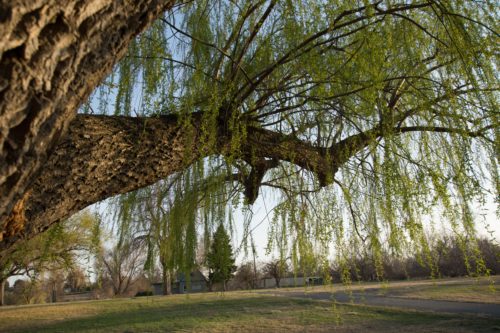 Question: Weeping willow, six years old and 9″ diameter. Wet, clay ground and thriving. Suddenly late last summer, I noticed the leaves were dead, and the bark on the trunk was completely loose and falling off. No other trees or shrubs within 50 feet (black walnut, sycamore, maple, rose of sharon) were affected. No obvious sign of insects, boring, trails, worms, etc.
Answer: When a tree starts to lose leaves, especially in the spring when they should be expanding for the new growing season, it can be puzzling. Often, this is a sign of troubles which can be caused by biotic or abiotic issues but not always a major cause for alarm. The dropping leaves can be a symptom of foliar diseases which weakens the tree, or it could be the result of an insect pest feeding on the petioles of the leaves. There are many pests which can cause leaf drop.
Another possible cause is the response to abiotic disorders which is typically a complex of issues. Leaf drop can occur on trees that have been exposed to prolonged wetness in heavy, clay soils. Some tree species like wet soils but not prolonged wetness without drainage. If trees are exposed to continual wetness, their roots can become diseased and cause the leaf drop. Additionally, it has been noted that trees which were planted improperly, especially if planted too deep, can result in several physiological issues such as decline and dieback.
If trees reveal symptoms of premature fall color, yellowing of leaves or unusual leaf drop, it may be necessary to send in a sample for diagnosis. The Purdue Plant and Pest Diagnostic Laboratory (PPDL) provides this service by a very capable team of pathologists, entomologists and extension specialists to analyze plant issues in the landscape. This is an inexpensive approach to investigating the issues and leading to the best possible curative measures. Protocol for submitting plant samples can be found on the PPDL website.
Resources
Hardwood Tree Improvement and Regeneration Center, Paula Pijut, Research Plant Physiologist, Purdue University
Relationships Between Advance Oak Regeneration and Biotic and Abiotic Factors, Songlin Fei, Associate Professor of Measurements and Quantitative Analysis, Purdue University
Diseases of Landscape Plants: Leaf Diseases, The Education Store, Purdue Extension Resource Center
Lindsey Purcell, Urban Forestry Specialist
Department of Forestry and Natural Resources, Purdue University

Recent Posts
- ID That Tree: Sugarberry
Posted: December 12, 2025 in Forestry, Wildlife, Woodlands - Powering Rural Futures: Purdue’s Agrivoltaics Initiative for Sustainable Growth
Posted: December 9, 2025 in Community Development, Wildlife - Learn How to Control Reed Canarygrass
Posted: December 8, 2025 in Forestry, Invasive Plant Species, Wildlife - Benefits of a Real Christmas Tree, Hoosier Ag Today Podcast
Posted: December 5, 2025 in Christmas Trees, Forestry, Woodlands - Succession Planning Resource: Secure your Future
Posted: December 2, 2025 in Community Development, Land Use, Woodlands - A Woodland Management Moment: Butternut Disease and Breeding
Posted: December 1, 2025 in Forestry, Forests and Street Trees, Woodland Management Moment, Woodlands - Controlling Introduced Cool-Season Grasses
Posted: in Forestry, Invasive Plant Species, Wildlife - Red in Winter – What Are Those Red Fruits I See?
Posted: in Forestry, Plants, Urban Forestry, Wildlife, Woodlands - Managing Common and Cut Leaved Teasel
Posted: November 24, 2025 in Forestry, Invasive Plant Species, Wildlife - Extension Team Wins Family Forests Comprehensive Education Award
Posted: November 21, 2025 in Forestry, Urban Forestry, Wildlife, Woodlands
Archives
Categories
- Alert
- Aquaculture/Fish
- Aquatic/Aquaculture Resources
- Ask the Expert
- Christmas Trees
- Community Development
- Disease
- Drought
- Forestry
- Forests and Street Trees
- Gardening
- Got Nature for Kids
- Great Lakes
- How To
- Invasive Animal Species
- Invasive Insects
- Invasive Plant Species
- Land Use
- Natural Resource Planning
- Nature of Teaching
- Plants
- Podcasts
- Ponds
- Publication
- Safety
- Spiders
- Timber Marketing
- Uncategorized
- Urban Forestry
- Webinar
- Wildlife
- Wood Products/Manufacturing
- Woodland Management Moment
- Woodlands