 Purdue University - Extension - Forestry and Natural Resources
Got Nature? Blog
Purdue Landscape Report: We are often the bearers of bad news when a new exotic insect species is discovered in Indiana. This time, however, we have some good news to share. Agrilus smaragdifrons, a beetle that feeds exclusively on Tree-of-Heaven (Ailanthus altissima), was detected in Indiana last year in Allen County.
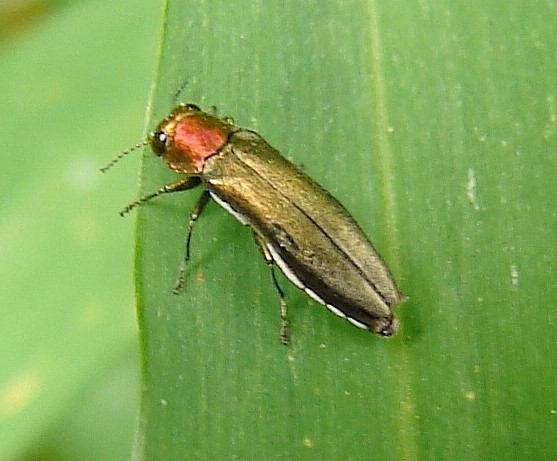
Figure 1. Agrilus smaragdifrons adult (Photograph by Dave Eib, iNaturalist)
You might notice that this beetle belongs to the same genus as the infamous Emerald Ash Borer (Agrilus planipennis) (EAB). Indeed, the two species look quite similar, although there are subtle differences in their striking metallic coloration. While Emerald Ash Borer is a vibrant green from head to wing, A. smaragdifrons has a golden-red head and thorax with green to black-green wings (Fig. 1).
This beetle has been present in the United States for several years, with the earliest record dating back to 2011 from a photograph taken in New Jersey that was uploaded to BugGuide.net. Subsequent detections occurred in several neighboring eastern states, often as bycatch during Emerald Ash Borer surveys (Hoebeke et al. 2017).
The life cycle of A. smaragdifrons also shares many similarities with Emerald Ash Borer. Although its life cycle under North American conditions has not yet been formally described, Hoebeke et al. (2017) summarize the beetle’s biology in its native Asian range based on Chinese literature (Xu and Yang 2007).
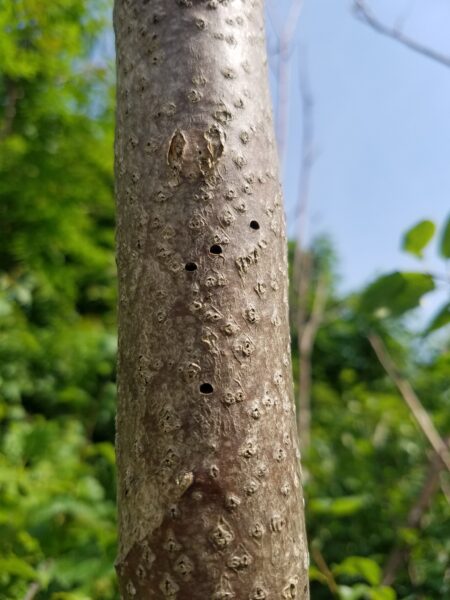
Figure 2. Agrilus smaragdifrons exit holes in Ailanthus altissima (Photograph by Patrick Perish, iNaturalist)
Females lay eggs in bark crevices during mid- to late summer, and newly hatched larvae burrow into the tree. The larvae overwinter within galleries beneath the bark and resume feeding the following spring. Pupation occurs in early summer, around June, and adult mating flights take place from June through July. When adults emerge, they leave characteristic “D”-shaped exit holes in the bark (Fig. 2; Photograph by Patrick Perish, iNaturalist).
It is not yet known whether A. smaragdifrons will function as a biological control agent for Tree-of-Heaven. Additional research and field observations are needed to determine its impact on its host. However, reports from Beijing Forestry University indicate that attacks by A. smaragdifrons can lead to decline and eventual death of Tree-of-Heaven (Hoebeke et al. 2017).
Scientists with the Indiana Department of Natural Resources and Purdue University are interested in tracking the distribution of A. smaragdifrons across the state. The next time you encounter a Tree-of-Heaven, keep an eye out for the distinctive D-shaped exit holes. In late summer, you may also observe adults feeding on the leaves.
See something? Report it Identifying and Reporting Pests at just as you would any other invasive species!
Original article posted: Beetle that attacks Tree-of-Heaven found in Indiana.
Subscribe and receive the newsletter: Purdue Landscape Report Newsletter.
Resources:
Ask the Expert: Pests in Your Woods, Purdue Extension – Forestry & Natural Resources (FNR) YouTube Channel
Report Spotted Lanternfly, Purdue Landscape Report
Invasive Species Playlist, Purdue Extension – FNR YouTube Channel
Indiana Department of Natural Resources: Invasive Species
Indiana Invasive Species Council
Cooperative Invasive Species Management Area (CISMA)
Report Invasive, Purdue Extension
What are invasive species and why should I care?, Got Nature? Blog, Purdue Extension – FNR
Purdue Plant Doctor, Purdue Extension
An Introduction to Trees of Indiana, The Education Store, Purdue Extension’s resource center
Fifty Common Trees of Indiana, Forestry & Natural Resources
ID That Tree, Playlist, Purdue Extension – FNR YouTube Channel
A Woodland Management Moment, Playlist, Purdue Extension – FNR YouTube Channel
Woodland Stewardship for Landowners, Playlist, Purdue Extension – FNR YouTube Channel
Native Trees of the Midwest, Purdue University Press
Forest Improvement Handbook, The Education Store
Alicia Kelley, Cooperative Agricultural Pest Survey (CAPS) Coordinator
Purdue Extension – Entomology

Recent Posts
- Minecraft Meets the Hellbender
Posted: September 22, 2026 in Aquaculture/Fish, Aquatic/Aquaculture Resources, Wildlife - Is It Too Early to Think About Christmas Tree Pests?
Posted: in Christmas Trees, Invasive Insects, Safety - What You Plant Matters to Wildlife
Posted: September 16, 2026 in Plants, Urban Forestry, Wildlife - Woodland Flowers of Late Summer
Posted: September 14, 2026 in Forestry, Gardening, Wildlife, Woodlands - Heavy August Rains Bring More Mosquitoes to Indiana
Posted: September 9, 2026 in How To, Invasive Insects, Safety, Wildlife - Question: Why Did the Shagbark Hickories Survive the Tornado?
Posted: August 27, 2026 in Forests and Street Trees, How To, Urban Forestry - New Indiana Woodland Steward Newsletter
Posted: August 12, 2026 in Forestry, Urban Forestry, Wildlife, Woodlands - Indiana Fall Hunting Licenses on Sale and New Mobile App Available
Posted: in Forestry, How To, Wildlife - Trees and Storms: Understanding Damage, Risk and Recovery
Posted: in How To, Urban Forestry - Lighting a Spark: Prescribed Burn Associations
Posted: August 6, 2026 in Community Development, Forestry, Safety, Wildlife
Archives
Categories
- Alert
- Aquaculture/Fish
- Aquatic/Aquaculture Resources
- Ask the Expert
- Christmas Trees
- Community Development
- Disease
- Drought
- Forestry
- Forests and Street Trees
- Gardening
- Got Nature for Kids
- Great Lakes
- How To
- Invasive Animal Species
- Invasive Insects
- Invasive Plant Species
- Land Use
- Natural Resource Planning
- Nature of Teaching
- Plants
- Podcasts
- Ponds
- Publication
- Safety
- Spiders
- Timber Marketing
- Urban Forestry
- Webinar
- Wildlife
- Wood Products/Manufacturing
- Woodland Management Moment
- Woodlands