Two research projects selected for Biomolecular Design Seed Grant
02-02-2026
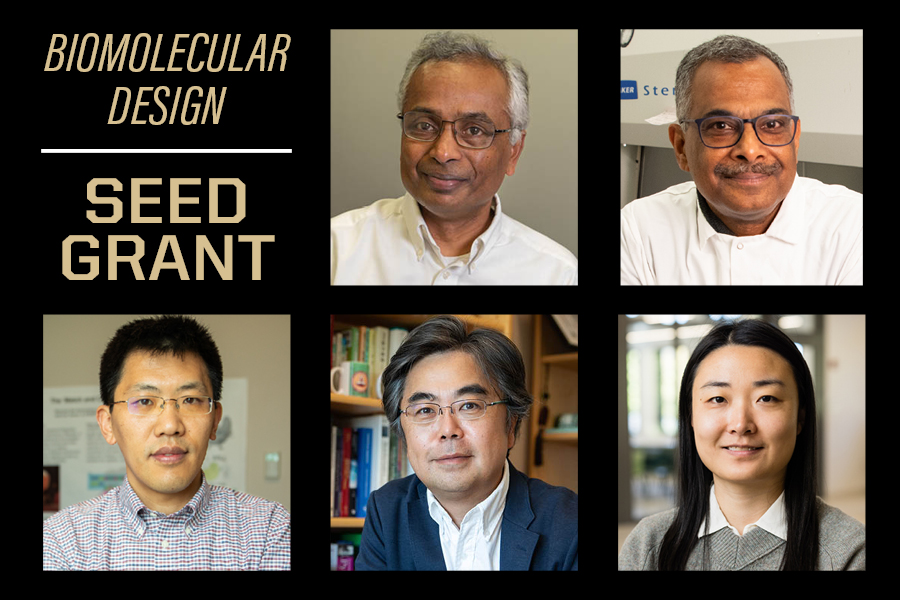
The Biomolecular Design Seed Grant awards research projects that accelerate collaborative research in the molecular biosciences at Purdue University. In the first year of this grant, two research projects have been selected. The projects are “AI-guided design of compact CRISPR-associated transposons for programmable gene insertion” submitted by Leifu Chang, Daisuke Kihara, and Ruqi Zhang and "A structured-conditioned, Small-Molecule-Driven Framework for Protein Design” submitted by Ramaswamy Subramanian and Ananth Grama.
The College of Science, Institute of Physical AI, Purdue Institute of Inflammation, Immunology and Infectious Disease, Purdue Institute for Cancer Research, Bindley Bioscience Center and Rosen Center for Advanced Computing launched this seed grant competition to help form teams pursuing multi-investigator and center-level funding in AI-guided biomolecular design, synthesis and assembly.
“Through this program, we aim to catalyze collaborative projects that connect Purdue scientists' research strengths,” says Guang Lin, Associate Dean for Research and Innovation for the Purdue College of Science, who leads this grant funding.
AI-guided CRISPR
A research team that brings computer and biological sciences together aims to engineer compact CRISPR-associated transposons (CASTs) by replacing large CRISPR complexes with streamlined RNA-guided systems. This project could potentially lead to programmable genome integration. The team includes Leifu Chang, associate professor of Biological Sciences, and Daisuke Kihara, professor of Biological Sciences and Computer Science, and Ruqi Zhang, assistant professor of Computer Science.
Their project is titled “AI-guided design of compact CRISPR-associated transposons for programmable gene insertion.” The team’s proposed process hopes to overcome a major size barrier that limits the development and application of CAST-based DNA insertion technologies.
“By integrating AI-guided protein interface design with high-performance computing, cryo-electron microscopy, and functional screening, the project will construct and validate synthetic RNA-guided DNA insertion systems and establish a proof of concept for compact genome integration in biochemical systems and bacteria,” says Chang. “This work will lay the foundation for future programmable genome integration tools and advances in AI-guided biomolecular design for genome editing.”
AI programmable detection
The second grant was awarded to the research team of Ramaswamy Subramanian, professor of Biological Sciences and Biomedical Engineering, and Ananth Grama, Distinguished Professor of Computer Science, who will use AI to detect diverse small molecules.
Their project, titled, “A Structure-Conditioned, Small-Molecule-Driven Framework for Protein Design,” aims to establish a generalizable biomolecular design pipeline that enables the programmable detection of diverse small molecules, thereby advancing both diagnostic and environmental monitoring applications.
Subramanian, who is the Director of Bindley Bioscience Center, says that this project has the potential for significant future development. He explains that the proposed research strongly aligns with the emerging funding priorities of AI-driven biomolecular design, biosensing, and environmental health. The project has Potential follow-up opportunities include the NSF’s Molecular Foundations for Biotechnology (MFB) program, NIH R21/R01 calls for biosensor development, and DOE’s initiatives on pollutant remediation. Additionally, corporate and defense agencies, such as DARPA’s Biodesign program and EPA’s PFAS challenge, would support future expansion.
Beyond PFAS detection, the team believes that the proposed design principles can be applied to engineer lipocalins that target neurotransmitters (e.g., dopamine), pesticides, and volatile biomarkers relevant to disease diagnostics. This project will establish a foundation for larger interdisciplinary proposals in synthetic biology, computational protein design, and environmental sustainability.
Grant details
The grant initiative supports teams aiming for major center-level funding and encourages new collaborations in biomolecular design, synthesis and assembly. The field has wide-ranging applications in medicine, materials science and energy. The goal is to help researchers leverage Discovery Park Centers facilities to advance experiments, synthesis and assembly projects. The program is intended as a steppingstone to larger, cross-disciplinary centers focused on biomolecular design, synthesis and assembly.
The grant offers $50,000 in funding for one year to support early-stage, high-potential projects that can grow into transformative technologies. Awardees will also benefit from access to the Bindley Bioscience Center and the Rosen Center for Advanced Computing. Both will provide the use of core facilities at a subsidized rate as part of this program.
This work supports Purdue’s One Health initiative, which brings together research on human, animal and plant health.
About the College of Science
Purdue University’s College of Science is committed to the persistent pursuit of mathematical and scientific knowledge that forms the very foundation of innovation. More than 350 tenure-track faculty conduct world-changing research and deliver a transformative education to more than 6,800 undergraduates and 1,800 graduate students. See how we develop practical solutions to today’s toughest challenges with degree programs in the life sciences, physical sciences, computational sciences, and mathematics at www.purdue.edu/science.
Contributors:
Guang Lin, Associate Dean for Research and Innovation, College of Science
Leifu Chang, associate professor in the Department of Biological Sciences
Daisuke Kihara, professor of Biological Sciences and Computer Science
Ruqi Zhang, assistant professor of Computer Science
Ramaswamy Subramanian, Director of Bindley Bioscience Center and professor of Biological Sciences and Biomedical Engineering
Ananth Grama, Distinguished Professor of Computer Science
Written by: Cheryl Pierce, College of Science
Photos by: Purdue University