 .
.Purdue Equestrian Team Makes History with First National Championship

The Purdue Equestrian Team made history when it captured its first Intercollegiate Horse Shows Association (IHSA) National Championship in team history this May.
With 37 points, the team edged second-place Sacred Heart by a single point to clinch the 2025 Hunter Seat title. Included in the team victory were two team class national championships won by Purdue riders – Kelsey Olivadoti, who won the team Team Introductory Flat title, and Abby Talcott, who captured the Team Intermediate Flat championship. In addition to being the team’s first national championship, the performance marked the first time Purdue had achieved a top-five finish since 1993. The individual titles by Olivadoti and Talcott were the first class wins by Purdue riders since 2005.
“My personal goal for the team for the season was to get into the top five,” says head coach Kathryn Kraft, who has guided the team to strong showings on the regional, zone and national stage over the past three years. “I wanted to break into that group because we’re a club team competing against varsity programs and student-athletes that are on scholarship. Being in that conversation is amazing and walking out with a blue ribbon was unreal.”
The performance capped off an undefeated 2024-25 campaign that saw the team earn an average of 41.4 points per show with an impressive 13.3-point average margin of victory. Twenty Purdue riders contributed points throughout the season, a testament to the team’s depth.
Team riders participating in the national championship included:
- Anna Cahill, Team Open Fences/Flat
- Nicolas Laplante, Team Intermediate Fences
- Lauren Dunnett, Team Limit Fences
- Abby Talcott, Team Intermediate Flat
- Haylie Johnson, Team Limit Flat
- Aveena Rawal, Team Novice Flat
- Kelsey Olivadoti, Team Intro Flat
Additionally, Purdue had the following riders qualify individually for the national championship in their respective events:
- Anna Cahill, Cacchione Cup Championship and Individual Open Flat
- Abby Shelchuk, Intermediate Open Flat
- Lauren Dunnett, Individual Limit Flat
- Allison Miller, Individual Introductory Flat
Cahill’s 10th-place finish in the Cacchione Cup Championship marked the highest-ever finish by a Purdue rider in the class. She added an honorable mention finish in the Individual Open Flat. Miller added a fourth-place finish, while Shelchuk placed fifth in her event and Dunnett notched an honorable mention. Between the team and individual classes, Purdue had at least one rider in 13 of the 17 classes at the national championship.
The Purdue Equestrian Team is made up of approximately 50 riding members and 13 horses. The team practices and stables its horses at the YMCA’s Camp Tecumseh, located about a half-hour drive north of campus. 
Team riders typically practice once per week and may ramp up the frequency of practices in preparation for major events. In addition to riding at practice, team members are responsible for chores such as feeding and watering horses and cleaning out stalls. Chores and practice days are rotated among team members, so each rider contributes to horse care while also receiving practice time in the saddle.
Members of the team credit an increased focus on the mental aspects of riding for their success this year. Since equestrian is a judged competition, results can be subjective. Aveena Rawal, who serves as the head of public relations for the team, says cultivating a team-focused mindset has helped riders stay focused on goals that are bigger than any individual.
“It’s not like basketball or football where you’re looking at a scoreboard and have a clear winner immediately,” says Rawal, who has been a member of the team for the last three years. “It’s completely up to the judges’ perspective on how the competition plays out. Learning to accept your fate and then switch gears to focus on the team aspect has been one of my biggest takeaways. Even if you have a bad ride, you have to shift focus to be a good teammate for the rest of the day.”
Continued commitment to quality horse care also led to the team bringing three horses to nationals. Horses are selected for nationals through a competitive process and their selection for the nationals is a testament to the team’s commitment to their mounts. The support system for the horses includes a show manager, barn manager, two horse care managers and a horse care committee.
Working closely with horses also requires a nuanced mentality for riders. The horses aren’t just pieces of equipment used to compete – they are sentient beings who can react to riders and situations in their own, unique way. Rather than being paired with their own team horses at events, riders draw which horse they will ride. For example, members of the team arrived at the competition facility at 6 a.m., all three days of the national championships, to see trainers working with horses they could draw to ride in the event. The fast-paced nature of some events creates further challenges.
“It’s hard to do what we do and let go of control because we’re only riding for maybe two minutes out of a show,” explains Haylie Johnson, who serves as team rep. “We’re not on a horse for very long, so we need to have a mentality where we can make our time count.”
Qualifying for the national championships requires riders and teams to first accumulate points to qualify for regionals. Individuals must total 36 points over the course of the season to qualify for regionals, while designated point riders in each class contribute to team point totals. Teams and individuals must advance through the regional and zone stages to reach the national championships. 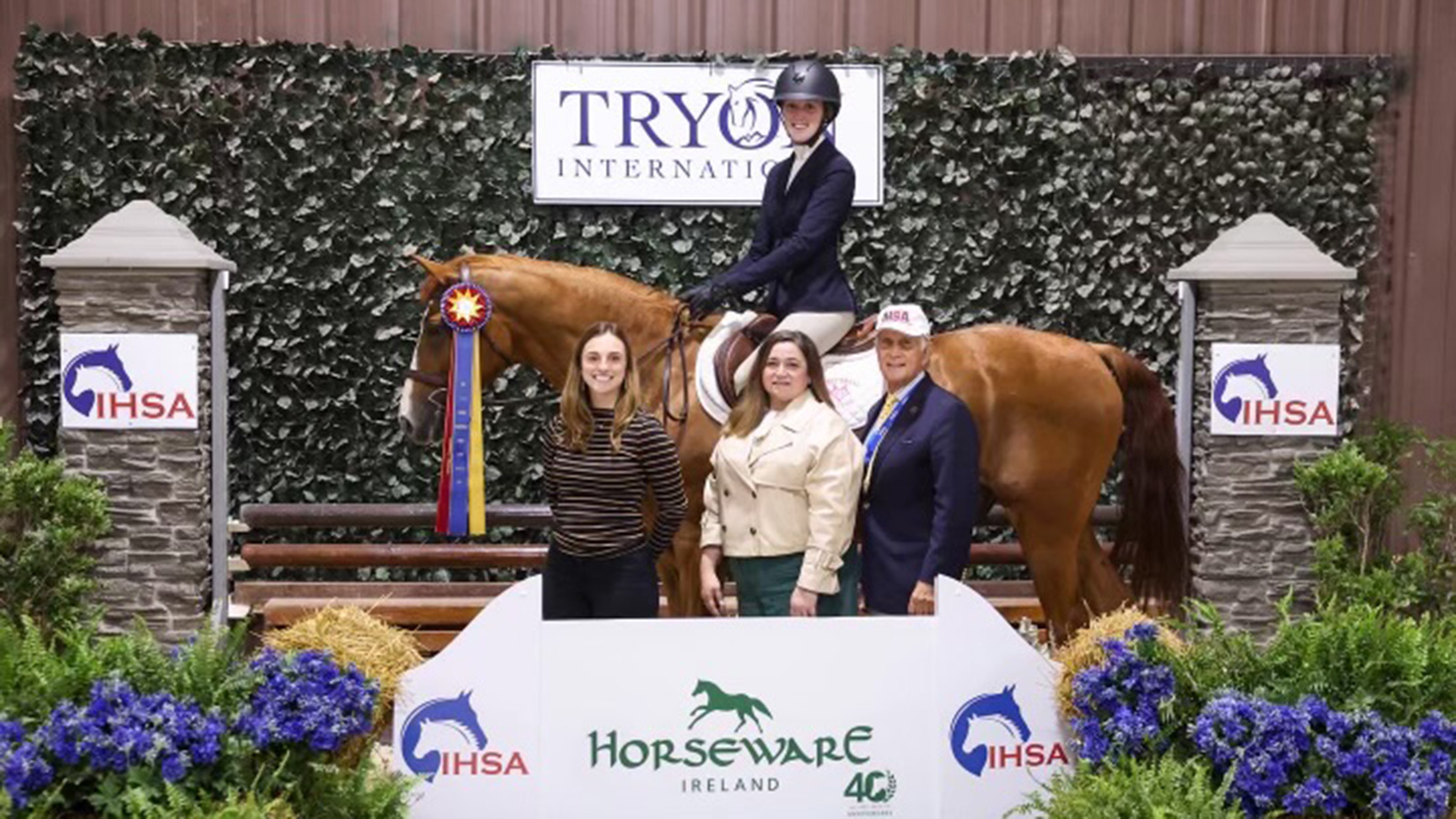
Purdue won its regional championship with a whopping 373 points, good for a 139-point margin of victory, and had three riders earn first-place finishes in their respective events. The team then went on to capture the Zone 7 Championship with all 11 competing riders placing in the top three. As a team, Purdue earned 50 points to punch its ticket to the national championship.
Team members were quick to credit their tight bond and supportive environment for their ensuing success at the national championships. While each rider focuses differently before competing in their event, mutual support was one of the biggest keys to earning the title.
“It can be a little intimidating, but this year especially, I wanted to remind myself that we were meant to be here,” says Lauren Dunnett, who serves as the team’s vice president. “We knew we were there to win and we weren’t there just to be a part of it. We’re a competitive team.
“When you’re out in the ring alone, you don’t always feel the support in that moment because you’re focused on what’s happening underneath you,” Dunnett continued. “But then, the second you’re out of that ring, you know you have your support with you. Our teammates are always there to lift us up.”
As point totals rolled in and the team realized it had won the title, it was a rush to gather, celebrate together and share an outpouring of emotion. At the official announcement, teams from other schools were quick to offer congratulations and, in a show of sportsmanship, created an arm tunnel for the team to run through as they celebrated their title – the culmination of a journey of persistence and dedication.
“The team continues to fly past my goals,” Kraft says. “I’m very much a goal-setter and I like to push the bounds. This was a dream come true and it’s still hard to fathom such a crazy moment. We’re just going to continue to get better and improve.”