Comparing Fuel Values: The Virtual Lab
Teachers: Request an Answer KEY
Learning Objectives:
- Students will use a calorimeter to measure the heat energy released by the combustion of various fuels.
- Students will calculate and compare the fuel values associated with various types of fuel.
- Students will analyze the results of this lab investigation to construct an evidence-based argument for the fuel that is the most promising for future transportation vehicles.
Key Vocabulary:
- Fossil fuel
- Hydrocarbon
- Biofuel
- Biomass
- Alcohol
- Combustion reaction
- Joule (J)
- Heat of combustion
Background Information:
Fossil fuels are mixtures of hydrocarbons, found naturally within the Earth’s crust, that formed from the remains of animals and plants (diatoms) that lived millions of years ago in a marine environment. Over millions of years, the remains of these animals and plants were covered by layers of sand, silt, and rock. Heat and pressure from these layers turned the remains into what we now call crude oil or petroleum. Fossil fuels are considered non-renewable resources because they take millions of years to form, meaning they are being depleted much faster than they can be naturally regenerated. When fossil fuels are burned (a process called combustion), the chemical energy stored in their bonds is released as thermal energy (heat). However, this combustion process also releases significant amounts of carbon dioxide and other pollutants into the atmosphere. When deciding whether to use fossil fuels, one must carefully weigh their performance benefits against their long-term ecological and economic costs. While fossil fuels offer superior energy density and are supported by vast, established infrastructure (pumps, tanks, and pipelines), they are finite, non-renewable resources.
Biofuels are renewable fuels derived from biomass (organic materials from plants, algae, or animal waste). Biofuels are considered a sustainable alternative to fossil fuels because the carbon dioxide released during combustion is generally offset by the carbon dioxide the source plants absorb during growth, creating a near carbon-neutral cycle. When deciding whether to use alternative fuel sources like biofuels, several factors beyond energy output must be considered. A primary consideration is sustainability and the fuel’s life-cycle carbon footprint. Another consideration includes land use and the “food vs. fuel” debate, assessing whether using agricultural land to grow energy crops would negatively affect food production. A final consideration is infrastructure compatibility. While some biofuels can use existing gasoline systems, others may require significant investment in new pipelines, storage facilities, and vehicle modifications.
This 5-minute video begins with a discussion about fuel, and then follows with a brief explanation on how to experimentally determine the fuel value for different types of fuel.
Purpose:
The amount of energy (measured in joules, J) released per gram of fuel is known as the fuel value. The purpose of this investigation is to determine and compare the fuel values of different types of fuel.
Hypothesis:
On the Lab Data Sheet, make a hypothesis about which type(s) of fuel will have the highest fuel value.
Materials:
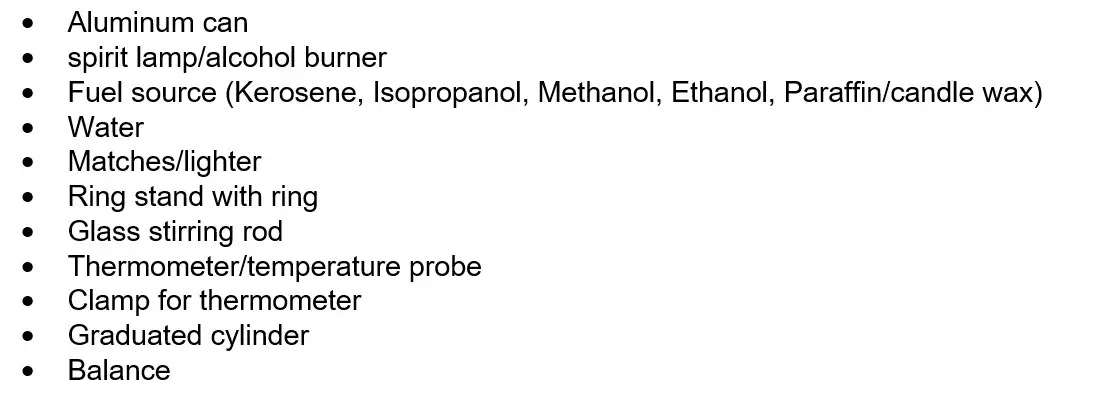
Procedure:
- Use the balance to find the initial mass of the fuel source you will be investigating, and record the mass in Table 1 on the Lab Data Sheet.
- Use the graduated cylinder to measure 300 mL of water. Put the water in an empty aluminum can.
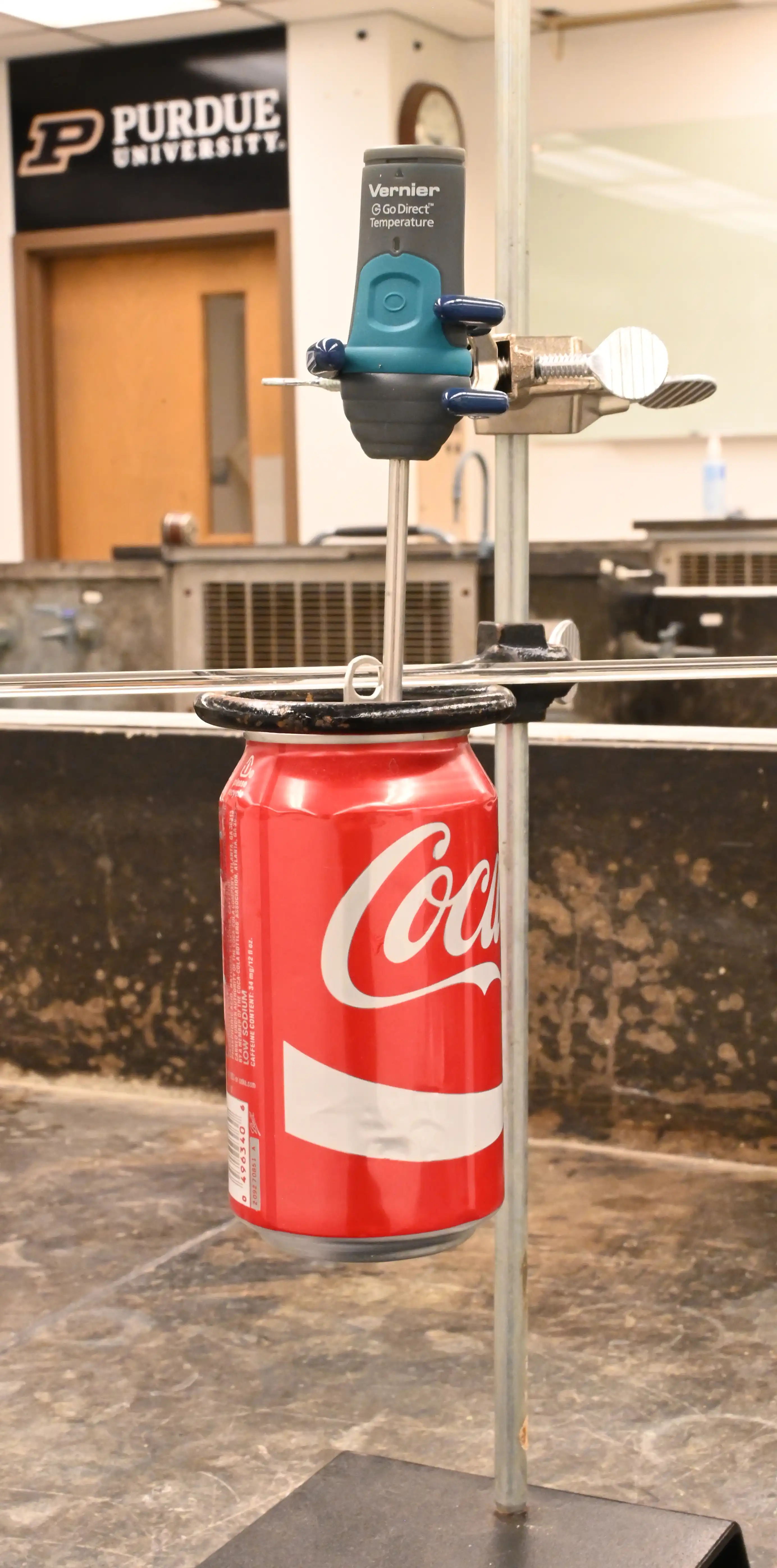
- Suspend the aluminum can from the ring stand by holding the can under the ring clamp so the attached tab goes through the ring. Place the glass stirring rod through the hole in the tab above the ring clamp so the can is hanging from the glass stirring rod supported by the ring clamp. Adjust the height of the ring clamp so the flame of the fuel source will be directly under the hanging aluminum can.
5. Light the wick of the fuel source and place it under the can of water. The flame should be very close to the bottom of the can.
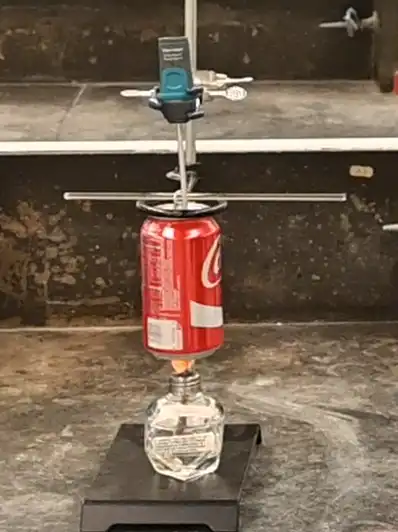
Photo 2: The flame from the fuel source should be very close to the bottom of the can.
6. Let the fuel source burn for 5 to 10 minutes.
7. Extinguish the fuel source and use the thermometer or temperature probe to measure the final temperature of the water. Record the temperature in Table 1 on the Lab Data Sheet.
8. Use the balance to determine the final mass of the fuel source. Record the mass in Table 1 on the Lab Data Sheet.
Data:
|
Fuel type Clink link to watch video |
Initial mass of fuel (g) |
Final mass of fuel (g) |
Initial temperature of water (℃) |
Final temperature of water (℃) |
|
|
|
|
|
|
|
|
|
|
|
|
|
|
|
|
|
|
|
|
|
|
|
|
|
|
|
|
|
|
Post-Lab Discussion and Explanation of Calculations:
In this video, students learn what to do with the data that was collected in this lab, how to calculate the fuel values, and process all the information in order to evaluate different types of fuels. An example is provided of using data from Table 1 in order to calculate energy per fuel type in Table 2.
|
Fuel type |
Mass of fuel burned (g) |
Change in temperature (℃) |
Total energy liberated (J) |
Energy per gram of fuel (J/g) |
Energy per milliliter of fuel (J/mL) |
|
Kerosene (lamp oil) |
|
|
|
|
|
|
Ethanol
|
|
|
|
|
|
|
Isopropanol
|
|
|
|
|
|
|
Paraffin (candle wax) |
|
|
|
|
|
|
Methanol
|
|
|
|
|
|
Results:
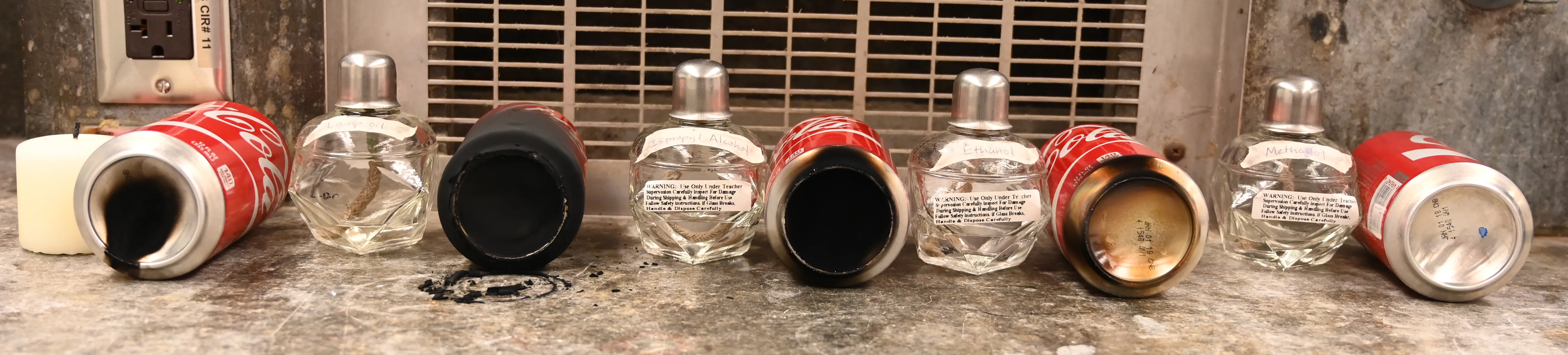
Fuel sources with resulting soot deposited on metal cans (listed from LEFT to RIGHT):
Paraffin (candle wax), Kerosene (lamp oil), Isopropanol, Ethanol, Methanol
Data Analysis:
1. From the data collected for each type of fuel in Table 1, calculate the mass of fuel burned and the temperature change of the water. Show your work on your data sheet and record your answers in Table 2.
2. For each type of fuel, use the following formula to calculate the total amount of energy liberated in joules (J). Show your work on your data sheet and record your answers in Table 2.
Energy liberated = [4.184 joules/(gram x ℃)] x Mass of water x Temp change of water
3. For each type of fuel, calculate the amount of energy liberated per gram of fuel that was burned. Show your work on your data sheet and record your answers in Table 2.
4. Make a bar graph on your data sheet that compares the amount of energy per gram for each type of fuel.
5. What type of fuel provides the most energy per gram? The least?
6. For each type of fuel, use the fuel densities below to calculate the amount of energy liberated per milliliter of fuel that was burned. Show your work on your data sheet and record your calculations in Table 2.
Fuel densities:
- Kerosene: 0.81 g/mL
- Ethanol: 0.789 g/mL
- Isopropanol: 0.79 g/mL
- Paraffin: 0.88 g/mL
- Methanol: 0.791 g/mL
7. Make a bar graph on your data sheet that compares the amount of energy per milliliter for each type of fuel.
8. What type of fuel provides the most energy per milliliter? The least?
9. Describe any differences you noticed in the amount of particulates (i.e. soot) produced by the different fuels. (See Photo 3.) Why might some fuels produce a large amount of particulates and others don’t? Discuss why this might be a concern when using these fuels.
10. Which of the fuels that were tested are fossil fuels? Discuss why this should be a consideration when choosing sources of fuel.
11. Choose one of the fuels tested in this investigation and make an argument for why it is the “most promising” fuel of the future to power transportation vehicles. Include both positive and negative aspects of the fuel you choose.
Conclusion:
Use the CER format (Claim, Evidence, Reasoning) to summarize your experiment: Determine and compare the fuel values of different types of fuel.
Claim: (Which fuel provided the most energy?)
Evidence: (Include any data, graphs, and descriptions of both data and graphs that support how you know that your claim is accurate.)
Reasoning: (Explain how you are able to make a connection between your Claim and the Evidence you have provided. Explain why your results make sense. Provide background information and define the terms that you use and the concepts that you need to know in order to understand and explain your findings.)
References:
Funding for this lab graciously provided by Purdue University College of Science.