
Instructors can create more accessible learning experiences by prioritizing inclusive design in course curriculum
Last updated: March 15, 2022
One of Purdue’s commitments to its students, staff and instructors is to provide an inclusive and accessible learning environment. As members of the Purdue community, it is everyone’s responsibility to make accessibility happen.
As part of Disability Awareness Month, which takes place in March, the Disability Resource Center (DRC) shared examples of how instructors have taken on this responsibility and have been proactive in making their courses more accessible to all Boilermakers.
The terms accessibility and inclusive design can be hard to define, and they can mean different things for different people and situations. To Dr. Hunter Duncan, access consultant at the DRC, inclusive design means considering every student, whether they have a disability or not.
“I think people tend to get a little apprehensive about words like ‘access’ and ‘inclusion,’ because they're such large umbrella concepts,” said Duncan. “They're hard to wrap your head around, but if you break it down into really teeny tiny small changes, they're a bit more digestible.”
Inclusive design starts with an intention to consider all students and their abilities when teaching. Duncan suggests expanding on the modes of how instructors relay information. For example, some students may be able to read the whiteboard, chalkboard or projector, but others may prefer to hear the information read out loud. Some prefer having the lecture printed out in front of them or having the material in a larger font. Duncan even suggests putting a QR code on course material displayed on a projector so students can have the material pulled up on their phone during lecture. While inclusive design may not be the same in every course, it always features an intentionality to make learning accessible for every student and instructor.

Dr. Hunter Duncan sits with Disability Resource Center Director Randall Ward and her service dog, Katie.
“Inclusive design can look different depending on your course structure, how many students you're teaching, what content you're teaching,” Duncan said. “Within the format of the class itself, I tried to embed as inclusive of a design structure as I possibly could given the framework of the curriculum I was teaching under.”
Designing a course with accessibility in mind doesn't just benefit the student. Inclusive design makes course material accessible for everyone, including the instructor.
“I think when faculty hear inclusive design, accessible teaching, universal design for learning, they focus on what it looks like for the student,” Duncan said. “Ultimately, as a faculty member, inclusive design benefits you because you learn ways to make teaching more accessible and inclusive toward you.”
Before becoming an access consultant at the DRC in March 2020, Duncan started her teaching career at Marquette University, her alma mater. As a visually impaired scholar, teacher and practitioner, Duncan has experienced first-hand the ways in which a lack of inclusive design can be harmful to the learning environment.
From 2017-2019, Duncan taught a rhetoric and composition course at Marquette University. The curriculum required her to teach a unit on visual rhetoric, but this course design did not consider Duncan’s abilities. She used this opportunity to make her course more accessible, not just for her students, but for herself.
To make the content of the course more equitable, Duncan changed the course from visual rhetoric to spatial rhetoric. Instead of students rhetorically analyzing art in museums, Duncan had her students explore areas on campus and analyze them in terms of inclusive design. This kept the fundamental curriculum the same but made the material accessible.
The course was such a success that spatial rhetoric is now part of Marquette’s curriculum.
“That's kind of an example of how as faculty, even though you're teaching under a curriculum, and you may have certain rules that you need to follow or core aspects of the curriculum that you need to have your students meet, there are flexible ways to do that regardless of what those requirements are,” Duncan said.
Instructors like Dr. Jim Weisman and Dr. Kathy Salisbury in the College of Veterinary Medicine have identified areas where the curriculum is lacking in inclusivity. They reached out to the DRC to work collaboratively to make changes to the curriculum to ensure accessibility for all students.
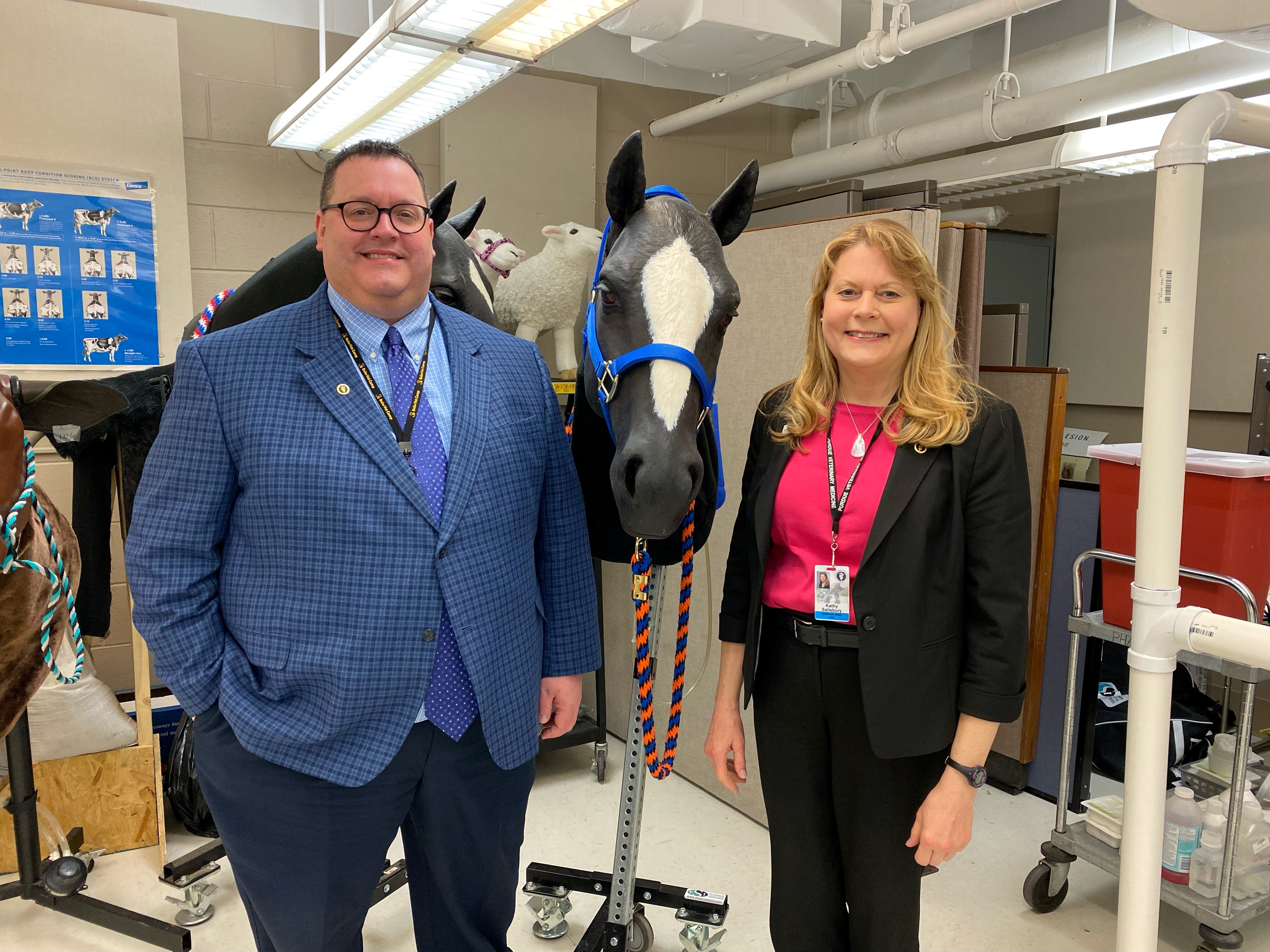
Dr. Kathy Salisbury (right), Associate Dean for Student Affairs, and Dr. Jim Weisman (left), Assistant Dean for Student Affairs in the College of Veterinary Science
Students in the professional program in the College of Veterinary Medicine need to demonstrate their skills through clinical, hands-on exams. For students who have accommodations that allows them extra time, it can be difficult to find a way to provide this accommodation while maintaining the integrity of the exam. This is a complex issue that Salisbury and Weisman have turned to the DRC for help in finding a solution.
These clinical exams begin with students conducting a physical examination of the patient and gathering necessary information regarding the case. Then, they are expected to present this information to the faculty clinician, and care continues from there.
“We started working with access consultants at the Disability Resource Center,” Salisbury said. “They look to us for advice on what’s a reasonable accommodation, and we look to them for advice on what a student needs to help overcome barriers.”
One solution Salisbury, Weisman and the DRC came up with is allowing students time in a quiet environment to process case information for a non-emergent patient before presenting a course of action to the clinician.
“It’s a little different because it’s in a hospital setting,” Weisman said. “It’s been a really collaborative effort as we all try to reach the best decision for everybody.”
Salisbury and Weisman are currently working with the DRC to find ways to make the Objective Structured Clinical Exams (OSCEs) more accessible for students with accommodations. In this practical exam, students must complete a task or answer a series of questions at designated stations to demonstrate what they have learned in their courses. Access consultants from the DRC will attend the OSCEs and collaborate with Vet Med to find ways to incorporate inclusive design in these exams.
One instructor, Ray Mentzer, professor of chemical engineering, proactively incorporates inclusive design and accessibility in his courses by meeting one-on-one with students with accommodations at the beginning of each semester.
“I ask (students with accommodations) to come see me and we have a one-on-one meeting just to discuss what is it that they’re entitled to and what makes them most comfortable,” Mentzer said. “It’s just to (ask) … ‘what is it that you want from me?’”
While instructors have the option to use the DRC Testing Center to facilitate students' accommodated exams, Mentzer reserves a room with a teaching assistant (TA) for every quiz and exam he schedules. He offers different modes of test-taking and allows students to choose what works best for them.
If instructors don’t know where to start with inclusive design, The Center for Instructional Excellence (CIE) is a resource on Purdue’s campus that will work with instructors to make access happen. The CIE has a variety of teaching resources available for instructors, including confidential consultations that will help instructors find ways to make their courses accessible. To learn more about CIE, visit the CIE website.
“Accessibility is everybody's responsibility, and we all have a part in that at Purdue,” said Randall Ward, DRC director and associate director of Student Success Programs.
To learn more about the Disability Resource Center, visit their website.
Writer: Molly Gilbride, Student Communications Assistant, Student Success Programs, mgilbrid@purdue.edu
Last updated: March 15, 2022