Uncovering Structure in the Knowledge of Children with Language Delay Using Vocabulary Networks
Children acquire language at an astounding speed: most produce their first word around their first birthday, and by 30 months of age, some can say as many as 600 words. Unfortunately, this is not the case for all children: up to one in five toddlers has delays in vocabulary skills. These delays are not trivial and were linked to risks of lower academic achievement. Traditionally, research on language delay has focused on vocabulary size, which alone cannot tell the whole story because words are not isolated in our memory. Rather, people organize words into a network-like structure, where words are linked if they are similar in sound, use, or meaning. To support children experiencing language delays, we need to understand not just how many words they know but how children are storing and organizing those words in memory. Our project approached this puzzle by investigating how children with and without language delays organize words into meaningful clusters, or semantic categories.
Why focus on categories? Categorization and children’s understanding of categories are foundational skills in language learning. For example, when learning the word for dogs, children need to learn what the label refers to (what counts as a “dog”). Since dogs vary in look, and since not all four-legged, furry animals are dogs, children have to determine which animals belong to this category. Hence, categorization is crucial for early word learning. As children accumulate more words, broader categories, like animals or vehicles, also shape learning.

Prior works from our lab show that children learn new words more easily in categories they already know more words in. For example, if a child knows more animal words than vehicle words, they will learn a new animal word faster than a novel vehicle word [1,2]. Furthermore, only knowledge organized into coherent categories boosts further word learning[3]. Despite the role of broad categories in learning, little research has examined whether children with language delays differ from their peers in how distinctly they form these broad categories.
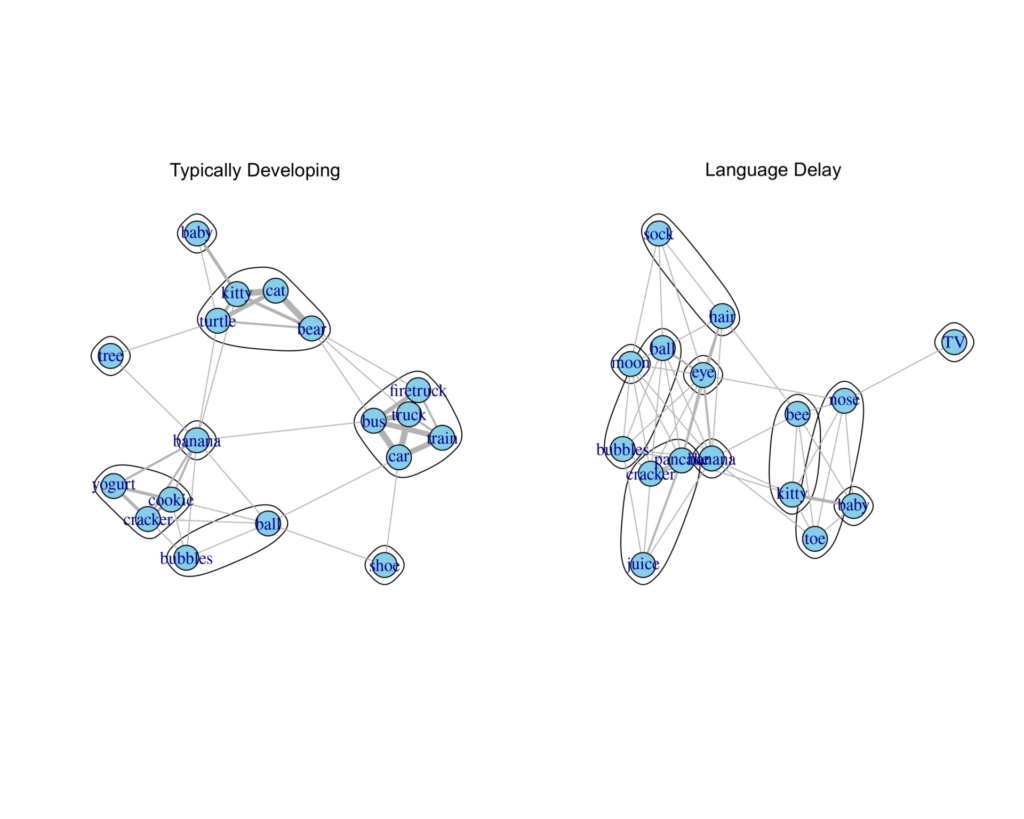
Our project set out to answer this overlooked question: Do children with language delays represent categories differently from their peers—and does this matter for later outcomes? At the Language Learning and Meaning Acquisition (LLaMA) lab, we followed 151 children as their language grew from 18 to 30 months of age. More than half of the children experienced language delays at the start. Every three months, we invited parents to report all the words that their child could say. With the words they produced, we constructed a “vocabulary network” for each child at each time point, where words are linked if they are similar in meaning. For example, “spoon” and “fork” are connected because they are usually made of metal and are used for eating. We then measured how easily each child’s vocabulary network could be divided into clusters—a measure of how distinctly the child stores categories in their memory.
The vocabulary network revealed something novel: For children with language delays, words within the same category, say animals, were less interconnected compared to those of their peers. And, relative to the age-matched peers, connections across categories were stronger in children with language delays, suggesting less separation between categories overall in this group. In other words, children with language delays formed less distinctive categories in their knowledge compared to peers who are not experiencing a delays.
Does this difference in category knowledge matter for later language outcomes? To answer this question, we split the children with language delays into two groups: children with persistent delays and children who caught up with peers by 30 months of age. As it turns out, clear-cut categories in knowledge did matter. The subset of children who caught up with peers showed a comparable level of distinction between categories as the typical group at 24 months, while the group with persistent delays never did. Having clear, differentiated categories early on was linked to positive language outcomes later.
We found that children with language delays not only know fewer words, but the words they do know give rise to less clear categories. Our finding is important in several ways. First, given prior observation[1] that only clear-cut categories enhance further word learning, our finding warrants concerns: Because children with language delays form less distinctive categories, those categories might less effectively boost learning in this population, further widening the delay–typical gap. Second, this finding suggests that children with language delays might benefit from intervention targeting both knowledge of words and categories. In fact, such intervention strategies are already in the work and have been found more effective than control[4]. Looking forward, we believe vocabulary networks can help us identify which target words would most effectively strengthen children’s knowledge structure when teaching children—a direction that some researchers at the LLaMA lab are investigating, paving the way for more personalized and effective language support.
References:
[1] Borovsky, A., Ellis, E. M., Evans, J. L., & Elman, J. L. (2016). Lexical leverage: Category knowledge boosts real-time novel word recognition in two-year- olds. Developmental Science, 19(6), 918–932. https://doi.org/10.1111/desc.12343; [2] Yuile, A. R., Kueser, J. B., Outzen, C., Christ, S., Stiegler, R., Adams, M., Brown, B., & Borovsky, A. (2026). Lexical Leveraging in Novel Word Learning: Different Semantic Properties Support Learners at Different Stages of Development. Developmental Science, 29(1), e70087. https://doi.org/10.1111/desc.70087; [3] Nematzadeh, A., Fazly, A., & Stevenson, S. (2012). Interaction of Word Learning and Semantic Category Formation in Late Talking. Proceedings of the Annual Meeting of the Cognitive Science Society, 34. Retrieved from https://escholarship.org/uc/item/8rf426sw; [4] Neuman, S. B., Newman, E. H., & Dwyer, J. (2011). Educational Effects of a Vocabulary Intervention on Preschoolers’ Word Knowledge and Conceptual Development: A Cluster-Randomized Trial. Reading Research Quarterly, 46(3), 249–272. https://doi.org/10.1598/RRQ.46.3.3
About the Author:
Minh Khong Bui (vi: Bùi Khổng Minh, he/him) earned in Bachelor’s degree in Communication Disorders at California State University, Fullerton. Minh is a second-year Ph.D. student in the department of Speech, Language, and Hearing Sciences. He’s interested in how children’s semantic memory influences cognitive processes such as categorization and reasoning and how children’s semantic knowledge supports word learning. The goal of his current line of work is to uncover processes that underlie learning, which can inform us on how to better support children with language delay and disorder.
Want to participate in the competition?