The Silent Regulator: How One Immune Protease May Hold Clues to Endometriosis and Polycystic Ovary Syndrome
Science often begins with curiosity. I was originally studying how the gut microbiota communicates with the immune system, and how these interactions contribute to health or disease. Working with mouse models, I spent countless hours isolating intestinal tissues. During this work, an unexpected observation emerged: the uterus and ovaries of certain mice looked noticeably different. These animals were missing a single immune-related protease, and yet the changes were striking. That moment of curiosity led to an entirely new line of research, one that now points toward a deeper understanding of women’s health.
The female reproductive tract is one of the most finely balanced systems in the body. It relies on constant coordination between immune signals and hormones to maintain tissue health, regulate cycles, and support fertility. When that balance is disrupted, the consequences can be profound. Conditions such as endometriosis, and polycystic ovary syndrome (PCOS), dysregulated hormonal disorders, affect millions of women worldwide. Beyond these clinical labels, the symptoms are often deeply painful and life-altering: severe menstrual pain, painful bowel movements during periods, and difficulty conceiving are common realities for those affected. Both disorders are associated with chronic inflammation, hormonal imbalance, and subfertility, meaning a reduced, but not absent, ability to get pregnant. Despite how widespread these conditions are, the underlying mechanisms that connect the immune system with hormone regulation in reproductive health remain largely unclear.
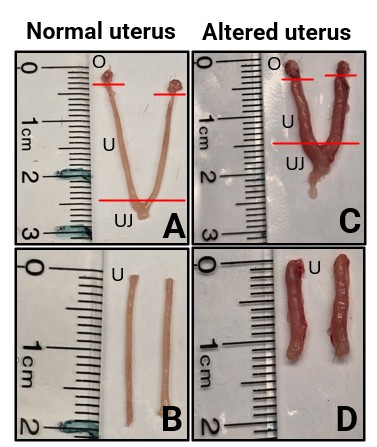
This is where the immune protease comes in. A protease is a protein whose job is to cut other proteins, allowing cells to control how signals are turned on or off. While immune proteases are traditionally studied for their role in fighting infections, our work shows they can also play unexpected roles in regulating reproductive health. By studying mice genetically engineered to lack this protease, we observed changes that closely mirrored features of endometriosis and PCOS. The uteri of these mice were shorter, thicker, and heavier than normal, regardless of cycle stage. Under the microscope, abnormal enlargement of the uterine layers was visible, along with looser connective tissue and signs of inflammation. Tests showed that genes involved in the production of hormones such as estrogen and testosterone were unusually active, disrupting the balance normally required for reproductive health. Functionally, the mice struggled with reproduction: they had difficulty synchronizing their cycles, took more than twice as long to become pregnant, and produced smaller litters. They even showed increased body weight, another hallmark of PCOS.
Together, these results paint a picture of disrupted immune–hormonal balance. Without this immune protease, the uterus cannot maintain its normal structure, hormone production is skewed, and fertility declines. Far from its usual role in immune defense, the protease appears to act as a silent guardian of reproductive health.
What makes this discovery striking is how unexpected it was. The research did not begin with the goal of studying the uterus or ovaries. Instead, a side observation opened the door to a project with wide-reaching implications. It highlights one of the most exciting aspects of science: that following the unexpected can lead to entirely new understandings of familiar problems.
The implications are profound. If similar mechanisms exist in humans, this immune protease could help explain why some women develop PCOS, endometriosis, or related fertility issues. It also raises the possibility that targeting immune pathways might one day complement existing therapies, offering new ways to restore balance in the reproductive tract. Much work remains before such applications can be realized, but uncovering this link marks an important first step.
At a broader level, this project shows how interconnected science can be. An investigation into the immune system and the gut evolved into a study of reproductive health, demonstrating how discoveries in one field can ripple into another. Endometriosis and PCOS are not just medical conditions; they are daily realities that affect the lives of millions of women, often causing years of pain and uncertainty before a diagnosis is made. By adding the immune system to the conversation, this research offers a new perspective on longstanding questions in reproductive medicine.
In the end, my story underscores the power of curiosity. What began as an observation outside the main focus of a study grew into evidence that an immune protease could influence fertility, hormone balance, and reproductive health. It illustrates how even small discoveries can change the way we understand disease. And perhaps, by continuing to follow where curiosity leads, science can take the next step toward easing the burden of endometriosis, PCOS, and infertility for women worldwide.
About the Author:
Alejandra Rodriguez is a Ph.D. candidate in the Interdisciplinary Life Science Program at Purdue University, working in Dr. Matthew Olson’s laboratory in the Department of Biological Sciences. She is also a member of the Inflammation, Immunology, and Infectious Disease training group. Her doctoral research investigates how immune proteases regulate reproductive health, focusing on mechanisms that connect immune balance with hormonal regulation in the uterus and ovaries. More broadly, her research interests include reproductive immunology, chronic inflammation, and the links between immune regulation and infertility-related disorders such as endometriosis and polycystic ovary syndrome. Outside of the academy, she is a cat lover whose favorite plan is to spend time with her two cats, Lucy and Lena, and she is also passionate about artistic makeup.
Want to participate in the competition?