Giving Pacemakers a Voice: How Human Body Communication Could Transform Remote Heart Monitoring
Imagine a heart patient with a pacemaker—one of the millions who rely on these tiny, implanted devices to keep their hearts beating steadily. While pacemakers save lives every day, their ability to talk to doctors outside the hospital is still surprisingly limited. Most “smart” pacemakers only check in once or twice a day or when something unusual happens. For patients at risk of sudden cardiac events, these long gaps—sometimes 14 hours or more before an alert reaches a doctor—can be dangerous.
The reason for this delay isn’t medical—it’s technological. Pacemakers are powered by small batteries designed to last many years inside the body. Current remote monitoring technologies, like Bluetooth, use so much power that transmitting continuous data simply isn’t feasible. Remote monitoring systems from leading manufacturers already shorten pacemaker life by about 1 to 1.5 years—and that’s with just one or two data uploads per day. If a pacemaker tried to send every heartbeat in real time, the battery would run out years too soon. That would mean more surgeries for patients just to replace the device—something every doctor and patient wants to avoid.

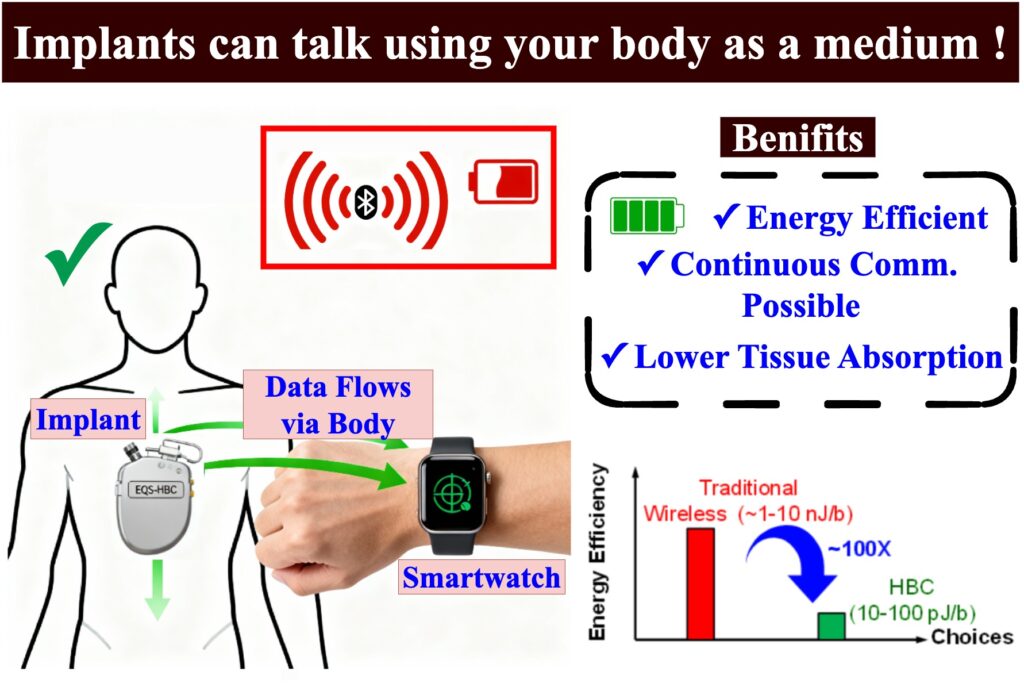
This is where my research comes in. As part of a team of researchers at Purdue University, I am exploring a non-traditional way for implants to communicate—one that uses the human body itself as the communication channel. It’s called Electro-Quasistatic Human Body Communication (EQS-HBC), and it could make continuous, secure, and ultra-low-power monitoring possible for pacemakers and other medical implants.
EQS-HBC takes a dramatically different approach. Rather than sending information through the air using radio waves, this method sends tiny electrical signals through the body itself. Think of it like using the body as a private “wire” between the implant and a wearable device, such as a smartwatch, that sits on the skin. From the wearable, data can then reach doctors securely through the internet.
This approach has three big advantages:
- Ultra-low power: EQS-HBC uses about 100 times less energy than Bluetooth. A pacemaker transmitting continuously with EQS-HBC could keep its battery life nearly unchanged.
- Continuous monitoring: With careful design, real-time, millisecond-scale heart data can be sent reliably, rather than waiting hours between uploads.
- Built-in security: Because signals are confined to the body, it is much harder for outsiders to intercept or hack them compared to standard wireless methods.
By using our energy-balance models and comparing with traditional aftermarket pacemakers, we found that if pacemakers use EQS-HBC, they could last up to 10 times longer than those using traditional radio methods for communication, even when transmitting frequently. By pairing this with careful memory and power optimization inside the device, we showed it’s possible to monitor a patient’s heart rhythm in near-real-time without sacrificing battery life.
Continuous monitoring like this could be a gamechanger for heart patients. Instead of waiting hours for a doctor to see data, dangerous arrhythmias could be flagged in seconds, allowing for quicker treatment and fewer hospitalizations. Moreover, the raw data sent by the pacemaker could be analyzed by advanced machine-learning algorithms tailored to each patient. This means more personalized care and better long-term outcomes.
It’s not only pacemakers that could benefit. The same approach could work for neural stimulators, glucose monitors, and other implants, opening the door to truly connected healthcare where patients are monitored safely and seamlessly at home.
Technology has always involved trade-offs. Until now, the trade-off in implantable devices was between how much information could be shared with doctors and how long the device could remain functional before needing surgical replacement. With EQS-HBC, we’re changing that equation. By dramatically cutting communication power costs, we can have both: continuous, secure monitoring and long battery life.
For patients, this could mean fewer surgeries, faster emergency responses, and peace of mind knowing their heart is always safely watched. For doctors, it means access to richer, real-time data to guide decisions.
This work has already been accepted for presentation at the IEEE EMBS Body Sensor Networks (BSN) Conference 2025, highlighting its potential to advance implantable medical device technology.
At its core, this research is about giving medical devices a stronger voice—one that speaks continuously, clearly, and safely through the human body itself.
About the Author:
Ayan Biswas is a Ph.D. student in the Elmore Family School of Electrical and Computer Engineering at Purdue University, working under Prof. Shreyas Sen at the SPARC lab. His research focuses on low-power communication methods for implantable medical devices, aiming to improve patient outcomes through better continuous monitoring.
Want to participate in the competition?