Detecting the Undetectable: Cosmic Rays for Nuclear Security
Imagine being able to see through walls of steel and concrete without cutting, drilling, or opening a single door. For decades, this has been the dream of scientists and security experts tasked with monitoring nuclear materials. Traditional imaging techniques like X-rays and CT scans work well for medical diagnostics or airport baggage screening, but they fall short when it comes to the most heavily shielded objects—like spent nuclear fuel sealed inside storage casks, smuggled materials hidden in cargo, the core of a nuclear reactor, the magma pathways of a volcano, or secret chambers buried deep within ancient pyramids.
My research explores a novel way to tackle this problem using something that rains down on Earth every second: cosmic-ray muons. These tiny subatomic particles are born when high-energy cosmic rays from outer space collide with atoms in our upper atmosphere. Billions of them pass through us every minute, invisible and harmless, yet powerful. Because muons are about 200 times heavier than electrons, they can travel through dense materials like lead or uranium that would completely block other types of radiation. This unique property makes them natural candidates for non-invasive imaging of extremely well-shielded systems.

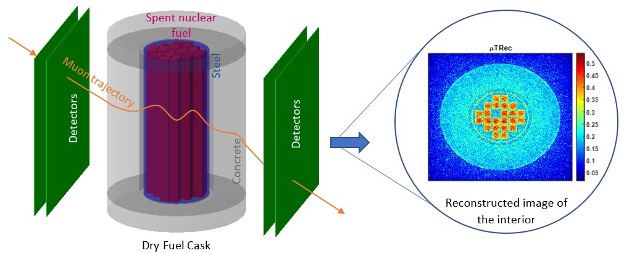
Safely handling and monitoring nuclear materials is one of the most urgent global challenges. Spent nuclear fuel, for example, is stored in towering steel-and-concrete containers known as dry storage casks. These casks must remain sealed and secure for decades to prevent any risk to public health or the environment. But once a cask is sealed, verifying its contents becomes nearly impossible without opening it, a dangerous, expensive, and sometimes unfeasible process. Muon imaging offers a revolutionary alternative. By tracking how muons scatter as they pass through a sealed cask, we can reconstruct a 3D image of what’s inside, much like a medical CT scan—but on a vastly larger and denser scale. This passive, non-intrusive method could transform nuclear safeguards by providing continuous, long-term monitoring without the need for radiation sources or invasive inspections.
When muons travel through matter, they are slightly deflected—a process known as multiple Coulomb scattering. Imagine a stream of water flowing smoothly down a river. When it encounters rocks beneath the surface, the water swirls, slows, or changes direction. By carefully watching how the water moves before and after, you could figure out where those hidden rocks are, even if you never see them directly. Muons behave in much the same way. As they travel through an object, dense materials like uranium act like those hidden rocks, causing the muons to scatter slightly. By placing detectors at the entry and exit points, we measure the muons’ incoming and outgoing paths and use that information to reconstruct a 3D picture of what’s inside.
The challenge is turning millions of these tiny scattering events into a clear, detailed image. Early methods were like rough sketches, good for basic outlines but too blurry to capture fine details. My research advances this process through Muon Trajectory Reconstruction (µTRec), which uses physics-based modeling to trace the most likely full path of each muon. This upgrade is like going from a fuzzy snapshot to a high-definition map, revealing hidden structures inside even the most complex and heavily shielded systems, such as tightly packed nuclear fuel or partially damaged storage casks.
In the past, I have collaborated with researchers at Oak Ridge National Laboratory (ORNL), and I am now working with a team at Los Alamos National Laboratory (LANL) to analyze real muon data collected from experimental setups. One of the most exciting aspects of this research is its potential to integrate with other imaging modalities. Imagine using muon tomography to first identify a suspicious region inside a cask or cargo container, and then applying high-resolution X-ray techniques to zoom in on that area. This “multi-scale imaging” approach could drastically improve both the efficiency and effectiveness of nuclear safeguards.
The stakes are enormous. Since the 1950s, U.S. commercial reactors alone have generated over 90,000 metric tons of spent nuclear fuel, much of which is stored in dry storage casks. Globally, large fleets of these casks are already deployed for long-term storage, with many more to come as nuclear plants continue to operate and older reactors are decommissioned. Ensuring the integrity of these casks is essential to protect the environment, maintain public trust, and prevent nuclear proliferation. Muon tomography also plays a critical role in nonproliferation efforts, helping to detect illicit trafficking of nuclear materials and verify compliance with arms-control treaties. Because muons are naturally occurring and require no artificial source, this technique can be deployed safely even in highly sensitive locations.
Ultimately, this research represents a step toward a future where we can “see the invisible”, using the natural particles that rain down from the cosmos every second. By harnessing muons, we are not only advancing science but also developing practical tools to safeguard people, strengthen global security, and protect our planet.
About the Author:
Reshma Ughade is a Ph.D. candidate in the School of Nuclear Engineering at Purdue University, where she also earned her master’s degree. She holds a bachelor’s degree in Mechanical Engineering from the College of Engineering Pune, India. Under the guidance of Dr. Stylianos Chatzidakis, her research focuses on developing advanced algorithms for muon tomography to enhance the imaging and safeguarding of nuclear materials.
Want to participate in the competition?