A Smarter Way to Watch Over Alpacas in Peru
In the Andean mountains of Peru, alpacas are more than animals; they are a lifeline for entire families who rely on them for wool, food, and a source of income. Alpaca shepherds, many of whom live in remote mountainous areas, spend countless hours watching over their herds. The reality of this work is difficult. Alpacas often roam freely across vast, rugged landscapes in search of grass and water. Without fences or boundaries, they can spread out for miles, sometimes vanishing behind valleys or hills. When this happens, shepherds may spend hours (sometimes days) searching for them.
Modern tools like Wi-Fi or cellular tracking apps are of little help here. In these high-altitude and remote areas, phone signals are rare, and internet connections are unreliable. As a result, families face stress, lost time, and even financial losses when animals go missing.
Thus, the question is clear: How can we give shepherds in these remote regions real-time knowledge of where their alpacas are, without relying on cell towers or the internet?
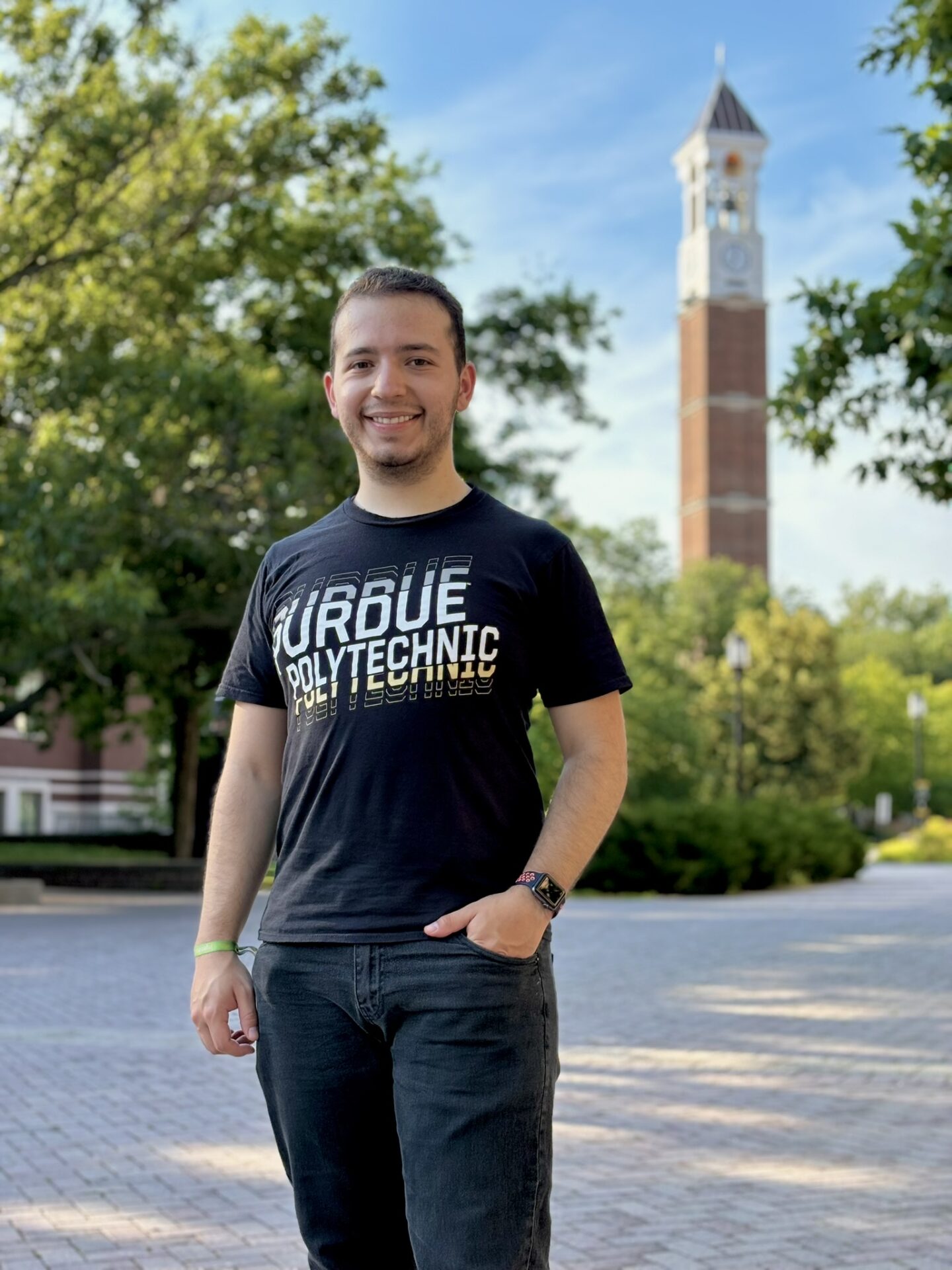
At Purdue’s tinyLab, my research focuses on designing practical, affordable technologies that meet community needs. In this case, we have created a reliable and long-range geolocation system tailored for alpaca herding in Peru, called LoRaWAN.
LoRaWAN is a communication technology that uses low-power, long-range radio signals. It’s different from Wi-Fi or cellular networks because it can send information over several miles using very little battery power, making it perfect for places with no traditional coverage.
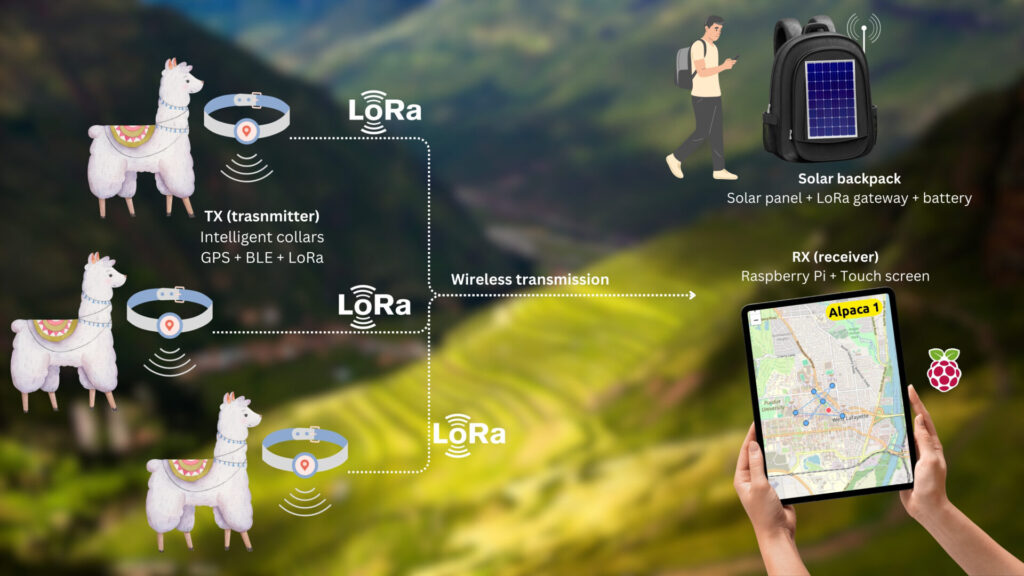
In our approach, small solar-powered transmitters are placed on alpacas. Each transmitter sends out radio signals that include the animal’s GPS position. Using LoRaWAN, these signals travel wirelessly to a portable and solar-powered receiver built around a Raspberry Pi (a small, affordable embedded computer). The receiver displays the alpacas’ locations on an offline map (no internet required). Shepherds can carry this receiver into the field and instantly see where their animals are, represented as dots moving across the map.
This solution is not just about convenience. It has the potential to transform rural livelihoods. With the ability to locate their animals in real time, shepherds can:
- Save time and energy, avoiding long searches across steep mountains.
- Prevent losses, since they will know quickly if an animal is getting too far.
- Protect their lands, as better tracking allows for improved grazing management.
- Spend more time on other productive activities.
To accompany this technology, we are organizing training workshops, so Shepherds can learn to operate the receiver, read the maps, and care for the devices. This hands-on training is essential because it ensures that the tools are not just delivered but fully understood and embraced by the community.
While this project is currently focused on alpacas in Peru, the implications go far beyond. The same system could be used for other livestock like sheep, goats, or cattle in rural areas around the world. It could even be adapted for crop monitoring or wildlife conservation, making it a versatile tool for smart agriculture and environmental protection.
At the Purdue Polytechnic, we see this as a step toward more equitable technology, bringing innovation not only to urban centers or wealthy farms but also to the people who need it most, in regions where technology is a privilege.
As we expand these networks, the impact will ripple outward: shepherds will spend less time searching, families will feel more secure, and entire communities will gain tools that improve resilience in the face of economic and environmental challenges.
This work is in its final stages, and we are preparing to fully deploy the system at the Sumbay research station, a station managed by our sponsor, Universidad Nacional de San Agustin (UNSA), for testing. By combining open-source technology, energy efficiency, and community training, we hope to demonstrate that innovation can be simple, practical, and deeply human-centered.
For the shepherds of Peru, this means less time worrying about where their alpacas are and more time building the future they want for their families. For us as researchers, it is a reminder that technology has the most impact when it listens to and learns from the communities it serves.
About the Author:
Nicolas Rendon-Arias is a master’s student in Engineering Technology at Purdue Polytechnic Institute under the guidance of Dr. Walter Daniel Leon-Salas. His research focuses on wireless communication systems, Internet of Things (IoT) applications, and embedded systems for smart agriculture solutions that support rural communities in Latin America. Many thanks to Mauricio Postigo-Malaga, professor of Electronic Engineering at UNSA, and Miguel Vizcardo, professor of Physics at UNSA, for their contributions to this research.
Want to participate in the competition?