
Rosie Lerner

716 articles by this author

Posts List

Fascinating Fasciation

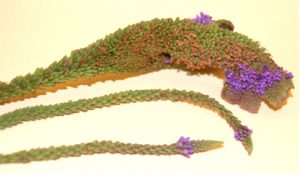
Every so often, gardeners find a deformed-looking flower or stem that appears as if the plant has bulked up on steroids. The stem or flower stalk will appear somewhat squashed and splayed, sometimes splitting in two or more sections. Or it may appear that two or more stalks have merged together to form one distorted structure. This odd growth is called fasciation, which literally translates to banding or bundling. Fasciation is thought to be caused…Read more about Fascinating Fasciation[Read More]

Question and Answer

Q. I have had a hummingbird vine for roughly five years, and it has yet to flower. It vines all over my front porch. I trim it down, thinking it will flower. I have called the company I got it from, and they tell me nothing. I have been thinking of cutting it down and digging it up, but I want this vine to flower. Anything you can tell me will be greatly appreciated. A….Read more about Question and Answer[Read More]

 Categories:

All-American Selections New Flowers and Vegetables for 2008

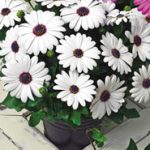
Only three new garden plants were chosen for All America Selections (AAS) 2008, based on superior performance in test gardens all over the country. Osteospermum (a.k.a. cape daisy) ‘Asti White’ is this year’s bedding plant winner, selected for its outstanding bright white 2 – 2.5 inch daisy flowers with blue centers that continue blooming all summer.  The compact plants, reaching up to 20 inches tall and wide, are ideal for container gardens and will tolerate…Read more about All-American Selections New Flowers and Vegetables for 2008[Read More]


Persimmon Tree Pollination, Potato Fruits, and Hydrangea Blooming Tips

Q. I have a question about persimmon trees. I bought three pairs over the past several years from a well-known mail-order company. They were supposed to be one male and one female. All of the trees have little bell-shaped blooms, but don’t develop fruit. Have I received all females? How can you tell the difference? The oldest trees are over 10 years old. How old do they have to be to bear fruit? A. While it can…Read more about Persimmon Tree Pollination, Potato Fruits, and Hydrangea Blooming Tips[Read More]


Showy Foliage for Shade Gardens

You don’t have to live in the tropics to have a stunning foliage display in your shade garden. Midwest gardeners have a wonderful foliage palette that can fill in areas among other perennials, or even star as the focal point. Of course, everyone thinks of hosta for showy shade-loving foliage, and there are an awesome number of cultivars to choose from. They come in various shades of green and blue and accented with white, cream…Read more about Showy Foliage for Shade Gardens[Read More]


July 2007

Q. Some years ago, I had a list of plants in the garden that were compatible and those that weren’t. If you have such information, could you include it in your “question and answer” column? It’s too late for this season, but we’d have it for next. A. The principles of “companion planting” are based on the belief that certain plants can benefit others when planted in combination or nearby. Such strategies can include using…Read more about July 2007[Read More]


Help Your Garden Cope with Dry Spell

Dry summers are not unusual in Indiana. In fact, I addressed dry conditions in this column just two years ago. Gardeners struggle hard enough to maintain healthy plants when extreme high temperatures are accompanied by lack of rain. What compounds the stress of this year’s dry weather is that it follows the wild weather extremes experienced earlier this year. March brought unseasonably warm temperatures to lure plants out of dormancy, and then April put the…Read more about Help Your Garden Cope with Dry Spell[Read More]


Question and Answer

Q. I have a lilac bush that I started from a “slip” from my sister several years ago that has never bloomed. It is growing leaves and is beautiful, but no blooms. What do I need to do? A. There are a number of reasons why a plant might fail to bloom. The most common factors are plant age, sunlight, plant nutrition, winter temperatures and improper pruning. You didn’t indicate how many years ago you…Read more about Question and Answer[Read More]


Wisteria A Mystery for Most Gardeners

Nothing rivals the beauty of a wisteria arbor in full bloom, but, unfortunately, successfully growing these lovely vines eludes many Midwestern gardeners. Two types of wisteria are most commonly planted in our area: Japanese wisteria ( Wisteria floribunda ) and Chinese wisteria ( Wisteria sinensis). Japanese wisteria is known for its fragrant violet blossoms, which are borne in 8- to 20-inch-long clusters. The individual flowers of a cluster open gradually, beginning at the base. Chinese…Read more about Wisteria A Mystery for Most Gardeners[Read More]


Question and Answer

Q. I have two hydrangeas. One is a small bush (Annabelle) about 6 years old. It is on the south side of the house but is in deep shade in summer due to large trees growing south and east of it. The other is a climbing hydrangea on the east side and is in the sun in the morning. The climber grows luxuriantly. The bush isn’t really that happy. Neither has ever bloomed. I have…Read more about Question and Answer[Read More]