
October 2, 2018
Dr. Jason Cannon Granted a $336,582 R01 Award
Read More about "Dr. Jason Cannon Granted a $336,582 R01 Award"

September 26, 2018
Millions of birds die each year in collisions with planes, and airports have used everything from fireworks to herding dogs to scare them away. Some methods have been relatively successful, but they’re useless after the plane takes off. Researchers at Purdue University may have just found a solution. Red and blue LED lights lead some birds in the opposite direction, according to a study published Wednesday in the journal PeerJ. Congratulations to Esteban Fernandez-Juricic for his excellent work!
Millions of birds die in collisions each year, but lights could change that

September 15, 2018
Dr. Mathew Tantama, Assistant Professor at the Purdue Department of Chemistry, along with Dr. Chris Rochet, Professor of Medicinal Chemistry and Molecular Pharmacology, has been awarded $192,785 for the initiation of their project of Leucine-Rich Repeat Kinase 2 being a potential treatment for Parkinson's disease (PD) intervention. Congratulations!

August 31, 2018
Tamara Kinzer-Ursem, assistant professor of biomedical engineering, and Janelle Wharry, assistant professor of nuclear engineering have received Early Career Development (CAREER) awards to further their research from the National Science Foundation. Kinzer-Ursem also received an NSF Innovation Corps (I-Corps) grant. Over the next five years, the award will provide Kinzer-Ursem with $550,000 and Wharry with $560,000.
Two Purdue engineering professors honored for early-career achievement, innovation
August 22, 2018
Dr. Bharadwaj received a NSF award for a multi-site project titled "Testing the relationship between musical training and enhanced neural coding and perception in noise".

August 20, 2018
The regulation of pH is essential for proper organelle function, and organelle-specific changes in pH often reflect the dynamics of physiological signaling and metabolism. For example, mitochondrial energy production depends on the proton gradient maintained between the alkaline mitochondrial matrix and neutral cytosol. However, we still lack a quantitative understanding of how pH dynamics are coupled between compartments and how pH gradients are regulated at organelle boundaries. Their results demonstrate the feasibility of studying interorganelle pH dynamics in live cells over time and the broad applicability of these sensors in studying the role of pH regulation in metabolism and signaling. Congratulations to Megha Rajendran, Benjamin Claywell, Emily P. Haynes, Umi Scales, Chace K. Henning, and Mathew Tantama for their work!
July 16, 2018
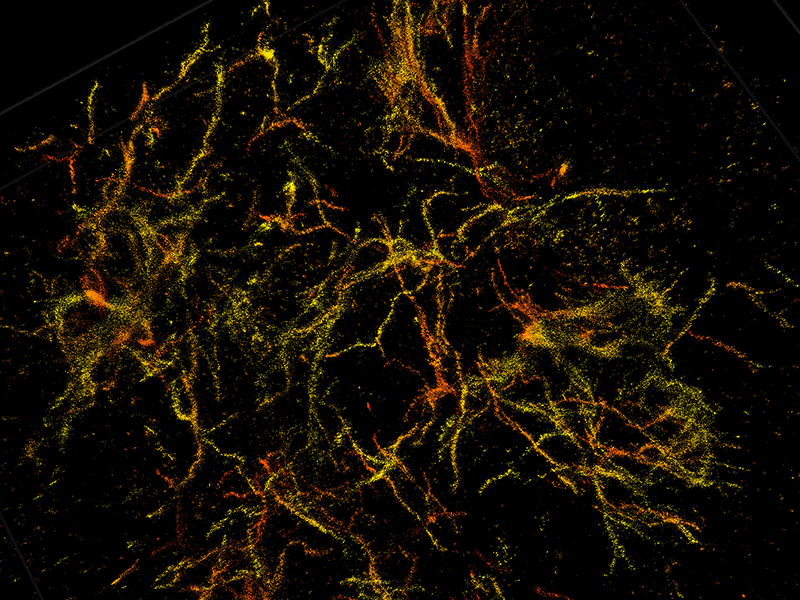
Recent studies show that 40 percent of Americans over the age of 85 have Alzheimer's disease, and that the disease begins 10 to 20 years before people show up at the doctor's office with memory problems. One major problem with understanding Alzheimer’s is not being able to clearly see why the disease starts. A super-resolution "nanoscope" developed by Purdue University researchers now provides a 3D view of brain molecules with 10 times greater detail. This imaging technique could help reveal how the disease progresses and where new treatments could intervene.
New development in 3D super-resolution imaging gives insight on Alzheimer's disease

July 12, 2018
Some level of molecules linked to oxidative stress may be essential to health and development, according to new animal studies. In a recent study from the Purdue Department of Biological Sciences, Daniel Suter’s team looked at an enzyme that produces ROS in zebrafish embryos to see if it’s essential to the development of their nervous systems. Inhibiting this enzyme, NADPH oxidase (Nox), resulted in complications with signaling between the eyes and the brain. The findings were published in The Journal of Neuroscience. The research team used a drug called celastrol to inhibit Nox activity, which led to defects in the formation of the ganglion cell layer and optic nerve, both of which send signals from the retina of the eye to the brain.
Chemicals associated with oxidative stress may be essential to development
June 28, 2018
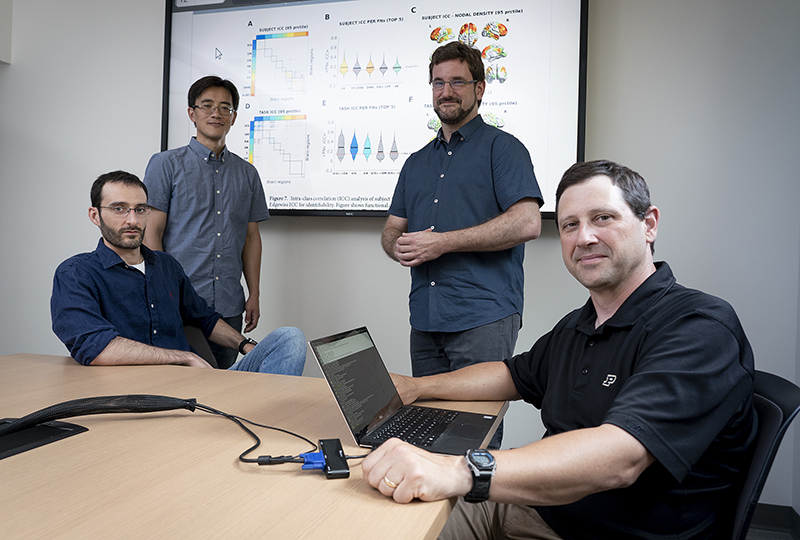
Patients with dementia and other neural diseases show physical symptoms such as stumbling and confusion, but identifying the problem isn’t as simple as taking an X-ray. A group of researchers at Purdue University are designing data-driven tools that will help clinicians better understand the progression of neurodegenerative diseases by identifying and tracking changes in the brain. The project is led by Joaquín Goñi, an assistant professor of industrial engineering and biomedical engineering who studies the network of neural connections composing the human brain.

June 14, 2018
Purdue University researchers have developed an analytical imaging technology based on functional MRI for detecting and monitoring cerebral vascular disorders and injuries that does not require the use of contrast agents. The new imaging method focuses on tracking an intrinsic blood-related MRI signal, which has been shown to travel with the blood. The signal is used as a natural biomarker to assess blood flow in a patient. Congratulations to PIIN Member Yunjie Tong on this outstanding achievement!
