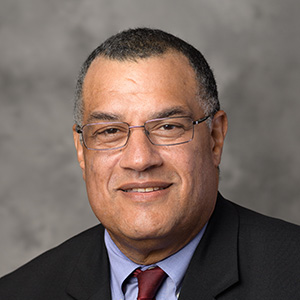
Roy M. Dejoie
Mitchell E. Daniels, Jr. School of Business MurphyRoy Dejoie – or “Dr. D,” as his Mitchell E. Daniels, Jr. School of Business students call him – continually builds on his own experiences as a learner and an instructor to be “a teacher, a mentor, a guide, and frequently the rock upon which the student’s flint is struck to create the initial spark.”
Prior to his selection as a 2021 Murphy nominee, the clinical associate professor of management earned numerous teaching honors and was named a member of the Purdue Teaching Academy (he now services on the Academy’s Executive Council). He was also a recipient of the Purdue University Class of 1922 Award for Outstanding Innovation in Helping Students Learn for his contributions in team dynamics in the classroom. Recently, Dejoie was named one of Poets and Quants’ Top 50 Undergraduate Professors of 2022.
In the following interview, Dejoie thinks back to students with whom he’s worked since arriving at Purdue in 2001, but particularly in the last few years as he seeks to expand their global understanding, and to connect with them both virtually and in person.
How has your teaching evolved over the last five years?
I’ve also ventured out of my domestic classrooms and become involved with the study abroad experience at Purdue. The Study Abroad experience is amazing, and I would highly recommend it to both students and faculty. For me, it helped me get a more expanded view of my field in looking at the influence that culture can have on the covered topics. It has driven me to think of different ways of exploring the topic to enhance the students’ study abroad experience, but also provided me with new examples that I can bring back into U.S. classrooms to also enhance the learning and cultural awareness of the students who haven’t yet partaken of the study abroad opportunity.
What changes to your teaching during the pandemic did you take with you going forward?
Having virtual office hours has provided more flexibility for students who may not be on campus at the time of my in-person office hours. Sometimes students just have a very simple or quick question to ask, but between travelling to the campus and finding parking, getting to in-person office hours might end up taking lots more time than it takes to relay the answer to those students (and they may just decide to forego asking the question). Also, with online availability, I can provide extra project hours even when I’m on the road in the summer with my boys’ baseball tournaments.
I’ve also re-evaluated deliverables that have been required in my class and tried to move toward more digital submissions, which also provides more flexibility in delivery times and requirements in assembling submissions.
I utilize various digital platforms that were necessary during the pandemic, but now provide additional convenience and flexibility for students. As an example, Purdue IT’s Rosen Center for Advanced Computing (RCAC) provides remote access to many of the software packages and applications that have traditionally only been available when students came on campus to the labs (or students had to purchase themselves). In some cases, this provides certain students (e.g., Mac users) the ability to use the strength of the cloud platform to access software that traditionally isn’t available on their own computers (e.g., Microsoft Access). In the past, these students had no options other than to come to the computer lab, or if they wanted the convenience of working on their own machine, they had to alter configurations or purchase a new computer.
Lastly, utilizing virtual exams in some classes has reduced the need for campus resources such as large classrooms (for exam seating) and even Disability Resource Center resources, as students can now often find their own test-taking areas that are distraction-free, use reader software on their own computers without distracting classmates in a large exam-taking environment, and can also take exams in environments that are more familiar and comfortable to them.
What suggestions do you have to Purdue instructors who want to improve their teaching and/or their students’ learning?
I find that being involved in the education of the new generation of teachers also keeps me thinking and increasing my skill set. More than a decade ago, I took on the job of training all the Ph.D. students in our area (Management Information Systems) prior to their teaching assignments. They attend class with me to see my techniques, bounce ideas off me about how they might approach or handle something in the classroom and review their teaching materials with me. Since taking that on, every Krannert Ph.D. student in our area has received award recognition from Krannert as an outstanding or distinguished Ph.D. student instructor.
I also participate in new faculty teaching workshops to give incoming faculty tips and techniques to help them out as they start their careers in higher ed at Purdue. In sharing my experience with them, I get to hear from other seasoned classroom veterans who are also participating, so I often come away from those events not just an instructor, but also as a learner.
What motivates you to do your best work in a student-centered learning environment?
While there, the teacher is visited by ghosts of some of his students. Many of them died in acts of bravery in war or in scientific research, etc. They all say they came back to let him know that, while they were the ones who did the acts, they remembered the things that he had taught them about bravery/courage, loyalty, ethics, caring for their fellow humans, and many other lessons that shaped their lives. The old teacher realizes that — while he was not the one who directly did these great things that his students did — he contributed to the building of their character and, thus, had won some victory for humanity.
I was struck by the idea of “victory for humanity” the very first time I saw this episode, which was roughly around 2000, and it reminded me of things that had always resonated as a teacher. While there is certainly something to be said for, and rewarding about, watching the spark in a student’s eyes when a hard concept suddenly makes sense, later in my career, I’ve come to cherish seeing my students when they come back many years later and tell me about the great things that they are doing.
One of the very first students that I taught at Purdue, who now owns their own company, recently visited the School of Business to speak to students in the Executive Forum. They sent me a follow-up note saying, “Thank you so much for taking time to support me in this journey. You’ve made a difference in my life and I’m confident in the lives of thousands of others. And that’s a big deal.”
It’s gratifying that former students like this still remember the lessons from the classroom, which may not have always been tied to the homework material or the exam but are subtle items that I don’t necessarily put in the schedule of topics, but that I weave into my classes. Things like integrity and honestly, being consistent in how you act, doing the best that you can (not because someone is watching you or you’ll get paid, but because it’s the right thing to do), realizing that just because something is hard doesn’t mean that it can’t be fun, how to be a member of a team and a leader in a team, how to discover what makes them unique and how, being creative in the approach to things and always giving 100 percent regardless of how big or small the task.
While I certainly hope to be around a lot longer, there’s a certain comfort in knowing that I have won some victory for humanity through the great things that my students have done and will do, even if I haven’t done them first-hand. My pebble into the lake has sent forth lots of ripples over my years that will have impacts, and that certainly motivates me to make sure that I’m doing my best when I’m engaged in education.
The Charles B. Murphy Outstanding Undergraduate Teaching Award is Purdue West Lafayette’s highest undergraduate teaching honor and awarded annually in the spring semester. Each College selects and advances its own nominee the previous fall as a model in excellent undergraduate education and includes input from its students. For other nominee interviews, see the Insights webpage. Further details on the award and selection procedure and university awardees are available on the Office of the Provost website.