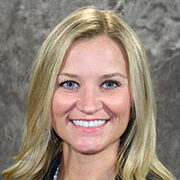
Jamie L. Woodyard
College of PharmacyJamie Woodyard, clinical assistant professor of pharmacy practice and director of professional skills laboratories in the College of Pharmacy, seeks to help students develop skills in the classroom that bridge to excellence in practice. Woodyard builds on the opportunities and mentoring she received while earning her Doctor of Pharmacy degree from Purdue in her commitment to teaching and learning, engagement, and scholarship.
In her efforts to create a safe learning environment in which pharmacy practice skills can be applied and assessed, the 2020 Purdue Teaching for Tomorrow Fellow implemented numerous active learning, simulation- and performance-based activities in the six courses she oversees. These include Performance-based Assessments, six realistic simulations to access student achievement of Pharmacy learning outcomes, and to which learning activities in pharmacy labs are aligned and consistently assessed. These assessments incorporate student reflection upon their performance and the creation of professional development plans. In addition, the MyDispense online pharmacy simulation program allows students to practice their communication and prescription dispensing skills in realistic situations with mock patients.
Woodyard is advisor to the American Pharmacists Association Academy of Student Pharmacists, the largest student organization in the College of Pharmacy. She offers an annual “Bike and Brunch with Dr. Woodyard” event for a student organization raffle for scholarship funds, and the Dr. Jamie L. Shelly Woodyard Scholarship to provide financial awards to students interests in pursuing teaching careers in academic pharmacy.
Her mentoring efforts led Woodyard to be named the 2020 Faculty Mentor of the Year in the Department of Pharmacy Practice. She holds monthly mentoring meetings with students and co-publishes with those interested in research, resulting in multiple publications and presentations related to teaching. She has authored/co-authored multiple articles, book chapters, and platform presentations.
Students describe Woodyard as approachable, upbeat, and focused on their success. “She was always very clear and effective in making sure we knew what to do and what we needed to learn,” one student said. “She was always helpful and encouraging, even if we did not get something right the first time.”
How has your teaching evolved over the last five years?
As I’ve grown over the past five years, both as an educator and as a practicing pharmacist, I have been able to incorporate my own practice experiences into the laboratory based on actual patients for whom I have cared.
My goal is for students to draw the connections of how the skills they are learning and practicing apply in pharmacy practice. Additionally, in response to student feedback requesting more examples and visual presentations of skills-based performance, I have incorporated more modeling of skills through both live and video demonstrations to provide students examples of what to do – and in some cases, what not to do – before performing themselves. As a result of providing these additional opportunities, students report feeling better prepared and more comfortable.
Last, but certainly not least, I have expressed more personal vulnerability in my laboratories as I’ve gained more professional experience by sharing my mistakes and lessons learned. I feel this has helped me connect better with students on a human level. It also helps to demonstrate the laboratory as a safe space where students can make mistakes and are encouraged to think through how to prevent these mistakes from occurring again when they are practicing pharmacists.
What changes to your teaching during the pandemic did you take with you going forward?
While I typically conduct most labs in person due to their interactive nature, the pandemic forced patient communication activities with mock patients to be conducted online. With telehealth more prevalent and widely used during the pandemic, it became important for our curriculum to incorporate instruction and practice opportunities on telehealth encounters with patients. This was not something I taught in the past or that our curriculum had emphasized, but suddenly our student pharmacists need preparation to assist patients virtually as pharmacists in several practice settings currently do, so we continue to do some remote mock patient encounters.
Additionally, the pandemic adversely affected individuals, my students being no exception, in a variety of ways, many of which have resulted in hardship. I have engaged in considerably more dialogue with students on how they are doing outside the classroom, as this inevitably can affect their learning and provide insight as to how I may need to adjust my teaching to better meet their needs.
I continue these wellness checks and hope that students are willing to be honest with professors about their circumstances so we can work together to ensure student success.
What suggestions do you have to Purdue instructors who want to improve their teaching and/or their students’ learning?
Becoming involved in an academic professional organization can also improve your teaching through idea sharing with colleagues, identification of mentors within these organizations, and resources the organization may offer.
Additionally, the Purdue Center for Instructional Excellence has a variety of resources I recommend such as the IMPACT program and teaching fellowships.
Lastly, do not forget to measure the outcomes of your teaching/student learning so you can, in fact, determine if they are improved.
What motivates you to do your best work in a student-centered learning environment?
I was blessed with professors here at Purdue who did this for me as a student, and I want to pay that forward.
Also, recognizing that my work on developing student knowledge and skills transcends to ultimately impact patients who pharmacists serve – in addition to the profession of pharmacy as a whole – is highly motivating, not to mention humbling.
The Exceptional Early Career Teaching Award recognizes undergraduate faculty members with the rank of assistant professor/assistant clinical professor. It is among several PWL-wide teaching honors awarded annually in the spring semester. Each college/school selects and advances its own nominee the previous fall as a model in exceptional undergraduate education and includes input from its students. Further details on the award and selection procedure and awardees are available on the Office of the Provost website.