Where learning meets practice: Purdue athletic training students gain hands-on experience in the heart of Indianapolis
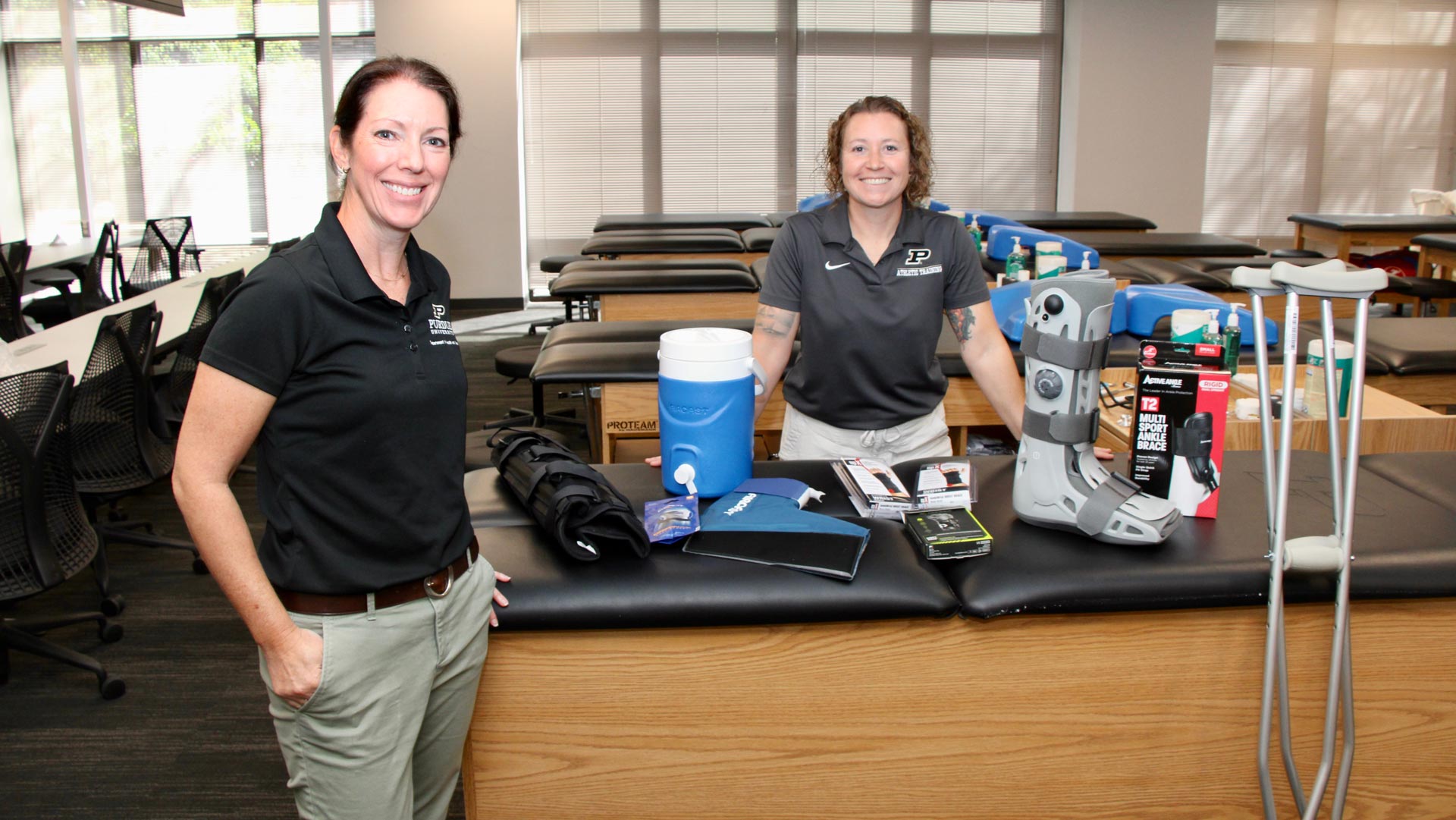
From treatment tables to rehabilitation equipment, the learning tools used by Purdue athletic training students are never far away. Jessica Jochum, associate program director for athletic training and clinical associate professor of health and kinesiology, and Tiffany Franklin, clinical education coordinator, stand in the program’s Canal Square space in Indianapolis, where students can apply classroom concepts in a setting designed to mirror professional practice. (Purdue University photo/Tim Brouk)
INDIANAPOLIS — For graduate students in Purdue University’s athletic training program cohort in Indianapolis, learning and practice happen in the same space, often within minutes of the other. At Canal Square, future athletic trainers move between classroom instruction and clinical simulations, developing hands-on skills in a facility designed to mirror professional practice.
The state-of-the-art athletic training educational space in downtown Indianapolis combines a specialized instructional area, access to the city’s extensive healthcare and sports medicine network, and the expertise of Purdue’s nationally recognized athletic training faculty. Taken together, students have a learning environment that connects classroom concepts to real-world patient care while giving them access to opportunities across both Indianapolis and West Lafayette.
“The vision was rooted in an academic model optimized for clinical programs,” said Scott Lawrance, clinical professor of health and kinesiology and director of athletic training education. “We have a cohort that’s going to live in that space essentially many hours a day for a year, and they need to be comfortable. They need to be able to practice skills that require a little bit more space than just your standard classroom.”
The 400,000-square-foot Canal Square facility, primarily residential with 320 apartments, is home to three College of Health and Human Sciences programs — with room to grow. Opened for inaugural cohorts in Indianapolis in fall 2026, the programs include Master of Science degrees in athletic training and sport management from the Department of Health and Kinesiology and a Bachelor of Science degree in hospitality and tourism management from the White Lodging-J.W. Marriott, Jr. School of Hospitality and Tourism Management.
Learning by doing
The space combines classroom and clinical learning in one flexible environment. One end features collaborative classroom seating, while the other includes treatment tables, examination spaces, simulation equipment and supplies for hands-on instruction.
“Students are actually practicing and perfecting a lot of the things that we teach in class,” Lawrance said. “You can teach about it, and then you go right over to the clinic portion of the room and do it.”
Jessica Jochum, associate program director for athletic training and clinical associate professor of health and kinesiology, teaches introductory and emergency management courses designed to prepare students for their first clinical assignments. Students learn everything from preventative taping techniques to fitting durable medical equipment and responding to emergency scenarios using a myriad of equipment, including high-fidelity and CPR simulation manikins. “I pretty much pull out every piece of equipment we have to introduce our students to clinical practice,” said Jochum.
Graduate student Ryan Russell said working with equipment such as therapeutic ultrasound and electrical stimulation machines has helped prepare him for fieldwork.
“When doing clinical rotations, I feel comfortable using the modality equipment they have on site to treat athletes due to my experience in the classroom,” he said.
Learning in the heart of Indianapolis
Faculty say Canal Square’s location expands those learning opportunities beyond the classroom.
“We’ve got major health systems right on our doorstep,” Lawrance said, noting that several hospitals and clinics are within walking distance of campus. “Indianapolis is such a great city for sports medicine but largely for medical care in a broader sense.”
Being part of a trailblazing cohort backed by Purdue’s reputation was a key factor in Russell’s decision to enroll in the graduate program, he said, with the bonus of being in a city with “unmatched clinical and professional opportunities.”
“We are actively shaping the culture and identity of this program in Indianapolis,” he said. “Combine that with Purdue’s elite academic reputation and the trusted legacy of its athletic training education, and it felt like a once-in-a-lifetime opportunity to get the best of both worlds.”
Russell lives in the Canal Square Apartments above the facility, a convenience he says reduces commuting stress and allows him to focus on academics and clinical training.
One program, two campuses
Purdue’s eight athletic training faculty intentionally operate as a single program serving students based in Indianapolis and West Lafayette.
“We’re one program, two campuses, one mission,” Jochum said. “Our students are experiencing the same thing because we’re collaborating daily on course content and learning objectives. The fun part is that we have the best of the best creating the best educational experience for students. We also bring our students together for learning experiences and use our combined professional networks to expand their clinical opportunities.”
For athletic training faculty, the Canal Square facility represents more than a new space. It is a visible example of how Purdue is creating distinctive educational experiences that connect students with the city’s sports medicine ecosystem while benefiting from the strength of a unified program. As future cohorts arrive, faculty see even greater opportunities ahead to grow partnerships, expand clinical experiences and prepare the next generation of athletic trainers.
About Purdue University
Purdue University is a research institution ranked among the top 10 public universities in the United States. More than 111,000 students study at Purdue across multiple campuses, including more than 57,000 at our main campus locations in West Lafayette and Indianapolis. As a land-grant university committed to affordability and accessibility, Purdue’s main campus has frozen tuition 14 years in a row, enabling more students than ever to graduate debt-free.