Past News
'Instantly rechargeable' battery could change the future of electric and hybrid automobiles
June 1, 2017
A technology developed by Purdue researchers could provide an “instantly rechargeable” method that is safe, affordable and environmentally friendly for recharging electric and hybrid vehicle batteries through a quick and easy process similar to refueling a car at a gas station.
'Instantly rechargeable' battery could change the future of electric and hybrid automobiles
Plasmonics could bring sustainable society, desalination tech
June 1, 2017
The emerging field of plasmonics could bring advances in chemical manufacturing, usher in new clean and sustainable technologies and desalination systems to avert a future global water crisis.
Plasmonics could bring sustainable society, desalination tech
Purdue-affiliated startup developing non-invasive, effective contact lenses and glasses to treat glaucoma, prevent blindness
May 30, 2017
A Purdue-affiliated startup, Bionode LLC, is developing a wearable neuro-modulation device that could be used as a non-invasive, personalized therapy to treat and prevent elevated intra-ocular pressure in patients diagnosed with glaucoma.
Microsoft, Purdue collaborate to advance quantum computing
May 30, 2017
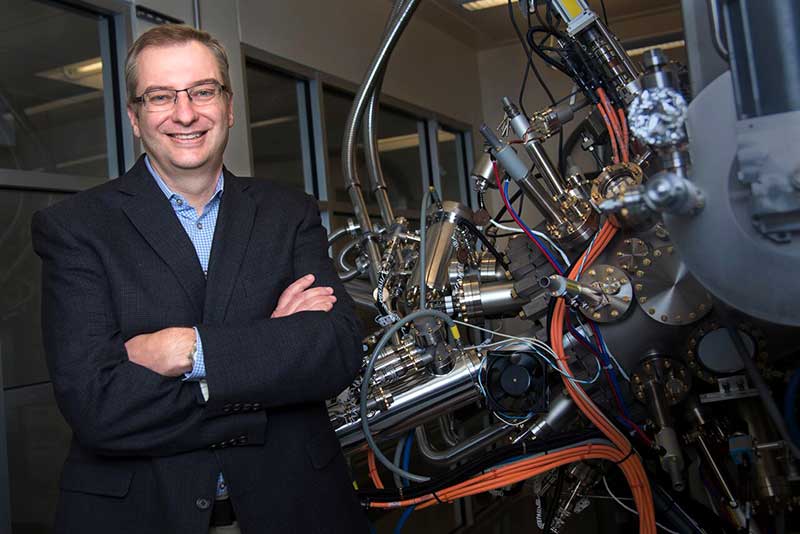
Purdue University and Microsoft Corp. have signed a multi-year agreement to develop a usable quantum computer. Purdue is one of four international universities in the collaboration. Michael Manfra, Purdue University's Bill and Dee O'Brien Chair Professor of Physics and Astronomy, professor of materials engineering and professor of electrical and computer engineering, will lead the effort at Purdue to build a robust and scalable quantum computer by producing what scientists call a "topological qubit."
Brain-imaging system uses ‘multi-pupil’ prism arrays
May 8, 2017
A specialized type of adaptive-optics technology that has been demonstrated by taking high-resolution time-lapse images of functioning brain cells might be used to better understand how the brain works. The system is capable of revealing changing details of biological processes in cells over a larger field of view than otherwise possible, allowing “high throughput” essential for the study of brain activity.
Study researches ‘gorilla arm’ fatigue in mid-air computer usage
May 8, 2017
Researchers at Purdue University’s C Design Lab are studying arm and muscle fatigue connected to advancements in the use of hand gestures for mid-air computer interaction. Computer interaction improvements have included the expanding use of natural motions and gestures to control floating graphical user interfaces. As a result, fatigue from prolonged use of the motions and gestures has become an issue.
Study researches ‘gorilla arm’ fatigue in mid-air computer usage
Device utilizing molecular technique could provide ultra-sensitive, automated system to detect viruses, disease
May 2, 2017
An innovation at Purdue University could allow highly sensitive detection of an infectious disease such as HIV or whooping cough by using a low-cost, automated, point-of-care test similar in packaging to a pregnancy test. The paper-based test could allow ultra-sensitive detection of pathogens with minimal user interaction and without having to send the test to a lab and wait for results.
Study: Food ingredient blends more sensitive to climate change
May 1, 2017
A recent Purdue study, featured on the cover of the May edition of the Journal of Food Science, deciphers why food ingredient blends are more sensitive to changes in climate than single ingredients. Understanding how food ingredients interact differently when blended can help those in the industry consider best practices to handle or package their product for a longer shelf life.
Study: Food ingredient blends more sensitive to climate change
‘Volumetric’ imaging method reveals chemical content, might lead to systems that eliminate need to draw blood for lab tests
April 27, 2017
A “chemical imaging” system that uses a special type of laser beam to penetrate deep into tissue might lead to technologies that eliminate the need to draw blood for analyses including drug testing and early detection of diseases such as cancer and diabetes.
Technology could help minimize the risk of head injuries from playground falls
April 26, 2017
A company based at Purdue Research Park of Northwest Indiana is commercializing technology that could help minimize the risk of children’s head injuries from playgrounds falls. Sonam Technologies recently received a U.S. design patent for its ST Impact Analyzer CH, a portable electronic tester that can measure and record impact data for the surfaces of playgrounds or other sports surfaces.
Technology could help minimize the risk of head injuries from playground falls