David J. Purpura - 2024 Lu Ann Aday Award
2024 Lu Ann Aday Award Lecture
The Science of Stories: Designing Picture Books to Test Empirical Theories and Improve Children's Learning
Biography
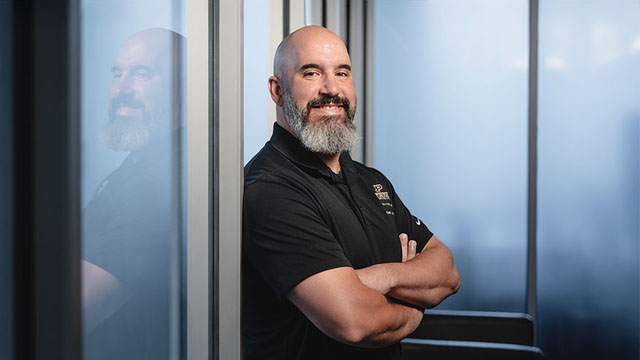
David Purpura was selected to receive the 2024 Lu Ann Aday Award, Purdue University’s highest recognition given annually to a faculty member who has made a major impact in the field of the humanities and social sciences.
Purpura, professor of human development and family science within the College of Health and Human Sciences, studies early childhood mathematics literacy. His novel approach, which has been demonstrated to improve young children’s math skills, uses picture books embedded with mathematical language and concepts. This is highly significant because the National Center for Education Statistics reports that fewer than 40% of U.S. children are performing at grade level in mathematics by fourth grade.
Expressing gratitude for the award, Purpura said his achievements are not his alone: “The award is really a testament to team science. The research studies we’ve conducted over the last decade in this area have been successful because of the amazing team of graduate students, postdoctoral scholars, undergraduate research assistants, project staff and faculty collaborators who I have had the joy of working with.”
Purpura has developed, tested and disseminated 20 picture books designed to improve early mathematical understanding. His rigorous research, including randomized controlled trials, has demonstrated the effectiveness of these books in home and school settings. The books, available in multiple languages, have benefited more than 11,000 children worldwide.
As the director of Purdue’s Center for Early Learning, Purpura spearheads initiatives to enhance early childhood education through research, practice and policy development. He also has played a key leadership role in the international Mathematical Cognition and Learning Society and has contributed to national education policy through his membership on a U.S. Department of Education practice guide panel.
Purpura has clear goals for the Purdue center he leads. “One of the biggest goals I have is to build what I call the Science and Stories Collaborative as part of the Center for Early Learning. The collaborative would be a research-to-practice incubator where we can continue to develop, evaluate and disseminate children’s picture books focused on early STEM learning. I would love for this to be a hub around campus and beyond — a place where we can take scientific ideas and processes and merge them into engaging and understandable educational tools for young children that resonate with their own daily lives.”
Purpura’s research has been published in more than 100 peer-reviewed articles and has received over $12 million in research funding. He currently leads multiple grants aimed at advancing early STEM education. His work has received national recognition, including the National Science Foundation’s CAREER Award and the Presidential Early Career Award for Scientists and Engineers, the highest honor bestowed by the U.S. government on early career scientists and engineers.
Lecture Abstract
David Purpura, professor of human development and family science, will discuss his work that demonstrates the power of picture books in early math learning.
He will take listeners behind the scenes in the design and development of effective and engaging educational picture books. Purpura’s novel approach, which has been demonstrated to improve young children’s math skills, uses picture books embedded with mathematical language and concepts. This is highly significant because the National Center for Education Statistics reports that fewer than 40% of U.S. children are performing at grade level in mathematics by fourth grade.
Purpura has developed, tested and disseminated 20 picture books designed to improve early mathematical understanding. His rigorous research, including randomized controlled trials, has demonstrated the effectiveness of these books in home and school settings. The books, available in multiple languages, have benefited more than 11,000 children worldwide.