Roger Wiens - 2024 Herbert McCoy Lecture
2024 Herbert Newby McCoy Lecture
Mars through the Eyes and Ears of ChemCam and SuperCam on NASA’s Rovers
Biography
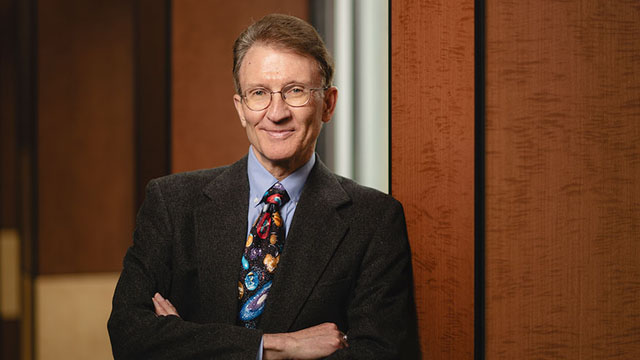
Roger Wiens, professor of earth, atmospheric, and planetary sciences in the College of Science, has been chosen to receive the 2024 Herbert Newby McCoy Award. Wiens was selected for his pioneering research in planetary science and instrumental role in advancing NASA’s Mars exploration efforts.
Roger Wiens is renowned for leading development of the SuperCam instrument aboard NASA’s Perseverance rover, technology that has revolutionized the study of Mars’ surface. Deployed in Jezero Crater in 2021, SuperCam integrates multiple spectroscopic techniques to analyze rock and soil composition remotely, identifying potential biosignatures and enhancing understanding of Mars’ habitability.
“Roger Wiens’ research has transformed planetary exploration, setting new standards for space instrumentation,” said Guang Lin, associate dean of research and innovation in the College of Science and chair of the McCoy Award selection committee. “His contributions to the Mars rover missions have provided critical insights into the planet’s geological history and potential for past life.”
Wiens said he is honored to be associated with McCoy and his accomplishments.
“I am absolutely elated and flattered,” Wiens said. “Herbert Newby McCoy was an outstanding chemist 100 years ago. I am sure he would be totally excited to know that his award this year is for discoveries in the chemistry of the surface of Mars, leading us to understand our sister planet’s ancient water content, its climate and habitability.”
Wiens is well known for developing a series of laser-based instruments used in NASA’s Mars missions. He pioneered the use of laser-induced breakdown spectroscopy (LIBS) for planetary analysis, first used in the ChemCam instrument on the Curiosity rover that landed on Mars in 2012. His work with LIBS has provided essential data on the origin and water history of Martian rocks, directly supporting NASA’s high-level exploration goals.
Wiens has led a global team of approximately 80 scientists and engineers who use the SuperCam for daily Mars observations. He has guided numerous discoveries, including the identification of volcanic rock formations on the Jezero crater floor and the detection of water-altered minerals, findings that are shaping future Mars exploration strategies.
Wiens also has advanced international scientific collaboration. His work with the French space agency in developing ChemCam and SuperCam has strengthened U.S.-France scientific partnerships, earning him two knighthood honors from the French government.
Wiens has over 300 peer-reviewed publications, and has received awards including the NASA Group Achievement Award, the Air and Space Academy Vermeil medal, and the R&D 100 Award from R&D World magazine. An asteroid, 41795 Wiens, bears his name.
At Purdue, Wiens said he wants to continue to inspire the next generation of scientists. His advice to those who aspire to his success is to “keep doing whatever challenging and uplifting things God puts in front of them to accomplish, and to find the good qualities in people around them and help to channel it. The efforts we put into working together with and helping others will always be worthwhile.”
Leading by example, Wiens has introduced graduate-level courses on spacecraft instrumentation and space policy, integrating his expertise into Purdue’s curricula.
Abstract
NASA’s rovers have been exploring Mars continuously for over 20 years, progressively discovering ancient water, long-term lakes and rivers, and organic materials that may have been precursors to life. Purdue staff and students have been an integral part of this exploration, living virtually on the Red Planet with the Curiosity and Perseverance rovers’ instruments. Wiens will share the excitement of the discoveries of our teams currently exploring the Gale and Jezero craters, and also look toward the future.