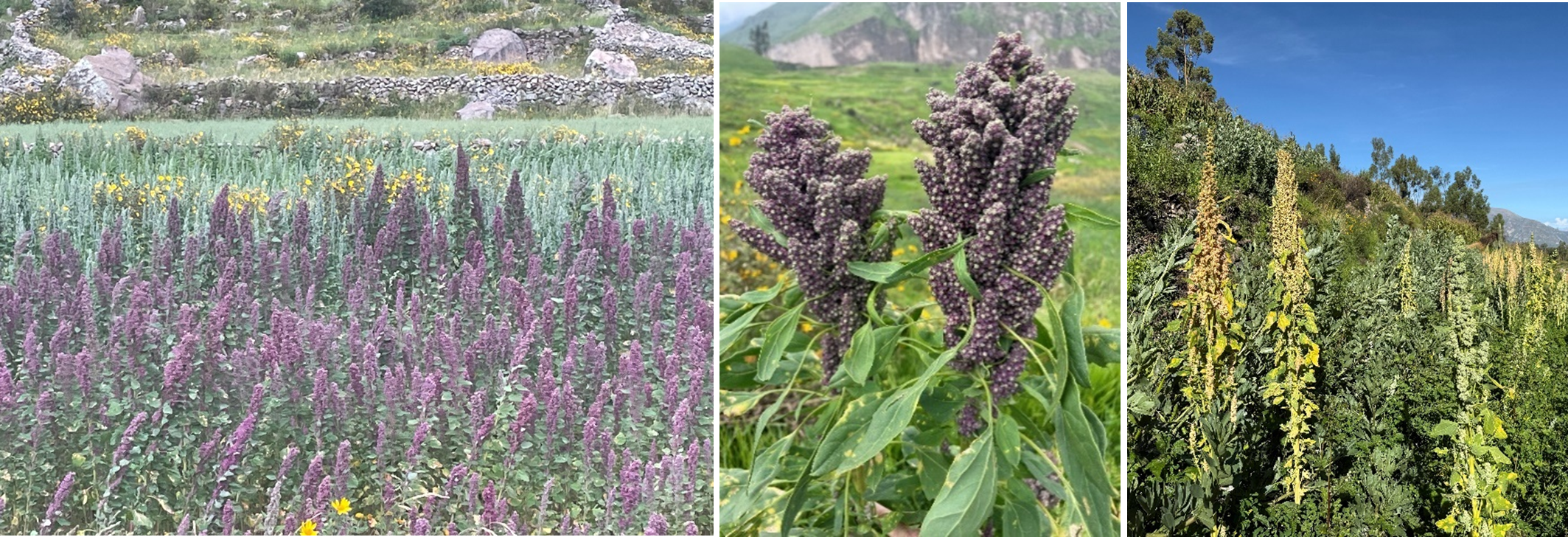
New publication from Nexus summarizing research that will help Arequipa’s farmers deal with heavy metal contamination
January 28, 2026
Some crops in Arequipa are at risk of contamination with toxic heavy metals such as cadmium, lead, and arsenic, due to a combination of natural volcanic activity and local mining operations. Members of the Nexus Organic Farming Systems (OFS) team are conducting studies aimed at addressing this food safety risk via strategies that include identifying soil amendments that can stabilize toxic heavy metals in soils and selecting crop varieties that further restrict uptake.
In a new publication, titled ‘Variability in cadmium stress and accumulation in quinoa: potential role of crop domestication and selection in mediating differences in resilience and uptake’ https://authors.elsevier.com/c/1mR~oB8cd4AAb, the authors describe results of one of their recent studies indicating that both domestication and environmental selection pressures have altered the capacity for quinoa to take up this heavy metal. Dennis Macedo, co-author, co-lead PI of the Nexus OFS team, and co-director of the Arequipa Nexus Institute, said that “the results of this study will have immediate benefits for Arequipa’s farmers in identifying quinoa varieties that can reduce risks. And, the results will be even greater in the longer-term as breeders use the results to develop new, improved varieties that can both restrict heavy metal uptake and have the best agronomic and food quality traits”.
Contact Details
- Rosa Cossio
- rcossio@purdue.edu
- 765-494-0721