Past News
Purdue study uses telehealth to help identify autism markers for babies and young toddlers
March 5, 2018
A long-distance telehealth study at Purdue University could help researchers identify autism symptoms in infancy, which could ultimately help children receive targeted therapy earlier.
Purdue study uses telehealth to help identify autism markers for babies and young toddlers
Purdue researchers show concrete infused with wood nanocrystals is stronger, plan to use it in California bridge
February 22, 2018
Purdue University researchers studying whether concrete is made stronger by infusing it with microscopic-sized nanocrystals from wood are moving from the laboratory to the real world with a bridge that will be built in California this spring. The researchers have been working with cellulose nanocrystals, byproducts generated by the paper, bioenergy, agriculture and pulp industries, to find the best mixture to strengthen concrete, the most common man-made material in the world.
Atomically thin building blocks could make optoelectrical devices more efficient
February 22, 2018
Researchers at Purdue University have developed new heterostructures that could make optoelectrical devices, such as solar panels and sensors, more efficient. Heterostructures are made by stacking layers of two-dimensional materials. The researchers stacked two very thin materials, tungsten disulfide and graphene, to see if they would work together to create electricity.
Atomically thin building blocks could make optoelectrical devices more efficient
Researchers validate several fluctuation theorems for first time
February 22, 2018
Researchers at Purdue University have performed the first experimental tests of several fundamental theorems in thermodynamics, verifying the relationship between them and providing a better understanding of how nanoparticles behave under fluctuation. As a system gets smaller, fluctuations away from equilibrium begin to dominate its behavior. This makes the data from experiments in small systems, such as biological molecular motors and nanoscale magnets, messy and difficult to make sense of. Fluctuation theorems help researchers make sense of the fluctuations in these systems.
Researchers validate several fluctuation theorems for first time
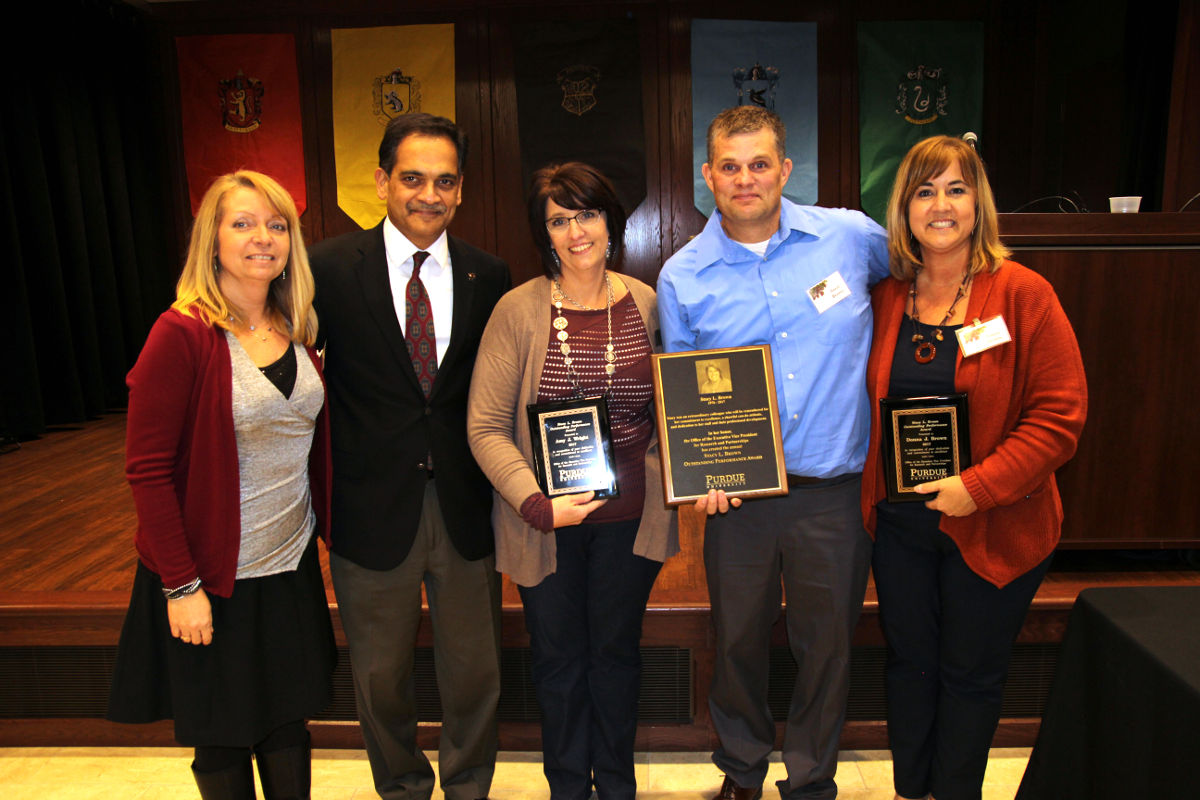
EVPRP establishes Stacy L. Brown Outstanding Performance Award
February 20, 2018
Amy Wright, assistant director of financial affairs for the Executive Vice President for Research and Partnerships (EVPRP) Office, and Donna Brown, assistant director of financial affairs for Discovery Park, are the inaugural recipients of the Stacy L. Brown Outstanding Performance Award. The award was established last year by the EVPRP in memory of Brown, who served as the office’s director of financial affairs until her death in 2017.
Read More about "EVPRP establishes Stacy L. Brown Outstanding Performance Award"
Purdue targeted drug combination could expedite bone fracture healing, be used as injection
February 20, 2018
Purdue researchers are developing and commercializing a targeted drug combination that once injected into a patient could speed up and improve bone fracture healing, and significantly cut recovery costs. Novosteo Inc., a startup developing the technology, was co-founded by father and son team Philip Low, the Purdue Presidential Scholar for Drug Discovery and the Ralph C. Corley Distinguished Professor of Chemistry and Stewart Low, a postdoctoral staff member in Purdue’s Department of Chemistry.
Purdue targeted drug combination could expedite bone fracture healing, be used as injection
Chinese space lab to fall back to Earth in April
February 20, 2018
Chinese space laboratory Tiangong-1 is predicted to re-enter Earth’s atmosphere in late April, but where or when it will reach the surface is hard to say. “Debris comes into Earth’s atmosphere all the time,” said Jay Melosh, a professor of earth, atmospheric and planetary sciences at Purdue University. “With a spacecraft like this, most of the material burns up high in the atmosphere, but a few denser things might come down.” Tiangong-1 was the first operational component of the Tiangong program, a larger, modular space station intended to be in space by 2023. It was originally planned to be deorbited in 2013, but never came down. In March 2016, the China National Space Administration announced it had lost contact with the lab.
Death by termite: Purdue entomologist uses natural cravings to control invasive ants
February 19, 2018
Death by termite: Purdue entomologist uses natural cravings to control invasive ants
Death by termite: Purdue entomologist uses natural cravings to control invasive ants
Mosquito gut may hold the key to preventing Dengue and Zika
February 15, 2018
The midgut of a mosquito may hold the key to preventing mosquito-borne diseases like Zika and Dengue, according to research published in PLOS Pathogens. A mosquito's ability to replicate and transmit a virus depends on the metabolic environment of tissues in its midgut: the primary site of infection. By targeting the sphingolipid pathway, which links together several pathways important for cell signaling and subcellular structure that are altered by virus infection, researchers could devise strategies that stall viral replication in the mosquito and prevent its transmission to humans.
All-terrain microbot moves by tumbling over complex topography
February 13, 2018
A new type of all-terrain microbot that moves by tumbling could help usher in tiny machines for various applications. The “microscale magnetic tumbling robot,” or ?TUM (microTUM), is about 400 by 800 microns, or millionths of a meter, smaller than the head of a pin. A continuously rotating magnetic field propels the microbot in an end-over-end or sideways tumbling motion, which helps the microbot traverse uneven surfaces such as bumps and trenches, a difficult feat for other forms of motion.
All-terrain microbot moves by tumbling over complex topography