Past News
Mapping arteries could help avoid complications and improve outcomes in oral surgeries
April 10, 2018
Starfish Engineering LLC, a Purdue University-affiliated startup, is seeking funding to build a prototype imaging device so that it can pursue testing of a way to map arteries in the roof of a person's mouth to help avoid complications and improve outcomes in oral surgery.
Mapping arteries could help avoid complications and improve outcomes in oral surgeries
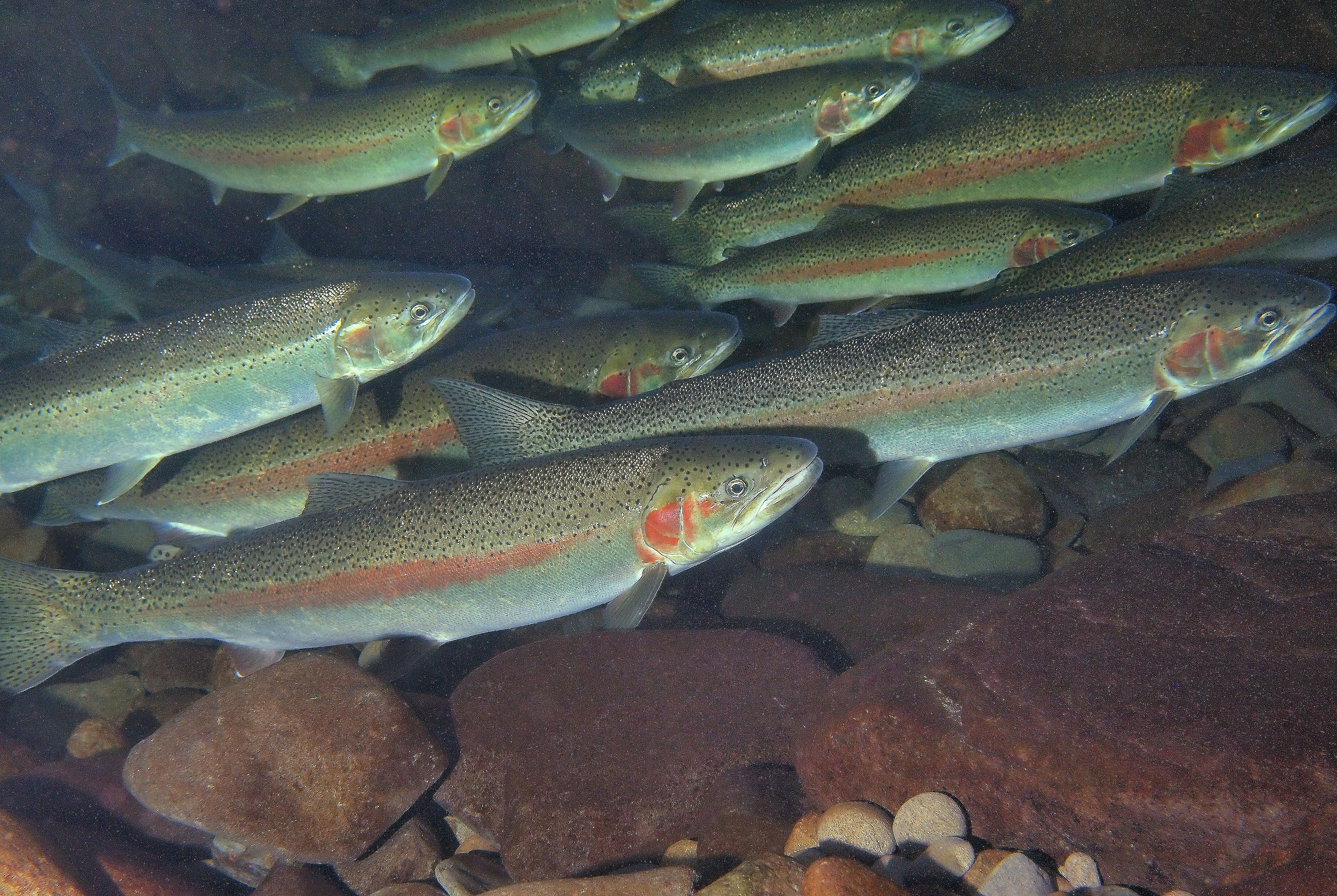
Repeat spawning comes with tradeoffs for trout
April 9, 2018
Steelhead trout that spawn multiple times have more than twice the lifetime reproductive success of single spawning trout, suggesting there is a substantial benefit associated with repeat spawning. But it comes with a tradeoff, according to new research published in Proceedings of the National Academy of Sciences. Repeat spawners make the dangerous journey from the ocean to their freshwater spawning grounds multiple times throughout their lives, while single spawners take the risk only once.
Researchers at Purdue, Stanford devise novel ultrafast laser beam steering for autonomous cars that is less complex, uses less power
April 3, 2018
Researchers at Purdue University and Stanford University believe they have found a novel laser light sensing technology that is more robust and less expensive than currently available with a wide range of uses, including a way to guide fully autonomous vehicles.
Researchers find alternate path for Listeria to sicken people
March 29, 2018
Purdue University scientists have found another pathway that Listeria uses to enter the bloodstream, suggesting that forms of the foodborne bacteria considered benign may be more dangerous than once thought.
Researchers find alternate path for Listeria to sicken people
New glass-like polymer could conduct electricity for transparent electronics
March 27, 2018
Purdue researchers have created a transparent polymer film that also conducts electricity, introducing an inexpensive organic material for applications such as the screens of electronic devices. While some polymers can already conduct electricity with the help of a process called chemical doping, none have yet been made that conduct just as well in a transparent form. This combination could find use in TV, phone and computer screens that currently use a relatively expensive inorganic material, indium tin oxide, to serve as a transparent conductor.
New glass-like polymer could conduct electricity for transparent electronics
Very thin film could help manage heat flow in future devices
March 26, 2018
Purdue University researchers have demonstrated the ability of a thin film to conduct heat on just its surfaces, identifying a potential solution to overheating in electronic devices such as phones and computers.
Very thin film could help manage heat flow in future devices
Purdue researcher helps classify new means of renewable light energy
March 26, 2018
Purdue professor Jeff Miller worked with researchers from the University of California, Los Angeles to characterize extremely small titanium dioxide that could help convert visible light into renewable energy. On its own, titanium dioxide captures ultraviolet light but not visible light, leaving out half of the solar spectrum. UCLA researchers discovered that adding boron oxide to titanium dioxide resulted in nanoparticles capable of absorbing a wider range of light to be transformed for electricity and other energy uses.
Purdue researcher helps classify new means of renewable light energy
Origami folds of insect wing can help improve machine functions
March 22, 2018
The way that an earwig insect folds its wings could be applied to how engineers preprogram technology to perform certain tasks, according to research published on March 23 in the journal Science. The earwig insect has more folds in its wings than any other organism in the animal kingdom but uses minimal energy to move. Through simulations and creating a 4-D replica of these folds, researchers from ETH Zürich in Switzerland and Purdue University have likened the wing to self-folding origami that could inform how to make machines be more adaptable and responsive with less energy used.
Origami folds of insect wing can help improve machine functions
Wasting food may be safe, reasonable decision for some, study says
March 14, 2018
About 21 percent of the American food supply goes to waste, with much at the consumer level in restaurants and homes. But the choice to throw out leftovers may often be a rational one based on time and food safety, according to research from Purdue University economist Jayson Lusk.
Wasting food may be safe, reasonable decision for some, study says
Mutating Ebola’s key protein may stop replication
March 12, 2018
Researchers may be able to stop the replication of Ebola virus by mutating its most important protein, according to a paper published in the Journal of Biological Chemistry. Researchers were able to mutate Viral Protein 40 (VP40) in a way that changed the residues of the protein, blocking the budding and replication of Ebola virus in a model system.