

Through earning a Lilly fellowship, Master of Science in AI grad clears a path for influencing technology ethics
The last time Purdue University spoke to Tamara Grant, she was working through her Master of Science in Artificial Intelligence (AI) online while homeschooling her children. Her studies were teaching her how to use AI more effectively and understand the ethics of the emerging technology, a topic Grant was particularly passionate about. She dreamed of influencing conversations about AI adoption and governance so she could help create a more human-centered technological landscape.
After graduating from the Master of Science in AI program in spring of 2026, Grant found an opportunity to do just that via Eli Lilly and Company’s AI Acceleration Fellowship. The fellowship, part of the Lilly-Purdue 360 initiative, gives Purdue grads the opportunity to work on advanced AI applications at Lilly.
Make your impact in the AI field with Purdue University
Grant found the fellowship by working with a Lilly recruiter at Purdue, who encouraged her to apply. She got an interview in March and then received the news that she’d been chosen as a fellow four weeks later, just two days before her birthday.
“I’ve always had a record for great timing,” Grant said.
When Grant joined Purdue’s Master of Science in AI program, she did not have a science, technology, engineering or math background. Her undergraduate degree was in interior design, and developing her technical skills has taken a lot of effort. But Grant believes that her non-traditional trajectory into AI work can help her see technical challenges in new ways. Her program’s curriculum, which includes a technical and non-technical pathway, have made Grant’s goal of building her technical skills more attainable.
“I’ll always believe it’s never too late to change your path,” Grant said. “By changing your path, you can be just as successful if not more successful in a new field. And I have a new way of looking at things. I can see AI adoption from an outside perspective and ask important questions that other people wouldn’t consider.”
In her role as an AI fellow, asking questions has been integral to Grant’s growth. During her 1-year fellowship at Lilly, she is focused on learning as much as she can, being curious and making the most of the experience.
I am already growing so much. It’s been such an experience.
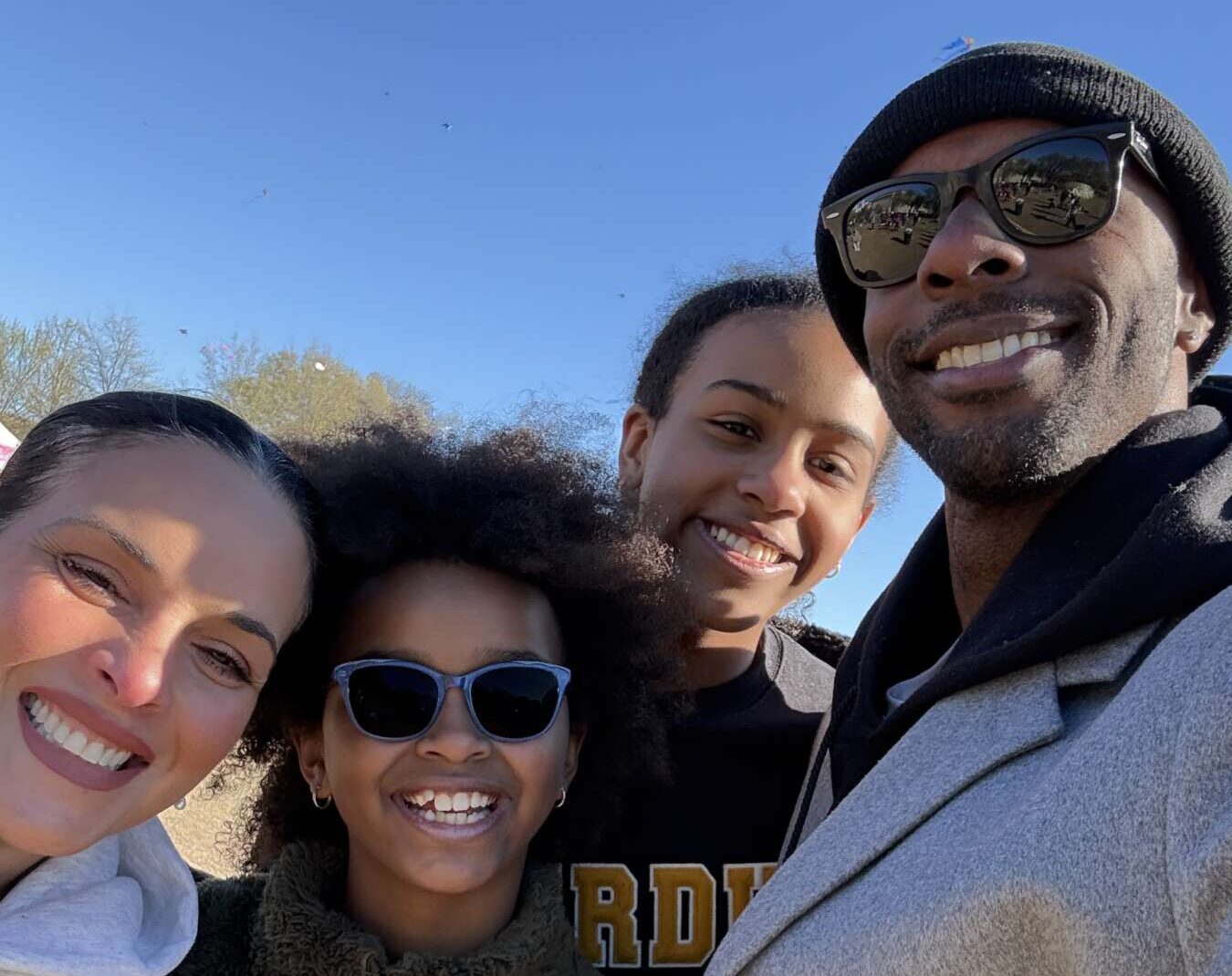
Tamara grant (on the left, pictured with husband keaton grant and two of their children)
Purdue MS in AI graduate and Lilly Fellow
Putting AI’s limitations into perspective
One of the most valuable lessons Grant took away from her master’s program was a course on AI governance, which taught her to understand AI’s utility as a tool and its limitations. From Grant’s perspective, to effectively use a tool, you have to see its blind spots.
“In my AI and governance class, I had a project where I had to build something with AI, and I chose to build a women’s health clinic where women can get better diagnoses for health problems,” said Grant. “I fed my parameters to Gen AI, and it created a poster that only had white women on it — there was no diversity. It took several iterations to get it right.”
“People need to understand that these tools are built on data, and data can be biased. It can be inaccurate or incomplete.”
Grant’s interest in applying AI to solve social issues is inspired by her own experiences. She is a mother, scholar and survivor — she survived moving to the mainland United States, learning a new language and building a life from the ground up. She also survived breast cancer, an experience that taught her every moment counts, and that being imperfect is a kind of superpower.
“Being human is about being imperfect,” Grant said. “That’s what drives me to push myself to the next level. It’s exciting to try, even knowing you might fail.”
Setting boundaries and making room for imperfection
Through her reverence for imperfection, Grant has found a way to center human beings in all of the work she does with AI. For starters, she never lets herself disappear behind the technology; instead, she sets boundaries. Maintaining these boundaries helps her create better quality work and prevent technological fatigue or addiction.
“There can be an addictive potential with Gen AI,” Grant said. “So, I only use it when I need it, I always unplug after work, and I spend time every day reading.”
Perhaps the most important boundary Grant has set with AI is that she will not let it stop her from doing hard things. Whether it’s writing a paper for a course, diving into a new project or connecting with her family, Grant ensures she’s the one putting in the work to have these experiences. AI is an assistant, nothing more.
“I love being an imperfect person, and that means embracing my mistakes,” Grant said.

AI seems perfect, but when you do everything perfectly, there’s no room to learn anything and no room for failure. Failure gives you that fire that says you must conquer something.
Tamara Grant
Purdue MS in AI graduate and Lilly Fellow
Still, Grant sees AI as a powerful tool and collaborator. It helps her expand her capacity at work and brainstorm new ideas. But she always uses it with human oversight, and she doesn’t use it as a crutch, even if there’s a possibility that her idea or project will fail. Her advice to other AI enthusiasts is to set reasonable boundaries, spend some time unplugged and embrace the possibility of doing something wrong. As an educator, Grant knows that’s where the real magic of learning happens — in those moments of confusion and doubt, right before the lesson clicks and a spark of brilliance sets aflame.
“Failure is a challenge,” Grant said. “I’m always going to find out why I failed, what I need to do to succeed and how hard I need to work to get there.”
To learn more about Purdue University’s online Master of Science in Artificial Intelligence, visit the program’s webpage.