

Through distance learning, a father and son forge a Boilermaker bond that transcends time, technology
Purdue University is known for standing at the forefront of innovation, and its history of distance learning is no exception. Long before high-speed internet enabled the creation of over 150 online degrees and certificates, Purdue used whatever technology was available to make a high-quality education accessible. In the 1920s, that meant broadcasting engineering courses over WBAA radio. Later in the 20th century, radio broadcasts were replaced with recorded lectures sent to students on VHS tape. And now, VHS tapes have been replaced with internet-enabled platforms like Brightspace, where information travels near the speed of light and can be accessed anytime, anywhere.
Father-son-duo Wade and Alex Johnson got a front row seat to Purdue’s storied history of distance learning — albeit almost 30 years apart. Wade Johnson graduated with his Master of Science in Interdisciplinary Engineering from Purdue in 1999 without ever setting foot on campus. His son, Alex Johnson, graduated with his Master of Science in Interdisciplinary Engineering from Purdue in 2025, also without ever setting foot on campus. They both say their degrees — which were earned via distance learning and online learning, respectively — feel identical in quality and rigor, even though the way they earned them was different.
Wade Johnson completed his Purdue courses via VHS tapes, which were shipped from Purdue to remote students through a partnership Purdue had with General Motors (GM), Wade’s employer at the time (he has since retired). He did the same homework as students on campus, and he took the same exams, too, though he took them many miles away from campus using a proctor. Despite the distance, he always felt like a Boilermaker.
“I always felt a part of the [Purdue] community,” Wade said. “I was taking the same tests as the other students and doing the same assignments. And, in the VHS, sometimes I could even see some of the students as they walked up and turned in their homework. It felt like, in a way, I knew them.”

That’s what drew me to Purdue. I knew they weren’t going to make it easy on me. I didn’t want a degree that was watered down. I wanted to achieve the same standard as everyone else.
Wade Johnson
MS in Interdisciplinary Engineering, 1999
Following in his dad’s footsteps, Alex wanted a graduate degree that would challenge him. He chose Purdue because the Purdue name was synonymous with engineering excellence, and he knew that getting a degree there wouldn’t be easy. Even though he was studying online and accessing his courses via Brightspace, Purdue’s online learning platform, the quality and rigor were identical to an on-campus engineering program.
“It really felt like everything was the same as if I was on campus,” Alex said. “I saw other students in the class in the recording of the lecture. I’d be able to see the professor and whatever PowerPoint was being covered that day.”
“I didn’t want to feel like I was getting a different education than any other Purdue student,” Alex continued. “But we [online students] were held to the same standard, and the education was exactly the same.”
Becoming Purdue engineers
Both Wade and Alex’s journeys to Purdue University began in the same place — GM, where Wade previously worked, and Alex currently works. While Wade focused mostly on electrical engineering and Alex focused mostly on mechanical engineering, working at General Motors meant collaborating with interdisciplinary teams. When Wade started thinking about going to graduate school in the 1990s, he wanted to find a top-ranked program with interdisciplinary roots. At Purdue, he found that and more.
“That was one of the things I really liked about Purdue,” Wade said. “I was able to set up a degree that fit what I was interested in.”
Working with his advisor, Wade set up a course schedule that met his need for interdisciplinary expertise and allowed him to explore new areas, like heat transfer and gas dynamics. His Gas Dynamics course was considered one of the hardest mechanical engineering courses at Purdue. He took it with Professor Joe D. Hoffman, who coauthored one of the world’s most pivotal texts on gas dynamics with another famous Purdue engineer, Maurice Zucrow.
“The first day of class, Dr. Hoffman said, ‘People often say this isn’t rocket science, but this is rocket science,’” Wade said. “That course really pulled together a lot of fundamental sciences, and Dr. Hoffman was fantastic.”


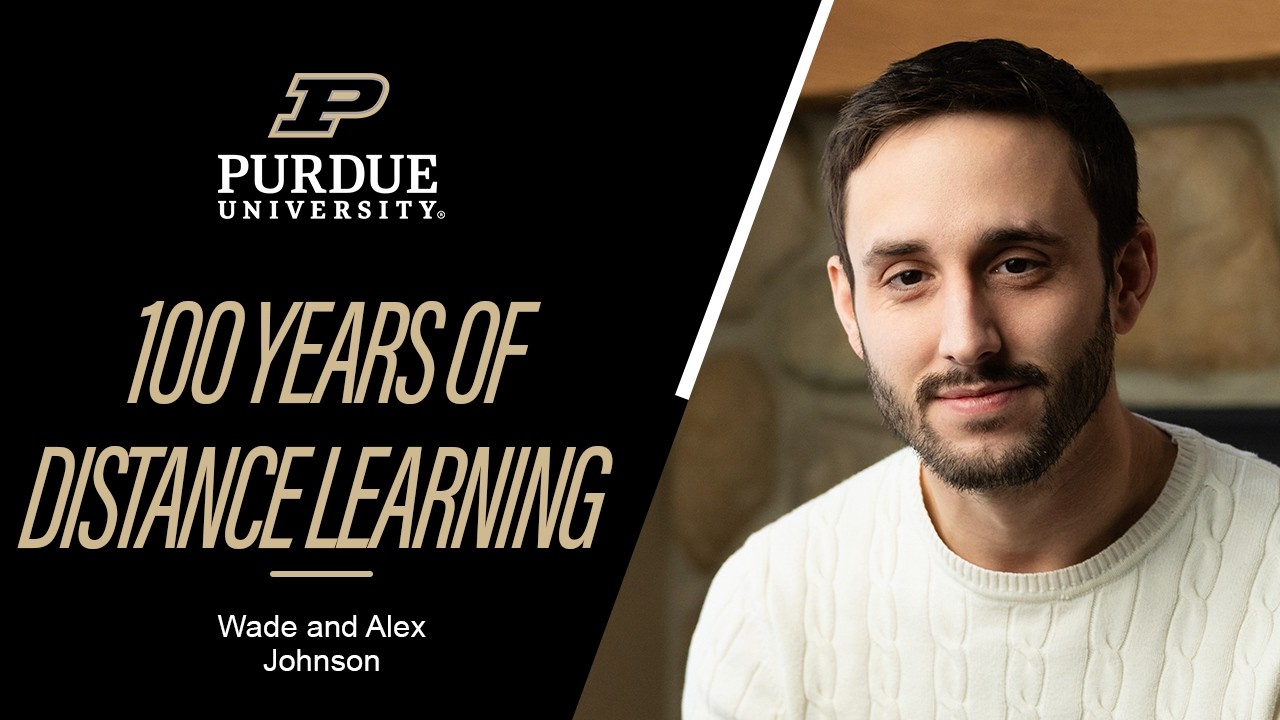
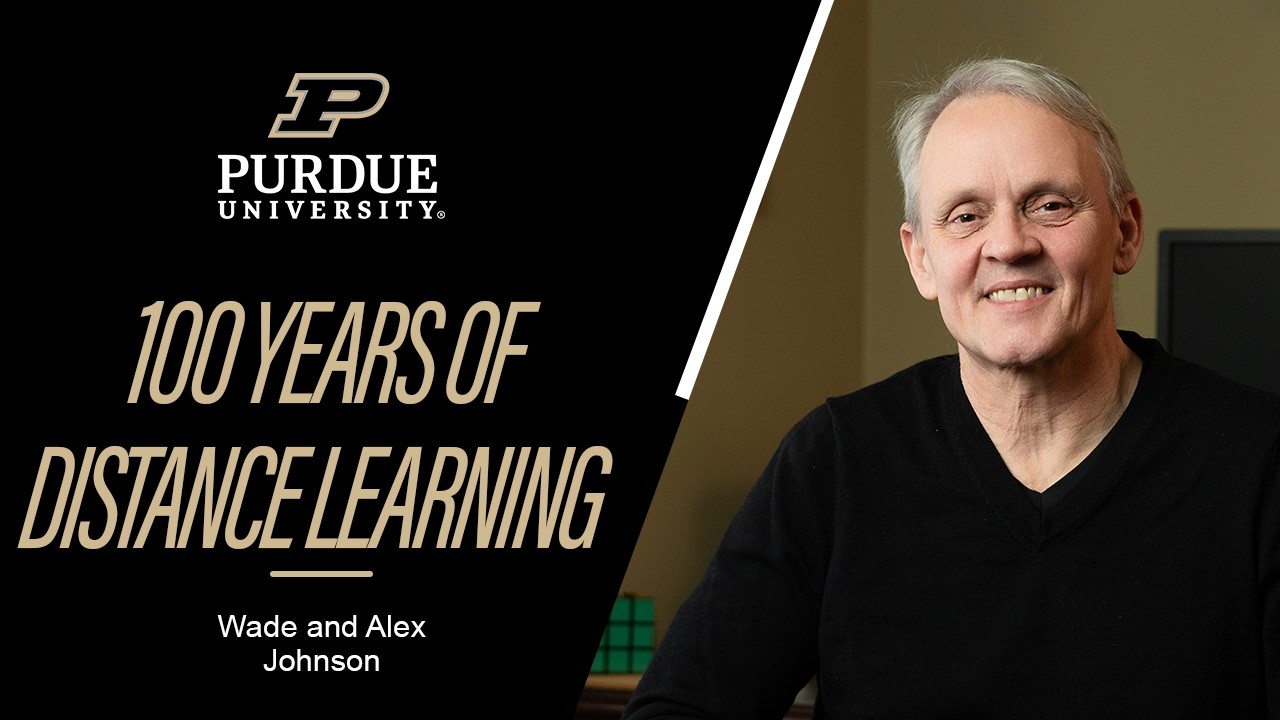
100 Years of Distance Learning
Alex Johnson’s journey to Purdue’s online Master of Science in Interdisciplinary Engineering program was inspired by his father, Wade, who completed the same program nearly 30 years ago. Where will your Purdue journey take you?


Nearly 30 years later, Alex began his search for graduate programs, and, like his dad, he wanted something interdisciplinary and prestigious — a degree that would challenge him to excel in his focus area and in other areas.
One of the interdisciplinary courses Alex took was an electrical engineering course called Electromagnetic Field Theory. Like Gas Dynamics, Electromagnetic Field Theory is considered one of the most difficult engineering courses at Purdue. Alex is proud to have completed it, especially considering it was in his dad’s focus area — electrical engineering.

I knew that Purdue was an amazing engineering school. It’s one of the best in the world. Might as well go with the best, right?
Alex Johnson
MS in Interdisciplinary Engineering, 2025
“Working in the engineering field, it’s very multidisciplinary,” Alex said. “So I was able to take some electrical courses, some thermodynamics courses, and I knew that would help me communicate at my job more effectively.”
“My dad telling me he took Purdue’s hardest mechanical engineering course is what really inspired me to go to Purdue” Alex continued. “So of course, I had to take the hardest electrical engineering course too.”
The same experience across time and space
Something that made Wade and Alex’s programs feel special was the interaction they both had with their professors. For Wade, that meant meeting with professors over the phone or asking questions over email. Though he was much farther away from campus than his classmates, his professors always made sure to make time for conversation. His electromagnetics professor, Daniel Elliott, even came up to Michigan to meet the cohort of GM employees who were completing a graduate degree at Purdue.
“My electromagnetics professor was really influential,” Wade said. “We had a lot of cool conversations. He was always available, even for distance learning students.”
During Alex’s online program, one of his professors, Davide Ziviani, took special care to ensure online students felt included. He tracked the average grades of on-campus and online students so the groups could compare their performances, and he discovered that the averages were almost identical. Ziviani also came to Alex’s graduation commencement ceremony so they could meet in person.
“Dr. Ziviani was my chairperson for my graduate program, and he just went out of his way to be a good professor and mentor in general,” Alex said.
Two graduations, 30 years apart
Wade’s first-time stepping foot on Purdue’s campus was for his graduation in 1999. Getting to experience graduation helped Wade feel closure about ending an influential chapter of his life, he said. It also gave him the opportunity to see Purdue’s campus — an experience that meant the world to him as a distance learning student.
“Purdue is a beautiful school,” Wade said. “I went to the bookstore, I walked around campus, I saw the Wabash River and the clock tower. I obtained my right of passage.”
Graduation was also a chance for Wade to celebrate with his family. He was there with his wife and three small children — including Alex — as well as his parents and in-laws. Though Wade did not know then that Alex would also go to Purdue, he said that, in hindsight, sharing his graduation with his son was the start of a connection that would have a profound effect on both of their lives.
“When I found out Alex was getting his degree, there was no doubt that I’d be at his graduation,” Wade said. “Because he was at mine, and my parents were also there to support me.”
Looking back, Alex’s graduation was really this full circle moment.
Wade Johnson
MS in Interdisciplinary Engineering, 1999
Alex graduated in 2025, also surrounded by his family. Watching Alex walk across the stage, Wade felt that he and his son had journeyed together down the same winding, serendipitous path. That they both ended up at Purdue felt like more than a coincidence — it was an unbreakable bond, almost 30 years in the making.
“Seeing him come across that stage, it triggered a lot of emotions,” Wade said. “We are just so proud of him. It was one of the best weekends of my life.”
“It was really amazing being on campus,” Alex added. “My dad and I got to see campus together and relive those memories from his graduation. It was really special.”
Looking toward the future
Now, when Wade and Alex reflect on their Purdue journeys, they think of how much distance learning has changed. Though how they earned their degrees was different, what’s most memorable to them is the similarities between their experiences. Both of their degrees feel indistinguishable from an engineering degree earned on campus — new technology has just streamlined the process, they said.
“I don’t even think about my program being online,” Alex said. “It was like Purdue was just down the street. And, when you think about it, most on-campus students also do a lot of their work online these days. There’s not much of a difference anymore.”
From Wade’s perspective, the ease of online learning compared to distance learning is a benefit to students everywhere, since the internet makes a high-quality education more accessible.
“I think my program was pretty much identical to Alex’s program. It’s just that the storage format has changed, and it’s obviously more convenient now,” Wade said. “Back then, when you had to check out a physical tape, only one student could check out the tape at a time. Now, any number of students can take an online course.”


At Purdue, thousands of online students access courses remotely every year. Following in both Wade and Alex’s footsteps, they use technology to ensure that opportunity can come to them. And on campus, residential students are doing the same thing — using the internet to meet learning objectives and reach goals. Every year, the separation between online and on-campus learners narrows. Eventually, it may cease to exist.
That doesn’t bother Wade or Alex. No matter what the future brings, they know that Purdue will stay at the top of its game, ensuring that a great education can meet students wherever they are, whenever they need it.
“Online learning isn’t any less valuable than the learning that happens on campus,” Alex said. “At Purdue, the standard will always be the same.”
Learn more about Purdue’s online programs by visiting the university’s online program webpage.