

Online Master of Science in Artificial Intelligence student’s project gains global recognition
When Areejit Banerjee completed the policy brief for his Artificial Intelligence Policy, Governance and Ethics class, Banerjee knew it was good. He just didn’t realize how good.
That policy brief is now being reviewed by the United States government after he submitted it in response to a White House Office of Science and Technology Policy request for information, providing Banerjee hands-on experience in the federal policymaking process. It has also placed Banerjee in the global spotlight: he was a finalist in the 2026 UK Cyber Outstanding Security Performance Awards (OSPA), competing against teams from international companies.
For someone who was just looking to enhance his skills, Banerjee is learning that even a single course project within Purdue University’s online Master of Science in Artificial Intelligence is a game changer.
It’s been transformational.
Areejit Banerjee
Purdue MS in AI student
“As I wrote my first external piece that I submitted with the White House, I could appreciate the merit of spending time on the bibliography and references,” Banerjee said. “If I had to name one thing that stands out from everything else, it is learning the way to research.”
Banerjee is a senior manager of data protection and product strategy at a global data infrastructure provider and an ardent defender of data purity and security.
He worries about the misuse of AI in collecting data and the breaching of corporate security to glean information. Chief of his concerns is data scraping, or the importing of data from websites that can result in loss of trade secrets, revenue erosion and the destruction of high quality data-providing companies. He calls his mission “defending the digital soul.”
“It brings more meaning to what I do,” Banerjee said. “It helps me be a better individual, I think. It is a way in which I grow from working to pay my bills to working to affect society and the community at large.”
The Kolkata, India, native started his career in investment banking operations and transitioned to business analysis. Assignments took him to Ireland, Singapore and Australia before he settled in Virginia.
Leading the digital vanguard
As his focus narrowed to data analysis, Banerjee realized with growing unease how valuable data had become and how weak its safeguards were.
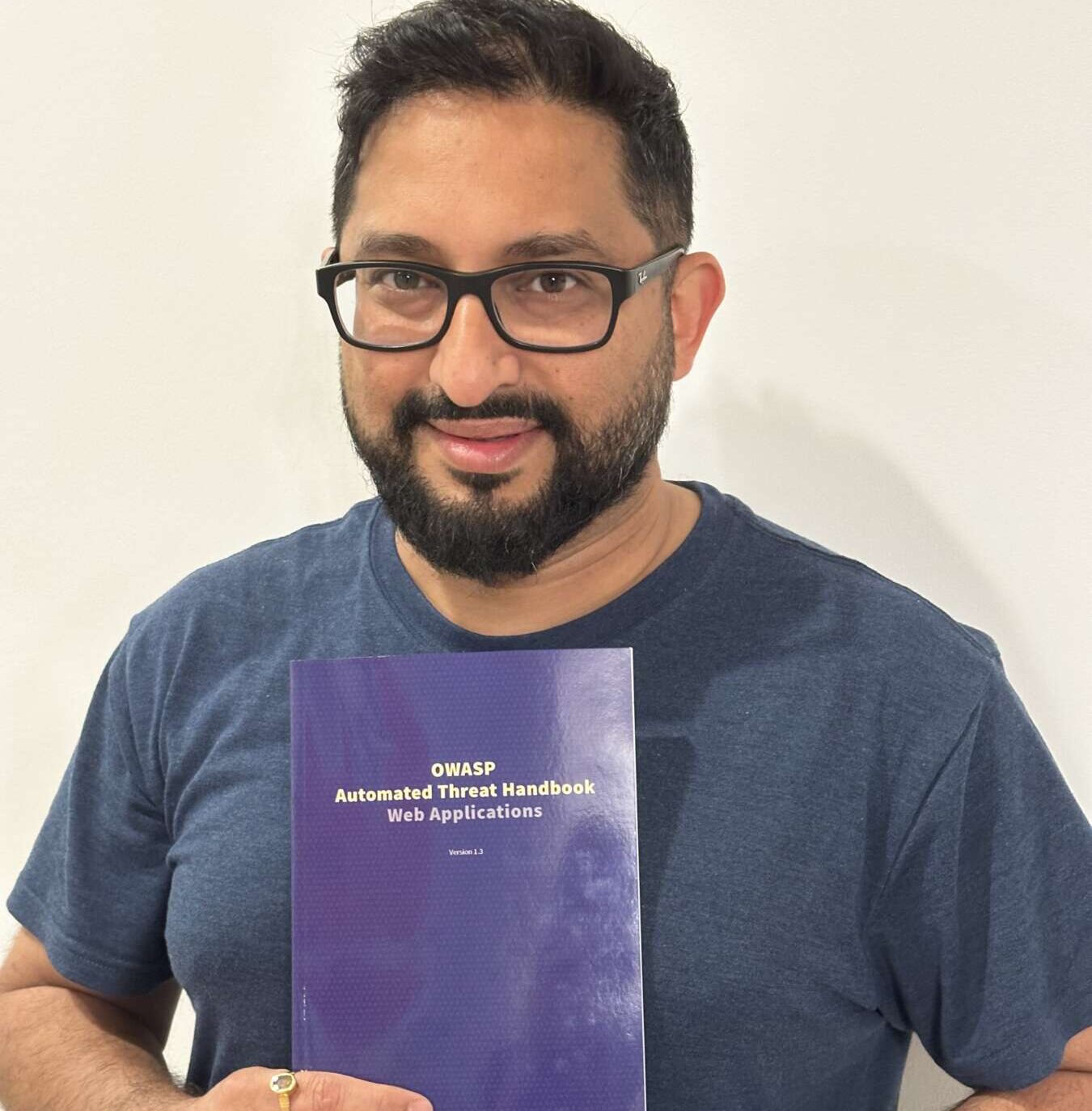
He created and published his three-tier architecture for both protection on the tech website, Hackernoon. He became a contributor for the Open Worldwide Application Security Project (OWASP) and its signature project, Automated Threat Handbook, which is used by companies worldwide to assess and mitigate automated threats. And, in the fall of 2025, he enrolled in Purdue’s online Master of Science in Artificial Intelligence program to update his skills.

“It’s one of the best universities,” Banerjee (left) said of his decision. “You have to live under a rock to not know about Purdue, and now it is one of the top 20 Ivies. You literally cannot be in the knowledge industry or even live in an area with people in the knowledge industry and not know about Purdue.”
The assignment that changed everything
When Alexandra Wood, a visiting assistant professor in the Department of Political Science, assigned the policy brief, Banerjee knew what topic he was going to address. Wood remembers that brief.
“It was a pleasure having Areejit in SCLA 522 last fall,” she said. “As part of his coursework, he wrote a policy brief highlighting the lack of a legal definition of ‘unauthorized scraping’ and proposing a new legislative framework grounded in an analysis of relevant technical, legal, and economic scholarship.
“It’s a fantastic example of how students in the MSAI program are developing the skills to translate research insights into actionable recommendations that tackle real-world challenges.”
Build in-demand AI skills with Purdue
After completing the assignment, Banerjee sought broader exposure for the issue by submitting that same policy brief to SSRN, formerly known as Social Science Research Network, an open-access platform that allows authors to share their research.
But the research transitioned from an academic exercise to a national policy contribution when he found a Request for Information (RFI) from the White House Office of Science and Technology Policy on regulations.gov. Banerjee submitted a formal response to ensure his insights were entered into the federal record for AI governance.
After getting confirmation that the policy brief was received and being reviewed, Banerjee said he thought it should be introduced to European audiences, too. He entered it into the 2026 UK Cyber OSPAs competition. In March, he was named a finalist in the Outstanding Overseas Cyber Security Initiative category for his project, Global AI Scraping Misappropriation Defense Initiative.
I think it made me realize that my skills and my value proposition are industry agnostic. It was self-realization through the mentoring process that I have more to offer than I realized before mentoring.
Areejit Banerjee
Purdue MS in AI student
While waiting for those results, Banerjee served as a mentor in the 2026 TMC Global Threat Modeling Hackathon. He found sharing his skills and knowledge to help his team defend against cyberattacks to be very rewarding.
A new frontier
All of those experiences have helped him to refine his message and vision. As he awaits news from the White House, he will be presenting “Defending the Digital Soul: Data Integrity, Global Bias and a Three-Pillar Defense Against AI Scraping” at Kennesaw State University this summer, the first — he hopes — of his data security and fraud prevention campaign.
“I want to call out at least one professor that I think has made a significant, significant impact: Dr. Alexandra Wood,” Banerjee said.
“I never knew that a policy brief existed. She’s the one who made us write the policy brief. But then she gave us the liberty to choose what we should write about, and I wrote about what I was experiencing as a gap in the sphere of operation that I am in.”
Learn more about Purdue’s online Master of Science in Artificial Intelligence at the program’s website.