

MPH vs. MHA vs. MBA: Choosing the Right Path for Your Career in Healthcare
The health industry is growing – influenced by new technologies, demographic changes like an increase in the number of Americans over 65, and growing demand for health services. The Bureau of Labor Statistics predicts that health careers will grow by over 13% in the next ten years. Though there are many non-clinical opportunities in the health industry, including healthcare. Some healthcare careers can be very competitive, with many candidates applying for the same jobs. Investing in a master’s degree is one way health and healthcare professionals can distinguish themselves in competitive fields and become qualified for management positions.
There are multiple kinds of master’s programs that can benefit health professionals in their careers. The most common non-clinical healthcare-related master’s degrees are the Master of Public Health (MPH), the Master of Healthcare Administration (MHA), and the Master of Business Administration (MBA). Understanding the distinctions between these degrees can help healthcare professionals make the best choice for their specific career goals. Below, we’ll break down these degrees based on their core focus, career opportunities and earning potential, and explain the unique benefits each degree offers healthcare leaders.
What is an MPH Degree?
A Master of Public Health (MPH) degree focuses primarily on improving community health outcomes through research, surveillance, policy development and creating public health programs. Healthcare workers who have this degree might work in areas like epidemiology, population health, health policy, chronic disease treatment or with specific high-risk populations in communities. Jobs in these areas require specialized expertise and some may require candidates to have a master’s in public health or a related field.
Key Features:
- Emphasis on population health and preventive care.
- Topics include epidemiology, biostatistics, health behavior, environmental health and health policy.
- Careers often involve non-profits, health systems, research institutions and government agencies.
People who seek an MPH degree are often interested in solving local to global health challenges, making impacts in their community, working with specific populations to improve health outcomes and addressing public health crises. A healthcare professional with an MPH might work specifically with veterans, for example, or address the healthcare challenges posed by infectious diseases.
“I’m on the preventative side of healthcare, so [in my MPH] I was able to research things like smoking cessation, delivering preventative programs, and exploring the social factors that affect veterans’ health, which really helped me expand my understanding of the field,” said Elizabeth Frietas, a graduate of Purdue’s University’s online Master of Public Health program who works with veterans as a health and wellness coach.
What kind of jobs can I get with an MPH?
Professionals with an MPH work in many different fields and industries, some of the most common roles include:
- Epidemiologist
- Public health analyst
- Health policy advisor
- Program manager in nonprofits or global health organizations
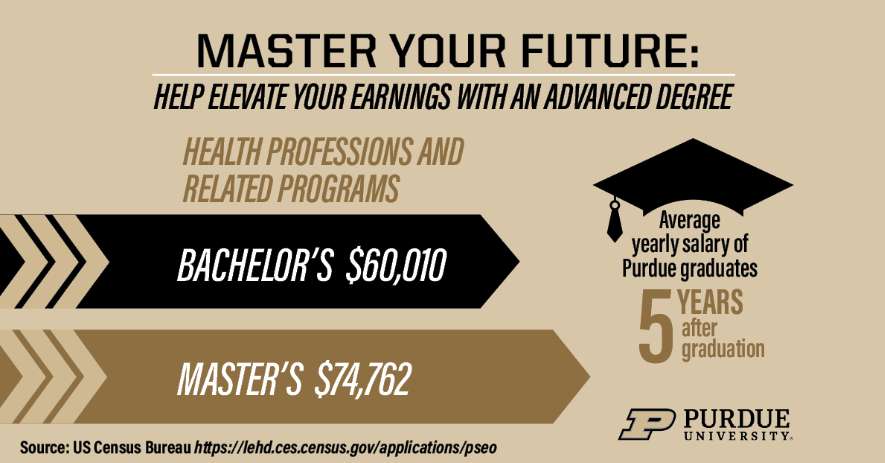
The amount of money healthcare professionals can make with an MPH varies depending on what career they choose. For epidemiologists, the median pay is $81,390 a year. For public health analysts, the average salary is $95,753 a year. For health program managers, the average salary is $76,292 a year. Generally speaking, healthcare professionals who have master’s degrees can expect to make more over the course of their careers than healthcare professionals who only have bachelor’s degrees.
What is an MHA Degree?
A Master of Health Administration (MHA) focuses on preparing professionals for upper-level administrative and leadership roles within the healthcare industry. MHA graduates have a strong grasp on healthcare operations, management and patient experience, and they are prepared to create organizational policies, ensure quality control, oversee staffing, coordinate services and make upper-level business decisions in healthcare organizations.
Key Features:
- Designed for healthcare-specific management and leadership.
- Covers healthcare finance, strategic planning, ethics and law.
- Prepares graduates to navigate the complex regulatory and operational challenges in healthcare.
People who seek MHAs usually have an interest in management and the higher-level operations of healthcare facilities and organizations. They may aspire to hold executive-level positions and want the business and leadership skills needed to excel in these roles.
“My MHA has allowed me to know that I can go further in my career,” said Victoria Olmsted, a student in Purdue University’s online Master of Health Administration program who works in healthcare operations. “I’m really striving to get into an executive level as I continue to grow in my career. I don’t think I would feel as comfortable pursuing leadership roles without the program.”
What kind of jobs can I get with an MHA?
Some common jobs for MHA graduates include:
- Hospital administrator
- Healthcare consultant
- Medical and health services manager
- Practice manager
- Chief operating officer (COO) in a healthcare facility
- Chief financial officer (CFO)
- Healthcare IT project manager
- Pharmaceutical sales director
- Healthcare executive (CEO)
The amount of money MHA graduates make varies by career. Medical and health services managers make an average of $110,680 a year, while healthcare executives and COOs can make more than $250,000 a year. An MHA prepares professionals for upper-level roles within healthcare organizations, so the earning potential for this degree is generally high.
What is an MBA?
A Master of Business Administration (MBA) focuses on helping professionals develop advanced business skills that can be applied to a broad range of organizations and roles. Professionals with MBAs are often interested in management, getting executive positions or even running their own business. In healthcare, an MBA can demonstrate a professional’s advanced business skills and help them compete for high-level positions in their organization.
Key Features:
- Focus on general finance, marketing, leadership and operations management.
- Offers flexibility to work in various sectors beyond healthcare.
- Ideal for those looking to combine business acumen with industry expertise.
MBA programs often provide a broad business education that’s applicable to many different industries. However, some MBA programs can be customized to focus on specific sectors like healthcare. Earning an MBA can give professionals the business knowledge they need to help run healthcare organizations. MBAs are common among healthcare executives – about 50% of them report having the degree. Additionally, MBAs can be useful for health professionals who want to change careers outside of healthcare.
[In my MBA] I stepped out of my comfort zone with things like economics and the financial management courses, but those were also the most valuable to me… (I’m) now a nurse who understands accounting,” said Lisa Rinker, a career nurse who graduated from Purdue University’s online MBA program and is now working in healthcare administration.
What kind of job can I get with an MBA?
Some healthcare roles where an MBA would be beneficial include:
- Healthcare consultant
- Chief financial officer (CFO)
- Chief operating officer (COO)
- Healthcare IT project manager
- Pharmaceutical sales director
- Healthcare executive (CEO)
Because professionals with MBAs can work in all kinds of industries and roles, the expected salary for this degree varies. Healthcare consultants make a median annual income of $168,000 a year according to Glassdoor. In executive healthcare roles like CEO, COO and CFO, salaries are typically more than $250,000 a year.
Which Degree is Right for You?
In summary, MPH, MHA and MBA degrees can all benefit healthcare professionals, but which degree is most valuable depends on your unique career goals. If you’re interested in solving healthcare challenges and working with communities to improve health outcomes, an MPH is a good option. If you’re interested in working in healthcare administration and want to develop business skills that are specific to the healthcare industry, an MHA would work well for you. If you want broad business skills that can be applied to many different industries and roles, an MBA would be the best fit. Regardless of which degree you choose, each program offers great opportunities for personal and professional growth and a strong pathway to career success.
Find the Perfect Fit with Purdue University
If you’re ready to take your healthcare career to new heights, Purdue University offers a 100% online Master of Health Administration, a 100% online Master of Public Health, and a 100% online Master of Business Administration. These flexible online programs are designed for working professionals and taught by industry-experienced Purdue faculty. Learn more by visiting the programs’ webpages.