

Professor’s dream of enhancing national defense leads to creation of global program
Conscripted soldier in the Romanian Armed Forces at 18. Member of the Romanian cultural underground resistance until the downfall of Romanian Dictator Nicolae Ceauşescu in 1989. BBC World Service reporter assigned to cover U.S. politics in Washington, D.C.
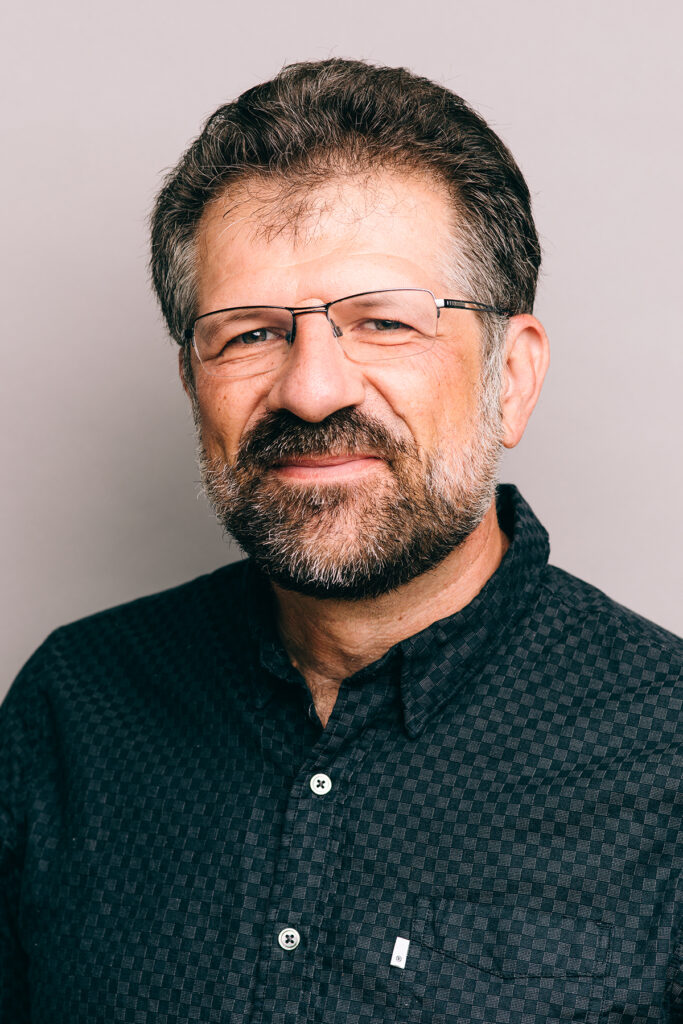
When it comes to national security, Purdue University professor of communication and FORCES initiative director Sorin Matei has seen it at its best and worst across the globe.
So, when he looked around campus and saw all the elements for an innovative program that would support national security and train a new generation of military thought leaders, Matei was compelled to move forward.
The result is the Master of Science in Strategy in Security and Defense Technologies program, which Matei now heads.
“A country is defended first and foremost by people, not by machines,” Matei said.
“Machines fight because we tell them what to do it. But it is people who fight, and we need to understand and cultivate defenders. We need to train them to be first and foremost leaders of other people and then machine managers.”
The interdisciplinary program is designed to support decision makers in the military, defense industry and government contractors by offering courses not commonly available at professional military education institutions or civilian organizations, Matei said. It also welcomes civilians interested in pursuing careers in those fields.
Taught by world-renowned experts from Purdue University’s College of Liberal Arts (CLA), College of Science, College of Engineering and School of Information Studies and outside experts, the core courses include:
- Strategic Foresight and Leadership
- Technology, War, and Strategy
- Grand Challenges in Defense Engineering
- Space Strategy
- Cyber Strategy
- Strategic Intelligence
- Artificial Intelligence Organizational Transformation in Security and Defense
“We’re playing to Purdue’s strengths, which include social science, education, and STEM disciplines, to serve the military in a very direct way,” he said. “The program is meant to speak about Purdue’s vision of being a comprehensive land-grant university. We care very much about multidisciplinary efforts, and I hope the program reflects that.”
Build strategic defense skills with Purdue’s online MS in Strategy in Security and Defense Technologies
Purdue is a Tier 1 Collegiate Purple Star of Indiana awardee for its service to the military and veterans. The honor is given to postsecondary educational institutions that support their “military-affiliated student population from application to graduation.”
The university’s continuous history with the military dates back to its founding in 1869 when male students were required to complete military training. Since then, Purdue has served as an on-campus infantry, a temporary army training center and base for its Reserve Officer Training Corps (ROTC) unit for more than 100 years.
By the time Matei arrived on campus, his path had already taken many unexpected twists.
He, like all able-bodied Romanian young men, was conscripted into the Romanian Armed Forces at 18. When he left the army almost two years later, Matei was a corporal with a strong understanding of artillery fire control. Those two years also helped him develop his own ideas about government and the role of its citizens.
At Bucharest University, he studied philosophy and history, an advanced degree by American standards, and discovered his passion for research. It also laid the groundwork for his first book, “The Mind Boyars,” refined from his honors thesis.
His college career was interrupted by the downfall of the Socialist Republic of Romania’s government after weeks of public protests and rioting against the regime of Nicolae Ceauşescu, the country’s dictator. Decades of resistance culminated in the military joining protesters to overthrow the government in December 1989.
“I was part of that,” Matei said. “Not militarily or anything like that. But we spoke our minds, protested and created underground discussion groups that had some consequences. It was mostly talk, but it was all for a good reason, and it led to a better world, at least in that part of the world.”
After college and the fall of the Iron Curtain, Matei became a journalist; first, for Radio Free Europe, a U.S. media agency serving Central and Eastern Europe, and later for the BBC World Service, covering Romania, London, Washington, D.C. and New York.
“I had some very interesting experiences,” he said. “I went several times to the White House press room. I was in the Secretary of Defense’s office once at the Pentagon. I wasn’t the most important person there. I was just a journalist writing about the things I saw, but it was transformative. I could see how history was made.”
And he continued studying. He earned a master’s degree in international relations from Tufts University’s Fletcher School of Law and Diplomacy. When his wife, Daniela, was accepted into a medical fellowship in Los Angeles, he earned his doctorate in communications at the University of Southern California’s Annenberg School for Communication, specializing in human-technology and communication technology research.
“I learned with the best; we created innovative research methodologies, including the first use of mental maps in digital survey research,” Matei said. “After I graduated with my PhD with a focus on human-computer interaction, I was offered a position at Purdue. I’ve been at Purdue for more than 20 years doing what I like the most: innovating and building.”
Along the way, he became known for his books and articles exploring human-technology interaction. The last decade saw him applying these concepts to military affairs.
He is currently collaborating on two different books: one examining Germany’s war against Russia using a spatial and quantitative approach. The other, an interdisciplinary approach to teaching human-technology interaction in defense studies.
“The work I’ve done in history has shaped my mind and my understanding of the world, which in time has become more and more comprehensive,” Matei said.
As the associate dean of Research and Graduate Education, Matei expanded interdisciplinary research in defense through the FORCES (4S), the Strategy, Security and Social Systems Initiative. His vision was “to accelerate interdisciplinary innovation and defense studies and teaching.”
That resulted in Purdue’s 100% online Strategic Defense Technologies Graduate Certificate, a program for military, defense, and security professionals who analyze, design, and execute defense and civilian defense technology strategies. In addition to introducing innovative technology, the program covers topics like threat analysis and defense system design.
But Matei —- who shares his research on human-technology interactions through military education journals —- believed there was still a need for something more encompassing.
He dreamed of a new interdisciplinary program that combined philosophy, history and political science with STEM courses. His goal: empower leaders who could think strategically about current affairs, predict future risks and react accordingly.
“This was a team effort,” Matei said. “I did not create this project out of my own personal passion alone; I put that in, but I started the project as an associate dean, trying to tighten the links between the various units at Purdue who could collaborate and contribute to our mission to promote national defense studies and teaching. I also wanted, and succeeded, in bringing Purdue closer to the national and international defense research and learning space.”
He said he was fortunate Purdue President Mung Chiang, former President Mitch Daniels, CLA Dean Christopher Yeomans and former CLA Dean David Reingold recognized the need for such a program, and his colleagues supported the mission as a land-grant university that’s dedicated to civic engagement.
“Civil engagement means making sure that the students you graduate have a civic consciousness, that they’re good citizens, that they’re fair, honest, and broadminded” Matei said.
“But it also means they’re ready to put their money where their words are. And, if need be, they are ready and willing to protect the things that are important, dear to them. I think that Purdue is doing well to be in that space.”
To learn more about the Master of Science in Strategy in Security and Defense Technologies, visit the program’s website.